The intersection of classical machine learning and modern generative artificial intelligence has long presented data scientists with a persistent architectural dilemma. For years, practitioners working within structured frameworks like Python’s scikit-learn have faced a stark operational divide. On one side stood the deterministic, highly optimized, and modular workflows of traditional machine learning—complete with standardized pipelines, rigorous cross-validation routines, and automated metrics reporting. On the other side lay the stochastic, unpredictable, and often messy realm of Large Language Models (LLMs), typically accessed via custom scripts replete with nested loops, explicit API call handling, brittle string parsing, and extensive try-except blocks designed to catch instances where an LLM returned free-form prose instead of a structured classification label.
While both methodologies achieved the ultimate goal of data classification, only the former offered a reusable, production-ready architecture. The manual integration of LLMs into established data science pipelines often resulted in technical debt, messy codebases, and maintenance challenges.
Enter Scikit-LLM, an open-source library designed to bridge this architectural gap by seamlessly wrapping state-of-the-art language models inside the familiar scikit-learn estimator application programming interface (API). By adhering strictly to the design patterns established by scikit-learn—where every model features standard methods such as fit, predict, and transform—Scikit-LLM allows developers to inject generative AI capabilities directly into native Pipeline objects and cross-validation loops.
The Evolution of Hybrid Machine Learning Workflows
To understand the significance of Scikit-LLM, one must examine the broader evolution of machine learning engineering over the past decade. Scikit-learn, initially released in 2007 as part of a Google Summer of Code project, quickly established itself as the undisputed lingua franca for classical machine learning. Its consistent API design allowed engineers to swap out estimators—such as moving from a Support Vector Machine to a Random Forest—with a single line of code change.
However, the advent of transformer architectures and Large Language Models in the late 2010s and early 2020s disrupted this uniformity. LLMs operate fundamentally differently from traditional statistical models. They do not learn internal weights through gradient descent on a local dataset during a traditional training phase; instead, they perform inference dynamically via API calls, relying on contextual prompts and vast pre-trained parameters. Consequently, data scientists attempting to leverage LLMs for text classification, sentiment analysis, or named entity recognition were forced to abandon their tried-and-true pipeline structures in favor of ad-hoc scripting.
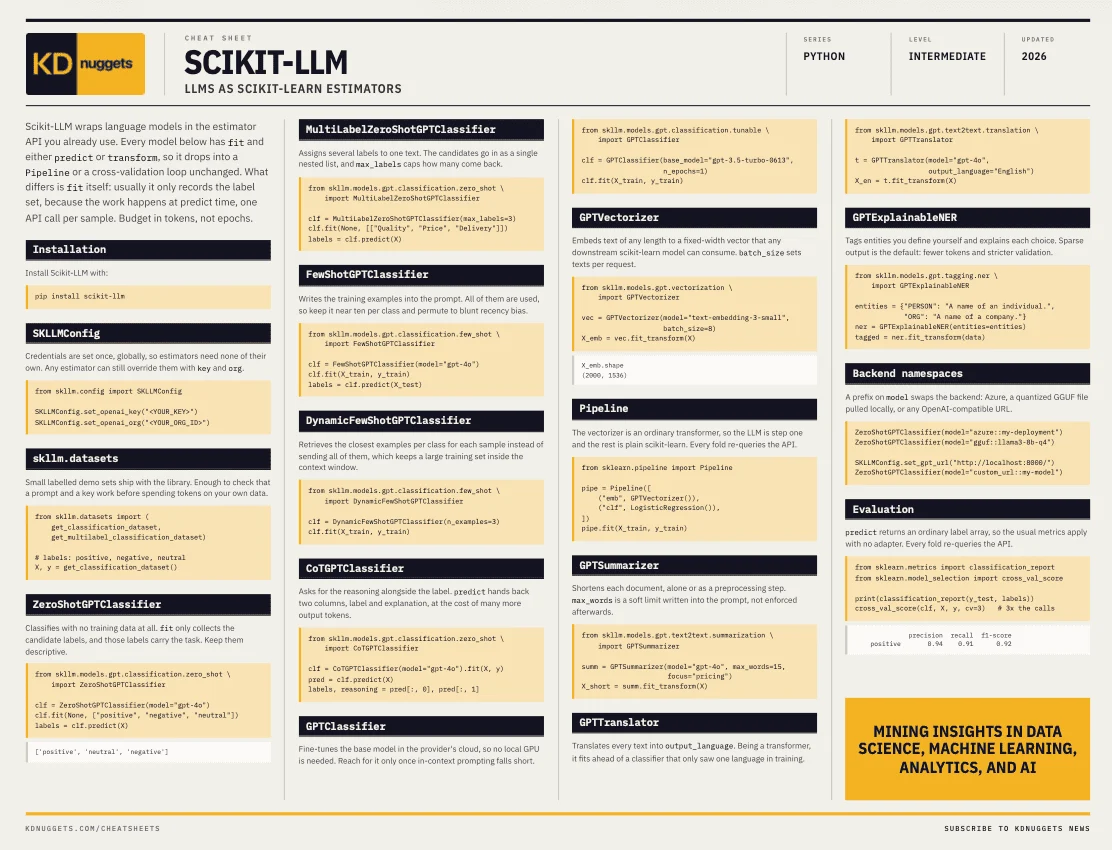
This operational friction sparked a demand for wrapper libraries that could harmonize the two paradigms. Scikit-LLM emerged as a leading solution by standardizing how developers interact with language models within Python environments. Under the hood, the fit method in a Scikit-LLM estimator typically performs a lightweight initialization—often merely recording the target label set—because the heavy lifting occurs during the predict phase, where runtime API calls process each sample individually. This design paradigm requires developers to shift their mindset toward token economics and prompt architecture, a transition that has driven the release of specialized educational resources, including newly published technical reference materials such as the Scikit-LLM Estimators Cheat Sheet.
Core Estimators and Architectural Mechanics
At the heart of Scikit-LLM are several specialized estimators designed to handle distinct natural language processing tasks. Navigating these tools effectively requires a clear understanding of their operational parameters and underlying mechanics.
ZeroShotGPTClassifier
Among the library’s offerings, the ZeroShotGPTClassifier is arguably the most frequently deployed. For practitioners accustomed to training models on labeled historical data, utilizing zero-shot classification via an LLM requires a cognitive shift. Initializing the model involves calling the fit method with an empty feature set and a predefined list of candidate labels—for example, fit(None, ["positive", "negative", "neutral"]).
This approach can feel counterintuitive to traditional developers. However, users quickly internalize that within the zero-shot paradigm, the candidate labels function as the task specification itself. Because the LLM interprets these strings semantically, vague or poorly defined labels invariably yield ambiguous classification results. Best practices dictate that candidate labels should be treated as descriptive instructions rather than mere categorical tags.
DynamicFewShotGPTClassifier
When zero-shot prompting proves insufficient for complex domain-specific tasks, practitioners traditionally turn to few-shot learning, supplying a static set of labeled examples within the prompt. Scikit-LLM refines this approach through the DynamicFewShotGPTClassifier. Rather than appending the entire training dataset to every outgoing API prompt—which quickly inflates token consumption and degrades model focus—this estimator intelligently retrieves the most contextually relevant examples per class for each individual sample. This dynamic retrieval mechanism optimizes both accuracy and cost efficiency.
GPTVectorizer and GPTTranslator
Beyond classification, Scikit-LLM provides powerful auxiliary tools that expand the boundaries of traditional pipelines. The GPTVectorizer estimator transforms text of arbitrary length into fixed-width numerical vectors via LLM embeddings. Once this transformation occurs, the language model effectively serves as the initial feature-extraction stage of the pipeline. All subsequent steps—such as dimensionality reduction or logistic regression—rely entirely on standard scikit-learn components, marrying the semantic depth of LLMs with the computational speed of classical algorithms.
Similarly, the GPTTranslator functions as a native transformer step within a pipeline. It can be positioned directly upstream of a classifier that was trained exclusively on English text. By translating incoming multilingual data into English prior to classification, organizations can deploy robust text-processing pipelines without the expense and complexity of retraining models on multilingual corpora.
Economic Realities and Token Consumption Implications
While the integration of LLMs into scikit-learn pipelines offers undeniable convenience, industry analysts and experienced AI engineers emphasize that developers must remain cognizant of the underlying economic realities. Traditional machine learning operations are computationally inexpensive once a model is trained; running cross-validation or grid searches involves local CPU or GPU cycles that incur negligible marginal costs.
In contrast, Scikit-LLM operations are tightly bound to external API calls and token-based pricing models. Executing a cross_val_score routine with a parameter of cv=3 triples the number of API calls required for evaluation. When combined with automated hyperparameter tuning or grid searches—processes that data scientists historically executed without a second thought—the financial and latency costs can escalate rapidly.
Data governance teams and financial officers within technology firms have increasingly highlighted the necessity of cost-monitoring frameworks when deploying wrapper libraries like Scikit-LLM. Habits cultivated during the era of free, local computation must be adapted to account for the transactional nature of generative AI services.
Broader Industry Impact and Future Outlook
The introduction and maturation of tools like Scikit-LLM reflect a broader industry trend toward developer ergonomics in artificial intelligence engineering. As enterprises seek to operationalize generative AI models without entirely discarding their existing software infrastructure, middleware that bridges legacy frameworks with modern foundation models will play a critical role.
By lowering the barrier to entry, Scikit-LLM enables data scientists, software engineers, and domain researchers to experiment with advanced language models within a familiar, highly structured environment. It minimizes the friction of custom script maintenance and encourages adherence to software engineering best practices, such as modular pipeline design and reproducible evaluation metrics.
For professionals seeking to master these workflows, technical guides and visual reference materials—such as comprehensive cheat sheets detailing estimator parameters, syntax structures, and best practices—have become invaluable assets. As the boundary between traditional machine learning and generative AI continues to blur, tools that harmonize these disparate methodologies will undoubtedly remain foundational to the modern AI toolkit.