Paint exposed to the elements does not last forever, a reality familiar to anyone who has ever maintained a wooden garden fence, an automobile exterior, or a residential home. Over time, environmental exposure gradually wears down protective surfaces, demanding regular maintenance and fresh coats of paint. This fundamental problem scales up dramatically when applied to massive infrastructure projects. Iconic global structures, including the Eiffel Tower in Paris and the Golden Gate Bridge in San Francisco, require continuous, extensive repainting operations to preserve their structural integrity and protect underlying metals from aggressive environmental decay.
For generations, structural engineers, materials scientists, and chemists have attributed this persistent degradation to two primary culprits: mechanical stress and chemical damage. Mechanical stress occurs when repeated physical contact, such as the relentless impact of falling water droplets, generates friction that slowly erodes a coating or causes microscopic pieces of the material to peel away. Chemical damage, meanwhile, happens when moisture contains corrosive substances such as atmospheric acids, industrial pollutants, or wind-borne coastal salts that chemically break down bonding agents within paints and polymers.
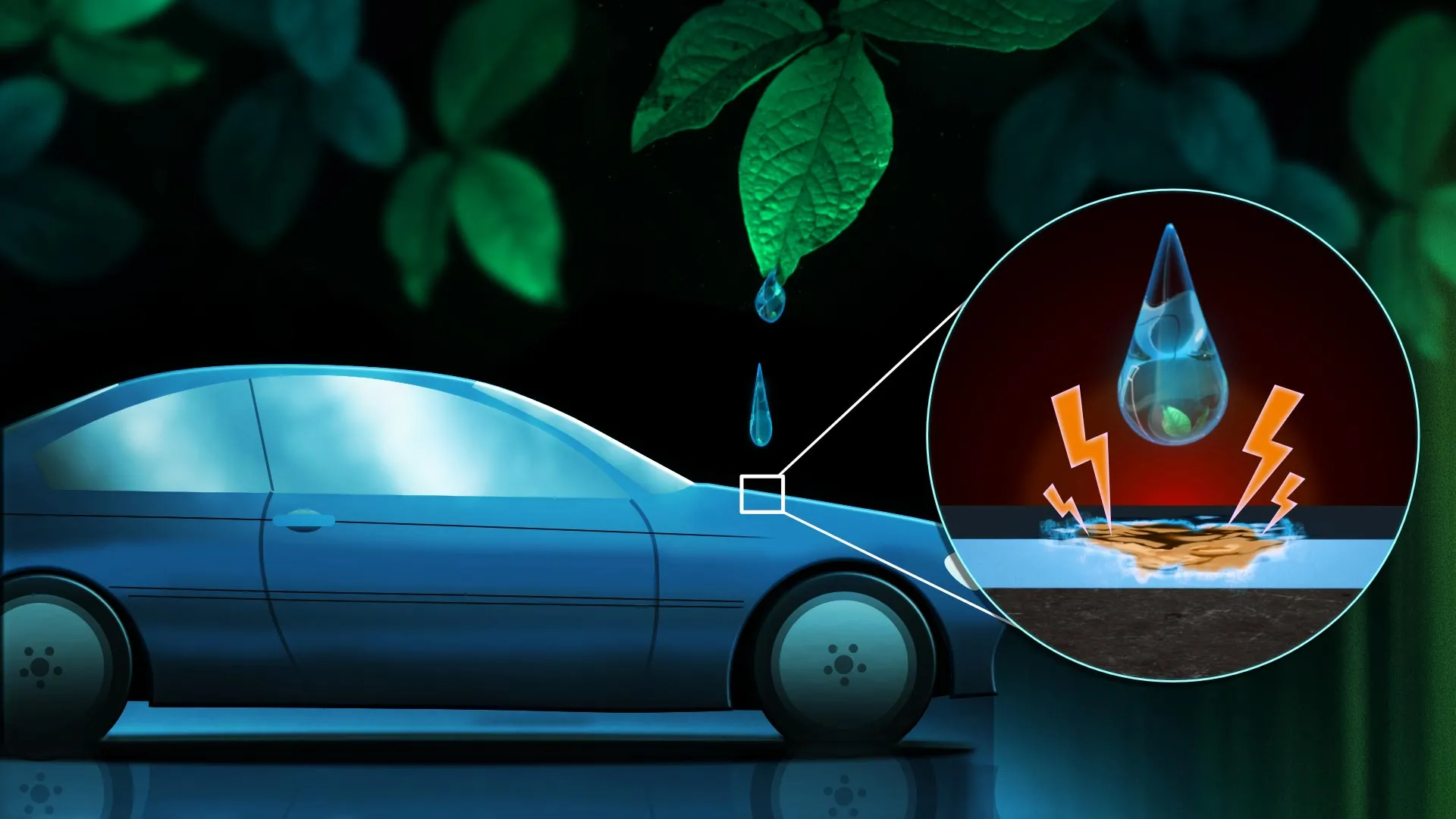
However, a groundbreaking international study published in the prestigious scientific journal Nature has revealed an entirely new, previously unrecognized mechanism of surface destruction: the electrical charge carried by falling water droplets. This invisible electrical phenomenon introduces a completely different perspective to surface physics, suggesting that every rainfall acts as a barrage of microscopic lightning strikes chipping away at our built environment.
The Multi-Institutional Research Effort
The groundbreaking research was spearheaded by Hans-Jürgen Butt, director at the Max Planck Institute for Polymer Research in Mainz, Germany. Butt worked in close collaboration with an interdisciplinary team of researchers from the University of Bonn, the South China University of Technology, the Massachusetts Institute of Technology (MIT), and Johannes Gutenberg University Mainz.
The investigation originated from fundamental questions regarding fluid dynamics and contact electrification that the team began exploring several years ago. Scientists wanted to understand the precise physics behind how water droplets accumulate electrical charges as they slide, roll, or splash across various surfaces.
"A few years ago, we investigated the physics behind how water droplets become charged as they surfaces," explains Rüdiger Berger, group leader in the Physics at Interfaces department at the Max Planck Institute. "This is a kind of ‘friction electricity’ in droplets and is physically much more complex than previously assumed. When such charged droplets strike a coating, they discharge locally and can puncture the layer in specific spots like a small flash of lightning—with consequences for the coating’s durability."
In practical terms, a water droplet acts as a mobile capacitor. As moisture moves across leaves, roofs, window panes, or industrial structures, it picks up static electrical charges via triboelectrification—the same mechanical friction process that causes static cling on laundry or allows a balloon to stick to a wall after being rubbed against hair. When this charged droplet finally detaches and impacts a protective coating elsewhere, the accumulated charge cannot be contained. It discharges instantaneously at the microscopic point of impact, creating a localized electrostatic discharge resembling a miniature lightning strike. This sudden electrical spike causes localized thermal and physical stress, slowly puncturing and weakening the protective barrier over millions of repeated impacts.
Methodology and Controlled Experimentation
To quantify the destructive potential of these micro-discharges, the Max Planck research team designed a controlled laboratory experiment. They began with a baseline testing surface uniformly covered in Teflon, a synthetic fluoropolymer globally renowned for its non-stick properties and widespread use in consumer cookware and industrial insulation.
Initially, the researchers subjected the Teflon surface to repeated impacts from uncharged water droplets. Even after a rigorous battery of 3,000 continuous impacts, advanced microscopic examinations revealed zero visible changes, structural deformations, or surface fatigue in the Teflon coating. The uncharged water alone caused no measurable harm.
The team then modified their experimental protocol to simulate natural environmental conditions more accurately. Before allowing the water droplets to fall onto the Teflon target, the team directed them to roll across common everyday materials frequently exposed to outdoor precipitation. These materials included living houseplant leaves, polyvinyl chloride (PVC), and polystyrene—the exact type of rigid plastic commonly found in window frames and insulation panels.
As the water droplets slid across these preliminary surfaces, they accumulated measurable electrical charges. Once charged, these droplets were guided to fall onto the test Teflon surface under identical physical conditions as the first trial.
The results were startling. After the exact same threshold of 3,000 impacts, microscopic analyses revealed undeniable alterations. High-resolution imaging showed clear structural changes both in the outer protective Teflon surface and, more critically, in the underlying metal substrate beneath the coating. The accumulation and discharge of electrical energy had successfully bypassed the protective barrier’s initial defenses, initiating micro-scale degradation that uncharged water failed to produce.
Variable Charge Generation Across Different Materials
One of the most revealing aspects of the study was the discovery that not all surfaces generate equal amounts of static electricity in water. The chemical composition and microscopic topography of the material a droplet traverses dictate the magnitude of the electrical charge it acquires.
"The charge a droplet acquires as it slides depends heavily on the specific surface—we measured differences of up to a factor of ten," explains Zhongyuan Ni, the study’s first author and a key contributor to the research project. "Regardless of this, we were able to detect changes in the coating in all experiments."
This variability highlights the complex interplay between atmospheric moisture and the diverse array of natural and synthetic materials found in urban and rural environments. Whether water rolls off a waxy plant leaf, a glass skyscraper window, an asphalt shingle, or a painted metallic panel, it builds a specific electrostatic profile. Despite wide discrepancies in the total charge gathered—varying by an order of magnitude depending on the source material—every single experiment involving charged droplets produced detectable micro-structural damage to the target coating.
Broader Impacts and Implications for Global Infrastructure
The identification of droplet-based electrification as a major degradation factor fundamentally shifts how materials scientists must approach surface protection. For decades, coating manufacturers have focused almost exclusively on mechanical hardness, chemical resistance, UV stabilization, and hydrophobic properties to enhance product lifespans.
The findings published in Nature demonstrate that electrostatic resilience must now be factored into the engineering of protective finishes. If water droplets routinely deliver microscopic electrical discharges that compromise barriers, next-generation coatings must be designed to either dissipate static charges safely or neutralize electrical accumulation upon impact.
The economic and practical implications of this discovery are vast. Every year, billions of dollars are spent globally on maintenance, surface preparation, repainting, and corrosion prevention. Infrastructure assets vulnerable to weather-induced wear include bridges, commercial shipping fleets, aerospace components, automotive bodies, historical monuments, and residential properties.
Furthermore, delicate cultural heritage sites—such as outdoor stone sculptures, ancient temples, and historic stone facades—suffer from continuous weathering that traditional conservation methods struggle to halt. Understanding that electrical discharges from ordinary rain contribute to this slow breakdown provides conservationists with a missing puzzle piece in preserving human history against the elements.
Future Directions in Materials Science
Armed with this new understanding, researchers at the Max Planck Institute for Polymer Research and cooperating global institutions are turning their attention toward commercial applications. The ultimate goal is to translate these fundamental physics insights into practical chemistry, guiding the development of advanced, longer-lasting protective coatings.
By engineering polymer matrices that possess antistatic properties or specialized dielectric constants, future coatings could absorb or safely bleed off the electrical energy delivered by charged raindrops before it can puncture the material. While garden fences and residential siding will still require routine upkeep in the foreseeable future, the creation of electrically resilient industrial coatings could soon extend the maintenance intervals for the world’s most critical infrastructure, saving industries billions of dollars and significantly reducing the environmental footprint associated with frequent repainting cycles.