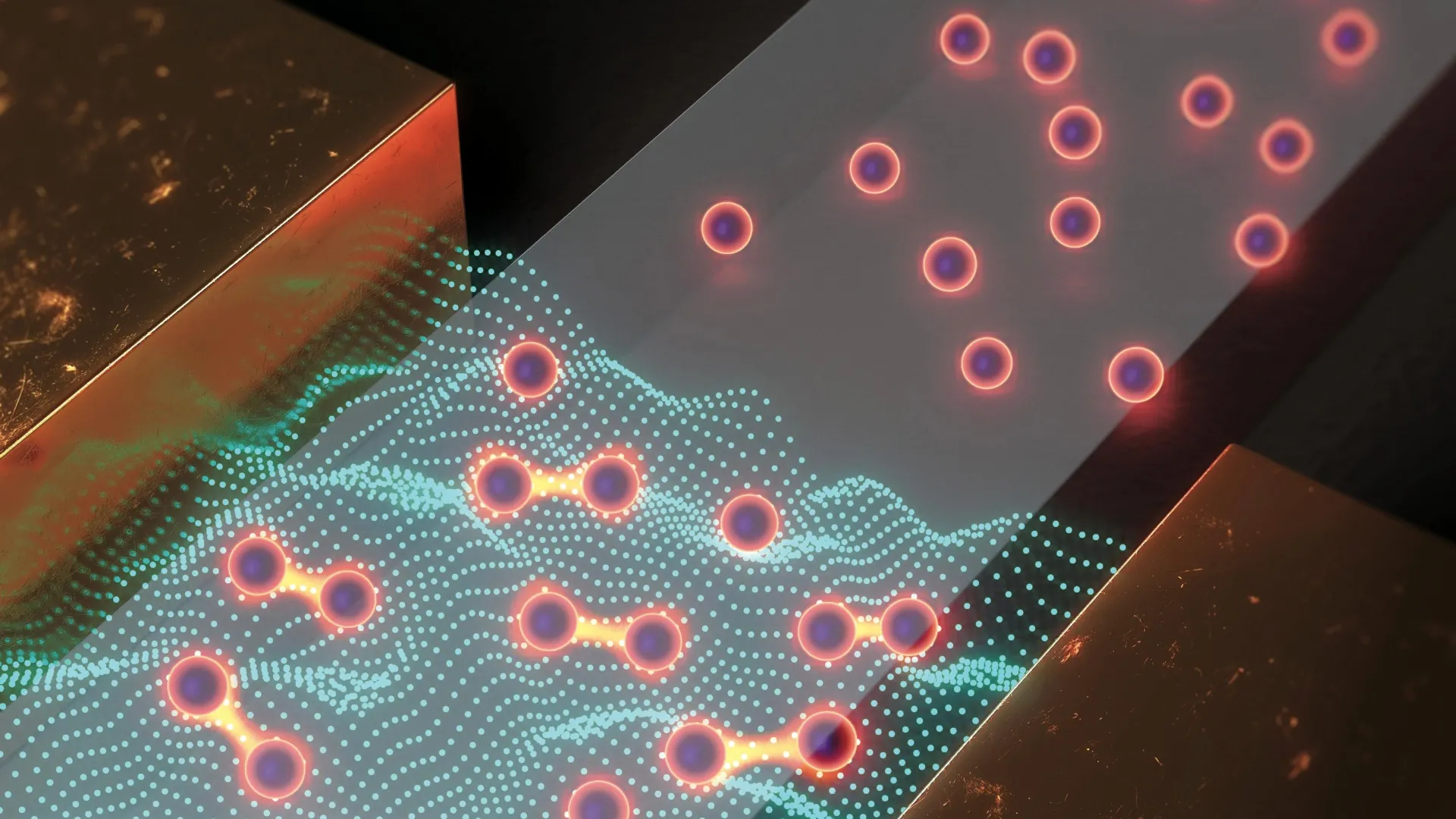
In a milestone achievement that bridges fundamental quantum electrodynamics with condensed matter physics, an international research collaboration has demonstrated for the first time that quantum fluctuations within a vacuum can be engineered to actively strengthen superconductivity. Published in the prestigious journal Nature, the study reveals that empty space—long viewed by physicists as a passive backdrop for physical phenomena—can be manipulated to reshape and enhance macroscopic quantum states of matter without the need for direct external energy injection.
The research was spearheaded by Professors Changgan Zeng and Guanghui Cheng of the University of Science and Technology of China (USTC), operating under the auspices of the Chinese Academy of Sciences. The multidisciplinary and cross-continental team also featured pivotal contributions from Professor Qingdong Jiang of Shanghai Jiao Tong University and Nobel laureate Professor Frank Wilczek of the Massachusetts Institute of Technology (MIT), alongside other esteemed colleagues. By merging advanced theoretical frameworks with precise nanofabrication techniques, the team has introduced a groundbreaking paradigm—termed "vacuumronics"—that could fundamentally alter how scientists approach the control and optimization of quantum materials.
Deconstructing the Quantum Vacuum
To understand the magnitude of this breakthrough, one must first revisit the traditional definition of a vacuum. In classical physics and everyday parlance, a vacuum denotes absolute nothingness—a void entirely devoid of matter, energy, and activity. However, modern quantum mechanics paints a vastly more dynamic and tumultuous picture.
According to quantum electrodynamics (QED) and Werner Heisenberg’s uncertainty principle, even the lowest possible energy state of a system—known as the zero-point energy—can never be perfectly quiescent. Instead, the fabric of empty space is continuously bubbling with activity, characterized by virtual particles that blink in and out of existence faster than direct measurement tools can typically capture. These transient phenomena produce an omnipresent background of quantum fluctuations.
While these fluctuations might sound purely abstract, their physical consequences are well-documented and verified by decades of empirical data. Landmark phenomena such as the Lamb shift (a tiny discrepancy in the energy levels of hydrogen atoms), spontaneous emission in atoms, and the Casimir effect (an attractive or repulsive force operating between closely spaced conducting plates) all stem directly from the reality of vacuum fluctuations.
Despite these established proofs, utilizing these fluctuations to control macroscopic states of matter remained an elusive frontier. For several years, the research groups led by Zeng and Cheng at USTC systematically investigated how vacuum fluctuations interact with condensed-matter systems. In a precursor study, the team successfully demonstrated that they could manipulate vacuum fluctuations by deploying a magnetic field to reversibly switch the Casimir force between attractive and repulsive states. That technical milestone catalyzed a broader, more ambitious inquiry: Could these ephemeral quantum ripples be harnessed not just to exert mechanical forces, but to actively govern macroscopic quantum states, such as superconductivity?
Engineering the Invisible: The Birth of Vacuumronics
While the USTC team pursued the experimental manipulation of electromagnetic environments, Professor Jiang’s theoretical group approached the challenge from a distinct analytical angle. They examined how intentionally engineered quantum vacuum environments could systematically influence diverse states of matter. This theoretical scaffolding gave birth to the concept of vacuumronics—a discipline dedicated to utilizing specially designed vacuum enclosures to govern electronic and photonic behavior.
A primary obstacle in harnessing vacuum fluctuations is their inherent scale. In free, unconstrained space, vacuum fluctuations are typically far too weak to produce measurable, practical effects on macroscopic condensed-matter systems. To bypass this fundamental limitation, Professor Zeng and his colleagues devised a hardware solution: a terahertz split-ring resonator functioning as a "dark cavity."
This dark cavity acts as an electromagnetic transformer. By tightly confining and reshaping the local electromagnetic field environment, the resonator substantially amplifies the intensity of the vacuum fluctuations within its boundaries. To test this apparatus empirically, the researchers integrated a few-layer sample of niobium diselenide ($textNbSe_2$), a well-known transition metal dichalcogenide superconductor, directly into the terahertz dark cavity. This setup forged a deeply coupled system wherein the superconducting condensate interacted intimately with the customized vacuum modes of the cavity.
Empirical Evidence and Measured Enhancements
Following the integration of the $textNbSe_2$ sample into the dark cavity, the research team conducted rigorous comparative evaluations, measuring the material’s superconducting properties both inside and outside the resonant environment. The empirical data yielded striking results: placing the superconductor inside the engineered cavity produced a quantifiable and substantial increase in its superconducting critical temperature ($T_c$)—the thermal threshold below which electrical resistance drops entirely to zero.
According to Professor Cheng, the critical temperature in a six-layer $textNbSe_2$ device increased by up to 5.4%. Furthermore, auxiliary metrics crucial to superconductivity—namely the critical current density and the critical magnetic field—demonstrated significant enhancements near the superconducting phase transition. These observations mark the first time researchers have successfully recorded vacuum-fluctuation-enhanced superconductivity in a laboratory setting.
To ensure the validity of these findings, the team executed an exhaustive battery of control experiments. They systematically altered multiple variables within the experimental apparatus, including cavity geometry, characteristic resonance frequencies, material layer thicknesses, underlying dielectric compositions, and metallic strip configurations. Through this methodical process of elimination, the researchers effectively ruled out alternative, conventional explanations for the observed changes, such as mechanical strain, material degradation, structural inhomogeneity, or standard metallic screening effects.
The most compelling proof of the mechanism at play emerged from analyzing the relationship between the superconductivity enhancement and the characteristic frequency of the dark cavity. Rather than observing a linear or random variation, the data revealed a sharp, resonance-like peak in superconductivity amplification occurring at one specific, tuned frequency.
"This result, closely tied to the cavity’s photonic properties, provides strong experimental evidence of the coupling between the superconducting state and dark-cavity modes," noted Professor Zeng.
Theoretical Validation via Virtual Photons
To contextualize these experimental outcomes, the theoretical teams led by Professor Jiang and Professor Frank Wilczek constructed a robust mathematical model rooted in the classic Ginzburg-Landau framework of superconductivity.
Their theoretical interpretation proposes that the macroscopic quantum state of the superconductor engages in a continuous exchange of virtual photons with the resonant modes of the dark cavity. This quantum-mechanical dialogue effectively lowers the ground-state energy of the superconducting phase, rendering it more stable against thermal fluctuations and thereby strengthening its overall coherence.
"When the characteristic energy of the cavity mode matched the low-energy superconducting fluctuations, the $textNbSe_2$ device exhibited resonant enhancement, producing the peak in superconductivity enhancement," explained Professor Jiang.
This mechanism fundamentally challenges the conventional, textbook conceptualization of the vacuum in physical sciences. Instead of serving as a passive backdrop or an empty stage upon which quantum events unfold, the engineered vacuum actively participates as a dynamic actor in physical systems.
"In most practical physics, the vacuum serves merely as the passive stage on which phenomena play out," observed Professor Frank Wilczek. "This work shows that the background itself can become an actor—engineered to strengthen superconductivity and reshape the behavior of quantum matter."
Chronology and Collaborative Milestone
The publication in Nature represents the culmination of years of iterative investigation across multiple premier academic institutions. The collaboration officially bridged foundational quantum electrodynamics with advanced materials science, uniting USTC’s expertise in nanofabrication and low-temperature transport measurements with Shanghai Jiao Tong University’s theoretical prowess in quantum optics and vacuum engineering, alongside MIT’s deep theoretical insights into fundamental quantum fields.
Chronologically, the project advanced through three primary phases:
- Preliminary Manipulation (2020–2022): The USTC teams established foundational methodologies for manipulating vacuum-related forces, successfully switching the Casimir force between attractive and repulsive states using external magnetic fields.
- Theoretical Formulation (2022–2023): Theoretical groups introduced the conceptual framework of vacuumronics, modeling how engineered dark cavities could alter the energetic landscape of condensed matter systems.
- Integration and Verification (2023–2024): Researchers coupled $textNbSe_2$ samples inside terahertz split-ring resonators, successfully recording resonance-dependent enhancements in critical temperature and validating the model through rigorous control tests.
Broader Implications and Future Horizons
The implications of vacuum-fluctuation-enhanced superconductivity extend far beyond the immediate properties of niobium diselenide. Traditionally, enhancing superconductivity—particularly raising critical temperatures—requires material doping, chemical substitution, extreme mechanical high pressures, or the application of direct external electromagnetic driving fields. Each of these conventional methods often introduces disorder, sample degradation, or parasitic heating.
In contrast, the vacuumronics approach relies on noncontact, environmental coupling. By modifying the surrounding electromagnetic boundary conditions rather than altering the internal chemical composition of the superconductor, scientists can achieve precise state control cleanly and non-invasively.
Independent physicists not directly involved in the study have praised the work as a masterclass in experimental ingenuity. While commercial applications remain distant—as integrating complex dark cavities with large-scale superconducting circuits presents significant engineering hurdles—the foundational principle has been soundly established.
Looking ahead, the research collective plans to refine the architecture of their dark cavities and explore a wider array of quantum materials, including high-temperature superconductors and topological insulators.
"With further optimization of cavity structures and material systems, vacuum-fluctuation coupling may enable more pronounced and widely applicable control of quantum states," concluded Professor Zeng. As this nascent field of vacuumronics matures, the once-empty vacuum may well become one of the most powerful control knobs in modern quantum engineering.