In a groundbreaking revelation that challenges centuries of established fluid dynamics, a team of researchers at Drexel University’s College of Engineering has demonstrated that simple liquids can undergo a physical transformation typically reserved for solid materials: they can snap. This phenomenon, known as brittle fracture, was previously thought to be impossible in liquids that are significantly above their glass transition temperature. The study, recently published in the prestigious journal Physical Review Letters, reveals that under specific conditions of extreme extensional force, even common fluids like oil or water could theoretically reach a point of "critical stress" where they break rather than flow.
This discovery fundamentally alters the scientific community’s understanding of viscosity and its role in material mechanics. While scientists have long understood that complex fluids—such as polymer melts or "Oobleck" (a non-Newtonian mixture of cornstarch and water)—can exhibit solid-like properties, the revelation that "simple liquids" share this trait suggests a universal law of fluid behavior that has remained hidden until now. The implications of this research are vast, promising to influence diverse fields including industrial manufacturing, high-speed 3D printing, hydraulic systems, and even the study of blood flow within the human cardiovascular system.
The Serendipitous Discovery: A Chronology of the Experiment
The path to this discovery began not with a search for fractures, but with a routine investigation into the flow properties of industrial lubricants. Dr. Thamires Lima, an assistant research professor at Drexel, and Dr. Nicolas Alvarez, a professor in the College of Engineering, were collaborating with the ExxonMobil Technology & Engineering Company to study the behavior of simple liquids under tension.
The team was utilizing a process known as extensional rheology. Unlike standard rheology, which measures how a liquid responds to shearing forces (like stirring), extensional rheology measures how a liquid responds to being pulled apart. This is a critical metric for industries that involve spraying, coating, or fiber spinning.
The chronology of the event unfolded as follows:
- Initial Testing: The researchers prepared samples of tar-like hydrocarbon blends, which are classified as "simple liquids" because they lack the long-chain molecular structures found in polymers.
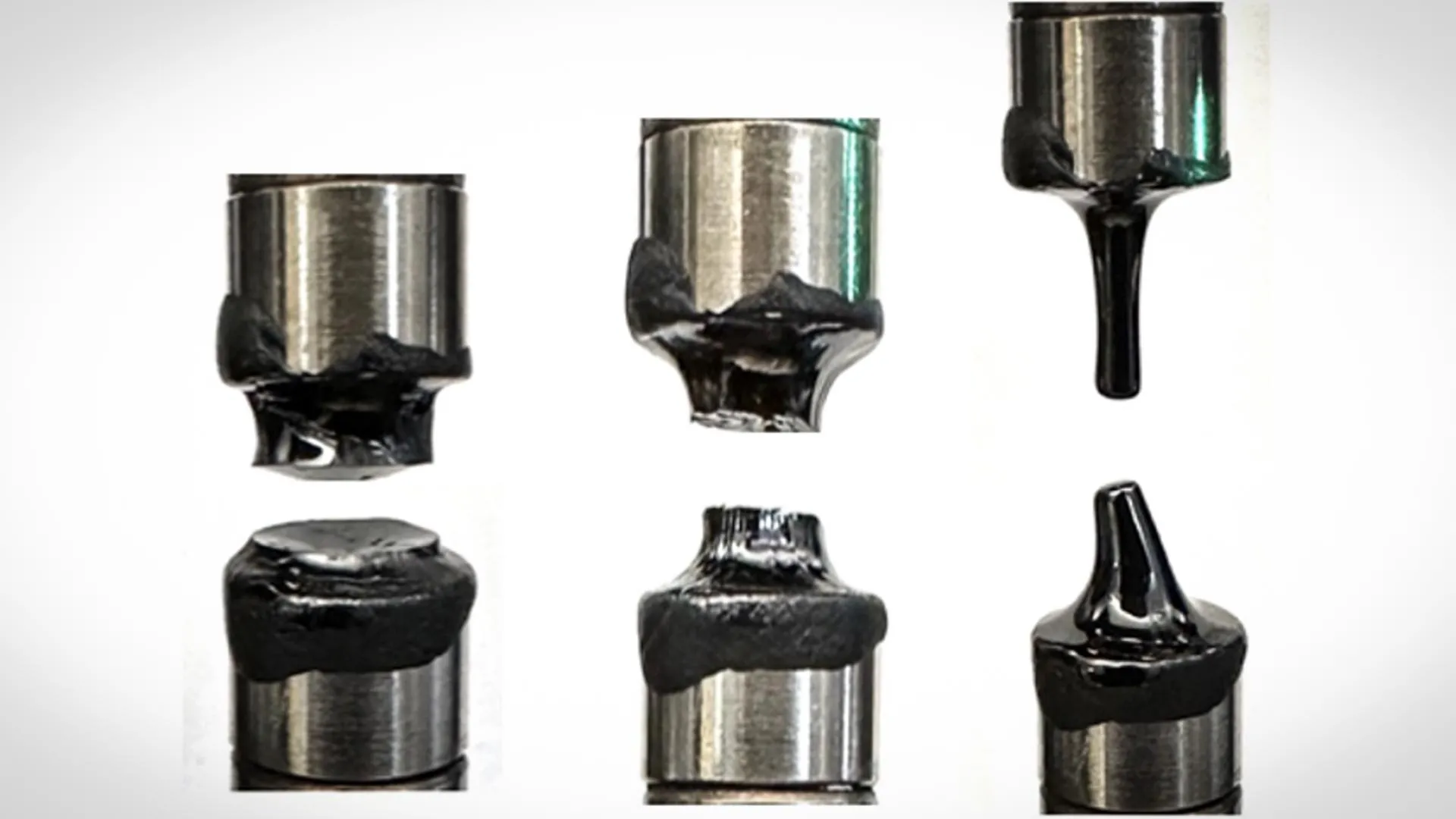
- The Unexpected Result: As the machine began to stretch the liquid, the researchers expected it to behave like warm honey—thinning out into a fine thread until it eventually pinched off. Instead, the liquid resisted the stretch until it reached a breaking point, at which it snapped instantly.
- The Audible Snap: The force of the fracture was so great that it produced a loud, sharp cracking sound. Dr. Lima noted that the noise was so unexpected she initially feared the testing equipment had suffered a mechanical failure.
- Verification: Recognizing the potential significance of the event, the team repeated the experiment multiple times using high-speed cameras to capture the frame-by-frame breakdown of the fluid. The footage confirmed that the liquid was not "flowing" to a point of separation but was undergoing a brittle fracture, a hallmark of solid-state physics.
Analyzing the Data: The 2 MegaPascal Threshold
To move beyond anecdotal observation, the Drexel team sought to quantify the exact forces required to break a liquid. They discovered that the tar-like hydrocarbons fractured at a critical stress of approximately 2 megaPascals (MPa). To put this into perspective, 2 MPa is a significant amount of pressure—roughly equivalent to the force of ten heavy bricks concentrated on the tip of a fingernail.
To determine if this was a unique property of the tar-like substance or a broader characteristic of fluids, the team tested a different simple liquid: styrene oligomer. Despite having a different chemical composition, the styrene oligomer fractured at the exact same 2 MPa threshold when subjected to the same stretching conditions.
Further data analysis revealed a crucial relationship between viscosity and temperature:
- Viscosity as a Catalyst: The researchers found that the higher the viscosity (the "thickness" of the liquid), the more easily it could be brought to the point of fracture.
- Temperature Sensitivity: By adjusting the temperature of the liquids, the team could manipulate their viscosity. At every temperature level tested, they identified a specific "stretching rate" that would trigger the fracture.
- Equipment Limitations: At lower viscosities, the liquids appeared immune to fracturing. However, the researchers believe this is not because the liquids cannot break, but because current laboratory equipment cannot stretch them fast enough to reach the 2 MPa critical stress point before the liquid naturally deforms.
Challenging the Foundations of Fluid Mechanics
For decades, the distinction between solids and liquids has been defined by how they handle stress. Solids are elastic; they store energy and, when pushed too far, they break. Liquids are viscous; they dissipate energy through flow. This study blurs those lines significantly.
Traditionally, the scientific consensus held that a liquid would only behave like a solid if it were cooled below its "glass transition temperature"—the point at which molecular motion slows down so much that the substance becomes a glass-like solid. The Drexel experiments, however, were conducted at temperatures well above the glass transition. This proves that "viscous effects" alone, independent of elasticity or cooling, are sufficient to promote solid-like fracture.
"Simple liquids have always been thought to exhibit continuous deformation… and therefore would not fracture," Dr. Lima explained. "Showing that viscous effects are enough to promote solid-like fracture behavior opens a world of new questions."
One of the most compelling pieces of data from the study was the comparison between the simple liquid (oligomer styrene) and a related polymer liquid. Both materials broke at the same critical stress point. This suggests that the chemical complexity of a substance—specifically whether it has the "elastic" properties of a polymer—does not determine its breaking point. Instead, the breaking point appears to be a universal physical constant related to the liquid state itself.
Theoretical Mechanisms: The Role of Cavitation
While the observation of the fracture is clear, the underlying "why" is still a subject of intense investigation. The Drexel team has proposed that the fracture may be caused by a phenomenon known as cavitation.
In fluid dynamics, cavitation occurs when the pressure in a liquid drops rapidly, causing tiny vapor bubbles to form. When these bubbles collapse, they generate intense shockwaves. The researchers hypothesize that when a simple liquid is stretched with enough force, the internal pressure drops so sharply that it triggers a localized "explosive" formation of cavities. These cavities then link together almost instantaneously, creating a fracture plane that allows the liquid to snap.
If this hypothesis is confirmed, it would mean that the "snap" is actually a high-speed chain reaction of microscopic voids forming and failing within the liquid’s structure.
Broader Implications and Industrial Applications
The discovery that simple liquids have a breaking point has immediate and practical implications for several high-tech industries.
1. High-Speed 3D Printing and Manufacturing
In additive manufacturing, liquids are often extruded through tiny nozzles at high speeds. If the liquid reaches its critical stress point and "snaps" during the printing process, it could lead to defects in the final product. Understanding the 2 MPa limit allows engineers to calibrate printing speeds to avoid unintended fractures.
2. Fiber Spinning and Textiles
The production of synthetic fibers involves pulling liquid polymers or solutions into thin strands. The Drexel findings suggest that there is a hard physical limit to how fast these fibers can be pulled. Exceeding this limit would cause the "liquid" fiber to shatter, leading to production downtime.
3. Hydraulics and Lubrication
In high-pressure hydraulic systems, such as those used in aerospace or heavy machinery, lubricants are subjected to extreme forces. If a lubricant "breaks" rather than flows, it could lead to a catastrophic loss of lubrication and mechanical failure. This research provides a new framework for testing the durability of industrial oils.
4. Biological Systems and Medicine
While blood is a complex fluid, many of its components behave like simple liquids. Understanding the stress limits of these fluids could provide new insights into how blood behaves under the extreme pressures found in certain cardiovascular conditions or when passing through artificial heart valves and medical pumps.
Future Research Directions
The team at Drexel’s College of Engineering, in collaboration with ExxonMobil, intends to expand their testing to an even wider variety of liquids. A primary goal is to develop new instrumentation capable of reaching the extreme stretching rates required to fracture low-viscosity liquids like water or common vegetable oils.
Furthermore, the discovery invites a re-evaluation of classical physics textbooks. If the "liquid" state is capable of brittle fracture, the definitions used to teach fluid dynamics to engineering students may need to be updated to include the concept of critical stress.
"Now that we have reported this unanticipated behavior, the work of fully understanding why it happens and how the behavior manifests in other liquids is an important next step," said Dr. Lima. As the scientific community digests these findings, the "loud snapping noise" heard in a Drexel lab may echo for years as a turning point in the history of material science.