

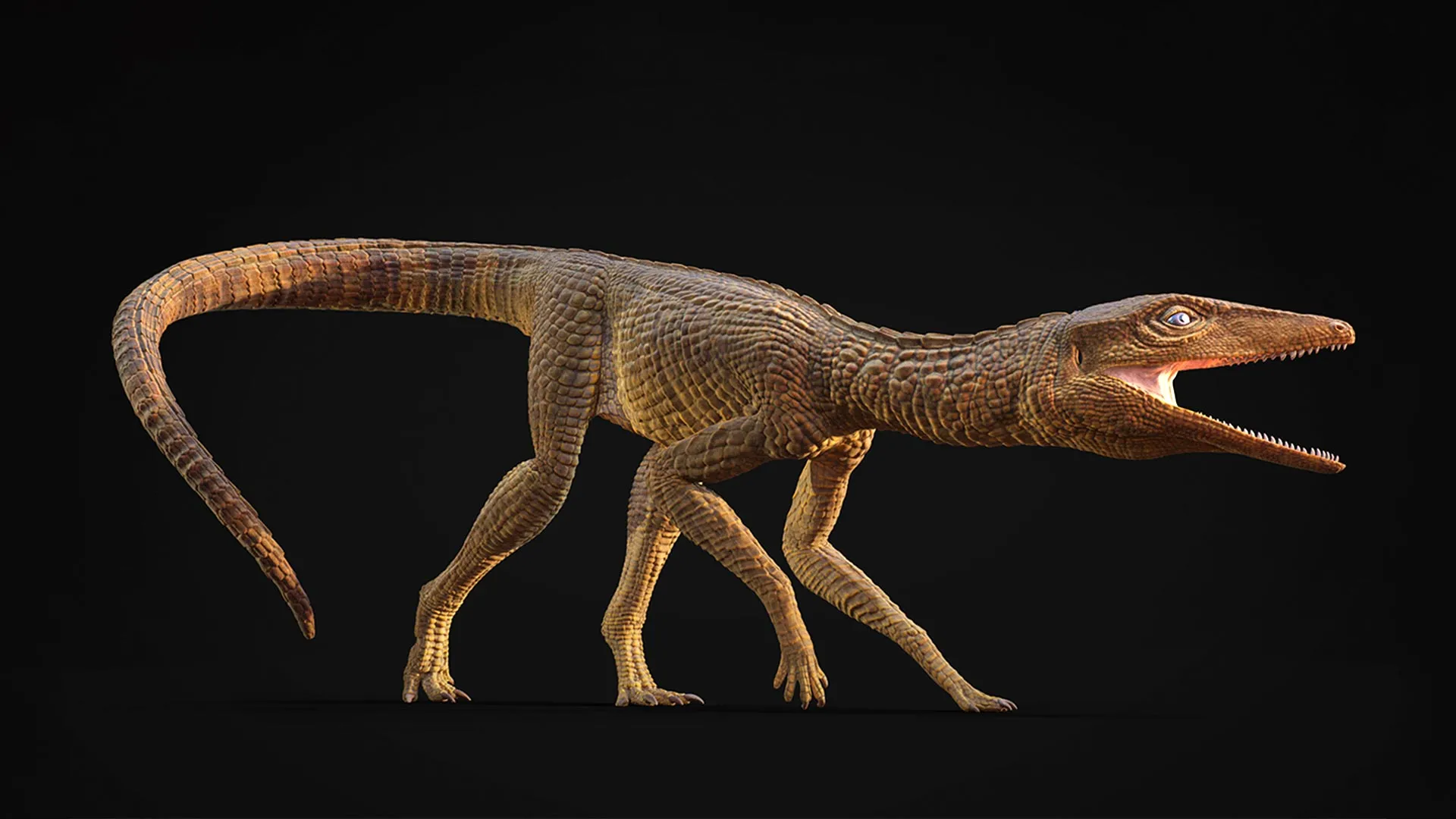
The ancient landscape of what is now Gloucester, UK, once teemed with a remarkable array of prehistoric life, and a recent paleontological discovery has shed new light on one of its most intriguing inhabitants. Scientists have unearthed and identified a new species of crocodylomorph, an early relative of modern crocodiles, that roamed the Earth approximately 215 million years ago during the Late Triassic period. This newly christened creature, named in part to honor a beloved former physics teacher, presents a stark contrast to its aquatic descendants, possessing a body finely tuned for rapid locomotion on land.
The implications of this find extend far beyond the identification of a single extinct animal. It offers a crucial glimpse into the complex ecosystems that existed just prior to the devastating Triassic-Jurassic mass extinction event, a period of profound environmental upheaval that reshaped life on Earth. The discovery, detailed in the latest issue of The Anatomical Record, underscores the dynamic evolutionary pathways taken by early archosaurs and provides valuable data for understanding adaptation and survival in the face of catastrophic change.
A Predator Built for Speed: Unveiling the New Crocodylomorph
Unlike the broad, flat-headed, semi-aquatic predators familiar today, this Triassic crocodylomorph was an agile terrestrial hunter. Its skeletal structure, characterized by long, slender legs and a comparatively lightweight frame, strongly suggests an animal built for speed and efficiency in terrestrial environments. Researchers believe this adaptation allowed it to pursue and capture small prey such as early mammals, lizards, and amphibians that inhabited the region during the Late Triassic. The environment at the time was significantly different from the temperate, verdant landscapes of modern Britain. Geological evidence indicates that this part of the world was an elevated plateau, surrounded by arid, hot plains, creating a unique ecological niche for specialized life forms.
The scientific nomenclature bestowed upon this ancient predator is a testament to both scientific rigor and personal inspiration. The genus name, Galahad, draws a parallel to the legendary Arthurian knight Galahad, renowned for his upright character and noble bearing. This choice reflects the animal’s posture, which would have been characterized by an erect stance rather than the sprawling gait of many reptiles. The species name, rhysjonesi, is a direct tribute to David Rhys Jones, a former physics teacher at Ysgol Uwchradd Aberteifi in Cardigan, Wales. Ewan Bodenham, a PhD student at the Natural History Museum London and UCL, and the lead author of the study, explained the personal significance of this dedication.
"We named it after my secondary school physics teacher," Bodenham stated in a recent interview. "Mr. Jones was just such a good teacher, not only in being able to explain things well, but you could tell that he was genuinely interested in the sciences. I think that really inspired me." Bodenham further elaborated on the profound impact Mr. Jones had on his academic journey, highlighting his encouraging yet challenging teaching style: "He also didn’t let me settle. He was very good at challenging people and helping students be the best they can be. Above all, he’s a very funny, genuine, nice guy." This personal connection underscores the human element often present in scientific discovery, where formative influences can echo through a career.
Unearthing the Past: Fossil Discoveries from Ancient Cave Deposits
The fossilized remains of this new crocodylomorph were not found in a single, cohesive specimen, but rather within fissure deposits. These geological formations are found on both sides of the Bristol Channel, spanning across southern Wales and southwest England. The process by which these fossils were preserved is quite specific: animals that perished on the surface would have been washed into subterranean cavities. Over millions of years, these underground spaces would have gradually filled with sediment, entombing the remains and protecting them from the ravages of time and the elements.
These fissure deposits have proven to be a rich repository of Triassic fauna. Notably, among the fossils recovered from these sites was Terrestrisuchus, another significant member of the Crocodylomorpha clade. Like the newly identified species, Terrestrisuchus also possessed long, slender legs and was adapted for a fully terrestrial lifestyle, distinguishing it from later, more aquatic crocodylomorphs. The discovery of both species within similar geological contexts reinforces the idea that this region was a hub for terrestrial crocodylomorph evolution during the Late Triassic.
The Rigors of Scientific Identification: Distinguishing a New Species
The process of identifying a new species is a meticulous and demanding endeavor, requiring extensive comparative analysis. Ewan Bodenham’s doctoral research focuses on the evolutionary relationships within early crocodylomorph lineages, making the analysis of these fossil specimens a central part of his academic pursuit.
"My PhD project is looking at the evolutionary relationships of these early crocodiles," Bodenham explained. "So we conducted a detailed anatomical description of this specimen, making comparisons to other early crocodiles to determine if it was another specimen of Terrestrisuchus or if it was something new." This involved an in-depth examination of the fossilized bones, noting every discernible anatomical feature. Through this painstaking process, the research team identified 13 distinct anatomical differences between the newly discovered specimen and known species, most notably Terrestrisuchus. These differences were significant enough to confidently classify the specimen as representing an entirely new species.
The implications of these anatomical differences are crucial for understanding the diversity within early crocodylomorph groups. It suggests that even within lineages adapted for similar ecological niches, there was significant evolutionary divergence, leading to the development of specialized forms. This highlights the complexity of the Triassic fauna and the intricate web of interactions that characterized these ancient ecosystems.
Pre-Extinction Ecosystems: Insights into a World on the Brink
The discovery of Galahad rhysjonesi adds another vital piece to the puzzle of Late Triassic ecosystems in southwestern Britain. This region has yielded an increasingly diverse array of fossil species from this period, providing invaluable data for reconstructing the environments and faunal assemblages that existed just before the Triassic-Jurassic mass extinction. This extinction event, one of the most severe in Earth’s history, is widely believed to have been triggered by massive volcanic activity, particularly the Central Atlantic Magmatic Province (CAMP) eruptions, which led to drastic climate change, including global warming and ocean acidification.
By studying the species that thrived and perished during this critical transition, paleontologists can gain profound insights into the mechanisms of adaptation and the resilience of life in the face of extreme environmental pressures. The presence of a fast-moving, terrestrial predator like Galahad rhysjonesi indicates that these ecosystems were capable of supporting specialized niches and complex food webs. Understanding the adaptations of such species – their prey, their locomotion, their habitat preferences – can help scientists model how different life forms responded to the rapid environmental shifts of the Late Triassic, offering lessons relevant to contemporary biodiversity challenges.
The study of these pre-extinction communities is paramount for understanding evolutionary trajectories. Species that survived the Triassic-Jurassic boundary often went on to diversify and dominate ecosystems in the subsequent Jurassic period. Conversely, those that succumbed highlight the vulnerabilities of specific adaptations to rapid and widespread environmental change. The detailed anatomical and ecological information gleaned from new discoveries like this one allows for more robust phylogenetic analyses and better predictive models for evolutionary processes.
The Scientific Publication and Future Research
The formal description of Galahad rhysjonesi as a new species is published in the esteemed scientific journal The Anatomical Record. The paper, titled ‘A second species of non-crocodyliform crocodylomorph from the Late Triassic fissure deposits of southwestern UK: implications for locomotory ecological diversity in Saltoposuchidae’, provides the comprehensive anatomical data and phylogenetic analysis that underpin the discovery.
The implications of this research are far-reaching for the field of paleontology. It not only expands our knowledge of early crocodylomorph diversity but also prompts further investigation into the ecological roles of these terrestrial predators. Future research will likely focus on further comparative anatomy studies of related fossils, refining our understanding of the evolutionary relationships within the Saltoposuchidae family. Additionally, researchers may seek to find more complete specimens of Galahad rhysjonesi to gain a more comprehensive understanding of its overall morphology and lifestyle. The continued exploration of Triassic fissure deposits across the UK and beyond promises to reveal further secrets of this pivotal period in Earth’s history, shedding light on the resilience and adaptability of life.












Leave a Reply