The seemingly mundane act of taking a breath, a process so fundamental to life that it often goes unnoticed, is in fact a testament to an evolutionary journey spanning hundreds of millions of years. The rhythmic expansion of the chest, the subtle interplay of intercostal muscles, and the vital influx of air into the lungs are not mere biological functions; they are echoes of an ancient adaptation that enabled vertebrates to conquer the terrestrial realm. Now, a remarkably preserved fossil of a small reptile that perished in an Oklahoma cave approximately 289 million years ago has provided unprecedented insight into the earliest known manifestation of this crucial breathing system in amniotes – the group of animals that includes reptiles, birds, mammals, and their common ancestors, marking a pivotal moment in the transition to land-based life.
Unveiling the Secrets of Captorhinus aguti
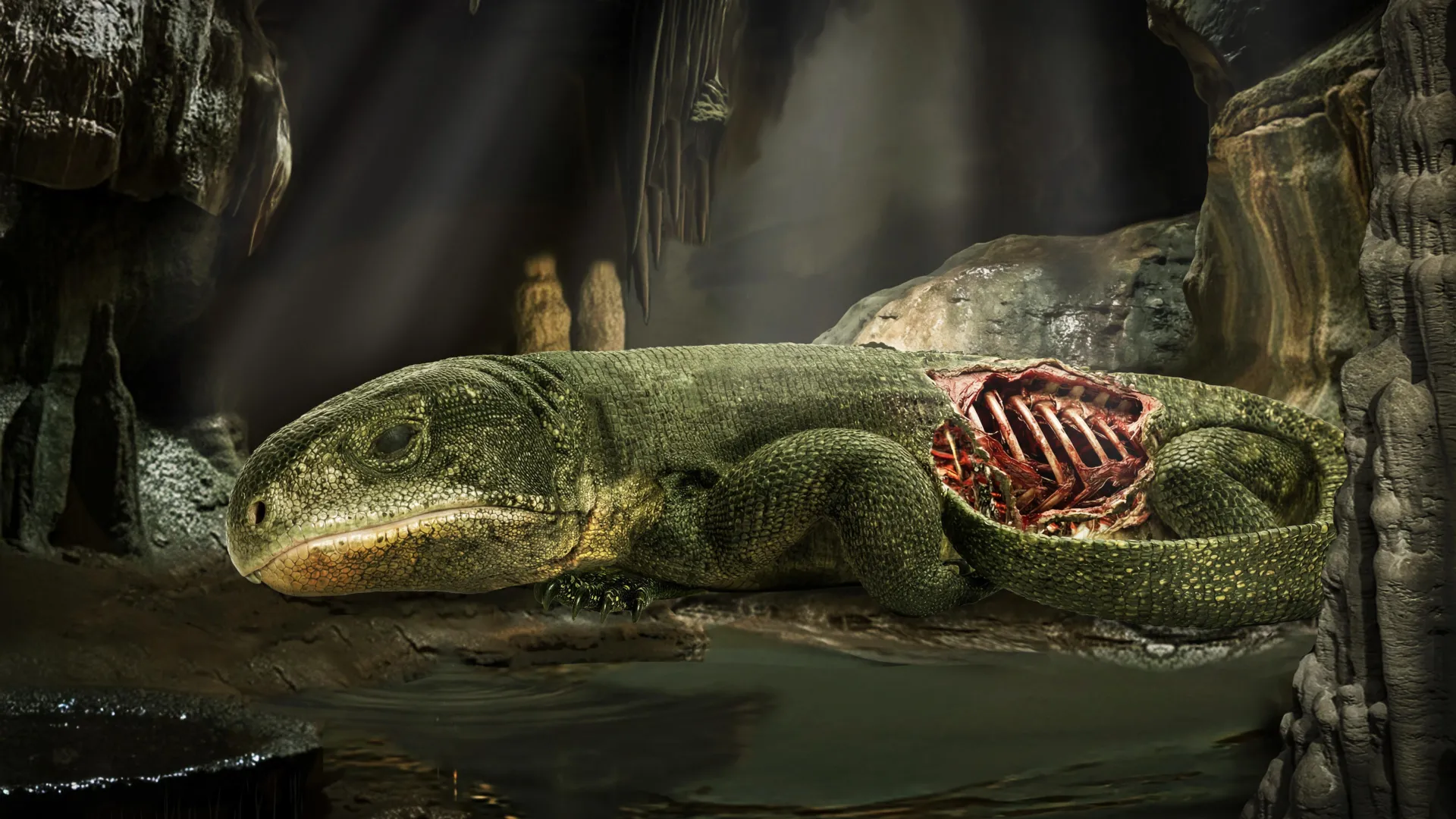
Published in the prestigious journal Nature, a groundbreaking study details the extraordinary preservation of Captorhinus aguti, a lizard-like reptile from the early Permian period. This diminutive fossil, measuring only a few inches in length, offers a treasure trove of biological information far beyond skeletal remains. It astonishingly preserves three-dimensional skin, calcified cartilage, and even molecular remnants of proteins. The detection of these protein traces is particularly significant, as they are nearly 100 million years older than any previously identified in the fossil record, pushing the boundaries of our understanding of biomolecular preservation.
Ethan Mooney, who co-led the research as a student in Professor Robert R. Reisz’s lab at the University of Toronto and is now a PhD candidate at Harvard University working with paleontologist Professor Stephanie Pierce, highlighted the significance of this ancient creature. " Captorhinus is an interesting lizard-looking critter that is critical to understanding early amniote evolution," Mooney stated. These early reptiles, which varied in size from mere centimeters to over a meter, represented some of the first successful colonizers of terrestrial environments. Their widespread distribution and ecological success underscore their evolutionary importance.
A Pristine Fossil Unearthed at Richards Spur
The exceptional specimen was discovered within the intricate cave systems near Richards Spur, Oklahoma. This locale is renowned globally for its unparalleled fossil record of late Paleozoic life, offering a diverse assemblage of terrestrial vertebrates from an era already teeming with species. The unique geological and environmental conditions at Richards Spur played a crucial role in this remarkable preservation. The presence of oil seeps, which released hydrocarbons, and the oxygen-free environment of the mud within the caves, created a protective cocoon that shielded not only the bones but also delicate soft tissues like skin and cartilage from decomposition.
As a consequence of these ideal conditions, the Captorhinus fossil exists as a three-dimensional mummified specimen, frozen in its final moments with one arm gracefully tucked beneath its body. This level of preservation is exceedingly rare, providing scientists with an exceptionally detailed anatomical snapshot of an ancient organism.
Advanced Imaging Techniques Illuminate Ancient Anatomy
To meticulously examine the fossil without causing any damage, researchers employed high-technology imaging techniques, specifically neutron computed tomography (nCT). This non-invasive method was conducted at a specialized facility in Australia, allowing scientists to peer beneath the encasing rock and reveal intricate details previously hidden within.
During his analysis, Mooney made a startling observation. "I started to see all these structures wrapped around the bones," he recounted, describing the initial moments of discovery. "They were very thin and textured. And lo and behold, there was a nice wrapping of skin around the torso of this animal. The scaly skin has this wonderful accordion-like texture, with these concentric bands covering much of the body from the torso and up to the neck." This distinctive scaled pattern bears a striking resemblance to the skin morphology observed in modern-day worm lizards, a group of small, burrowing reptiles that still inhabit the Earth today.
Reconstructing the Dawn of Rib-Based Respiration
The discovery of the preserved skin was just one piece of the intricate puzzle. By studying three distinct Captorhinus specimens unearthed from Richards Spur, the research team was able to reconstruct the animal’s respiratory mechanism. One particular fossil yielded crucial information, revealing a segmented cartilaginous sternum, alongside sternal ribs, intermediate ribs, and the connections that linked the ribcage to the shoulder girdle.
This comprehensive view allowed scientists, for the first time, to visualize these structures clearly in an early reptile and to meticulously reconstruct a complete breathing system in an early amniote. The findings provide direct evidence of costal aspiration breathing, a method where muscles situated between the ribs contract and relax, expanding and compressing the chest cavity to facilitate the intake of air into the lungs.
A Leap Forward from Amphibian Respiration
Prior to the evolution of this rib-based breathing system, amphibians relied on a fundamentally different approach to respiration. They primarily exchanged gases through their skin and employed buccal pumping – a method involving the movement of the floor of the mouth and throat to force air into their lungs. While this system remains effective for many amphibians today, it inherently limits their capacity for vigorous physical activity. The advent of rib-based breathing, however, revolutionized oxygen uptake. This mechanism enables deeper, more efficient airflow, leading to a greater intake of oxygen and a more effective expulsion of carbon dioxide. This enhanced physiological capacity was a critical enabler for a more active terrestrial lifestyle.
Professor Reisz elaborated on the evolutionary significance of their findings: "We propose that the system found in Captorhinus represents the ancestral condition for the kind of rib assisted respiration present in living reptiles, birds, and mammals." This suggests that the breathing mechanism observed in this ancient reptile is the foundational blueprint for the respiratory systems found in the vast majority of terrestrial vertebrates today.
A Pivotal Innovation for Terrestrial Colonization
The adoption of ribcage muscles for breathing represented a monumental evolutionary leap. It endowed early amniotes with the capacity to sustain more active and energetically demanding lifestyles, which was crucial for their successful dispersal and diversification across a wide range of terrestrial environments.
"It was a game changer that allowed these animals to adopt a much more active lifestyle," Mooney emphasized. This newfound physiological advantage likely played a significant role in the subsequent evolutionary success of reptiles and their diverse lineages, laying the groundwork for their eventual dominance in terrestrial ecosystems for millions of years.
Ancient Proteins: Pushing the Boundaries of Fossil Science
Beyond the anatomical revelations, the Captorhinus fossils yielded another astonishing discovery: the detection of original protein traces. Utilizing advanced synchrotron infrared spectroscopy, researchers identified these molecular remnants embedded within the fossilized bone, cartilage, and skin. These molecules are the oldest of their kind ever identified, predating previous discoveries in dinosaur fossils by nearly 100 million years.
"The protein remnant finding is exceptional," Mooney stated, underscoring the profound implications of this discovery. "It dramatically pushes our understanding of what is possible in terms of soft tissue preservation in the fossil record." This opens up new avenues for research, potentially allowing scientists to glean even more detailed molecular and physiological information from ancient organisms.
A Window into the Evolution of Vertebrates
The invaluable Captorhinus fossils are now curated at the Royal Ontario Museum in Toronto, where they will be accessible for ongoing scientific investigation. Mooney’s continued research at Harvard University focuses on the evolutionary history of early reptiles, building upon the insights gained from this remarkable discovery.
Findings like this are instrumental in painting a clearer picture of how early vertebrates transitioned from aquatic to terrestrial environments and how crucial evolutionary innovations, such as efficient rib-based breathing, fundamentally shaped the trajectory of life on Earth. The story of Captorhinus aguti is not just about a single fossil; it is a profound narrative that connects the fundamental act of breathing today to the ancient challenges and triumphs of life’s earliest terrestrial pioneers.
Broader Implications for Evolutionary Biology and Paleontology
The implications of this discovery extend far beyond the specific anatomy of Captorhinus aguti. The ability to preserve and analyze proteins from such ancient specimens offers a paradigm shift in paleontological research. Previously, the study of soft tissues in fossils was limited to rare instances of exceptional preservation, often confined to specific environmental niches. The detection of proteins in the Captorhinus fossil suggests that molecular remnants may be more widespread in the fossil record than previously thought, provided the right analytical tools are employed.
This opens up exciting possibilities for future research, including:
- Reconstructing Ancient Diets and Physiology: Protein analysis could potentially reveal dietary habits, metabolic rates, and even immune system components of extinct organisms.
- Understanding Evolutionary Relationships: Molecular data from ancient proteins could offer independent lines of evidence to corroborate or refine phylogenetic trees based on skeletal morphology.
- Tracing Disease and Health in Extinct Populations: Identifying specific protein markers could shed light on diseases or pathologies that affected ancient animal populations.
The study’s detailed reconstruction of the costal aspiration breathing system also provides a crucial data point in understanding the macroevolutionary transition from water to land. This transition was fraught with challenges, including the need for efficient oxygen uptake in a less dense medium and the development of support structures against gravity. The evolution of a more powerful and efficient respiratory system directly addresses the former, enabling greater mobility and activity levels necessary for navigating terrestrial landscapes.
The early Permian period, when Captorhinus thrived, was a time of significant diversification for terrestrial vertebrates. The development of amniotic eggs, which allowed reproduction away from water, and the evolution of more efficient locomotion and respiration, were key innovations that facilitated this radiation. This research firmly places the development of efficient rib-based breathing as a cornerstone of this success, a trait that would be inherited and refined by countless subsequent lineages.
Furthermore, the comparison of the Captorhinus skin texture to that of modern worm lizards highlights the remarkable evolutionary conservatism of certain biological features. While worm lizards are highly specialized burrowing reptiles, their superficial resemblance to an ancient amniote’s skin suggests that the underlying principles of epidermal structure and scaling may have been established very early in amniote evolution. This underscores the power of evolutionary processes to retain and adapt successful designs over vast geological timescales.
The ongoing study of these fossils, housed at the Royal Ontario Museum, will undoubtedly continue to yield valuable insights. As new analytical techniques are developed and applied, the story held within these ancient bones and tissues will continue to unfold, offering a deeper appreciation for the intricate tapestry of life and the remarkable journey of evolution that brought us to the present day. The simple act of breathing, so vital to our existence, is indeed a profound connection to an ancient world, a testament to innovations forged in the crucible of evolutionary time.