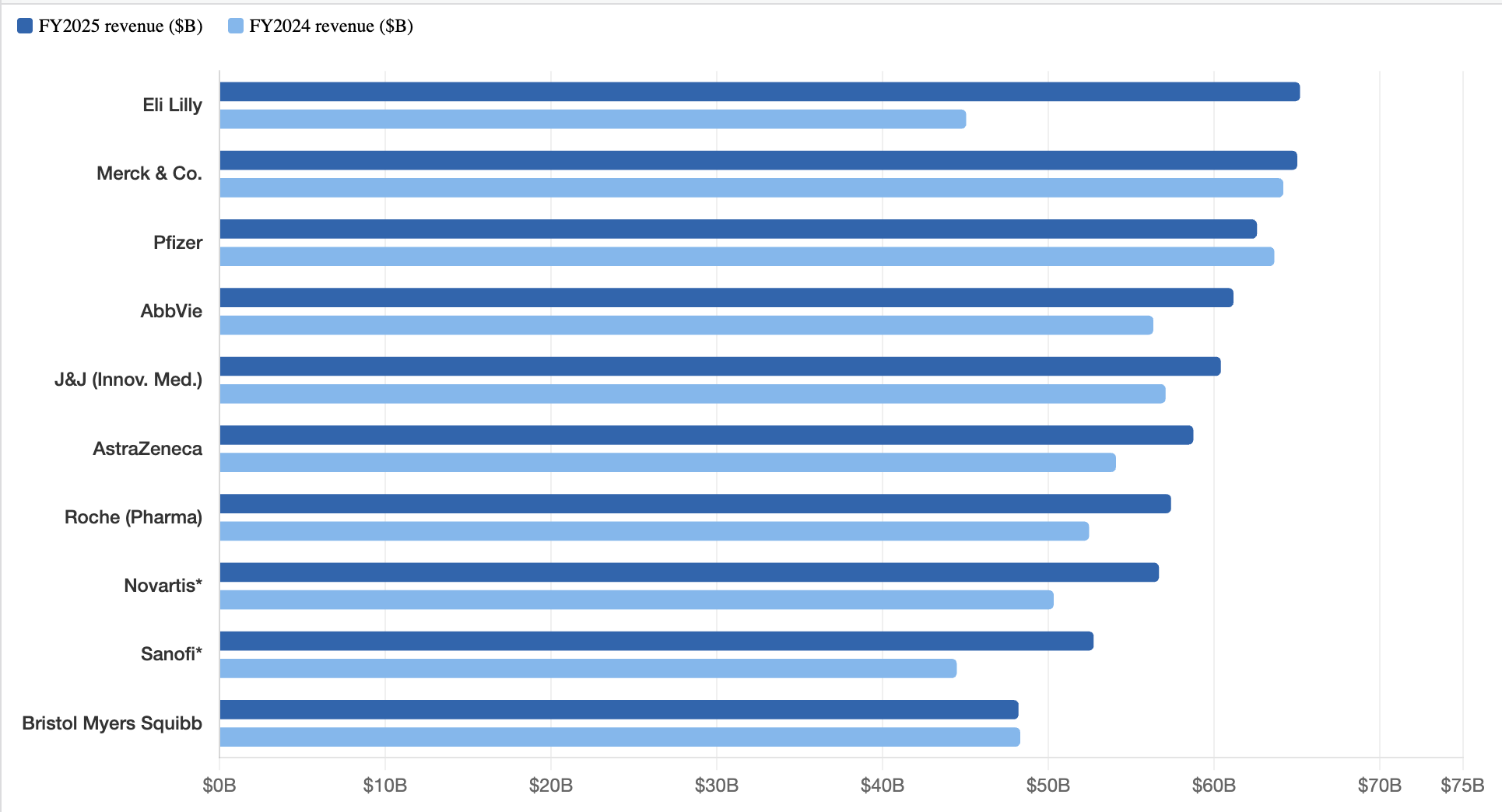
Eli Lilly and Company has officially concluded its fiscal year 2025 as the world’s leading pharmaceutical enterprise by revenue, a landmark achievement that significantly outpaced prior industry projections. The Indianapolis-based pharmaceutical giant reported a staggering $65.2 billion in total revenue for the fiscal year, narrowly surpassing its closest competitor, Merck & Co., which posted $65.0 billion. This slim margin of approximately $169 million marks a pivotal shift in the global pharmaceutical hierarchy, solidifying Lilly’s meteoric ascent. The company’s revenue surge represents an extraordinary 44.7% increase year-over-year, translating to an additional $20.1 billion in revenue generated within a single year, a growth trajectory largely attributable to the overwhelming demand for its groundbreaking diabetes and weight-loss medications, Mounjaro and Zepbound. This remarkable performance occurred a full year earlier than a November forecast had predicted Lilly would overtake Merck by late 2026, underscoring the unprecedented speed and scale of its recent expansion.
The Ascent to Dominance: A Strategic Overview
Lilly’s journey to the pinnacle of the pharmaceutical industry has been characterized by strategic foresight and significant investment in innovative therapeutic areas. Just five years prior, in 2020, the company’s total revenue stood at $24.5 billion. The current FY2025 figure of $65.2 billion represents a nearly threefold increase in its revenue base within half a decade, a growth rate that few, if any, major pharmaceutical companies have sustained. This explosive expansion is not merely an incremental gain but a fundamental reshaping of Lilly’s financial profile and market standing. The company’s 2026 guidance further illustrates its robust outlook, projecting revenues between $80 billion and $83 billion, already surpassing the base-case model of $77.2 billion set for that year, signaling sustained confidence in its pipeline and market penetration.
This rapid climb reflects a culmination of years of dedicated research and development, particularly in the metabolic disease space. While Lilly has a diversified portfolio, including strong oncology, immunology, and neuroscience franchises, the recent revenue explosion is undeniably tethered to its dual-agonist tirzepatide franchise. The company successfully navigated complex clinical development, regulatory approvals, and manufacturing scale-up to bring these highly sought-after treatments to market with remarkable efficiency.
Tirzepatide: The Engine of Unprecedented Growth
The financial backbone of Lilly’s record-breaking year is the tirzepatide franchise, comprising Mounjaro (tirzepatide) for type 2 diabetes and Zepbound (tirzepatide) for chronic weight management. Together, these two medications generated a combined $36.5 billion in revenue for FY2025. This single franchise alone now commands more annual revenue than the entire corporate revenues of established pharmaceutical giants such as Bristol Myers Squibb or Sanofi, illustrating the sheer economic power concentrated within these innovative treatments.
Mounjaro, initially approved for type 2 diabetes, saw its revenue nearly double, reaching an astounding $23.0 billion in FY2025, representing a 99% year-over-year increase. Its efficacy in blood sugar control, coupled with significant weight loss benefits observed in clinical trials and real-world use, led to its rapid adoption by physicians and patients alike. The drug’s dual mechanism of action, activating both glucagon-like peptide-1 (GLP-1) and glucose-dependent insulinotropic polypeptide (GIP) receptors, distinguishes it from earlier GLP-1 agonists and is believed to contribute to its superior efficacy profile.
Building on Mounjaro’s success, Zepbound, which received its FDA approval for chronic weight management in November 2023, rapidly accelerated its market penetration. In its first full year on the market, Zepbound nearly tripled its revenue, generating $13.5 billion and marking a staggering 175% increase. The demand for effective weight-loss solutions has proven to be immense, driven by a global obesity epidemic and a growing recognition of obesity as a chronic disease with significant health implications. Zepbound’s approval provided a dedicated, potent tool for healthcare providers to address this critical public health challenge. The synergistic effect of Mounjaro’s established presence and Zepbound’s targeted launch has created an unparalleled revenue engine for Lilly.
A New Leader in a Shifting Landscape
The displacement of Merck & Co. from the top revenue spot signifies a notable shift in the competitive dynamics of the pharmaceutical industry. While Merck reported $65.0 billion in revenue, its performance was essentially flat year-over-year, as detailed in Eli Lilly’s investor relations releases. This contrast highlights the divergent trajectories of two industry titans: one riding a wave of unprecedented product success, the other maintaining a steady, albeit less dynamic, revenue stream. Merck’s portfolio, anchored by its blockbuster oncology drug Keytruda, has delivered consistent performance, but it has not experienced the explosive, market-redefining growth seen with Lilly’s GLP-1/GIP agonists.
The broader pharmaceutical landscape remains highly competitive, with companies like Johnson & Johnson, Pfizer, Roche, and Novartis consistently ranking among the top earners. However, Lilly’s current growth rate and future projections suggest a potential for it to not only maintain but further extend its lead. This shift underscores the immense value placed on innovation, particularly in areas addressing large, unmet medical needs. The success of tirzepatide also emphasizes the increasing focus on complex metabolic pathways as targets for highly effective therapies, moving beyond traditional small molecule or antibody approaches that have dominated for decades.
The Chronology of Innovation and Market Entry
The journey of tirzepatide from discovery to market dominance is a testament to long-term pharmaceutical development cycles and strategic execution. GLP-1 receptor agonists have been a cornerstone in diabetes management for years, with drugs like liraglutide (Victoza/Saxenda) and semaglutide (Ozempic/Wegovy) from Novo Nordisk paving the way. However, Lilly’s tirzepatide, a novel dual GIP and GLP-1 receptor agonist, represented an evolution in this class.
- Early Development: Research into GIP and GLP-1 receptor agonism for metabolic diseases began years prior, with preclinical studies demonstrating the potential for enhanced glycemic control and weight reduction.
- Clinical Trials (SURPASS program for Mounjaro): A comprehensive series of global clinical trials, known as the SURPASS program, rigorously evaluated tirzepatide’s efficacy and safety in patients with type 2 diabetes. These trials consistently showed superior glycemic control and significant weight loss compared to existing treatments and placebo.
- FDA Approval for Mounjaro: In May 2022, the U.S. Food and Drug Administration (FDA) granted approval for Mounjaro (tirzepatide) for the treatment of adults with type 2 diabetes, as an adjunct to diet and exercise. This approval marked the official market entry for the drug, initiating its rapid uptake.
- Clinical Trials (SURMOUNT program for Zepbound): Recognizing the profound weight loss observed in diabetes patients, Lilly initiated the SURMOUNT clinical trial program to specifically evaluate tirzepatide for chronic weight management in individuals with obesity or overweight with weight-related comorbidities. These trials demonstrated unprecedented levels of weight reduction.
- FDA Approval for Zepbound: In November 2023, the FDA approved Zepbound (tirzepatide) for chronic weight management in adults with obesity or overweight with at least one weight-related condition. This pivotal approval unlocked a massive new market segment for Lilly, directly addressing the global obesity crisis.
- Manufacturing Scale-Up: In parallel with clinical development and regulatory approvals, Lilly has been aggressively investing in expanding its manufacturing capabilities to meet the anticipated, and now realized, extraordinary demand for tirzepatide. This includes billions of dollars in new production facilities and supply chain enhancements globally.
Analyst Reactions and Executive Commentary
The financial community has largely reacted with enthusiasm to Lilly’s performance. Analysts from major investment banks have lauded the company’s ability to execute on its pipeline and capitalize on market opportunities. Many have revised their price targets upwards, citing the robust demand for tirzepatide and the strength of Lilly’s overall portfolio. The company’s market capitalization has soared, reflecting investor confidence in its future growth prospects.
While specific quotes from FY2025 earnings calls are not available in the original context, it is reasonable to infer the tone of executive commentary based on similar milestones. Lilly’s CEO, David Ricks, would likely emphasize the company’s unwavering commitment to patients and innovation. Statements would highlight the transformative impact of Mounjaro and Zepbound on the lives of individuals managing diabetes and obesity, underscoring the unmet medical needs these drugs address. A typical executive statement might include phrases such as, "We are incredibly proud of our teams’ dedication and swift execution, which has brought life-changing medicines to millions and propelled Eli Lilly to this historic position. This milestone is a testament to our long-term investment in science and our patient-centric mission. Our strong 2026 guidance reflects our confidence in continued momentum and our robust pipeline across multiple therapeutic areas." Chief Financial Officers would likely speak to the operational efficiencies, successful manufacturing scale-up, and disciplined financial management that supported this exponential growth.
Broader Market Implications and Future Outlook
Lilly’s ascendancy has profound implications for the pharmaceutical industry, public health, and global economies.
- Addressing the Global Epidemics of Obesity and Diabetes: The success of Mounjaro and Zepbound underscores the immense societal burden and market potential associated with type 2 diabetes and obesity. These conditions affect hundreds of millions globally, driving significant healthcare costs and reducing quality of life. Effective pharmacological interventions like tirzepatide are transforming treatment paradigms, moving beyond symptom management to disease modification, particularly in weight loss.
- Intensified "GLP-1 Wars": Lilly’s success will undoubtedly intensify competition in the GLP-1/GIP agonist space. Novo Nordisk, with its own highly successful Ozempic and Wegovy, remains a formidable competitor. Other pharmaceutical companies are rapidly advancing their own GLP-1-based therapies, including oral formulations and next-generation molecules that target multiple receptors (e.g., amylin, glucagon). This competitive landscape will drive further innovation, potentially leading to even more effective or convenient treatments, but also posing long-term threats to Lilly’s market share.
- Supply Chain Challenges and Access: The unprecedented demand for these drugs has led to global supply constraints. Lilly, like Novo Nordisk, has faced challenges in scaling manufacturing fast enough to meet patient needs. This necessitates massive capital investments in new facilities and complex supply chain management. Ensuring equitable access and affordability for these high-cost therapies will remain a critical public health and policy challenge, sparking discussions around pricing, insurance coverage, and global distribution strategies.
- R&D Pipeline Investment: The substantial revenue generated by tirzepatide provides Lilly with significant capital to reinvest in its research and development pipeline. This could accelerate the development of new treatments across its core therapeutic areas—oncology, immunology, and neuroscience—and potentially lead to acquisitions of promising biotech firms or innovative drug candidates. The company’s success could also inspire greater industry-wide investment in metabolic research.
- Investor Confidence and Valuation: Lilly’s strong performance reinforces investor confidence in pharmaceutical innovation. The company’s valuation has surged, reflecting expectations of sustained growth. However, investors will closely monitor competition, patent cliffs, and the company’s ability to diversify its revenue streams beyond the tirzepatide franchise in the long term.
Methodological Transparency
It is important to reiterate the methodology behind this ranking. The designation of Lilly as the "top-earning pharma company" is based on a practical, pharma-focused ranking derived from company fiscal-year reporting, with segment carve-outs where needed to focus purely on pharmaceutical revenues. This approach, while robust for comparing dedicated pharmaceutical entities, acknowledges that it is not always a perfectly clean, apples-to-apples comparison across the entire spectrum of global corporations that may have diversified healthcare interests (e.g., medical devices, consumer health products, diagnostics) under a larger corporate umbrella. However, within the realm of companies primarily focused on drug discovery and commercialization, Lilly’s FY2025 revenue clearly positions it at the forefront.
In conclusion, Eli Lilly’s emergence as the world’s top pharmaceutical company by revenue in FY2025 is a monumental achievement, driven by the extraordinary success of its tirzepatide franchise. This milestone not only redefines Lilly’s position in the global healthcare landscape but also signals a profound shift in the industry’s focus and priorities, with metabolic diseases and innovative dual-agonist therapies at the forefront of medical advancement and economic growth. The path forward for Lilly will involve navigating intense competition, managing immense demand, and continuing to innovate, but for now, the company stands at an unprecedented peak, poised to shape the future of medicine.