

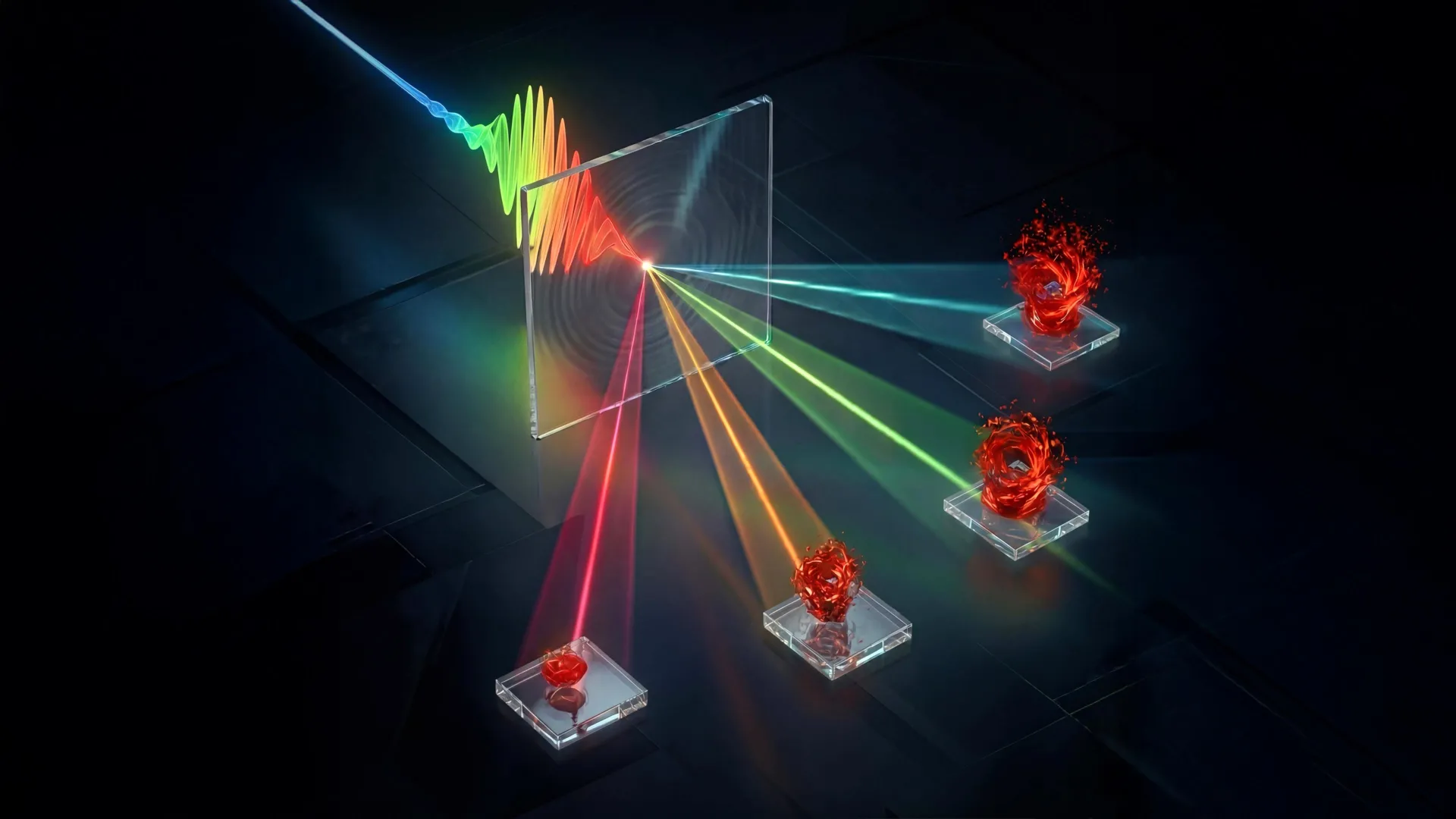
The landscape of modern physics and materials science has long been constrained by the fundamental speed of observation. While human perception operates on the scale of milliseconds, the foundational processes that govern the universe—chemical bonds breaking, electrons shifting within semiconductors, and the formation of plasma—occur at the scale of femtoseconds, or one quadrillionth of a second. To bridge this gap, a research team at East China Normal University has developed a pioneering imaging modality known as compressed spectral-temporal coherent modulation femtosecond imaging (CST-CMFI). This breakthrough, recently detailed in the journal Optica, allows scientists to record the complete evolution of an object’s brightness and internal phase structure in a single, non-repeatable measurement, marking a significant milestone in the field of ultrafast optics.
The development of CST-CMFI addresses a critical limitation in high-speed photography. Traditional ultrafast imaging techniques have primarily focused on capturing light intensity, or the brightness of an event. However, light also possesses a "phase" component, which describes how the wave-like nature of light is delayed or shifted as it passes through a medium. This phase information is often more sensitive to subtle changes in density, refractive index, and atomic structure than intensity alone. By capturing both simultaneously in a single shot, the team led by Yunhua Yao has provided a more holistic view of the microscopic world, enabling the study of irreversible phenomena that were previously impossible to document with such precision.
The Evolution of Ultrafast Observation
To understand the magnitude of the CST-CMFI breakthrough, one must consider the historical context of high-speed imaging. The quest to capture motion began in the 19th century with Eadweard Muybridge’s famous photographs of a galloping horse, which utilized a series of triggered cameras to resolve motion faster than the human eye. By the mid-20th century, electronic strobes and rotating mirrors pushed these limits into the microsecond and nanosecond ranges. However, the dawn of femtosecond science—pioneered by Ahmed Zewail, who won the 1999 Nobel Prize in Chemistry for studying chemical reactions in real-time—demanded a new paradigm.
Until recently, studying femtosecond events required "pump-probe" experiments. In this setup, a laser pulse (the pump) initiates a process, and a second pulse (the probe) takes a "snapshot" at a specific delay. By repeating this thousands of times with different delays, scientists could piece together a "movie." The inherent flaw in this method is that it requires the event to be perfectly repeatable. In many of the most critical areas of modern science—such as laser-induced damage, chaotic plasma dynamics, or complex chemical explosions—the event happens differently every time. This created a desperate need for "single-shot" imaging, where an entire sequence of events is captured in one exposure.
Technical Architecture of CST-CMFI
The CST-CMFI system is a sophisticated fusion of three distinct optical concepts: time-spectrum mapping, compressive spectral imaging, and coherent modulation imaging. The process begins with a "chirped" laser pulse. Unlike a standard laser pulse where all wavelengths arrive simultaneously, a chirped pulse is stretched out so that different colors (wavelengths) arrive at different times. This effectively turns the pulse into a "temporal ruler" where color corresponds to time.
As this chirped pulse interacts with a rapidly changing object, the scattered light becomes encoded with spatial, spectral, and phase data. This information is then processed through a dispersion-encoded coherent modulation system. The complexity of the resulting data is handled by a physics-informed neural network (PINN). Unlike traditional AI, which relies solely on pattern recognition, a PINN incorporates the laws of physics into its algorithms to reconstruct the images. It separates the various wavelengths and reconstructs a sequence of frames, each showing both the intensity and the phase of the object at a specific femtosecond interval.
"In the fields of physics, chemistry, biology and materials science, many important phenomena happen incredibly fast," said research team leader Yunhua Yao. "Our new technique can capture the complete evolution of both the brightness and internal structure of an object in a single measurement. This is a big step forward for understanding the fundamental nature of matter, designing new materials and even uncovering the mysteries of biological processes."
Experimental Validation: Plasma and Semiconductors
The research team at the Extreme Optical Imaging Laboratory put CST-CMFI to the test by observing two notoriously difficult phenomena: the formation of laser-induced plasma in water and the dynamics of charge carriers in Zinc Selenide (ZnSe).
In the first experiment, a high-power femtosecond laser was fired into water, creating a plasma channel. Plasma formation is a violent, non-linear process that occurs in less than a trillionth of a second. Using CST-CMFI, the researchers were able to observe the creation of a dense free-electron plasma. Crucially, they recorded the phase changes, which revealed how the plasma altered the refractive index of the water. This data is vital for medical applications, such as laser surgery and lithotripsy (the breaking of kidney stones), where understanding the exact energy deposition and shockwave formation is essential for patient safety and procedure efficacy.
The second experiment focused on ZnSe, a semiconductor used in advanced optics and electronics. When light hits a semiconductor, it excites "charge carriers" (electrons and holes). The movement and decay of these carriers determine the speed and efficiency of electronic devices. The CST-CMFI system allowed the team to track these carriers with unprecedented sensitivity.
"Using CST-CMFI, we were able to see phase variations associated with the carrier dynamics, even when there were no significant changes in intensity," Yao noted. "This highlights a key advantage of our method: Phase measurements can be much more sensitive than intensity measurements in detecting subtle ultrafast processes."
Implications for Industry and Energy
The implications of this technology extend far beyond the laboratory. In the realm of clean energy, CST-CMFI could revolutionize research into inertial confinement fusion. Fusion energy requires the precise compression of fuel pellets using high-power lasers. Capturing the ultrafast instabilities that occur during this compression is critical for achieving a "burning plasma" state and, eventually, commercial fusion power.
In advanced manufacturing, the technique offers a window into the world of laser-matter interaction. As industries move toward femtosecond laser machining for microchips and aerospace components, the ability to see how materials melt, evaporate, or transform in real-time allows for the optimization of manufacturing parameters to a degree never before possible. This could lead to the production of more efficient electronics, as engineers gain a better understanding of how materials behave under extreme thermal and electrical stress.
Furthermore, the integration of CST-CMFI into scientific instrumentation could accelerate the development of next-generation solar cells. By observing exactly how photons are converted into electrical charges and where energy is lost in the first few femtoseconds, researchers can design material architectures that minimize "recombination" losses, potentially pushing solar panel efficiency toward theoretical limits.
Chronology of Development and Future Horizons
The development of CST-CMFI is the result of years of iterative progress at East China Normal University. The timeline of this research reflects a broader trend in the scientific community toward "computational imaging," where hardware and software are designed in tandem.
- 2018-2020: The laboratory focused on perfecting single-shot intensity imaging, utilizing compressed ultrafast photography (CUP) to reach frame rates of billions of frames per second.
- 2021-2022: The team identified the "phase gap," realizing that intensity-only data missed critical refractive index changes in transparent and semi-transparent media.
- 2023: The integration of coherent modulation and chirped pulse technology began, alongside the training of physics-informed neural networks to handle the massive data throughput.
- 2024: Successful demonstration of CST-CMFI on plasma and semiconductor samples, followed by publication in Optica.
Looking ahead, the team is already working on the next iteration of the technology. While CST-CMFI is highly effective, it currently links spectral information directly to temporal information. This means that if an object undergoes a change that is highly sensitive to color (spectrum), the temporal data might become blurred. To solve this, Yao and his colleagues plan to combine CST-CMFI with compressive ultrafast photography. This hybrid approach would decouple time and spectrum, allowing each to be captured independently.
"Beyond helping scientists study materials that change instantly in response to laser light, chemical reactions that rearrange atoms at lightning speed and the dynamic behavior of biomolecules over incredibly short timescales, CST-CMFI could help improve high-power laser technologies used for clean energy research, advanced manufacturing and scientific instrumentation," said Yao.
Analysis of Scientific Impact
The introduction of CST-CMFI represents a shift from "observation" to "characterization." In the past, scientists were often content to see that an event happened. Now, they can quantify the internal state of the matter as the event unfolds. The ability to measure phase shifts with femtosecond resolution provides a direct probe into the electron density and molecular orientation of a substance.
In the biological sector, this could lead to a deeper understanding of how radiation interacts with living tissue at the molecular level, potentially refining cancer treatments that use ultra-short laser pulses to target tumors with sub-millimeter precision. In the world of quantum computing, the ability to observe the decoherence of quantum states—which occurs on incredibly fast timescales—could provide the insights needed to build more stable quantum bits (qubits).
The work at East China Normal University underscores the growing importance of multidisciplinary research. By combining optical physics, materials science, and artificial intelligence, the researchers have created a tool that transcends the limitations of its individual components. As CST-CMFI continues to evolve, it is poised to become a standard instrument in laboratories worldwide, providing a high-definition "movie camera" for the smallest and fastest events in the universe. The "mysteries of biological processes" and the "fundamental nature of matter" that Yao mentioned are no longer hidden behind the veil of time; they are now within the reach of a single, powerful shot.











Leave a Reply