

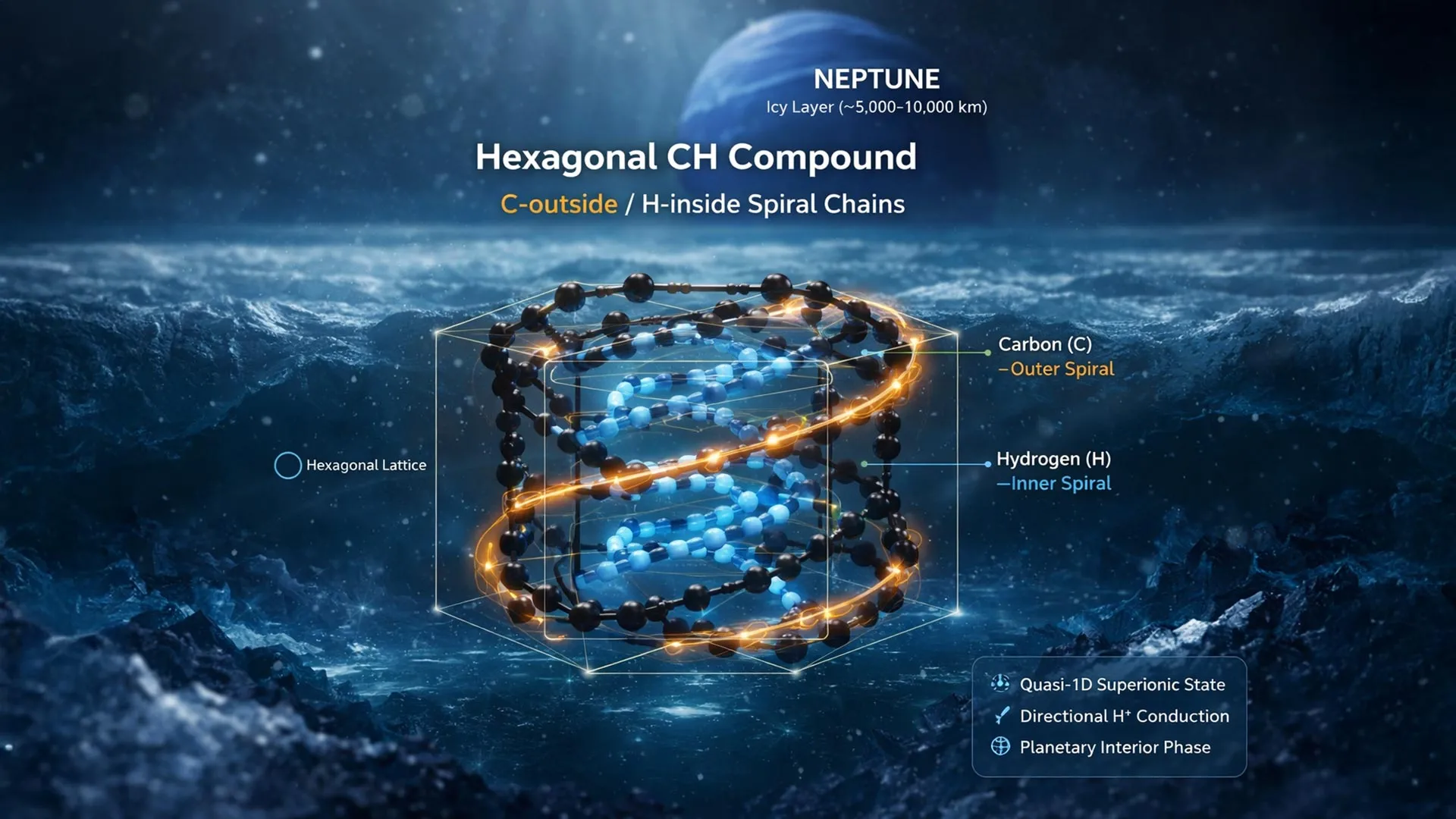
The deep interiors of ice giant planets such as Uranus and Neptune may contain a previously unknown form of matter, according to a groundbreaking study conducted by Carnegie scientists Cong Liu and Ronald Cohen. Their research, published in the prestigious journal Nature Communications, suggests that carbon hydride can transform into an unusual quasi-one-dimensional superionic state under the staggering pressures and temperatures found far beneath the surfaces of these distant worlds. This discovery challenges existing models of planetary composition and provides a new lens through which to view the 6,000-plus exoplanets identified by astronomers to date. By simulating conditions that are nearly impossible to replicate in a physical laboratory, the team has uncovered a state where hydrogen atoms move in spiral-like paths through a solid carbon framework, a phenomenon that could redefine our understanding of planetary magnetism and heat transport.
The Evolution of Planetary Science: From Voyager to Virtual Simulations
The quest to understand the ice giants of our Solar System—Uranus and Neptune—has long been hampered by their immense distance from Earth. Much of what is known about these planets stems from the Voyager 2 flybys in the 1980s, which provided the first glimpses of their complex atmospheres and unusual magnetic fields. For decades, the planetary science community has relied on these snapshots, combined with Earth-based telescope observations, to theorize about what lies beneath the thick clouds of hydrogen and helium.
However, the field is currently undergoing a paradigm shift. The convergence of astronomy, planetary science, and condensed matter physics has allowed researchers to peer into the hearts of these planets using advanced computational tools. The work of Liu and Cohen represents a significant milestone in this chronology. By moving beyond simple observational data, the researchers utilized high-performance computing and machine-learning-enhanced quantum simulations to explore the behavior of carbon and hydrogen—the fundamental building blocks of the "ices" that give these planets their name. This shift toward "computational alchemy" allows scientists to predict the existence of materials that may never be seen by human eyes but are essential to the functioning of the cosmos.
Defining the "Hot Ice" Layers of the Outer Solar System
Uranus and Neptune are often categorized as ice giants to distinguish them from gas giants like Jupiter and Saturn. While Jupiter and Saturn are composed primarily of hydrogen and helium, Uranus and Neptune are thought to possess a vast mantle of "hot ices" situated between their outer gas shells and their rocky, metallic cores. Despite the nomenclature, these "ices" are not cold; they are high-pressure fluids and solids composed of water, methane, and ammonia.
Under the crushing gravity of a giant planet, these substances do not behave like the ice found in a household freezer. Instead, they enter exotic phases. Previous research has already identified "superionic water ice," a state where oxygen atoms form a solid lattice while hydrogen ions flow through it like a liquid. The discovery by Liu and Cohen adds a new layer of complexity to this model by focusing on carbon hydride (CH). As a primary component of the methane found in these planets, the behavior of carbon-hydrogen bonds under pressure is critical to understanding the overall density and thermal profile of the planetary interior.
The Mechanics of the Quasi-One-Dimensional Superionic State
The centerpiece of the Carnegie study is the identification of a "quasi-one-dimensional" superionic state. To understand this, one must first grasp the concept of superionicity. In a standard solid, atoms are locked into a rigid crystal lattice. In a liquid, atoms move freely and randomly. Superionic materials exist in a strange middle ground: one element (in this case, carbon) maintains a stable, solid structure, while another element (hydrogen) becomes mobile.
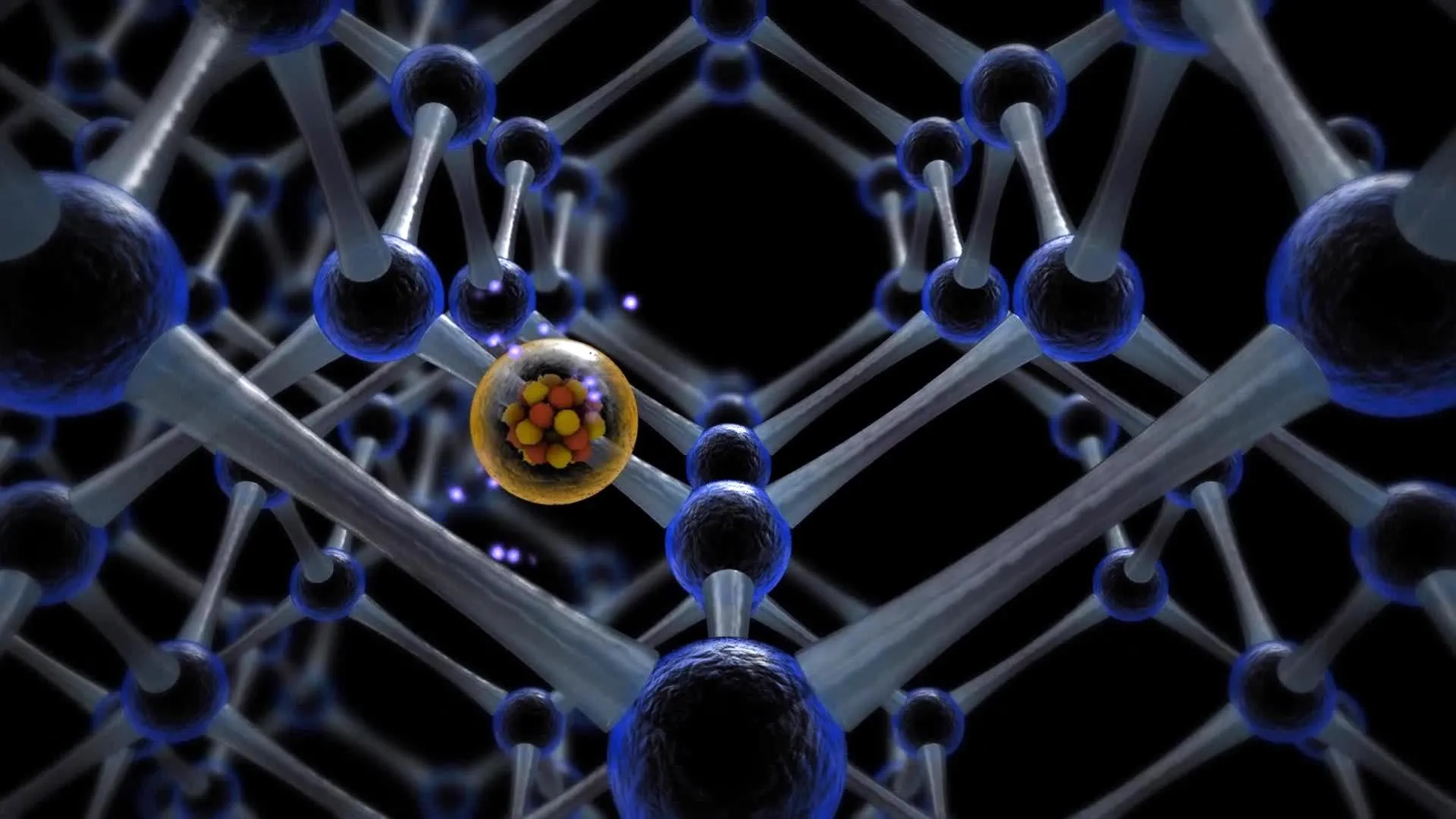
In the newly discovered carbon hydride phase, the carbon atoms organize themselves into a hexagonal framework, providing the structural "skeleton" of the material. What makes this phase unique is the specific path taken by the hydrogen atoms. Rather than moving randomly in three dimensions, the hydrogen atoms are restricted to spiral-like, helical paths embedded within the carbon structure.
"This newly predicted carbon-hydrogen phase is particularly striking because the atomic motion is not fully three-dimensional," Ronald Cohen explained. "Instead, hydrogen moves preferentially along well-defined helical pathways." This directional movement is what gives the state its "quasi-one-dimensional" designation, suggesting that the material possesses highly anisotropic properties—meaning its physical characteristics, such as conductivity, differ depending on the direction in which they are measured.
Supporting Data: Simulating the Extremes of the Planetary Deep
To reach these conclusions, Liu and Cohen had to simulate environments that dwarf the pressures found at the bottom of Earth’s deepest oceans. Their quantum simulations covered a range of conditions specifically tailored to the predicted interiors of Uranus and Neptune:
- Pressure Range: 500 to 3,000 gigapascals (GPa). For context, 1 GPa is roughly 10,000 times Earth’s atmospheric pressure at sea level. The upper limit of 3,000 GPa is approximately 30 million times the pressure humans experience on Earth’s surface.
- Temperature Range: 4,000 to 6,000 Kelvin (approximately 6,740 to 10,340 degrees Fahrenheit). These temperatures are comparable to the surface of the Sun, illustrating that the "ices" in ice giants are incredibly hot.
The researchers employed Density Functional Theory (DFT), a quantum mechanical modeling method used to investigate the electronic structure of many-body systems. By integrating machine learning algorithms, the team was able to accelerate these complex calculations, allowing them to observe the long-term stability of the carbon-hydrogen structures over timescales that were previously computationally prohibitive. The data revealed that at the 2,000 GPa mark, the transition to the helical superionic state becomes most pronounced, suggesting this material may be a dominant feature of the mid-to-lower mantle of the ice giants.
Solving the Magnetic Mystery of Uranus and Neptune
One of the most enduring puzzles in planetary science is the nature of the magnetic fields of Uranus and Neptune. Unlike Earth’s magnetic field, which is roughly aligned with its rotational axis and centered at the core, the magnetic fields of the ice giants are "wonky." They are highly tilted—up to 59 degrees in the case of Uranus—and significantly offset from the planet’s geometric center.
The discovery of a quasi-one-dimensional superionic state provides a potential explanation for these anomalies. Magnetic fields are generated by the movement of electrically charged particles (the dynamo effect). In Earth, this happens in the liquid iron outer core. In Uranus and Neptune, it was long thought that the dynamo resided in the "hot ice" layers.
Because the hydrogen ions in the newly discovered carbon hydride phase move along specific, directional paths, they would create highly directional electrical conductivity. "The directional movement of hydrogen atoms could have major effects on how energy flows inside planets," the researchers noted. If the electrical current is forced to flow along helical paths rather than diffusing evenly, it could result in the complex, multipolar, and asymmetrical magnetic fields observed by Voyager 2. This findings suggests that the very geometry of the matter at the atomic level is responsible for the planetary-scale behavior of the magnetic field.
Official Responses and Scientific Context
While the findings are currently based on theoretical simulations, they have sparked significant interest across the scientific community. Experts in high-pressure physics have noted that these results provide a roadmap for future laboratory experiments using diamond anvil cells—devices that can squeeze tiny samples between two diamonds to reach planetary pressures.
"Carbon and hydrogen are among the most abundant elements in planetary materials, yet their combined behavior at giant-planet conditions remains far from fully understood," Cong Liu stated in the study’s conclusion. The consensus among peer reviewers and related parties is that this research highlights the necessity of a dedicated mission to the ice giants.
NASA’s recent Planetary Science Decadal Survey has prioritized a "Uranus Orbiter and Probe" (UOP) mission as a top priority for the next decade. Scientists involved in the planning of that mission have suggested that understanding the internal phases of carbon hydride will be essential for interpreting the gravity and magnetic data the probe will eventually collect. The Carnegie study provides the theoretical framework that these future missions will need to validate their findings.
Broader Impact: From Exoplanets to Materials Science
The implications of this research extend far beyond the borders of our own Solar System. Of the thousands of exoplanets discovered by missions like Kepler and TESS, a large percentage fall into the "Sub-Neptune" or "Mini-Neptune" category. These are worlds with sizes and masses between Earth and Neptune. Understanding the internal states of carbon and hydrogen is vital for determining whether these exoplanets have protective magnetic fields, which are often considered a prerequisite for habitability.
Furthermore, the study contributes to the fundamental understanding of materials science. The discovery of a material that behaves as a solid in three dimensions but a liquid (ionically) in one dimension is a rarity. This "directional behavior" could inform the development of new synthetic materials on Earth, particularly in the fields of battery technology or superconductors, where controlling the flow of ions through a solid framework is a primary engineering challenge.
Conclusion: A New Frontier in Planetary Interior Research
The work of Cong Liu and Ronald Cohen serves as a reminder that the most common elements in the universe—carbon and hydrogen—still hold secrets when subjected to the extremes of gravity and heat. By identifying the quasi-one-dimensional superionic state, the Carnegie team has provided a missing piece of the puzzle for the internal structure of ice giants.
As computational power continues to grow and machine learning becomes more integrated into physical chemistry, the gap between what we can observe and what we can simulate will continue to shrink. For now, the "spiral" paths of hydrogen beneath the clouds of Uranus and Neptune stand as a testament to the unexpected complexity of the universe, suggesting that the deep interiors of distant worlds are far more dynamic and structured than previously imagined. The next step for the scientific community will be to seek physical confirmation of these "helical" states, potentially through the next generation of high-pressure laser experiments or the long-awaited return of a spacecraft to the outer reaches of our planetary neighborhood.
















Leave a Reply