In the specialized field of condensed matter physics, the quest to understand and manipulate the fundamental building blocks of matter has led researchers to the precipice of a new era in quantum technology. At the University of California, Santa Barbara (UCSB), a team led by materials scientist Stephen Wilson has recently published a groundbreaking study in the journal Nature Materials that explores the intricate physics of "frustrated" systems. By investigating how unconventional magnetic states emerge from the internal tension of atomic structures, the researchers have provided a new framework for understanding the complex behaviors of quantum materials. This work, while rooted in fundamental basic science, offers a potential roadmap for the development of future devices that rely on the subtle and often counterintuitive laws of quantum mechanics.
The Architecture of Atomic Tension: Understanding Frustration
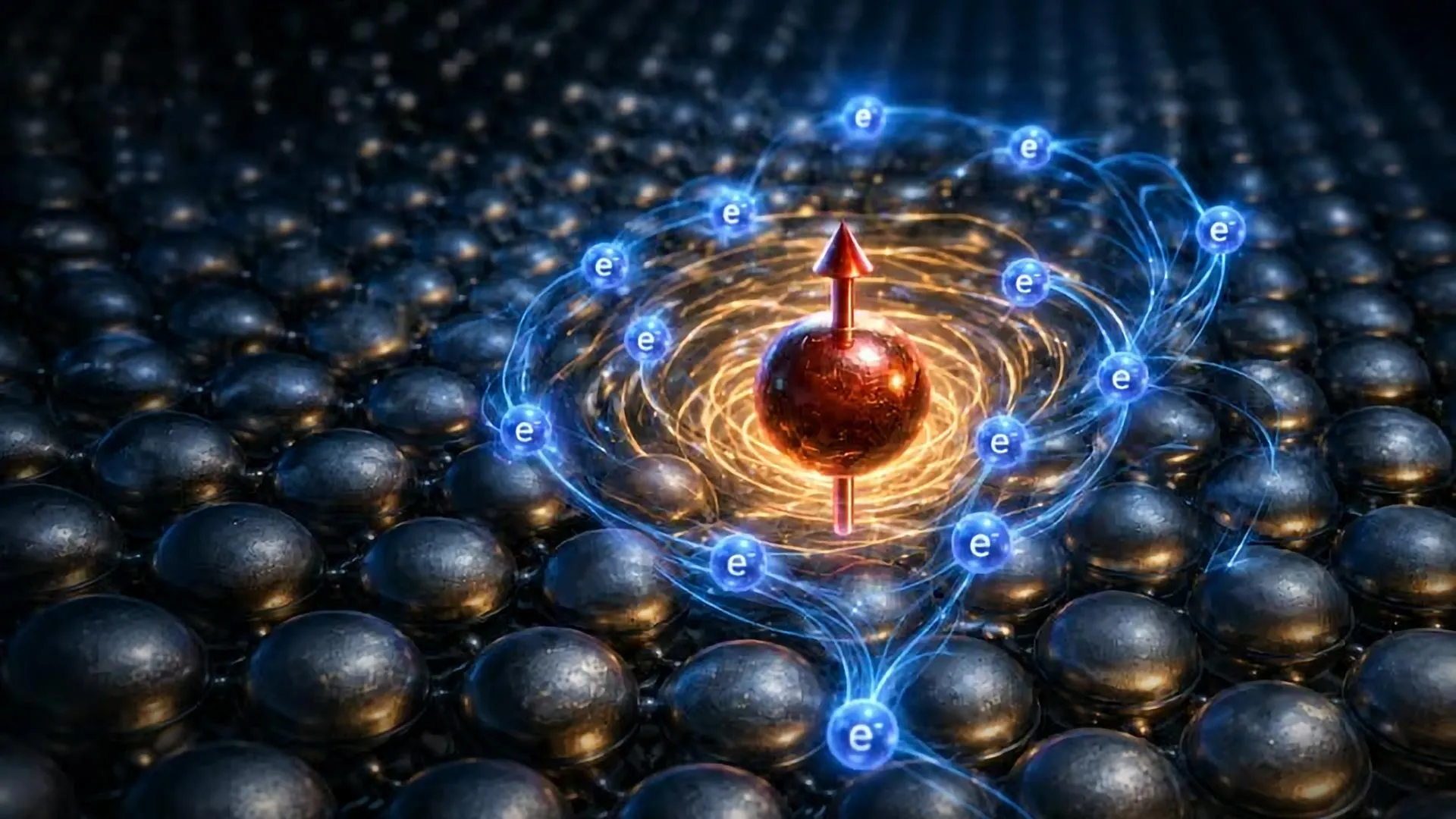
To comprehend the significance of Wilson’s research, one must first understand the concept of "frustration" in a physical context. In daily life, frustration describes a state of being hindered; in materials science, it refers to a geometric or structural constraint that prevents a system from reaching its simplest, lowest-energy state. At the atomic level, materials are often organized into crystal lattices—repeating patterns of atoms. Each of these atoms possesses a magnetic dipole moment, which can be visualized as a microscopic bar magnet with a north and south pole.
In many materials, these atomic magnets interact with their neighbors. In a phenomenon known as antiferromagnetism, these moments prefer to point in opposite directions (antiparallel) to one another to minimize energy. In a simple square lattice, this is easily achieved: if one atom points "up," its four immediate neighbors can all point "down," creating a stable, checkerboard-like equilibrium.
However, the geometry of a triangular lattice introduces a profound complication. If three atoms are arranged in a triangle and each wants to point in the opposite direction of its neighbor, the third atom is left in an impossible position. If atom A is up and atom B is down, atom C cannot be opposite to both simultaneously. This inherent conflict is what physicists call geometric frustration. Because the system cannot satisfy all its interactions at once, the magnetic moments remain in a state of flux, fluctuating even at temperatures approaching absolute zero.
The Discovery of Interleaved Bond Frustration
The UCSB study, titled "Interleaved bond frustration in a triangular lattice antiferromagnet," elevates this concept by introducing a second, simultaneous form of frustration: bond frustration. While magnetic frustration involves the orientation of spins, bond frustration involves the sharing of electrons between ions.
In certain materials, nearby ions attempt to share an electron to form a "dimer," a stable pair. In specific geometries, such as the triangular or honeycomb lattices studied by Wilson’s team, the system faces a dilemma similar to the magnetic one. The atoms cannot decide which neighbor to "pair" with because the lattice structure offers too many equivalent options. This leads to a network of bonds that is inherently unstable and highly sensitive to external influences.
The research identifies an extremely rare class of materials where these two distinct types of frustration—magnetic and bond—are "interleaved" or woven together within the same crystal structure. This dual-frustration state creates a highly complex landscape where the magnetism and the physical bonds of the material are inextricably linked.
Chronology and Evolution of Frustrated Magnetism Research
The study of frustrated magnetism is not new, but it has evolved significantly over the last several decades. The conceptual foundations were laid in the mid-20th century, but it wasn’t until the early 2000s that experimentalists began to identify materials that could realistically host these states.
- 1930s-1950s: Early theoretical work on "ice frustration" in water molecules provided the first hints that geometric constraints could prevent systems from reaching a singular ground state.
- 1973: Physicist Philip Anderson proposed the existence of a "quantum spin liquid," a state where magnetic moments never freeze into a solid pattern, even at absolute zero, due to intense frustration.
- 2010s: The focus shifted toward lanthanide-based materials. Lanthanides, the elements located in the f-block of the periodic table, possess large magnetic moments and strong spin-orbit coupling, making them ideal candidates for creating frustrated systems.
- 2017-Present: Researchers began exploring triangular lattice networks of lanthanides to induce "intrinsically quantum disordered states."
The current work by the Wilson Group represents the latest milestone in this timeline. By moving beyond simple magnetic frustration and incorporating bond frustration, the team has moved from merely observing disordered states to proposing ways to "functionalize" or control them.
Technical Analysis: The Role of Lanthanides and Strain
The materials utilized in Wilson’s laboratory involve complex triangular networks of lanthanide elements. These elements are chosen specifically for their 4f electrons, which provide the magnetic "heaviness" required to sustain quantum fluctuations. The researchers sought to embed these lanthanide moments into a crystal lattice that also exhibits bond frustration, creating a "system of systems."
One of the most significant findings of the study is the role of mechanical strain. Because the bond network is frustrated and sensitive, applying a small amount of physical pressure or "strain" to the crystal can break the symmetry of the lattice. This, in turn, can relieve some of the frustration, forcing the bonds—and consequently the magnetic moments—into a specific order.
"Gaining control over those states via applying a strain in the frustrated bond network would be exciting," Wilson noted. This sensitivity suggests that these materials could act as highly responsive quantum sensors or as a medium for "tunable" quantum states.
Supporting Data and Collaborative Context
While the UCSB team led the experimental and conceptual push, the study of such materials often involves high-level characterization techniques. Typically, this includes:
- Neutron Scattering: Used to map the magnetic fluctuations within the lattice.
- X-ray Diffraction: Used to observe the physical displacement of atoms when bond frustration is present.
- Specific Heat Measurements: Used to determine the energy states of the material at cryogenic temperatures.
Data from the study indicates that the coupling between the two frustrated systems allows for a "ferroic response." This means that a stimulus affecting the structure (like strain) can induce a magnetic change, and a stimulus affecting the magnetism (like a magnetic field) can induce a structural change. This cross-functionality is a hallmark of "multiferroic" behavior, which is highly sought after for high-density data storage and low-power electronics.
Official Perspectives and Industry Implications
Stephen Wilson emphasizes that his work is "fundamental science aimed at addressing a basic question." However, the broader scientific community views such research as the bedrock for the next generation of computing.
Researchers in the field of Quantum Information Science (QIS) are particularly interested in "long-range entanglement." In a frustrated system that remains quantum disordered, the spins of atoms far apart can become entangled, meaning the state of one is instantly connected to the state of another regardless of distance. This is a requirement for building stable qubits—the units of information in a quantum computer.
While there are no immediate commercial products resulting from this study, the ability to "engineer" entanglement by coupling two frustrated lattices is a major conceptual leap. If scientists can use bond frustration as a "handle" to manipulate magnetic entanglement, it could solve one of the greatest challenges in quantum computing: the fragility of quantum states.
Broader Impact: Towards a New Class of Materials
The implications of "Interleaved bond frustration" extend beyond magnetism. This research suggests that materials can be designed with "hidden" functionalities. By layering different types of frustration, scientists can create materials that respond to environmental cues in ways that traditional silicon or copper cannot.
For example, the study explores the idea of "nucleating" different types of order. In the same way that a seed crystal causes a saturated solution to crystallize, the proximity of two frustrated lattices can cause new, exotic phases of matter to emerge at their interface. This "big-picture idea," as Wilson describes it, opens the door to creating materials with "designer" properties—superconductivity at higher temperatures, dissipationless electricity, or revolutionary new forms of magnetic memory.
As the global race for quantum supremacy intensifies, the work coming out of the UC Santa Barbara materials department highlights a critical shift. The focus is no longer just on finding materials that exist in nature, but on engineering complex, frustrated architectures that push the boundaries of what physics allows. The discovery of interleaved frustration marks a significant step toward a future where we do not just observe the strange laws of the quantum world, but actively harness them.