

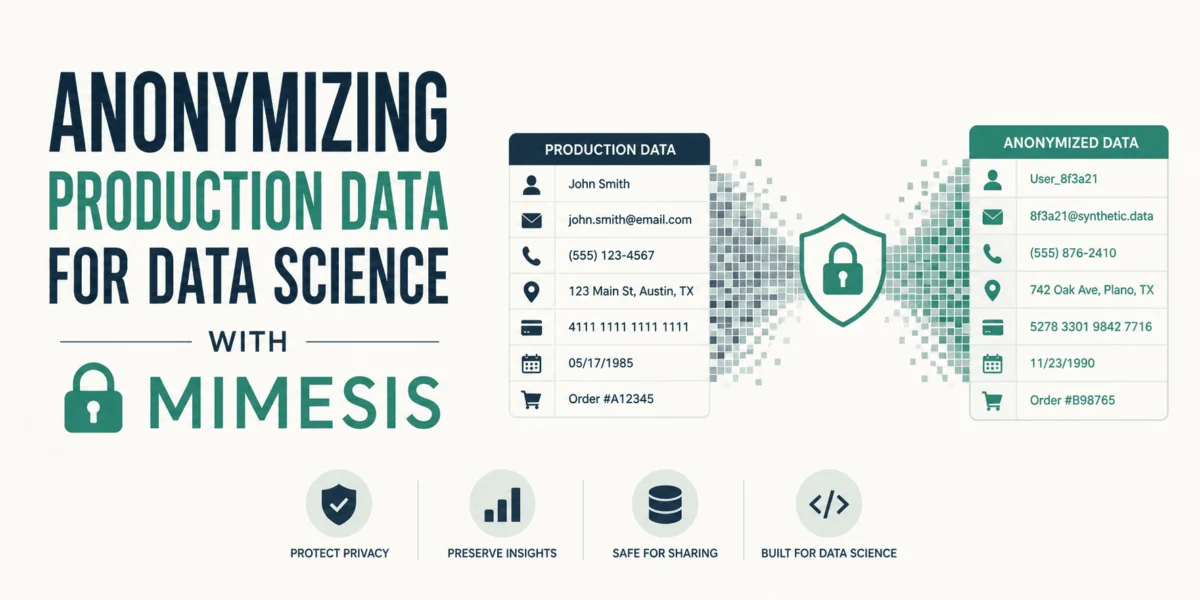
In an increasingly data-driven world, the ability to harness the power of vast datasets is paramount for innovation, yet it is frequently hampered by stringent privacy regulations and the inherent sensitivity of personal identifiable information (PII). Organizations across sectors grapple with the dilemma of extracting value from production data while upholding privacy commitments and avoiding severe penalties associated with data breaches. This challenge has catalyzed the development and adoption of robust anonymization techniques, with open-source solutions like the Python library Mimesis emerging as critical tools for data scientists and developers.
The Imperative of Data Privacy in the Digital Age
The landscape of data privacy has undergone a profound transformation over the past decade. Regulations such as the General Data Protection Regulation (GDPR) in Europe, the California Consumer Privacy Act (CCPA) in the United States, and numerous other national and international frameworks, have fundamentally reshaped how organizations collect, process, and store personal data. These regulations impose significant obligations, including requirements for explicit consent, data minimization, and robust security measures. Non-compliance can lead to staggering fines, reputational damage, and a significant erosion of customer trust. For instance, the average cost of a data breach reached a record $4.45 million in 2023, according to IBM’s annual Cost of a Data Breach Report, underscoring the severe financial implications beyond regulatory penalties.
Within this environment, the tension between data utility and data privacy is particularly acute for data science initiatives. Machine learning models thrive on large, diverse datasets, often requiring real-world production data to achieve optimal performance and generalization. However, direct use of sensitive production data in development, testing, or even certain analytical environments is fraught with risk. Developers, researchers, and analysts often need to work with data that mirrors the characteristics of live systems but without exposing actual individuals. This necessity drives the demand for effective data anonymization and synthetic data generation.
Challenges in Data Science and the Rise of Synthetic Data
Traditional methods of handling sensitive data in development or testing environments often involve manual data scrubbing, simple redaction, or using heavily sampled, non-representative subsets. These approaches frequently fall short. Manual scrubbing is labor-intensive and prone to human error, potentially leaving residual sensitive information. Simple redaction, while effective for basic privacy, can destroy the statistical properties and relationships within the data, rendering it useless for complex analytical tasks or machine learning model training. Using small, non-representative samples can lead to models that perform poorly in production because they were trained on data that doesn’t accurately reflect the real distribution.
This gap has led to a significant surge in interest and investment in synthetic data generation. Synthetic data is artificially created data that maintains the statistical properties, patterns, and relationships of the original dataset without containing any actual PII. It serves as a privacy-preserving proxy, enabling data scientists to develop, test, and validate models in environments where real data cannot be used. The market for synthetic data is projected to grow substantially, reflecting its increasing importance as a foundational technology for privacy-enhancing analytics and AI development. Gartner predicts that by 2030, synthetic data will entirely overshadow real data in AI models, further highlighting its transformative potential.
Mimesis: An Open-Source Solution for Realistic Data Generation
Enter Mimesis, an open-source Python library specifically designed to generate realistic "fake" data. Mimesis distinguishes itself through its high-performance capabilities, local execution, and ability to produce data that closely mimics real-world patterns across a wide array of categories. Unlike simple random string generators, Mimesis understands the structure and common formats of various data types—from names and email addresses to geographic locations and financial details—making its output genuinely useful for development and testing.
The library offers a free and robust solution for creating data pipelines, enabling developers to quickly populate databases, mock APIs, or, critically, anonymize sensitive production datasets. Its design philosophy centers on providing flexibility and realism, allowing users to specify locales (e.g., English, French, Japanese) to generate culturally appropriate data, and to use random seeds for reproducible data generation. This combination of features positions Mimesis as a valuable asset in the toolkit of any data professional navigating the complexities of data privacy and utility.
A Practical Guide to Anonymization with Mimesis
To illustrate the practical application of Mimesis, consider a common scenario in software development or data analytics: a tier-based subscription system for a software product. This system inherently collects sensitive customer data, including names, email addresses, and phone numbers, alongside non-sensitive information like subscription tiers. Accessing this data for internal analysis, feature development, or quality assurance without proper anonymization presents a significant privacy risk.
The following step-by-step procedure demonstrates how Mimesis can be employed to transform such a sensitive dataset into an anonymized version suitable for safe use in data science projects.
1. Environment Setup and Mimesis Installation
Before diving into the anonymization process, ensure Mimesis is installed in your Python environment. This can be achieved with a simple pip command. If working within an interactive environment like a Jupyter Notebook or Google Colab, prefix the command with ! to execute it as a shell command.
!pip install mimesis pandasThis command installs both Mimesis and Pandas, a fundamental library for data manipulation in Python, which will be used to manage our dataset.
2. Crafting the Mock Sensitive Dataset
For demonstration purposes, we will synthesize a small, representative dataset that mirrors real-world customer information. This "production data" will contain highly sensitive fields alongside other attributes crucial for analysis.
import pandas as pd

# Creation of a mock "production" customer dataset
production_data =
    'user_id': [101, 102, 103, 104],
    'real_name': ['Alice Smith', 'Bob Jones', 'Charlie Brown', 'Diana Prince'],
    'email': ['[email protected]', '[email protected]', '[email protected]', '[email protected]'],
    'phone': ['555-0100', '555-0101', '555-0102', '555-0103'],
    'subscription_tier': ['Premium', 'Basic', 'Basic', 'Enterprise']


df = pd.DataFrame(production_data)
print("--- Original Sensitive Data ---")
print(df.head())
The output clearly displays the sensitive nature of real_name, email, and phone columns. The subscription_tier and user_id columns, while important, are typically not considered PII in isolation and can remain unchanged for many analytical purposes.
3. Initializing a Mimesis Provider for Personalized Data
Mimesis operates through "providers," which are specialized generators for specific categories of data. Since our sensitive data pertains to individuals, the Person provider is the most appropriate choice. This provider can generate realistic names, contact details, and other personal attributes. To ensure the generated data is culturally relevant and reproducible, we specify a Locale (e.g., Locale.EN for English) and a seed value. The seed is particularly useful for ensuring that the same sequence of "fake" data is generated each time the code is run, which is invaluable for testing and debugging.
from mimesis import Person
from mimesis.locales import Locale

# Initializing a Person provider for English locales with a fixed seed
person = Person(locale=Locale.EN, seed=42)
By setting seed=42, we guarantee that the specific fake names, emails, and phone numbers generated will be consistent across different runs, aiding in the reliability of tests and demonstrations.
4. Strategic Data Replacement for Anonymization
With the Person provider initialized, the next crucial step involves iterating through the DataFrame and replacing the sensitive columns with Mimesis-generated synthetic data. Mimesis’s Person class offers dedicated functions for various personal attributes, such as full_name(), email(), and telephone(), which ensures the generated data maintains a realistic format.
# 1. Replacing real names with fake, realistic names
df['real_name'] = [person.full_name() for _ in range(len(df))]

# 2. Replacing real emails with fake ones
df['email'] = [person.email() for _ in range(len(df))]

# 3. Replacing real phone numbers
df['phone'] = [person.telephone() for _ in range(len(df))]

# 4. Renaming the column to reflect that it is no longer the real name
df.rename(columns='real_name': 'anon_name', inplace=True)
This process effectively overwrites the original PII with synthetic, yet authentic-looking, information. Crucially, the user_id and subscription_tier columns remain untouched, preserving the analytical utility of the dataset. Renaming the real_name column to anon_name is a best practice, explicitly signaling that the data contained within is no longer original and sensitive.
5. Verification of Anonymized Data
After the replacement process, it is essential to verify the transformation. Printing the head of the modified DataFrame confirms that the sensitive PII fields have been completely altered, replaced by legitimate-looking synthetic data. The structure and integrity of the overall dataset, including the non-sensitive subscription_tier and user_id, remain perfectly intact.
print("n--- Anonymized Data for Data Science Analyses ---")
print(df.head())
Output:
--- Anonymized Data for Data Science Analyses ---
   user_id         anon_name                    email            phone
0      101    Anthony Reilly    [email protected]     +13312271333
1      102           Kai Day    [email protected]  +1-205-759-3586
2      103  Cleveland Osborn     [email protected]     +13691067988
3      104       Zack Holder  [email protected]  +1-574-481-3676

  subscription_tier
0           Premium
1             Basic
2             Basic
3        Enterprise
As evident from the output, the anon_name, email, and phone columns now contain entirely new, synthetic values, effectively anonymizing the dataset while retaining its format and the relationships between user_id and subscription_tier.
Broader Implications and Best Practices for Data Anonymization
The successful application of Mimesis, as demonstrated, holds significant implications for various facets of data-driven operations.
Enhanced Data Utility and Innovation
By providing a mechanism to generate realistic, anonymized data, Mimesis empowers data scientists to iterate more rapidly on models and analyses. They can work with datasets that mimic production data’s complexity and scale without the overhead of navigating stringent access controls or risking privacy breaches. This accelerates development cycles, fosters innovation, and allows for more thorough testing in environments that closely resemble production. Experts within the data science community often emphasize that access to high-quality, privacy-compliant data is a major bottleneck for AI innovation, and tools like Mimesis offer a viable path forward.
Regulatory Compliance and Risk Mitigation
The use of anonymized or synthetic data significantly bolsters an organization’s ability to comply with privacy regulations. By removing PII from datasets used for non-production purposes, companies reduce their data footprint of sensitive information, thereby mitigating the risk of breaches and associated penalties. This proactive approach is critical in an era where regulators are increasingly vigilant and penalties are escalating. Data privacy officers often advocate for the "privacy by design" principle, and incorporating synthetic data generation tools like Mimesis into data workflows aligns perfectly with this philosophy.
Ethical Considerations and Re-identification Risks
While Mimesis excels at generating realistic, non-identifiable data, it is crucial to understand that no anonymization technique is entirely foolproof. The risk of re-identification, where seemingly anonymous data can be linked back to individuals through external datasets or advanced analytical techniques, always exists, albeit varying in degree. Therefore, a multi-layered approach to data security and privacy is advisable. This includes combining Mimesis-based anonymization with other techniques like k-anonymity, l-diversity, or even differential privacy for highly sensitive contexts. Furthermore, organizations must establish clear data governance policies regarding the use and retention of anonymized datasets.
Scalability and Integration into Data Pipelines
Mimesis’s high-performance design makes it suitable for handling large datasets, a critical factor for enterprise-level applications. Its Pythonic interface allows for seamless integration into existing data pipelines, CI/CD workflows, and MLOps practices. Data engineering teams can automate the anonymization process, ensuring that development and testing environments are continuously fed with fresh, privacy-compliant data. This automation reduces manual effort, improves consistency, and accelerates the delivery of data-driven products and services.
The Open-Source Advantage
As an open-source library, Mimesis benefits from community contributions, ongoing development, and transparent auditing. This collaborative model often leads to more robust, secure, and adaptable solutions compared to proprietary alternatives. The absence of licensing costs also makes it an attractive option for startups, academic institutions, and organizations with budget constraints, democratizing access to advanced data anonymization capabilities.
Future Outlook and Conclusion
The demand for effective data anonymization and synthetic data generation tools is only set to grow as AI adoption expands and privacy regulations become more pervasive. Mimesis represents a significant stride in addressing this need, offering a practical, efficient, and open-source solution for generating realistic fake data. Its ability to transform sensitive production datasets into versions suitable for analysis without compromising private information empowers data professionals to innovate responsibly.
The work of individuals like Iván Palomares Carrascosa, a leader and adviser in AI and machine learning, in advocating for and demonstrating the practical application of such tools, underscores the importance of bridging the gap between cutting-edge technology and real-world data challenges. By embracing libraries like Mimesis, organizations can confidently navigate the complex interplay of data utility, privacy, and compliance, paving the way for a future where data-driven insights are generated ethically and securely.












Leave a Reply