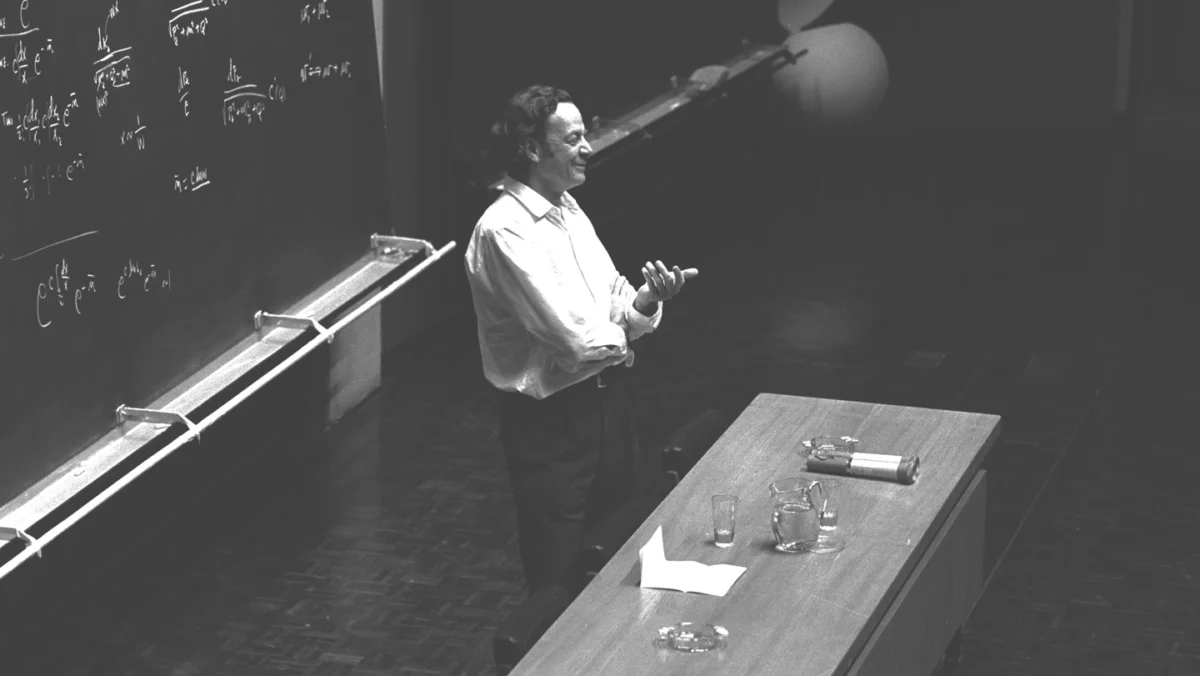
Decades after Nobel laureate physicist Richard Feynman famously scribbled the solution to a seemingly trivial, yet universally relatable, dilemma—whether to stick with a familiar favorite or venture into the unknown when dining out—researchers have finally deciphered and rigorously tested his ingenious mathematical approach. The elegant solution, born from a casual conversation in the 1970s, has now been formally validated, offering profound insights into decision-making under uncertainty and the power of well-placed heuristics.
Feynman, a towering figure in theoretical physics renowned for his unconventional thinking and insatiable curiosity, reportedly grappled with this quintessential question during a lunch outing. His penchant for dissecting complex problems, no matter how mundane their origin, led him to translate the choice between a reliable meal and a potentially superior new discovery into a mathematical problem. The resulting calculations, jotted down in his characteristically idiosyncratic handwriting, remained a cryptic puzzle for years following his passing in 1988. It was only recently that a team of computational cognitive scientists, led by Brian Christian, recognized the underlying mathematical framework within Feynman’s scrawl as a solution to a class of problems known as "stopping problems."
Unlocking Feynman’s Cryptic Calculations
Stopping problems, a well-established area of probability theory and statistics, deal with the optimal time to cease an ongoing process and accept a particular outcome. These problems are ubiquitous, ranging from making investment decisions to deciding when to stop searching for a parking spot or, as in Feynman’s case, choosing a meal. The core challenge lies in balancing the potential for a better outcome by continuing the search against the risk of losing a good, albeit not perfect, option already encountered.
Christian and his colleagues, in their study published on June 2 in the Proceedings of the National Academy of Sciences, meticulously worked to decipher Feynman’s notes. They recognized that Feynman had developed an equation for a "threshold." This threshold acts as a benchmark against which one compares the quality of the best option discovered so far. The strategy, as detailed by Christian’s team, is as follows: on any given dining occasion, after having explored a certain number of options, one compares the current best-found option against this calculated threshold. If the current best surpasses the threshold, the diner should commit to it for all subsequent dining occasions within the defined period. If it falls short, the diner should opt for a new, untried option.
Crucially, Feynman’s insight was that this threshold is not static. It dynamically adjusts based on the number of remaining dining opportunities. In the early stages of the decision-making process, when there are many future opportunities to potentially discover an exceptional meal, the threshold is set relatively high. This encourages exploration and holding out for truly outstanding choices. As the number of remaining dining nights dwindles, the threshold progressively lowers. This reflects the diminishing returns of continued searching; with little time left, the incentive shifts towards securing any option that demonstrably outperforms the average experience, thereby minimizing the risk of ending up with a subpar meal on the final occasion.
From Restaurant Choice to Broader Applications
While Feynman framed his problem within the context of selecting dishes at a single restaurant, Christian and his colleagues expanded its applicability by re-casting it as a decision-making process involving multiple distinct restaurants over a series of nights. The underlying mathematical principles, however, remain identical, underscoring the generality of Feynman’s solution. This reinterpretation allows for direct application to scenarios where individuals or organizations must choose from a variety of options over time, such as selecting research projects, hiring candidates, or even determining the optimal time to exit a particular market.
The quality distribution of the options also plays a significant role, as Feynman himself acknowledged. His initial assumption was that any given dish or restaurant had an equal probability of being good, bad, or mediocre. However, Christian’s team investigated how the optimal strategy shifts when this assumption is altered. For instance, if the general landscape of dining options is characterized by predominantly poor quality, with only a few truly exceptional establishments, the threshold calculation would need to be adjusted. In such a scenario, the threshold might remain higher for longer, reflecting the increased rarity of truly desirable outcomes and the greater need for careful discernment. This highlights the sophisticated nature of Feynman’s probabilistic thinking, which accounted for varying statistical distributions of quality.
Empirical Validation and Human Heuristics
To test the real-world applicability and compare Feynman’s optimal strategy against actual human behavior, Christian and his colleagues conducted a large-scale online survey involving over 2,500 participants. The findings revealed a fascinating dichotomy. While individuals did not consistently adhere to Feynman’s precisely calculated optimal strategy, their decision-making processes employed simpler, yet remarkably effective, heuristics or mental shortcuts. These approximations of Feynman’s optimal strategy resulted in comparable overall scores—meaning participants, on average, achieved dining experiences nearly as satisfying as those predicted by the ideal mathematical model, without undertaking the full computational burden.
Brian Christian, speaking on the implications of these findings, emphasized the efficiency of human cognition. "People don’t always do the optimal thing," he stated. "They use these heuristics and shortcuts. But the heuristics that they use are strikingly, or uncannily, good." This suggests that human decision-making, while not always mathematically perfect, is often remarkably adaptive and efficient in navigating complex choices under uncertainty. The observed heuristics often mirror the core principles of Feynman’s solution—a tendency to explore initially and then settle once a satisfactory option is encountered—demonstrating a robust, albeit intuitive, understanding of the trade-offs involved.
The Broader Implications of Feynman’s Insight
Feynman’s ability to distill a universal human experience into a quantifiable problem and derive an elegant mathematical solution speaks volumes about his intellectual prowess. The fact that his scribbles, left on a piece of paper for decades, have now been rigorously analyzed and confirmed by contemporary research underscores the enduring relevance of his work.
The implications of this deciphered solution extend far beyond the culinary realm. It offers a powerful framework for understanding and optimizing decisions in numerous fields:
- Business and Economics: Businesses can use this model to optimize product development cycles, marketing strategies, or investment portfolio diversification. For example, when launching a new product line, companies could use a similar threshold strategy to decide when to commit resources to a particular design or market segment based on initial performance data.
- Artificial Intelligence and Machine Learning: The principles of stopping problems are fundamental to various AI applications, including reinforcement learning and sequential decision-making algorithms. Feynman’s approach provides a clear, human-understandable example of an optimal policy in such contexts.
- Personal Finance: Individuals can apply this logic to financial decisions, such as when to sell an investment, when to refinance a mortgage, or when to accept a job offer. The "best option found so far" could represent the highest stock price, the lowest interest rate, or the most attractive salary package.
- Everyday Life: Beyond dining, the strategy can inform decisions about job searching, apartment hunting, or even choosing which movie to watch from a streaming service’s vast catalog. The core principle of exploring a set number of options before making a commitment based on a dynamic threshold remains applicable.
A Legacy of Curiosity and Problem-Solving
Richard Feynman’s legacy is one of relentless curiosity and a profound ability to break down complex issues into their fundamental components. His exploration of the "optimal dining strategy" is a testament to this spirit. While he may not have intended for his lunchtime musings to become a subject of formal academic research decades later, his work serves as a powerful reminder that profound scientific insights can emerge from the most ordinary of human experiences.
The successful deciphering and validation of Feynman’s solution by Christian and his colleagues not only illuminate a specific aspect of decision theory but also highlight the continued value of revisiting and understanding the work of scientific giants. Feynman’s scribbles, once an enigmatic puzzle, now offer a clear, actionable, and elegant solution to a question that has puzzled diners for generations, solidifying his place not just as a groundbreaking physicist, but also as a profound thinker on the nature of choice itself. The research serves as an inspiration, encouraging us to look for the underlying mathematical order in the world around us, even in the simple act of deciding where to eat.