The quest to understand the fundamental building blocks of reality has, for decades, led physicists into a labyrinth of mathematical complexity. If one were to take a common object, such as an apple, and divide it repeatedly, the journey would pass through familiar milestones: molecules, atoms, and the subatomic world of protons, neutrons, and electrons. Deeper still lie the elementary particles—quarks and gluons. However, for those specializing in theoretical physics, the journey does not end at the point-like particles described by the Standard Model. Instead, at scales approximately a billion billion times smaller than a proton, a new paradigm emerges. According to string theory, every particle in the universe is not a point, but a tiny, vibrating filament of energy.
A groundbreaking new study titled "Strings from Almost Nothing," recently accepted for publication in the prestigious journal Physical Review Letters, has provided significant new evidence for this framework. Researchers from the California Institute of Technology (Caltech), New York University (NYU), and the Institut de Fisica d’Altes Energies (IFAE) in Barcelona have demonstrated that the core features of string theory—long thought to be a specific, constructed model of the universe—actually emerge automatically from a few basic physical principles. By using a "bootstrap" approach, the team has shown that if the universe behaves according to certain universal laws of scattering and energy, string theory is not just a possibility, but a mathematical inevitability.
The Great Divide: General Relativity vs. Quantum Mechanics
To appreciate the significance of the "Strings from Almost Nothing" study, one must first understand the central crisis in modern physics. For over a century, the physical world has been governed by two incompatible sets of laws. General relativity, Albert Einstein’s masterwork, describes the universe on a grand scale—planets, stars, galaxies, and the fabric of spacetime itself. It treats gravity as the curvature of this fabric. Conversely, quantum mechanics governs the subatomic realm, where particles exist in states of probability and interact through discrete forces.
The conflict arises when physicists attempt to combine the two. When the equations of general relativity are applied to the quantum scale, the math produces "infinities"—nonsensical results that suggest the theory has broken down. This breakdown typically occurs at the Planck scale, an energy level 19 orders of magnitude greater than the mass of a proton. Because gravity is so weak compared to other fundamental forces, it only becomes significant at these extreme energies, making it nearly impossible to observe quantum gravitational effects directly.
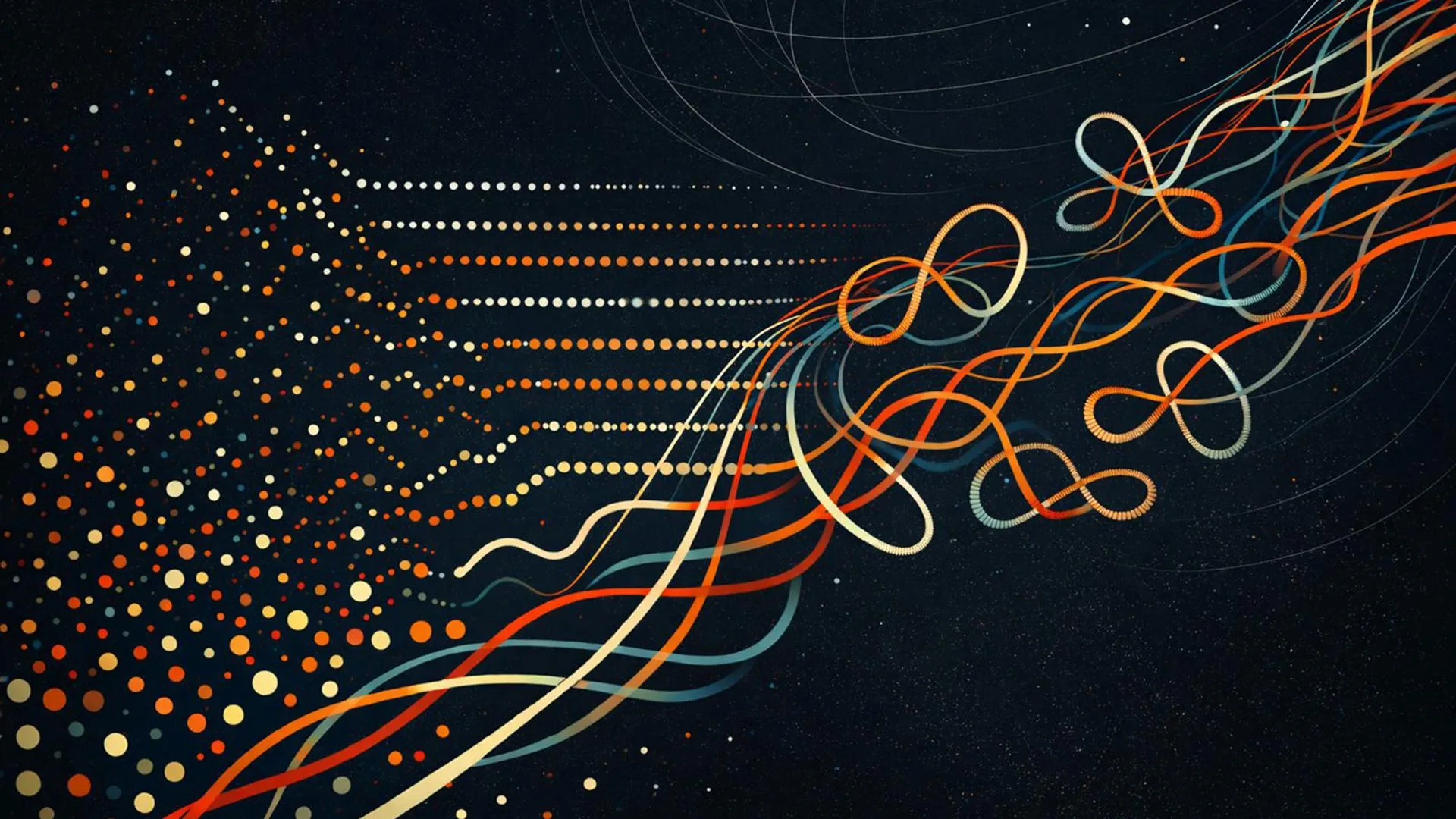
String theory emerged in the late 1960s and early 1970s as a potential bridge across this chasm. By replacing point-like particles with one-dimensional strings, the theory avoids the mathematical "singularities" (points of infinite density or energy) that plague other models. In this framework, different particles are simply different "notes" played on a string. A string vibrating one way appears as a photon; vibrating another way, it appears as a quark. Crucially, string theory predicts a specific vibration that corresponds to the graviton, a hypothetical particle that carries the force of gravity, thereby offering a unified "Theory of Everything."
The Bootstrap Method: A Modern Revival of an Old Strategy
Directly testing string theory remains one of the greatest challenges in science. To see a string, or to witness the effects of quantum gravity, researchers would require a particle collider the size of a galaxy—a feat far beyond current or foreseeable technology. Consequently, physicists have turned to mathematical consistency as their primary guide.
The "bootstrap" approach is a philosophy of physics that avoids making specific assumptions about the "stuff" the universe is made of. Instead, it starts with a set of "must-have" principles—logical constraints that any consistent theory of nature should satisfy. By applying these constraints, physicists try to "pull themselves up by their own bootstraps" to see which laws of physics are forced into existence.
"The deep irony is that this bootstrap idea that we’re pursuing now with modern tools and modern ideas is super retro," says Clifford Cheung, professor of theoretical physics and director of the Leinweber Forum for Theoretical Physics at Caltech. "The original discovery of the Veneziano spectrum, and John Schwarz’s work, took a similar approach. They didn’t start with string theory models but rather the solutions came out of basic principles."
In the new study, Cheung and his colleagues, including Grant N. Remmen of NYU and Francesco Sciotti of IFAE, applied the bootstrap method to the way particles scatter during high-energy collisions. They set out to see what kind of mathematical functions could describe these collisions without violating the laws of causality or probability.
Chronology of String Theory and the Bootstrap Approach
The history of this discovery is rooted in a timeline of theoretical breakthroughs that spans over sixty years:
- 1960s: The S-Matrix and Early Bootstrap: Physicists Geoffrey Chew and Steven Frautschi at UC Berkeley pioneered the "bootstrap" idea, suggesting that the laws of nuclear physics could be derived from the requirements of the S-matrix (the mathematical description of particle scattering).
- 1968: The Veneziano Amplitude: Gabriele Veneziano, a researcher at CERN, discovered a mathematical function that described the "spray of junk" seen in particle colliders. He identified a "tower" of particles with masses and spins that increased in an orderly, harmonic sequence.
- 1970: The String Interpretation: Yoichiro Nambu, Holger Bech Nielsen, and Leonard Susskind independently realized that Veneziano’s "tower" of particles behaved exactly like the harmonics of a vibrating string.
- 1974: The Gravity Connection: Caltech’s John Schwarz and Joël Scherk realized that string theory naturally contained a massless particle with a spin of two—the exact properties required for a graviton. This transformed string theory from a theory of nuclear forces into a candidate for quantum gravity.
- 2024: Strings from Almost Nothing: The current research by Cheung and his team uses modern computational techniques to prove that the Veneziano amplitude and the string spectrum are the unique solutions to the bootstrap constraints of "ultrasoftness" and "minimal zeros."
Technical Analysis: Ultrasoftness and the Planck Scale
The team’s research focused on "scattering amplitudes," which are formulas used to calculate the probability of various outcomes when particles collide. In standard theories of gravity, as the energy of a collision increases toward the Planck scale, the scattering amplitude grows until it reaches infinity, signaling a failure of the theory.
String theory avoids this through a property called "ultrasoftness." Because strings are extended objects rather than points, they "smear" the interaction over a small region of space. As the energy increases, the probability of a violent scattering event actually drops.
"In a string theory framework, as you increase the energy transfer between particles, you will see a swift fall off in the probability that the particles will scatter," Cheung explains. "It’s like the particles don’t even want to scatter off one another, but rather pass freely. The scattering amplitudes don’t go to infinity. It’s better behaved."
The researchers added a second constraint called "minimal zeros." In the mathematics of scattering, there are certain "kinematic points" where the probability of particles interacting vanishes entirely (a "zero"). By demanding that a theory have the fewest number of these zeros allowed by logic, the researchers found that only one mathematical solution remained: the exact equations of string theory.
"The precise details of string theory emerged automatically, including the infinite tower of massive spinning particles that form the ‘harmonics’ of the string that the theory is famous for," says co-author Grant N. Remmen.
Official Reactions and Scientific Impact
The findings have been met with significant interest from the theoretical physics community, particularly among those who have spent decades looking for a "unique" theory of the universe. If the mathematics of string theory is the only way to satisfy basic physical requirements, it suggests that string theory is not just one of many possible models, but perhaps the only mathematically consistent way to describe a universe with gravity and quantum mechanics.
Hirosi Ooguri, the Fred Kavli Professor of Theoretical Physics and Mathematics at Caltech, notes that the revival of the bootstrap method is a major turning point. "The bootstrap idea had become obsolete, but now people like Cliff are reviving and modernizing it," Ooguri says. "We now have a better understanding of the basic assumptions we can make, as well as stronger techniques for translating these assumptions into properties of scattering amplitudes."
John Schwarz, one of the founding fathers of string theory, expressed excitement at how these modern tools reinforce the work he began in the 1970s. "String theories are well-behaved at very high energies, unlike Einstein’s general theory of relativity," Schwarz says. "We were very excited that some version of string theory could provide a unified quantum theory of everything."
Broader Implications: The Nature of Reality
While the "Strings from Almost Nothing" study does not constitute experimental proof of string theory—which would still require the aforementioned "galaxy-sized" collider—it provides a powerful theoretical validation. It suggests that the mathematical structure of our universe may be far more constrained than previously thought.
The study implies that if we want a universe where particles interact in a way that doesn’t "break" the math at high energies, we are essentially forced into a reality made of strings. This "uniqueness" is a holy grail in physics; it suggests that the laws of nature are not arbitrary but are the only ones that could possibly work.
Furthermore, the research reinforces the necessity of higher dimensions. For the mathematics of these vibrating strings to remain consistent, they must move in at least ten dimensions. While we only experience four (three of space and one of time), string theory suggests the others are "compactified" or curled up so tightly that they are invisible to us.
As physicists continue to refine the bootstrap approach, the goal is to see if other features of our universe—such as the specific masses of quarks or the strength of the Higgs field—also emerge as "inevitable" solutions to simple logical puzzles. For now, the work of Cheung, Remmen, and their colleagues has provided a profound reminder: sometimes, to find the secrets of the entire universe, you don’t need to build a bigger machine; you simply need to ask what the math requires.
The study "Strings from Almost Nothing" was supported by a coalition of high-level scientific organizations, including the US Department of Energy, the Walter Burke Institute for Theoretical Physics, and the Next Generation EU initiative. It marks a significant step forward in the ongoing effort to unite the smallest and largest scales of the cosmos into a single, elegant framework.