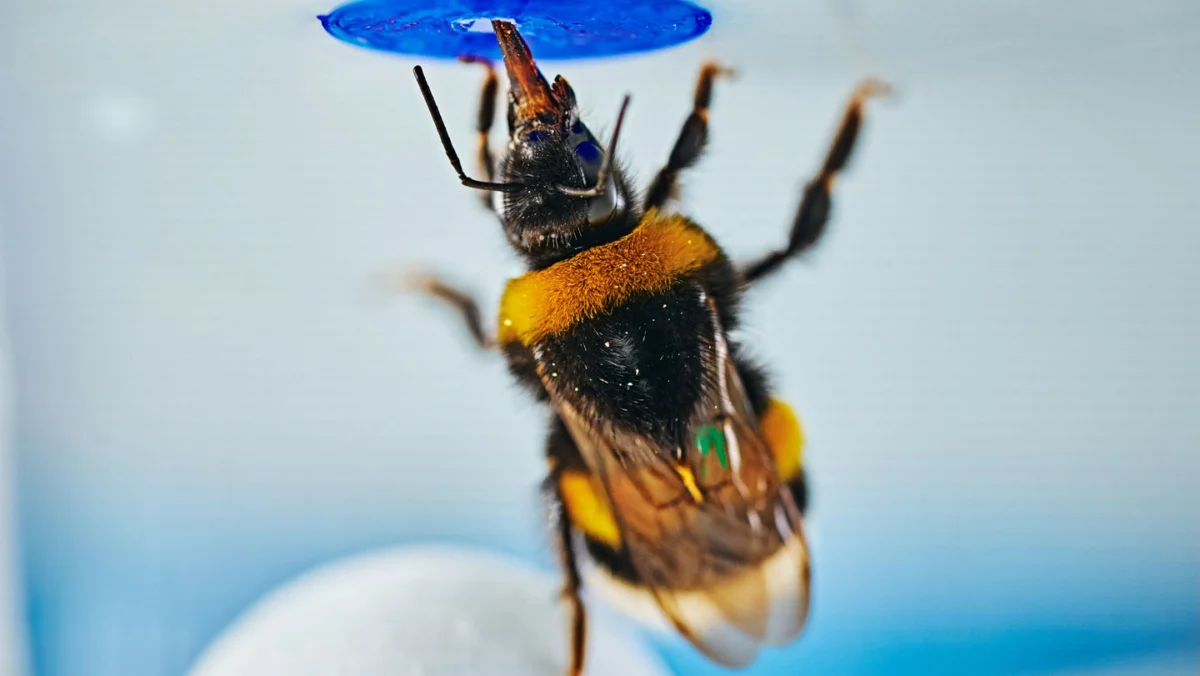
The remarkable cognitive capabilities of bumblebees have taken a significant leap into the scientific spotlight with the groundbreaking discovery that these insects can exhibit spontaneous problem-solving, a feat previously undocumented in any invertebrate species. Researchers have observed buff-tailed bumblebees ingeniously utilizing a ball as a makeshift ladder to access a sugar reward from an artificial flower positioned beyond their immediate reach. This sophisticated behavior, detailed in the June 4th issue of the journal Science, suggests a level of cognitive flexibility and independent reasoning that challenges long-held assumptions about invertebrate intelligence.
Unlocking a Novel Cognitive Skill
The study, spearheaded by Olli Loukola, a behavioral ecologist at the University of Oulu in Finland, along with his colleagues, aimed to explore the problem-solving potential of bumblebees in a controlled yet naturalistic setting. Unlike many previous studies on animal cognition, which often involve animals with prior experience in puzzle-solving or captivity, this research was designed to ensure that the observed behaviors were truly spontaneous, emerging without any learned strategies or specific training for the task at hand.
"Spontaneous problem-solving is something that has never been shown in any invertebrate before," stated Loukola in a press release accompanying the study. This assertion underscores the profound implications of the findings, positioning bumblebees as a unique model organism for understanding the evolution of complex cognitive processes. While vertebrates such as chimpanzees and parrots are well-known for their ability to independently devise solutions to novel problems, demonstrating this capacity in an invertebrate opens new avenues for comparative cognition research.
Experimental Design: A Test of Ingenuity
The experimental setup was meticulously crafted to isolate and test the bees’ problem-solving prowess. Initially, the researchers established two crucial associations for the bumblebees. First, they were trained to understand that balls were movable objects within their environment. Second, they learned that a specific visual cue – a blue ring, designed to mimic a flower – signaled the presence of a food reward, in this case, a sugar solution.
Following this foundational training, the bees were introduced to plexiglass arenas. These enclosures were deliberately designed to be too small for the bees to fly directly to the target blue ring, which was positioned on the ceiling. The artificial flower, dispensing the sugary reward, was suspended above the arena floor. Crucially, the ball was placed beneath the flower, presenting a potential, yet unlearned, pathway to the prize.
The researchers observed the bees’ interactions with the environment. The critical question was whether the bees would spontaneously recognize the ball’s potential utility as a stepping stone to reach the out-of-reach reward. The results were striking: over 70 percent of the bumblebees successfully navigated the challenge. They independently moved the ball beneath the blue ring and then climbed onto it, effectively using it as a platform to access the sugar.
Eliminating Alternative Explanations
To further solidify that the bees were engaging in genuine problem-solving rather than random trial-and-error or reliance on incidental cues, the researchers introduced further complexities. In subsequent trials, the arenas were divided into two sections, with one section containing a barrier. The blue ring, or "flower," was located in the second section, inaccessible without navigating the barrier and then utilizing the ball. This modification served to test whether the bees were truly working towards a goal or simply stumbling upon a solution. The fact that bees continued to successfully reach the reward in these more complex environments suggests they were not merely relying on immediate visual cues or engaging in playful exploration that coincidentally led to the solution. Instead, they appeared to be forming a mental representation of the task and devising a strategy to achieve it.
Akshaye Bhambore, a behavioral ecologist also affiliated with the University of Oulu, commented on the bees’ performance in these more constrained environments. "There was not much room for trial and error or playfulness in arenas with barriers," Bhambore noted. He elaborated that the bees not only had to locate the hidden flower but also retain that information and then retrieve and position the ball. "They had a goal in their mind, and they were able to understand the nature of the task," he added, reinforcing the conclusion that the bees demonstrated intentional problem-solving.
The Broader Context of Bumblebee Cognition
This discovery builds upon a growing body of research highlighting the impressive cognitive abilities of bumblebees. Previous studies have indicated that bumblebees may possess complex emotions, with research suggesting they experience something akin to joy when receiving rewards. Furthermore, their capacity for social learning has been demonstrated through experiments where bees learned to "play soccer," pushing a ball into a designated goal to receive a sugar reward. These findings, taken together, paint a picture of bumblebees as far more cognitively sophisticated than previously assumed.
The ability to spontaneously solve problems is a significant indicator of advanced cognitive function. It implies the capacity for flexible thinking, the ability to adapt to novel situations, and the potential for abstract reasoning. For an invertebrate, whose nervous system is vastly different from that of vertebrates, exhibiting such capabilities is particularly remarkable. It suggests that the evolutionary pressures faced by these insects may have driven the development of sophisticated cognitive tools for survival and reproduction.
Implications for Understanding Intelligence
The implications of this research extend beyond the realm of entomology. By demonstrating spontaneous problem-solving in bumblebees, scientists gain a valuable new model for studying the fundamental mechanisms of intelligence across different species. Understanding how an invertebrate brain achieves such feats can provide insights into the evolutionary origins of problem-solving abilities and may even inform the development of artificial intelligence.
The study’s authors are planning further investigations to delve deeper into the cognitive processes at play. They intend to employ high-speed cameras and advanced video analysis techniques to meticulously examine the bees’ behavior. The goal is to identify subtle cues, such as specific grooming behaviors or unique movement patterns, that might signal an "aha moment" – the point at which a bee understands and formulates a solution to the problem, analogous to how humans experience such cognitive breakthroughs.
A New Frontier in Invertebrate Cognition
The research on bumblebee problem-solving represents a significant advancement in our understanding of invertebrate intelligence. It challenges the anthropocentric view of complex cognition and opens up new avenues for scientific inquiry. The ability of these small insects to independently devise solutions to novel challenges underscores the diversity and complexity of cognitive evolution on Earth. As scientists continue to explore the intricate workings of the bumblebee brain, we can expect further revelations about the remarkable capabilities of the natural world. This study not only elevates the status of bumblebees as intelligent creatures but also broadens the scope of what we consider possible for minds that operate on vastly different biological architectures.