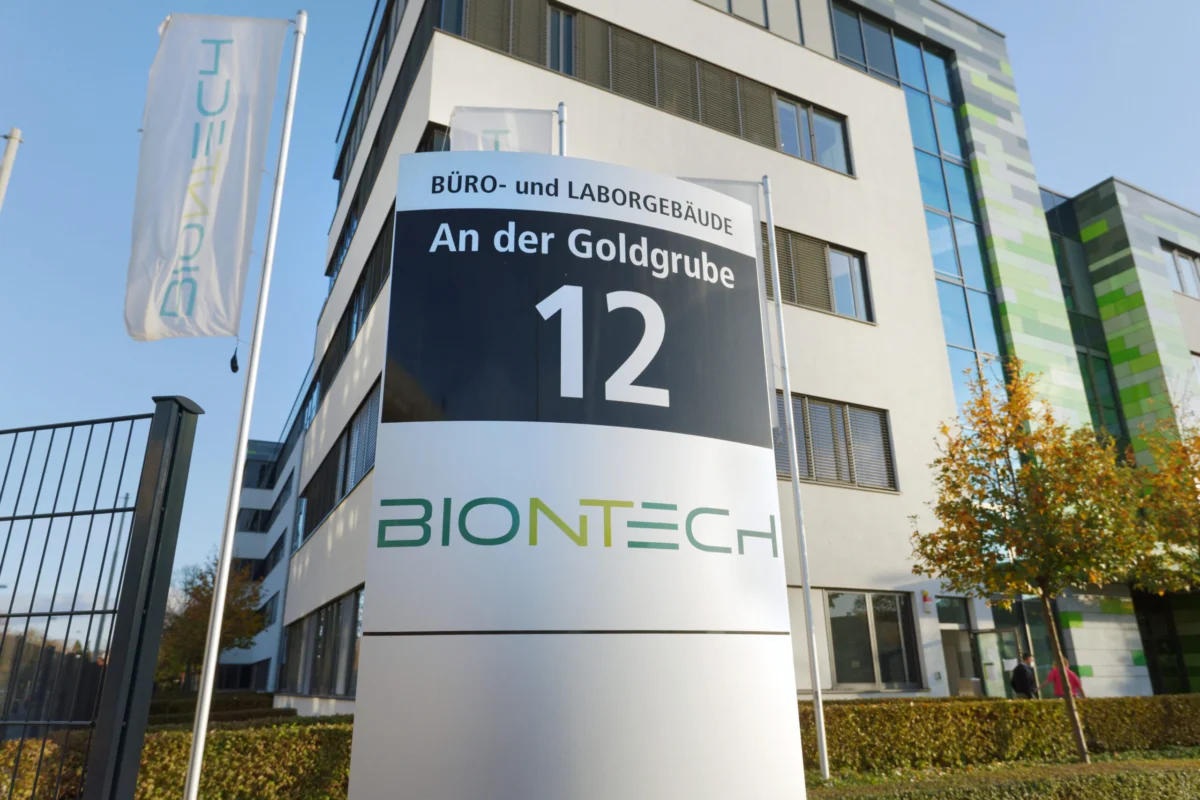
Mainz, Germany — BioNTech SE, the German biotechnology firm that achieved global recognition for its pivotal role in developing the first widely available mRNA-based COVID-19 vaccine, is undergoing a profound strategic transformation marked by significant job cuts, a complete exit from in-house COVID-19 vaccine manufacturing, and an ambitious return to its oncology roots. This dramatic pivot follows a precipitous decline in revenue from a pandemic-fueled peak of €19 billion in 2021 to a mere €118 million in the first quarter of 2026, signaling the end of an extraordinary era and the dawn of a high-stakes bet on cancer therapeutics. The company has announced the elimination of approximately 1,860 jobs and the closure of key facilities, even as it plans to deploy a substantial €16.8 billion in cash reserves towards an expansive oncology pipeline, aiming for 15 Phase 3 trials by year-end and seven late-stage data readouts in 2026.
The Unprecedented Ascent: From Project Lightspeed to Global Vaccine Leader
BioNTech’s journey to prominence began long before the pandemic, founded in 2008 by Uğur Şahin and Özlem Türeci with a singular focus on developing individualized immunotherapies for cancer. Their expertise in messenger RNA (mRNA) technology, however, would soon be redirected towards an unprecedented global health crisis. In January 2020, mere days after the genetic sequence of SARS-CoV-2 was made public, BioNTech launched "Project Lightspeed," an ambitious and accelerated program to develop an mRNA-based vaccine against the novel coronavirus. This audacious undertaking was quickly bolstered by a €375 million grant from the German government, providing crucial capital to accelerate research and production capabilities.
The partnership with American pharmaceutical giant Pfizer proved to be a synergistic alliance that would redefine vaccine development. While Pfizer notably declined direct U.S. government research and development funding through Operation Warp Speed, opting to preserve scientific independence, the U.S. government nonetheless provided a critical demand guarantee. In July 2020, it placed a $2 billion advance-purchase order for 100 million doses of the vaccine candidate, with options for hundreds of millions more. This financial commitment, combined with the U.S. Food and Drug Administration’s emergency use authorization in December 2020, paved the way for Comirnaty (BNT162b2) to become one of the best-selling pharmaceutical products in history. The vaccine’s rapid development, high efficacy rates demonstrated in clinical trials, and widespread global deployment positioned BioNTech and Pfizer as leaders in the pandemic response. For BioNTech alone, Comirnaty generated approximately €36 billion in revenue across 2021 and 2022, transforming the relatively obscure biotech firm into a global pharmaceutical powerhouse with a market capitalization soaring into the tens of billions.
The Inevitable Descent: Waning Demand and Revenue Freefall
As the acute phase of the COVID-19 pandemic receded and global vaccination rates stabilized, the demand for COVID-19 vaccines entered a steep decline. Booster fatigue, the emergence of less severe variants, and a general public shift away from pandemic-era vigilance contributed to a dramatic reduction in vaccine orders. The impact on BioNTech’s financials was stark and immediate. The company’s revenue plummeted from its peak of €19 billion in 2021 to just €118 million in the first quarter of 2026, representing a near-complete collapse of its primary revenue stream. This revenue freefall underscored the inherent volatility of relying on a single, pandemic-driven product and highlighted the urgent need for a diversified pipeline.
Compounding the challenges of waning demand, the political landscape in key markets began to shift, creating additional headwinds for the entire mRNA vaccine sector. In August 2025, U.S. Department of Health and Human Services (HHS) Secretary Robert F. Kennedy Jr. announced a controversial decision to terminate 22 BARDA (Biomedical Advanced Research and Development Authority) mRNA vaccine development investments, effectively rejecting the platform for certain applications. Secretary Kennedy Jr. stated that data indicated mRNA vaccines "fail to protect effectively against upper respiratory infections like COVID and flu," a conclusion that sparked significant debate within the scientific community. Prestigious institutions such as Johns Hopkins University, Harvard University, and the National Academy of Medicine publicly disagreed with these assertions, emphasizing the demonstrated efficacy of mRNA vaccines in preventing severe disease and death. However, the move by the HHS signaled a clear shift in federal funding priorities under what was perceived as a "Trump 2.0" administration, actively steering federal dollars away from mRNA technology, a stark reversal from the previous administration’s Operation Warp Speed commitments that had initially propelled the technology. This political climate further complicated the long-term prospects for mRNA-focused companies in the infectious disease space.
Strategic Consolidation: The CureVac Acquisition
In anticipation of these challenging market conditions and as part of its strategic realignment, BioNTech initiated a move to consolidate its position within the German mRNA landscape. In June 2025, the company announced the acquisition of CureVac, another German mRNA specialist, in an all-stock deal valued at $1.25 billion. CureVac, like BioNTech, had its own pandemic narrative, though one marked by less success. Its first-generation COVID-19 vaccine candidate, CVnCoV, demonstrated only 48% efficacy in a Phase 3 trial in 2021, falling short of the performance of its rivals, including Comirnaty. Consequently, CureVac and its partner Bayer abandoned their COVID-19 development efforts for that particular candidate and refocused on next-generation mRNA platforms, forming a partnership with GSK.
Despite CureVac’s earlier setbacks, BioNTech viewed the acquisition as strategically valuable. Fierce Biotech reported that BioNTech considered CureVac’s research and manufacturing site in Tübingen a "major prize." This acquisition was not primarily about CureVac’s existing pipeline but rather about integrating its advanced mRNA platform technologies, intellectual property, and skilled workforce, particularly in areas like second-generation mRNA backbones and manufacturing capabilities, which could potentially bolster BioNTech’s long-term ambitions in oncology and other therapeutic areas. The deal was seen as a move to strengthen BioNTech’s foundational mRNA expertise and potentially reduce future competitive pressures.
Restructuring and Retrenchment: Job Cuts and Manufacturing Exit
However, the strategic consolidation quickly led to significant operational restructuring. Five months after the CureVac deal closed, BioNTech announced a series of drastic measures to optimize its cost structure and streamline operations. The company revealed plans to shutter the Tübingen site, acquired through CureVac, along with facilities in Idar-Oberstein, Marburg, and Singapore. These closures are projected to result in the elimination of approximately 1,860 jobs across its global operations, representing a substantial reduction in its workforce. The decision to close the Tübingen site, acquired only months earlier, underscores the rapid and decisive nature of BioNTech’s pivot away from infectious disease manufacturing.
Furthermore, BioNTech is completely exiting in-house COVID-19 vaccine manufacturing, a move that symbolizes the end of an era. All future production of its COVID-19 vaccine will be handled by its long-standing partner, Pfizer. This outsourcing decision is expected to generate significant annual savings, estimated at €500 million by 2029, by offloading the operational complexities and costs associated with large-scale vaccine production to a partner with vast global manufacturing infrastructure. The restructuring, while painful for the affected employees, is a critical step in BioNTech’s effort to right-size its operations for its new strategic focus and ensure financial sustainability in a post-pandemic world.
The Oncology Pivot: A Return to Roots and a Multi-Billion Euro Bet

Amidst the dramatic financial downturn and operational restructuring, BioNTech is embarking on an ambitious and high-stakes "bet-the-company" pivot back to its original mission: oncology. Despite the current lack of oncology revenue, the company retains a formidable war chest of €16.8 billion in cash reserves, which it intends to deploy aggressively to build a leading oncology franchise. The scale of this ambition is evident in its immediate plans: BioNTech aims to launch 15 Phase 3 oncology trials by the end of the year and expects seven late-stage data readouts in 2026. This level of clinical activity signifies an unparalleled commitment to advancing a diverse pipeline of cancer therapeutics.
The company’s R&D investment for 2025 stood at a substantial €2.1 billion, demonstrating its unwavering dedication to drug discovery and development in cancer. On the same earnings call where the layoffs were announced, BioNTech’s board also approved a €1 billion share buyback program, a move typically aimed at boosting shareholder value and signaling confidence in the company’s long-term prospects, even amidst significant operational changes.
A Shifting Clinical Pipeline: From Infectious Disease to Cancer Dominance
The transformation of BioNTech’s clinical pipeline is striking. As recently as March 2025, the company’s clinical pipeline prominently featured nine infectious disease programs, including Comirnaty (COVID-19), a next-generation COVID vaccine, a COVID-influenza combination with Pfizer, a standalone influenza vaccine out-licensed to Pfizer, an HSV vaccine with the University of Pennsylvania, a tuberculosis vaccine funded by the Gates Foundation, a malaria vaccine, an mpox vaccine funded by CEPI, and a shingles vaccine in collaboration with Pfizer. A tenth program, a protein-based therapeutic for bacterial vaginosis, rounded out the non-oncology portfolio.
Today, BioNTech’s public pipeline page starkly reflects its new strategic direction. It lists only a single infectious disease program remaining: an mpox vaccine, notably funded externally by the Coalition for Epidemic Preparedness Innovations (CEPI). This near-complete exit from infectious disease research underscores the depth of the company’s commitment to its oncology pivot.
In stark contrast, the oncology pipeline has expanded dramatically. The live site now boasts more than 25 Phase 2 and Phase 3 clinical trials, alongside over 10 novel-novel combination studies. The centerpiece of this expanded portfolio is Pumitamig (BNT327), a bispecific PD-L1/VEGF-A immunomodulator developed in collaboration with Bristol Myers Squibb. Pumitamig is currently being investigated across a wide range of challenging cancers, with active trials spanning lung cancer, triple-negative breast cancer, colorectal cancer, gastric cancer, hepatocellular carcinoma, and glioblastoma, among others. This broad clinical development strategy for a key asset highlights BioNTech’s ambition to address multiple significant unmet medical needs in oncology.
Financial Strategy and Leadership Transition
During BioNTech’s Q1 2026 earnings call, the shift in focus was palpable. Analyst questions were almost exclusively directed towards the oncology pipeline, covering topics such as trial endpoint changes, previews of data for the upcoming American Society of Clinical Oncology (ASCO) conference, strategies for Antibody-Drug Conjugate (ADC) combinations, and the ongoing CEO succession search. The topic of COVID-19, once the sole focus, was not raised.
CFO Ramón Zapata articulated the company’s strategic vision, describing BioNTech as being in "an investment phase as we are building BioNTech into a commercial stage, multi-product oncology company by 2030." This statement underscores the long-term nature of the oncology pivot, acknowledging that significant upfront investment and sustained development efforts will be required before substantial commercial returns can be realized.
The supervisory board’s ongoing search for a new CEO with extensive experience in late-stage development and commercialization of pharmaceutical products at scale further emphasizes the company’s commitment to this new direction. The current co-founders, while brilliant scientists and innovators, are recognized for their expertise in research and early-stage development. A new leader with a proven track record in bringing complex oncology drugs to market and scaling commercial operations will be crucial for navigating the highly competitive and regulated pharmaceutical landscape. This leadership transition signals BioNTech’s maturity as it moves beyond its initial entrepreneurial phase into a more established, multi-product pharmaceutical entity.
Broader Implications for BioNTech and the mRNA Sector
BioNTech’s dramatic transformation carries significant implications, not only for the company itself but also for the broader mRNA technology sector and the pharmaceutical industry at large. For BioNTech, the pivot represents both an immense opportunity and a substantial risk. While the company is returning to its foundational expertise in cancer immunotherapy, the oncology drug development landscape is notoriously challenging, characterized by high failure rates, long development timelines, and intense competition. "Betting the company" on oncology, even with a robust cash reserve, means that the successful execution of its clinical trials and subsequent commercialization will be critical for its long-term viability and shareholder value. The €16.8 billion cash on hand provides a substantial buffer, but it will be rapidly deployed to fund the extensive clinical trials and R&D necessary for this ambitious strategy.
The job cuts, while a necessary measure for operational efficiency, will undoubtedly have a human cost and impact the affected regions. The decision to outsource all COVID-19 vaccine manufacturing to Pfizer highlights a strategic shift towards a leaner operational model, focusing internal resources on core R&D and clinical development rather than large-scale production.
For the mRNA sector, BioNTech’s experience serves as a powerful case study. The unprecedented success of mRNA vaccines during the pandemic showcased the technology’s speed and versatility. However, the subsequent decline in demand and the political backlash in certain regions underscore the challenges of translating emergency-driven success into sustained, diversified commercial products. While mRNA technology continues to hold immense promise for various diseases, including cancer, infectious diseases beyond COVID-19, and rare genetic disorders, companies must now demonstrate its efficacy and commercial viability in more traditional, competitive markets.
In a profound sense, BioNTech has come full circle. Founded in 2008 as a cancer immunotherapy company, it temporarily diverted its formidable scientific and operational prowess to address a global pandemic. Having successfully navigated that crisis, it is now strategically recalibrating, channeling its accumulated wealth and expertise back into the fight against cancer. The journey ahead will be complex and demanding, but BioNTech is banking on its deep scientific foundation, substantial financial resources, and a renewed focus to establish itself as a dominant force in the oncology market by 2030. The coming years will reveal whether this bold pivot can once again propel the German biotech firm to global leadership.