For the past several years, success has grown more elusive for American biotech firms, grappling with a confluence of shifting investment landscapes, heightened regulatory scrutiny, and aggressive global competition, particularly from China. While the biotech sector has always demanded a unique blend of risk appetite and patient capital, contrasting with the rapid exits often seen in other tech domains, the post-2022 investment climate has introduced unprecedented challenges. A notable increase in caution from both U.S. regulators and investors has coincided with a surplus of capital and increased regulatory streamlining in China, creating an increasingly challenging environment for innovative biotech firms in the West. This intricate dilemma necessitates American biotech companies to forge novel strategic pathways that can circumvent intellectual property (IP) appropriation, maximize investment in strategically sound drug development areas, or pioneer innovative operational models to unlock new markets and cost efficiencies. Each of these approaches, while carrying inherent risks, offers the potential for significant differentiation not only from crowded markets dominated by existing drugs but also from the burgeoning competition emanating from China.
The Shifting Tides: A New Era for Biotech Investment and Competition
Historically, the American biotech sector thrived on a robust ecosystem of venture capital, academic innovation, and a relatively predictable regulatory environment. Companies could often secure substantial funding rounds based on promising preclinical data, with investors understanding the long timelines and high costs associated with drug development. However, the investment euphoria that peaked during the COVID-19 pandemic, fueled by rapid vaccine development and a general surge in life sciences interest, began to wane in late 2021 and intensified into a "biotech winter" in 2022. This period saw a significant contraction in venture capital funding, a cooling of public markets for biotech IPOs, and a general flight to lower-risk assets.
Simultaneously, China has strategically positioned itself as a formidable player in global biopharmaceutical innovation. Over the past decade, the National Medical Products Administration (NMPA) in China has undergone substantial reforms, significantly streamlining drug approval processes and reducing clinical trial timelines. This regulatory agility, coupled with massive government investment in biotech infrastructure and a vast pool of scientific talent, has attracted considerable capital and fostered an explosion of innovation within the country. According to industry reports, China’s share of global drug discovery and development has surged, with a particular focus on "fast-follower" strategies that leverage existing knowledge to rapidly develop biosimilars and next-generation therapies. This dual dynamic of increased U.S. caution and amplified Chinese efficiency creates a stark competitive landscape for American innovators.
The Looming Shadow of Commodification and Target Herding
A primary challenge exacerbated by these global shifts is the phenomenon of "target herding" and modality commodification. As Elliott Hershberg cogently argues, the biopharma industry has seen an inexorable drive towards the commoditization of therapeutic modalities, leading to a crowded pursuit of popular biological targets. This trend, present even a decade ago—evidenced by over 200 distinct PD-(L)1 inhibitor programs at one point—has been dramatically accelerated by advancements in artificial intelligence (AI) and computational biology.
When a promising new drug target emerges publicly with robust clinical data, a multitude of companies, often supported by advanced AI algorithms, can swiftly identify and pursue similar therapeutic avenues. The ease of access to scientific literature, public databases, and increasingly sophisticated AI tools allows competitors to rapidly design novel molecules that achieve similar biological effects, even if they circumvent existing patent claims. For protein therapeutics and especially chemical drugs, AI can facilitate the rapid generation of diverse molecular structures that target the same pathway but possess sufficient novelty to potentially avoid direct patent infringement. This capability significantly shortens the effective patent exclusivity period, making it challenging for original innovators to recoup the substantial clinical development costs, which can average over $2 billion and take more than a decade for a single drug.
The competitive edge of fast-followers is particularly pronounced for Chinese firms. Their significantly lower development costs, streamlined regulatory pathways, and a large domestic market often enable them to bring copycat programs to market faster or with greater cost efficiency. This puts immense pressure on American innovators to not only discover truly novel mechanisms but also to protect them effectively and efficiently.
Strategic Pathways for Differentiation: Three Exemplars
In this complex environment, American biotech firms are exploring diverse strategies to maintain their competitive edge. Three distinct approaches illustrate the varied solutions to this conundrum.
1. The Sanctuary of Secrecy: Variant Bio’s Approach to Novel Target Discovery
Variant Bio, a Seattle-based genomics company, exemplifies a strategy centered on deep, proprietary discovery and strategic secrecy. Recognizing the pitfalls of target herding, their solution is to develop technology capable of uncovering novel drug targets that are not easily visible or accessible to competitors. This allows them to operate in a quiet, isolated development phase for extended periods, building a durable advantage.
Variant Bio achieves this by leveraging privileged access to genomic sequencing data derived from rare, isolated human populations. These unique populations often exhibit distinct genetic predispositions or resistances to diseases, offering invaluable clues to novel biological pathways that can be targeted therapeutically. By focusing on these genetically unique insights, Variant Bio aims to identify truly first-in-class targets rather than competing in the crowded "best-in-class" space.
Their operational model involves withholding patent filings until the last possible minute, thereby extending the period of proprietary knowledge and reducing the window for fast-followers to catch up. This "keep secret" approach, while demanding extreme discipline and robust internal IP protection measures, minimizes the risk of immediate replication. Industry analysts suggest that while this strategy requires exceptional scientific rigor and investor patience—as the payoff may be further down the line—it offers the potential for profound market differentiation and significantly higher returns if successful. The ethical considerations around using genomic data from isolated populations are carefully navigated, often involving extensive community engagement and consent, ensuring that the benefits are shared and that privacy is paramount. This strategy directly counters the AI-accelerated commodification by focusing on truly hidden biological insights.
2. Maximizing Known Pathways: The Polypharmacology Play by Spyre and Kailera
Conversely, some firms are embracing the very commodification of drug modalities as an opportunity. The biotech industry has become exceptionally adept at developing certain classes of drug molecules, such as monoclonal antibodies and peptides. This expertise translates into lower development risk for individual components. Companies like Spyre Therapeutics and Kailera are leveraging this proficiency by combining known, de-risked modalities to achieve superior therapeutic efficacy and create new layers of intellectual property.

Spyre Therapeutics is aggressively pursuing this "bio-better" strategy in the inflammatory bowel disease (IBD) space. Instead of searching for entirely new targets, Spyre focuses on established, validated targets like IL-23, TL1A, and α4β7. Their pipeline consists of novel combinations of monoclonal antibodies that target these pathways, aiming for synergistic effects that significantly improve patient outcomes beyond current standards of care. For example, while biosimilars of blockbuster drugs like Humira (adalimumab, targeting TNF-α) are becoming widely available and significantly cheaper (as exemplified by initiatives like Mark Cuban’s Cost Plus Drugs selling generics at deep discounts), a combination therapy that doubles efficacy could still command a premium in the U.S. healthcare system. The combination itself can be patented, and the intricate execution required for developing and testing such multi-component therapies often acts as a natural barrier to entry for would-be copycats.
Similarly, Kailera is applying this approach to the highly lucrative weight-loss market. Current leading therapies like semaglutide primarily target GLP-1. Kailera is developing bivalent, trivalent, or even quadrivalent peptide constructs that target multiple synergistic pathways, aiming for significantly enhanced weight loss. While the article notes that even these advanced combinations might not alleviate side effects like vomiting, the potential for vastly improved efficacy could secure substantial market share.
The catch with this strategy, however, lies in its capital intensity. While development risk per component may be lower, the complexity of clinical trials for combinatorial therapies, along with the need for extensive manufacturing and regulatory navigation, translates into substantial costs. Both Spyre and Kailera have reportedly raised over a billion dollars each to fund their expansive clinical programs, highlighting that while the scientific risk is mitigated, the financial investment remains colossal. Venture capitalists, in this context, often view such "de-risked" but capital-intensive approaches favorably, as they build upon validated biology, offering a clearer path to market, albeit one that requires deep pockets.
3. Pioneering New Platforms: Lumen Bio’s Transformative Model
A third, perhaps more disruptive, strategy involves the development of entirely novel biomanufacturing platforms. Seattle-based Lumen Bio, co-founded by co-author Brian Finrow, exemplifies this approach. Like Spyre and Kailera, Lumen Bio’s pipeline includes biologic cocktail drugs designed for powerful therapeutic synergies. However, their core differentiator is a completely novel biomanufacturing platform technology that offers significantly greater scalability and delivered cost advantages.
This platform’s transformative potential lies in its ability to make preventive drugs and access to international markets far more addressable. The current cost structure of traditional biologic manufacturing often makes large-scale preventive applications or distribution in lower-income countries economically unfeasible. Lumen Bio’s platform aims to overcome these barriers, democratizing access to complex biologics.
The novelty, however, comes with its own set of pros and cons. A significant disadvantage has been investor sentiment: novel biomanufacturing platforms have been "out of fashion" with investors since the end of the COVID-era boom in 2022. This skepticism often stems from the high upfront capital investment required for platform development, the longer timelines to demonstrate commercial viability, and the inherent risks associated with entirely new technologies. Moreover, established biopharma companies often prefer to work with technologies compatible with their existing manufacturing footprints, favoring commodified modalities over disruptive new ones.
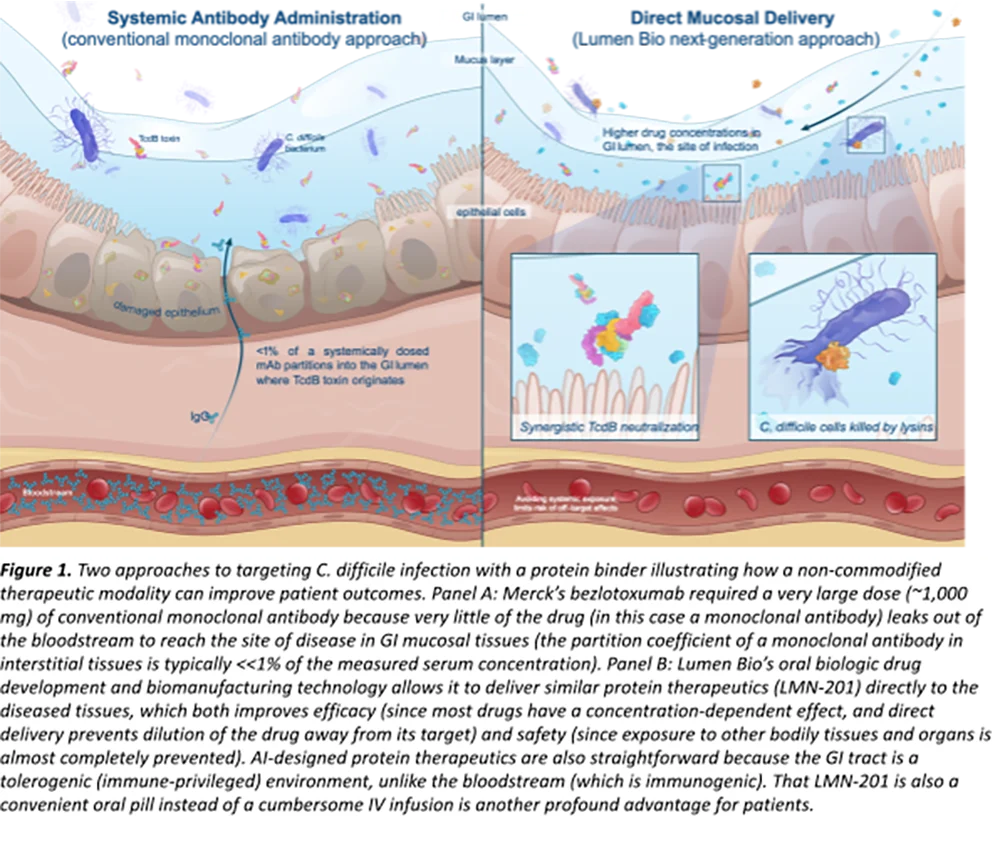
Nevertheless, Lumen Bio’s competitive advantages are compelling. Beyond cost and scalability, new therapeutic modalities represent entirely new ways of addressing unmet medical needs. For example, Lumen Bio’s LMN-201 attacks the same target as Merck’s IV-infused antibody bezlotoxumab for Clostridioides difficile (C. diff) infection. Crucially, LMN-201 is an oral biologic, dramatically simplifying administration and making treatment far more accessible and patient-friendly compared to an intravenous infusion. This shift from injection to oral delivery can revolutionize patient care, particularly for chronic or recurrent conditions. Furthermore, the lack of pre-existing manufacturing capacity for such novel platforms means that would-be competitors face a much steeper hill to climb, requiring significant investment in new infrastructure and expertise to catch up to a pioneering product launch. The triumph of Moderna with its mRNA COVID-19 vaccine serves as a powerful illustration of the immense upside potential when a novel platform proves its efficacy and scalability, especially when legacy manufacturing approaches struggle to meet market demands.
Broader Implications for Global Biotech Leadership
The strategic choices made by American biotech firms in the coming years will have profound implications beyond individual company success. They will shape the future of U.S. innovation leadership, the global pharmaceutical landscape, and ultimately, patient access to life-saving and life-improving therapies.
Maintaining a competitive edge against increasingly sophisticated and cost-efficient Chinese competition necessitates not just scientific brilliance but also strategic foresight in business models. If American firms cede too much ground in the "fast-follower" or commoditized spaces, they risk losing market share and the financial returns necessary to fund truly groundbreaking, risky research. The imperative is to continue driving deep, durable innovation—whether through hidden discoveries, synergistic combinations, or disruptive platforms—that creates high barriers to entry and offers distinct patient benefits.
The global health implications are also significant. Strategies that lead to more affordable and scalable treatments, such as Lumen Bio’s platform, could unlock access to medicines for vast populations in developing countries, addressing global health inequities. Conversely, an over-reliance on ultra-high-cost combinatorial therapies, while effective for some, could exacerbate healthcare spending pressures in developed nations.
Expert Consensus and Future Outlook
Industry experts and analysts widely agree that the era of "easy" biotech investment is over, and adaptability is paramount. Dr. Kevin Klowden, an economist and principal at Melcene Advisory and senior fellow at the Milken Institute, emphasizes the need for a nuanced understanding of global competitive dynamics. "The artful balancing of tradeoffs among these three approaches—secrecy, capital-intensive polypharmacology, and novel platforms—is key to American biotech keeping its competitive edge amidst Chinese competition," Klowden states.
The future of American biotech lies in embracing a multi-faceted approach. Deep, durable innovation requires not only an appetite for risk but also the astute identification of both a potential market and a viable pathway to delivery. Keeping a product secret offers a huge potential payoff, provided the secrecy can be maintained and investors remain patient. Modality commodification, while reducing development risk, demands superior execution to prove increased efficacy and achieve successful market differentiation. Developing a new platform, though carrying the inherent risks of any fully novel approach, also presents the opportunity to unlock entirely new markets and achieve dramatically reduced product costs. The ability of U.S. biotech to navigate these complex strategic choices will determine its continued leadership in global medical innovation.
Brian Finrow is CEO, co-founder, and co-chair of Lumen Bioscience, a clinical-stage biotechnology company in Seattle. Kevin Klowden is an economist and principal at Melcene Advisory and senior fellow at the Milken Institute.