Quantum mechanics has long challenged our deepest intuitions about the nature of reality. At the core of this departure from classical physics lies quantum entanglement, a phenomenon so counterintuitive that Albert Einstein famously referred to it as "spooky action at a distance." When particles such as photons become entangled, their individual physical states lose their independence. They can no longer be described as isolated entities; instead, the entire system must be treated as a single, unified mathematical and physical entity. This reality rejects the classical expectation that objects possess distinct, predetermined properties independent of observation.
While entanglement once occupied the realm of purely theoretical debate among early twentieth-century physicists, it has transitioned into the cornerstone of the modern quantum revolution. Today, harnessed correctly, entangled states form the foundational resource driving the development of transformative technologies, including quantum computing, ultra-secure quantum communications, and advanced quantum information transfer protocols.
However, translating the promise of multi-photon entanglement into scalable, commercial technologies requires overcoming severe experimental bottlenecks. Chief among these is the ability to efficiently detect and categorize specific entangled states once they are created in the laboratory. For decades, a major obstacle has persisted regarding the classification of one of the most vital multi-photon configurations: the W state.
Now, a collaborative team of researchers from Kyoto University and Hiroshima University has shattered a 25-year-old experimental barrier. By successfully engineering and demonstrating an entangled measurement capable of identifying the three-photon W state, these scientists have opened a critical new pathway for the advancement of quantum information science. Their breakthrough not only resolves a long-standing challenge in optical quantum information processing but also provides a vital tool for future quantum networks, computing architectures, and quantum teleportation systems.
The Historical Context and the Measurement Dilemma
To understand the magnitude of the Kyoto and Hiroshima research breakthrough, it is necessary to examine the historical trajectory of multi-photon entanglement detection. In the late 1990s and early 2000s, as experimental physics began producing robust entangled states of light, physicists focused heavily on two primary archetypes of multi-photon entanglement: the Greenberger-Horne-Zeilinger (GHZ) state and the W state.
The GHZ state represents an all-or-nothing form of multipartite entanglement where measuring one particle immediately defines the state of all others. Pioneering theoretical proposals in the late 1990s enabled physicists to perform direct entangled measurements for GHZ states. These one-shot measurements allowed researchers to instantly identify a GHZ state without resorting to cumbersome, multi-step reconstruction processes.
Conversely, the W state—first highlighted for its unique robustness against particle loss—resisted similar methods. If a single photon is lost in a multi-photon GHZ system, the entire entanglement is destroyed. In a W state, however, if a photon is lost, the remaining particles retain a significant degree of entanglement. This resilience makes W states exceptionally valuable for fault-tolerant quantum computing and robust quantum communication networks. Despite this utility, for more than two decades, physicists lacked a direct, efficient method to perform an entangled measurement specifically designed to identify W states.
The conventional method for characterizing unknown quantum states has long been quantum tomography. This technique requires researchers to perform a vast array of individual measurements on numerous identical copies of a quantum system, subsequently using statistical algorithms to reconstruct the density matrix of the state. While effective for simple systems, quantum tomography suffers from a severe scaling problem known as the curse of dimensionality. The volume of required measurements scales exponentially with the number of particles involved. Adding even a modest number of photons to an optical circuit can transform a manageable data collection task into an intractable computational and experimental mountain.
Faced with this scaling wall, the pursuit of entangled measurements—sometimes referred to as Bell-state measurements generalized to multiple particles—became paramount. Unlike tomography, an entangled measurement evaluates the collective properties of a multi-photon system simultaneously, rendering a definitive classification in a single shot.
Unlocking the W State Through Cyclic Symmetry and Quantum Circuits
To bypass the limitations of quantum tomography and conquer the W state classification problem, the research team at Kyoto University and Hiroshima University turned to advanced mathematical symmetry.
Led by corresponding author Shigeki Takeuchi, the team focused on an intrinsic property of the W state known as cyclic shift symmetry. Mathematically, a W state exhibits a structural symmetry wherein the positions of the constituent excitations or photons can be shifted in a repeating, cyclic order without altering the fundamental underlying quantum correlation pattern.
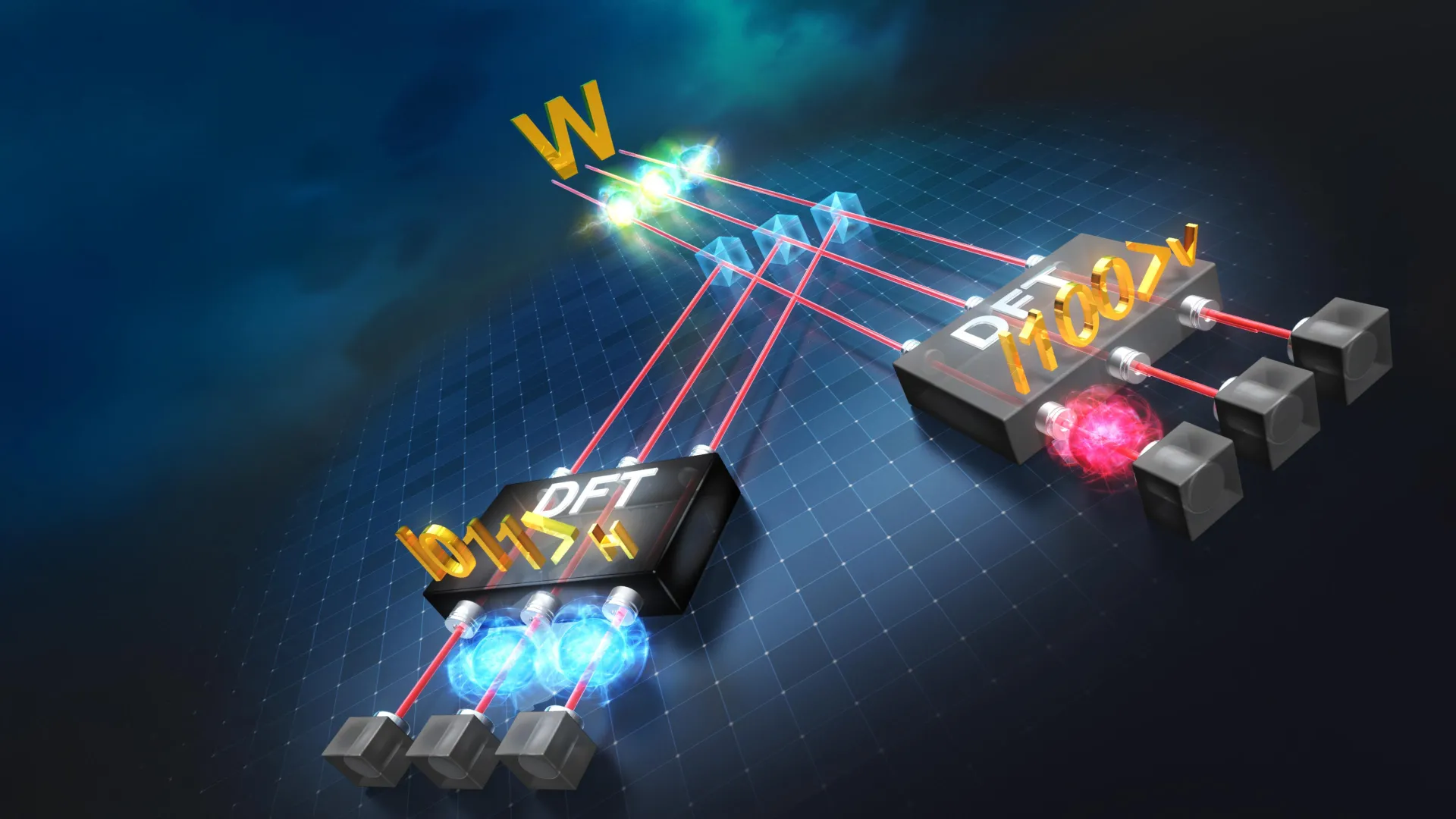
Utilizing this cyclic shift symmetry as their architectural blueprint, the researchers theoretically designed an advanced photonic quantum circuit capable of executing a quantum Fourier transformation. The quantum Fourier transformation is a specialized mathematical operation that reorganizes quantum information across different modes of light, transforming complex, hidden phase relationships into easily detectable interference patterns. By integrating this transformation into their optical circuit design, the team devised a measurement protocol that could, in principle, be scaled to accommodate W states containing any arbitrary number of photons.
To validate their theoretical model, the research team constructed a physical testing apparatus in the laboratory. They engineered high-stability optical quantum circuits built from precision components designed to minimize phase drift and environmental interference. This stability ensured the experimental rig could operate continuously over extended periods without requiring active electronic stabilization or recalibration.
During the experimental phase, the researchers fed three individual photons, configured with carefully calibrated polarization states, into the custom optical device. By analyzing the resulting interference patterns and outputs, the team successfully demonstrated that the system could accurately distinguish among different categories of three-photon W states. Each distinguished state represented a unique, non-classical correlation shared among the incoming photons.
Quantifying Performance: The Crucial Metric of Fidelity
In experimental quantum physics, theoretical success must be validated by rigorous performance metrics. To evaluate the efficacy of their new entangled measurement device, the research group measured its operational fidelity.
Fidelity is a standard quantum metric that quantifies how accurately a system performs its designated task. It represents the mathematical overlap between the expected theoretical state and the physical state actually produced or identified by the device. In the context of this experiment, fidelity measured the exact probability that the optical circuit would yield a correct classification result when fed a pure W-state input.
While the researchers optimized their high-stability optical circuits to push fidelity metrics to levels required for precision quantum information processing, the successful demonstration itself marks the primary milestone. Achieving high fidelity in a one-shot entangled measurement for multi-photon systems confirms that optical quantum architectures can handle complex, multipartite states without succumbing to excessive decoherence or optical loss.
Implications for Quantum Teleportation and Communication Protocols
The successful experimental realization of the W-state entangled measurement carries profound implications for the broader landscape of quantum information science and technology. As governments, academic institutions, and private industry race to build functional quantum networks, the tools required to manipulate information at the subatomic level are expanding.
One of the most immediate beneficiaries of this breakthrough is quantum teleportation. Contrary to popular science fiction depictions, quantum teleportation does not involve the physical movement of matter across space. Instead, it utilizes the principles of entanglement to transfer the exact quantum state containing information from one particle to another across arbitrary distances. Multi-photon entangled states, particularly W states, are crucial for multi-party quantum teleportation networks, where information must be securely shared among several nodes simultaneously. The ability to perform rapid, one-shot entangled measurements on W states streamlines these protocols, reducing error rates and operational overhead.
Furthermore, the new technique promises to enhance emerging quantum communication protocols. Secure quantum key distribution (QKD) networks rely on multi-party entanglement to distribute cryptographic keys across global distances with absolute theoretical security. Utilizing W states for such networks offers enhanced fault tolerance against eavesdropping and photon loss, and the new measurement protocol provides the missing link required to process these states efficiently at relay nodes.
The advance also impacts measurement-based quantum computing (MBQC). Unlike standard gate-based quantum computers that execute algorithms through sequences of logic gates applied to active qubits, MBQC begins with a highly entangled multi-qubit resource state—such as a cluster state or specialized multipartite entangled state—and computes by performing sequential single-qubit measurements. The creation of efficient entanglement identification tools helps characterize and stabilize these foundational resources.
Reflecting on the milestone, Shigeki Takeuchi emphasized the philosophical and practical urgency of foundational research in the quantum sector. "More than 25 years after the initial proposal concerning the entangled measurement for GHZ states, we have finally obtained the entangled measurement for the W state as well, with genuine experimental demonstration for 3-photon W states," Takeuchi stated. "In order to accelerate the research and development of quantum technologies, it is crucial to deepen our understanding of basic concepts to come up with innovative ideas."
Looking Ahead: Scaling to Larger Systems and On-Chip Integration
Having successfully demonstrated the measurement technique using three-photon systems, the research consortium is already looking toward the next phase of development.
The primary objective for the team’s ongoing research agenda is scaling the methodology beyond the three-photon demonstration. By refining the underlying optical circuits and quantum Fourier transformation parameters, the researchers aim to apply the technique to larger-scale and more complex multi-photon entangled states, pushing the boundaries of how many particles can be simultaneously entangled and measured with high efficiency.
Simultaneously, the team is working on the translation of their optical setups into integrated photonic chip architectures. Constructing on-chip photonic quantum circuits—where waveguides, beam splitters, and phase shifters are etched onto a single semiconductor or glass substrate—represents the future of optical quantum computing. On-chip integration drastically reduces the physical footprint of the apparatus, eliminates the mechanical instability associated with bulk optics, and paves the way for mass-producible, scalable quantum hardware.
As the global scientific community continues its quest to realize the full potential of the quantum era, breakthroughs such as the Kyoto-Hiroshima W-state measurement demonstrate that longstanding theoretical hurdles can indeed be overcome. By closing a 25-year gap in our experimental toolkit, this research provides the quantum engineering community with a vital instrument, ensuring that the technology of tomorrow can process complex quantum information with unprecedented speed and reliability.