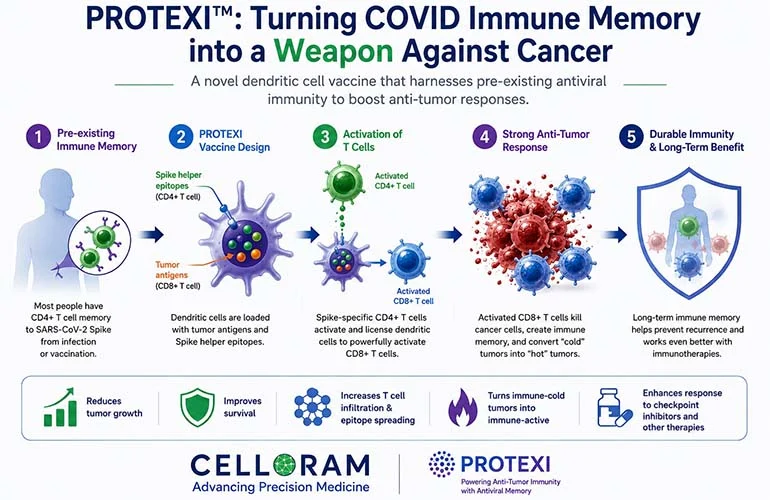
The global landscape of immunology has been irrevocably altered by the COVID-19 pandemic, leaving behind a massive, persistent, and highly durable archive of immune memory within the human population. Leveraging this biological legacy, a Cleveland-based biotechnology firm, Celloram, has unveiled a novel therapeutic approach that repurposes the body’s established response to the SARS-CoV-2 Spike protein to combat malignant tumors. In a study recently published in Nature Communications, researchers from Celloram, Case Western Reserve University, and University Hospitals Cleveland Medical Center detailed the preclinical success of "Protexi," a dendritic cell vaccine designed to bridge the gap between viral memory and oncological intervention.
The Mechanism: Re-engineering Immune Memory
Dendritic cell vaccines have long been viewed as a promising pillar of cancer immunotherapy. These specialized cells function as the sentinels of the immune system, capturing antigens and presenting them to T cells to initiate an attack. Traditionally, these vaccines focus on activating CD8+ cytotoxic T cells—the "killer" cells responsible for identifying and destroying tumor cells. However, clinical history has been sobering: historical data suggests that only about 15% of patients achieve an objective clinical response when relying on CD8 activation alone.
The Protexi platform introduces a sophisticated architectural shift. By incorporating epitopes derived from the SARS-CoV-2 Spike protein, the vaccine acts as a dual-action trigger. While the vaccine presents tumor-specific antigens to CD8+ cells, it simultaneously presents Spike-derived epitopes to CD4+ T helper cells. CD4+ cells serve a critical role as the "conductors" of the immune orchestra. When activated, they provide the necessary cytokine signals to fully mature dendritic cells and guide CD8+ cells into the dense, often immunosuppressive microenvironment of a tumor.
Preclinical Results and Experimental Efficacy
The experimental data presented in the study underscores the potency of this collaborative immune response. In trials involving mouse models, the administration of Protexi yielded a 100% survival rate through day 40, a significant improvement over the 40% survival observed in control groups receiving conventional dendritic cell vaccines.
In a specific melanoma model, the results were equally compelling. Five out of seven mice treated with the Protexi protocol exhibited tumor growth suppression, with masses measuring under 200 cubic millimeters by day 26. This data suggests that by tapping into the pre-existing, robust "memory" of the COVID-19 virus, the immune system is primed to act with greater velocity and precision than it would when encountering a novel tumor antigen in isolation.
Chronology of the Research
The development of Protexi is the culmination of decades of immunological theory and recent rapid-response medical research. The conceptual foundation dates back to the 1990s, when foundational studies established that CD4+ T helper cells were essential for the optimal induction of CD8+ responses against MHC-II-negative tumors.
The integration of these concepts accelerated during the pandemic. Observations made between 2020 and 2025 revealed that COVID-19 vaccination status frequently correlated with improved outcomes for cancer patients undergoing checkpoint inhibitor therapies. This prompted the Celloram team to ask a fundamental question: if the immune system is already "trained" to react violently to the Spike protein, why not use that readiness to escort the immune system to the site of a tumor?
By 2026, the research had matured from theoretical modeling to the peer-reviewed preclinical stage, with the current focus now shifting toward the regulatory requirements for human trials.
Addressing the "Immunological Gap"
A primary concern in the development of such vaccines is the variation in population immunity. While over 80% of the U.S. population and roughly 65% of the global population possess some level of SARS-CoV-2 immune memory, some patients remain without this specific history.
John Letterio, a co-author of the study, addressed this concern by highlighting the durability of T-cell memory. Research into SARS-CoV-1, the virus responsible for the 2003 outbreak, demonstrated that CD4+ T-cell memory could persist for up to 17 years. Data on SARS-CoV-2 suggests a similar, albeit shorter, window of 2 to 4 years, which remains sufficient for clinical purposes. For those without prior immunity, the Celloram team has developed a "priming" protocol. By administering a short, preliminary dose of Spike-loaded dendritic cells, clinicians can synthetically create the necessary immune memory, ensuring that the patient’s body is "prepared" to support the subsequent cancer-fighting vaccine.
Implications for Clinical Oncology
The implications of the Protexi platform extend far beyond COVID-19. The methodology serves as a proof-of-concept for a "plug-and-play" vaccine architecture. If a patient’s immune memory against a common, highly immunogenic virus can be successfully coupled with tumor-specific antigens, the same logic could theoretically be applied to other pathogens, such as influenza or common cold coronaviruses, should a patient’s Spike-specific memory wane.
Furthermore, this approach addresses the historical challenge of identifying tumor-specific CD4+ epitopes, which are computationally difficult to map and vary significantly between individual patients. By using a "known" epitope (the Spike protein) as a universal helper, researchers can standardize a significant portion of the vaccine manufacturing process.
Regulatory Path and Future Outlook
The research team is currently navigating the transition from laboratory success to human clinical application. The next phase involves preparing an Investigational New Drug (IND) submission to the U.S. Food and Drug Administration (FDA). If cleared, the first-in-human trial is slated to take place at the Angie Fowler Adolescent & Young Adult Cancer Institute, focusing on patients diagnosed with sarcoma.
The oncology community is watching this development closely. If the results seen in mouse models translate to human patients, Protexi could represent a paradigm shift in how dendritic cell vaccines are utilized. By utilizing the global immune history of the pandemic as an ally, scientists may have unlocked a way to transform the immune system’s past experiences into a potent, personalized weapon against cancer.
While the transition to clinical trials remains a high-stakes hurdle, the synthesis of infectious disease research and oncology offers a compelling path forward. By leveraging the body’s existing biological defenses, Celloram aims to improve the efficacy of immunotherapy, potentially turning the tide for patients who have historically seen little benefit from traditional vaccine approaches. The coming years will determine whether this reliance on "immune memory" can withstand the complex and often hostile environment of human tumor growth, but the current data provides a promising baseline for the future of personalized medicine.