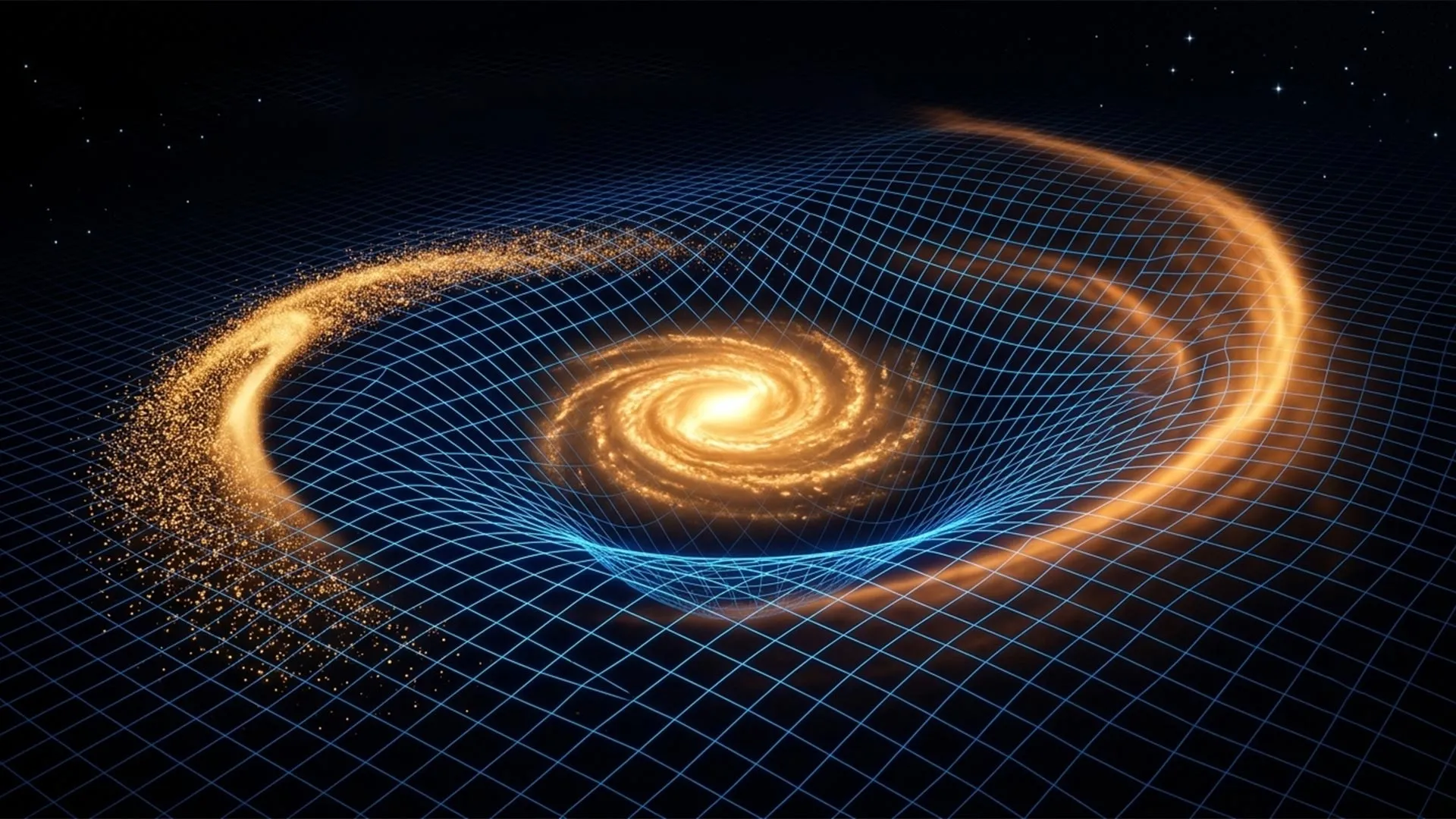
The faint, persistent hum of extremely low-frequency gravitational waves rippling through space-time may hold the key to events that transpired more than 13 billion years ago. In recent breakthroughs, international networks of astronomers utilizing Pulsar Timing Arrays (PTAs) have detected a stochastic background of gravitational waves at nanohertz frequencies. While conventional astrophysical models attribute this background primarily to the slow, inevitable orbital decay of supermassive black hole binaries in the relatively recent universe, groundbreaking research suggests a much deeper, more ancient origin. According to a study recently published as a Letter in Physical Review D by Colgate University researchers Sohan Ghodla and Cosmin Ilie, this cosmic background could serve as an archaeological record detailing the emergence of the universe’s earliest supermassive black holes.
By bridging two previously distinct domains of modern astronomy—the observational conundrum of surprisingly massive black holes existing in the primitive universe and the contemporary detection of gravitational waves generated by merging black hole pairs billions of years later—the Colgate study offers a unifying framework. Specifically, the researchers modeled whether the remnants of primordial, supermassive "Dark Stars" could have acted as seeds for these giants, eventually producing a significant, if not dominant, share of the gravitational wave background measured by today’s PTAs.
The Mechanics of Pulsar Timing Arrays: Nature’s Precision Clocks
To understand the significance of these findings, one must examine the instrument arrays making them possible. Pulsar Timing Arrays rely on pulsars—rapidly spinning, highly magnetized neutron stars that emit beams of electromagnetic radiation. As they rotate, these beams sweep across the sky, appearing to observers on Earth as rhythmic, highly regular pulses of radio waves. Because the rotation of stable pulsars is as precise as atomic clocks, any disturbance in the space-time fabric between Earth and the pulsar introduces minute, measurable shifts in the arrival times of these pulses.
When a stochastic background of gravitational waves washes over the cosmos, it stretches and compresses space-time, causing correlated timing residuals across multiple pulsars spread throughout the galaxy. Over decades of observation, international collaborations—such as NANOGrav in North America, the European Pulsar Timing Array (EPTA), Parkes Pulsar Timing Array (PPTA) in Australia, and the Indian Pulsar Timing Array (INPTA)—have pooled their data to reveal evidence of this nanohertz background.
For years, astrophysicists have debated the precise composition of the sources generating this signal. The prevailing consensus points toward populations of supermassive black hole binaries—systems where two black holes, each possessing masses equivalent to millions or billions of Suns, orbit one another before eventually merging. While this explains the contemporary signal, it exposes a profound chicken-and-egg problem: how did black holes grow to such immense proportions so rapidly in the early universe?
The Enigma of Early Supermassive Black Holes
The deployment of advanced observatories, most notably the James Webb Space Telescope (JWST) and the Chandra X-ray Observatory, has fundamentally challenged standard cosmological models. These instruments have repeatedly discovered supermassive black holes possessing masses exceeding a billion solar masses existing merely hundreds of millions of years after the Big Bang. In standard models of cosmic evolution, black holes grow by accreting surrounding gas and merging with other black holes over many billions of years. Finding such monolithic objects in the infant universe leaves an extraordinarily narrow window for their assembly, necessitating the existence of massive "seed" black holes that formed very early and grew at maximal rates.
To address this deficit, Ghodla and Ilie investigated how ancient seed populations could survive the tumultuous history of the cosmos, grow alongside their host galaxies, pair up into binaries, and ultimately generate the gravitational wave background detected by modern PTAs. The researchers focused their analysis on two primary theoretical pathways for generating massive black hole seeds during the cosmic dawn: direct collapse black holes and the hypothetical remnants of supermassive Dark Stars.
Dark Stars and Primordial Seed Formation
Dark Stars represent a fascinating departure from conventional stellar physics. Unlike modern stars, which are powered by nuclear fusion in their cores, Dark Stars are hypothesized primordial objects sustained by the annihilation of weakly interacting massive particles (WIMPs)—a leading candidate for dark matter. During the universe’s first epochs, before heavier elements were forged, clouds of primordial hydrogen and helium could have been densely populated with dark matter.
In the WIMP dark matter scenario examined by Ghodla and Ilie, these stars would remain relatively cool and physically expansive while continuously gathering material from their surrounding environments. Unburdened by the explosive pressures of traditional nuclear fusion that typically limit stellar growth, these supermassive Dark Stars could swell to sizes exceeding a million solar masses. Eventually, as the dark matter fuel is exhausted or conditions shift, these gargantuan objects would collapse directly into massive black holes, bypassing normal stellar-mass black hole phases entirely.
By contrast, the second pathway—direct collapse black holes—involves the rapid gravitational implosion of massive pristine gas clouds in the early universe, driven by ultraviolet radiation from nearby star-forming galaxies.
Through sophisticated numerical modeling, Ghodla and Ilie traced the lifecycle of black holes produced by both pathways across cosmic time. They tracked the evolution of the host dark matter halos, estimated the frequency of galaxy and black hole mergers, and calculated the cumulative gravitational wave background these mergers would produce.
Quantitative Findings and Implications
The results of the Colgate study provide a striking quantitative distinction between the two seed models. The researchers discovered that if remnants of supermassive Dark Stars existed at a characteristic number density of roughly 10⁻³ Mpc⁻³ (cubic megaparssecs), their descendants would yield a substantial, and potentially dominant, contribution to the stochastic gravitational wave background observed by PTAs.
Conversely, the direct collapse black hole population evaluated in the study proved significantly less prolific. Exhibiting characteristic densities closer to 10⁻⁶ Mpc⁻³, direct collapse remnants would contribute far less to the aggregate signal measured by modern observatories.
Furthermore, the study established strict upper limits on how common these ancient seeds could have been. If early seed densities were to climb into the 10⁻² to 10⁻¹ Mpc⁻³ range, the resulting mergers would generate a gravitational wave background far exceeding the maximum limits allowed by current PTA observations.
"Produce too many of these massive seeds and you end up over-producing the PTA-detected signal," explained Sohan Ghodla. "Produce too few, and you need other sources to efficiently assemble these supermassive black holes later in the life of the universe to match PTA observations."
This realization endows Pulsar Timing Array measurements with a novel capability: acting as an indirect probe of redshifts greater than 10, constraining the population and density of objects that existed during the cosmic dawn despite the actual gravitational wave-emitting mergers occurring billions of years later. The models also reinforce the principle that binaries with total masses exceeding 10⁹ solar masses dominate the observable PTA signal, while systems composed of lighter black holes remain largely hidden beneath the noise floor.
Broader Context and Future Outlook
The implications of this research extend far beyond black hole astrophysics, weaving together disparate threads of modern cosmology. By linking the properties of dark matter, the formation mechanisms of the first luminous objects, and the macro-scale phenomena of gravitational waves, the study offers a multi-messenger strategy for exploring the early universe.
"Dark Stars were originally proposed as objects that might be seen directly at cosmic dawn," noted Cosmin Ilie. "This work points to a completely different way of testing their possible role in cosmic history. Their descendants could leave a gravitational-wave imprint that persists all the way to the present-day Universe."
As international PTA collaborations continue to accumulate observational data—sharpening their sensitivity and reducing measurement uncertainties—the constraints on early black hole formation models will tighten. Coupled with ongoing spectroscopic and infrared observations from the James Webb Space Telescope, astronomers are entering an unprecedented era of precision cosmology. The faint hum of gravitational waves detected today may soon resolve the long-standing mystery of how the universe’s earliest cosmic behemoths were born, validating theoretical constructs like Dark Stars and illuminating the dark history of the early cosmos.