Google’s Antigravity, initially launched and perceived primarily as an integrated development environment (IDE) for AI-first coding, is rapidly revealing a much broader spectrum of capabilities that extend far beyond traditional software development. While its debut showcased impressive features for scaffolding applications and leveraging advanced AI models like Gemini 3 to write code, a deeper examination of its underlying architecture reveals a powerful agentic platform designed to tackle a diverse array of professional tasks. This sophisticated tool, built upon autonomous browser agents, persistent knowledge bases, parallel task orchestration, and native database connectivity, is poised to redefine productivity across numerous non-coding domains, from market research to data analysis and content generation.
The Evolution of Google Antigravity: Beyond the Codebase
When Google first introduced Antigravity, the narrative largely centered on its revolutionary approach to developer workflows. The ability to generate code, refactor applications, and streamline development cycles with intelligent agents was undeniably compelling, immediately capturing the attention of the tech community. Early adopters quickly recognized its potential to significantly reduce the manual effort involved in coding, leading to widespread excitement about the future of software engineering. However, the true innovation of Antigravity lies not just in its coding prowess but in its comprehensive suite of agentic capabilities. It features a browser that can interpret and navigate web pages with human-like understanding, a robust memory system that retains context and learnings across multiple sessions, and an agent framework capable of managing several complex tasks concurrently. These foundational elements transform Antigravity from a specialized coding tool into a versatile AI assistant, offering substantial advantages in various professional fields that traditionally involve laborious, repetitive, or complex information processing.
The platform’s deep integration with Google’s AI ecosystem, particularly its reliance on models like Gemini 3, positions it at the forefront of the agentic AI revolution. This shift marks a significant evolution from passive AI tools that merely offer suggestions or complete isolated tasks, to proactive agents that can understand, plan, execute, and learn from multi-step objectives. Google’s strategic investment in such platforms underscores a broader industry trend towards intelligent automation, where AI is increasingly empowered to act autonomously to achieve defined goals, thereby augmenting human capabilities rather than merely assisting them. This contextual understanding is crucial to appreciating why Antigravity’s non-coding applications are not merely secondary features but integral components of its overarching design philosophy.
Antigravity as a Strategic Research Assistant
One of the most immediate and impactful non-coding applications of Antigravity is its utility as a sophisticated research assistant. Traditional competitive or market research is often a fragmented and inefficient process, typically involving manual navigation across dozens of browser tabs, inconsistent note-taking, and the arduous task of synthesizing disparate information into a coherent report. Researchers frequently grapple with information overload, context loss, and the challenge of producing structured, actionable insights from vast quantities of raw data.
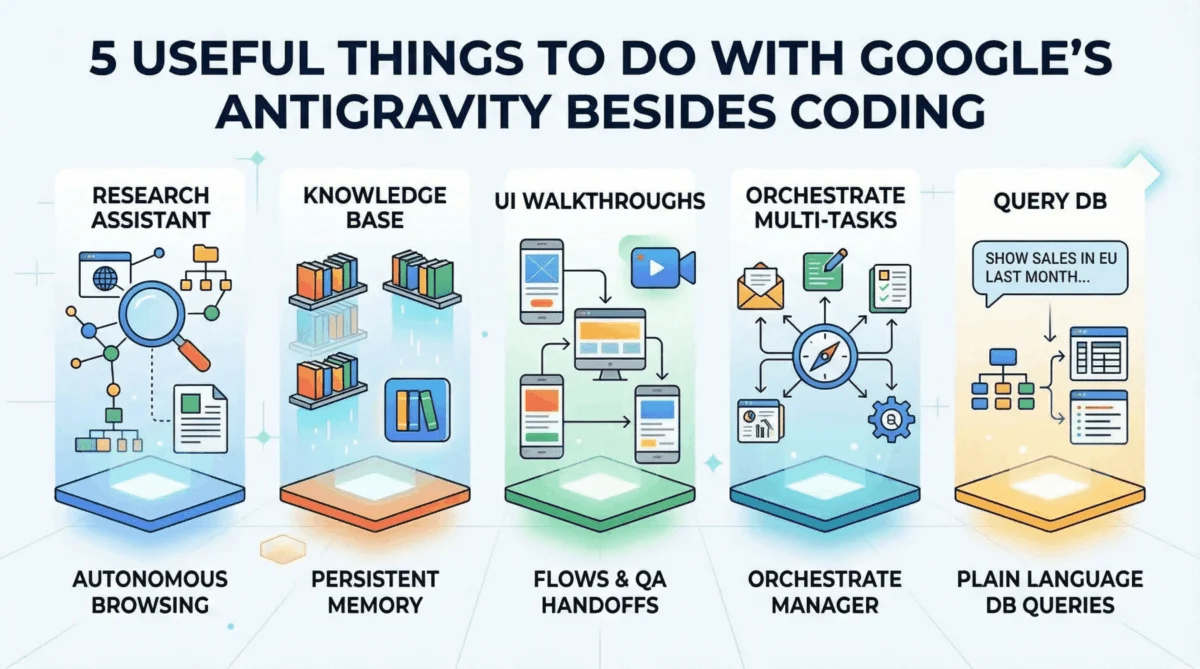
Antigravity’s browser agent fundamentally transforms this workflow. Users can articulate their research objectives in natural language – such as "find recent product announcements from competitors A, B, and C," "gather pricing pages for service X across different regions," or "identify key updates in industry Y from the last quarter." The agent then autonomously navigates the web, utilizing its deep Chrome integration to "see" and interact with web pages much like a human user would. This means it scrolls, clicks, fills forms, and reads rendered content, bypassing the limitations of parsing raw HTML. As it gathers information, Antigravity synthesizes these findings into a structured "Artifact," which can be organized by category, source, recency, or any other user-defined parameter. This output is not a chaotic wall of text but a logically arranged, commentable document that is immediately actionable.
For professionals engaged in recurring market research, competitive intelligence, or academic literature reviews, the time savings and quality improvements are substantial. What might traditionally consume days of manual effort – comprising countless hours of browsing, data extraction, and organization – can be completed by Antigravity in minutes. This capability reduces the cognitive load on human researchers, allowing them to focus on analysis and strategy rather than the tedious mechanics of data collection. Industry analyses suggest that inefficiencies in research processes can lead to significant delays in decision-making and product development. Tools like Antigravity, by automating the preliminary stages of research, can dramatically accelerate the insight-generation pipeline, potentially cutting research cycle times by 50-70% according to some estimates for similar automation tools, thereby fostering more agile and informed business strategies.
Building a Persistent and Evolving Knowledge Base
A persistent challenge in many organizations is the transient nature of institutional knowledge. Information, whether in the form of code snippets, company policies, project specifications, or client feedback, often becomes siloed, forgotten, or simply "evaporates" as employees move on or projects conclude. Antigravity addresses this directly through its core design principle of treating learning and context as persistent features rather than session-dependent resets. The platform enables agents to save and recall context, recurring patterns, and critical reference materials to a shared knowledge base that continually grows and refines itself with every interaction.
This knowledge base is remarkably versatile, capable of ingesting and organizing a wide array of information types. Beyond technical documentation, users can feed it corporate style guides, internal standard operating procedures (SOPs), onboarding materials, legal compliance guidelines, or even create interactive flashcards using external tools like Coursebox for quick reference. The critical distinction is that this structured memory system remains intact across sessions. It is not wiped clean when the application is closed, nor does it require users to repeatedly paste the same foundational information into new prompts.
Over time, as agents interact with this accumulating knowledge base, their accuracy and contextual awareness improve significantly. They draw upon a comprehensive history of the user’s work and the organization’s accumulated wisdom, leading to more relevant, precise, and consistent outputs. This capability is transformative for fields requiring high levels of consistency and adherence to specific guidelines, such as legal, financial, or content creation industries. It combats information silos, streamlines onboarding processes for new team members, and ensures that critical operational knowledge is preserved and actively utilized. The economic impact of improved knowledge management is well-documented; studies from organizations like the American Productivity & Quality Center (APQC) have shown that effective knowledge management can lead to a 20-30% improvement in productivity and a significant reduction in operational costs. Antigravity’s approach offers a tangible solution to these pervasive challenges, fostering an environment where organizational learning is continuous and accessible.
Automated UI Walkthrough Generation for Enhanced Documentation
For product managers, UX researchers, quality assurance (QA) teams, and technical writers, the manual creation of user interface (UI) walkthroughs and documentation is a notoriously time-consuming and often frustrating task. It typically involves meticulously navigating an application, capturing screenshots at each step, annotating them, and then compiling these elements into a coherent, step-by-step guide. This process is not only labor-intensive but also prone to errors and can quickly become outdated as software evolves.
Antigravity’s browser agent offers a revolutionary alternative. By simply pointing the agent at a specific URL and describing the desired user flow in natural language (e.g., "log in, navigate to user settings, change profile picture, save changes"), the platform autonomously executes the entire sequence. During this process, it captures screenshots at each critical stage, records video of its actions, and compiles all these assets into a comprehensive "walkthrough Artifact." The resulting deliverable is a timestamped, visually rich, and commentable user journey that faithfully reflects the exact state of the UI at the moment of execution.
This automation slashes the time and effort traditionally required for such documentation from days to mere minutes. A task that might consume an entire day or two of focused, repetitive manual work can be generated almost instantaneously. The reliability of the output is particularly valuable for QA handoffs, stakeholder reviews, and training material development. It ensures that all parties are working from an accurate and up-to-date visual representation of the application’s functionality, reducing ambiguities and facilitating smoother communication across product development teams. In an era where rapid iteration and agile development are paramount, the ability to quickly generate high-fidelity UI documentation accelerates product cycles, enhances the quality of user experiences, and significantly reduces the overhead associated with maintaining comprehensive product guides.
Orchestrating Multiple Tasks Simultaneously
The Agent Manager within Antigravity introduces a powerful paradigm shift in how complex projects are handled, allowing users to orchestrate multiple intelligent agents in parallel across distinct workspaces. This "mission-control" interface empowers users to assign independent tasks to different agents, each operating with its own context and generating its own set of Artifacts. The interaction becomes asynchronous, moving away from real-time monitoring of every step to checking completed outputs when they are ready.
While Antigravity’s official documentation often frames this capability through a developer-centric lens, its underlying mechanics are broadly applicable to a multitude of non-coding scenarios. Imagine simultaneously running a comprehensive content audit (checking for SEO compliance, grammatical errors, and factual accuracy across an entire website), a multi-faceted market research task (collecting data from diverse sources on competitor pricing, customer sentiment, and emerging trends), and a database exploration (identifying anomalies or patterns in sales data). Each of these complex tasks, traditionally requiring dedicated human attention and sequential execution, can be assigned to separate agents.
This parallel processing capability delivers profound benefits, most notably a significant reduction in context-switching overhead. Human cognition suffers when rapidly shifting between disparate tasks, leading to decreased efficiency and increased error rates. By delegating these parallel workstreams to autonomous agents, individuals and teams can maintain focus on higher-level strategic thinking and critical decision-making. The ability to operate at the level of assigning briefs rather than executing individual steps represents a fundamental shift in productivity. For organizations managing intricate projects that involve gathering, processing, and analyzing information from various sources or formats, Antigravity’s Agent Manager offers a robust solution for enhancing throughput and overall project efficiency. Industry studies on multitasking and context-switching indicate that productivity losses can range from 20% to 80% depending on task complexity, making tools that enable parallel processing invaluable.
Natural Language Database Querying
Accessing and analyzing data stored in enterprise databases often remains a significant barrier for non-technical users. Typically, extracting specific insights requires proficiency in Structured Query Language (SQL) or reliance on data analysts, creating bottlenecks and delaying data-driven decision-making. Antigravity directly addresses this challenge with its native Model Context Protocol (MCP) server support, enabling seamless, UI-driven connectivity to prominent databases such as Google BigQuery, AlloyDB, and Spanner.
Once connected, the Antigravity agent gains access to the database schema and can perform complex operations – querying, describing, and reasoning over the data – using plain, natural language. Users simply provide their project details and authenticate via standard identity and access management (IAM) credentials. The agent then intelligently translates the user’s natural language question into the appropriate SQL query, executes it, and presents the answer in an understandable format. This eliminates the need for users to write complex SQL queries or grapple with intricate configuration files. The setup process itself is streamlined and intuitive, driven by a user-friendly form rather than requiring manual manipulation of YAML files or debugging connection strings.
This capability is quietly revolutionary for business analysts, operations managers, and other professionals who require regular access to insights from large datasets. It democratizes data access, empowering individuals across departments to retrieve critical information without needing specialized technical skills. This significantly reduces the dependency on IT or data analytics teams for routine data pulls, freeing up specialized personnel for more strategic initiatives. The implications for faster insights and improved data-driven decision-making are immense, contributing to more agile business operations and competitive advantage. As the demand for data literacy and self-service analytics continues to grow, Antigravity’s natural language querying stands out as a critical enabler for fostering a data-empowered culture within organizations.
Broader Impact and Future Implications
Google Antigravity’s emergence as a versatile agentic platform, extending far beyond its initial perception as a coding tool, signifies a pivotal moment in the evolution of AI-powered productivity tools. While its launch strategically focused on developer benchmarks and a clear product announcement, the inherent architecture was designed for a much broader scope. The integration of autonomous browser agents, persistent knowledge bases, parallel task orchestration, and native database connectivity collectively positions Antigravity not merely as an IDE but as a comprehensive platform for intelligent automation across a myriad of professional functions.
This shift aligns with Google’s broader AI strategy, emphasizing the creation of AI agents that can actively "do" rather than just "suggest." Industry analysts widely concur that such platforms represent a significant leap forward, moving from assistive AI to generative and executive AI. The implications for the future of work are profound: tasks that were once labor-intensive, repetitive, or required specialized technical skills can now be delegated to intelligent agents, allowing human professionals to concentrate on higher-order thinking, creativity, strategy, and complex problem-solving. This doesn’t necessarily mean job displacement but rather job transformation, where human roles evolve to leverage these powerful tools for enhanced efficiency and innovation.
As businesses continue to seek competitive advantages through digital transformation and AI adoption, platforms like Antigravity will play a critical role in driving operational efficiency, accelerating decision-making, and fostering a culture of continuous learning and innovation. The emphasis on user-friendly interfaces, natural language interaction, and persistent memory addresses key pain points across various industries, democratizing access to advanced AI capabilities for a wider professional audience. While ethical considerations around AI governance, data privacy, and potential biases in agent behavior will undoubtedly remain central to the ongoing discourse, the immediate promise of Antigravity lies in its demonstrated ability to redefine productivity and streamline workflows in ways previously unimaginable, firmly establishing Google as a frontrunner in the evolving landscape of agentic AI.