Natural Language Processing (NLP) stands as a foundational pillar of modern artificial intelligence and software systems, underpinning everything from sophisticated search engines and intelligent chatbots to automated customer support routing and critical entity extraction pipelines. In the realm of production-grade NLP within the Python ecosystem, spaCy has firmly established itself as an industry standard. Engineered specifically for high-performance deployment, spaCy offers industrial-strength speed, a suite of pre-trained statistical and transformer models, and an intuitive API designed to streamline development. However, a common pitfall for many developers is treating spaCy as a monolithic black box, loading models, running them on text, and passively accepting default processing speeds and extraction limitations. This oversight can transform a local prototype into a computational bottleneck when scaling to millions of documents, leading to increased latency, bloated memory footprints, and a failure to recognize crucial domain-specific entities. To build truly high-performance text processing pipelines, a nuanced understanding of spaCy’s internal execution flow and optimization levers is indispensable. This article delves into three essential spaCy techniques—selective pipeline loading, parallel batch processing, and hybrid rule-based statistical entity recognition—that every developer should master to maximize processing speed, reduce resource consumption, and precisely customize entity recognition capabilities.
The Evolving Landscape of Natural Language Processing and spaCy’s Role
The journey of Natural Language Processing has seen remarkable evolution, shifting from early rule-based systems to statistical methods, and now into the era of deep learning and large language models (LLMs). This progression has exponentially increased the capabilities of machines to understand, interpret, and generate human language. Early NLP efforts relied heavily on handcrafted rules and lexicons, which were precise but brittle and difficult to scale. The advent of statistical NLP, driven by machine learning algorithms and vast text corpora, brought robustness and generalization. More recently, transformer architectures and LLMs have revolutionized the field, achieving unprecedented levels of performance across a wide array of linguistic tasks.
Amidst this rapid evolution, spaCy emerged to address a critical need: a library that bridges the gap between research-oriented NLP tools and the demands of production environments. Developed by Explosion AI, spaCy was introduced with a clear vision in mind—to provide "industrial-strength NLP" that is fast, efficient, and user-friendly. Its design philosophy emphasizes speed, accuracy, and ease of deployment, making it a go-to choice for companies building real-world applications. Unlike some academic libraries focused on experimentation, spaCy provides robust, optimized components suitable for handling large volumes of text data in mission-critical systems. However, even with such a powerful toolkit, developers who do not engage with its optimization features risk underutilizing its full potential, transforming a state-of-the-art library into a source of performance constraints.
Unlocking Efficiency: Strategic Pipeline Management
One of the most immediate avenues for optimizing spaCy involves judicious management of its NLP pipeline components. By default, when a pre-trained spaCy model like en_core_web_sm is loaded, it initializes a comprehensive NLP pipeline designed to perform a wide array of linguistic analyses. This typically includes a tokenizer, a tagger (for part-of-speech tagging), a parser (for dependency parsing), a lemmatizer, and a named entity recognizer (NER). While this rich default feature set is incredibly powerful, it comes with a substantial computational overhead. Each component adds to the processing time and memory footprint, regardless of whether its output is actually required for the specific application.
Understanding Default Pipeline Overhead
Consider an application solely focused on named entity recognition. In such a scenario, running the dependency parser and lemmatizer on every document constitutes a significant waste of CPU cycles and memory resources. Conversely, if the goal is merely text cleaning and lemma extraction, the deep statistical NER model represents an unnecessary computational burden. Unchecked, this default behavior can lead to prohibitive resource consumption when processing data at scale. Industry benchmarks often show that components like dependency parsing can consume a significant portion of the total processing time—potentially 30-40% or more, depending on the model and text complexity—making their exclusion a prime target for optimization.
Strategic Component Disabling for Performance Gains
spaCy offers elegant solutions to this problem through selective component exclusion during model loading and temporary disabling during execution. By passing an exclude parameter to spacy.load(), developers can prevent heavy, unused components from being loaded into memory from the outset. This not only reduces the memory footprint but also accelerates model initialization. For instance, spacy.load("en_core_web_sm", exclude=["parser", "tagger"]) would load the model without the computationally intensive dependency parser and part-of-speech tagger.
Furthermore, for scenarios where different parts of an application require varying pipeline components, spaCy’s nlp.select_pipes() context manager provides a powerful mechanism for temporary disabling. This allows developers to deactivate specific components only for a particular processing block, reactivating them afterwards without having to reload the entire model. For example, with nlp_optimized.select_pipes(disable=["attribute_ruler", "lemmatizer"]): would temporarily skip these components, ensuring that processing is streamlined only for the essential tasks, such as NER.
Empirical tests demonstrate tangible speedups. Processing 1,000 documents with a full pipeline might take approximately 2.85 seconds. By strategically excluding the parser and tagger and temporarily disabling the attribute ruler and lemmatizer, the same workload can be completed in roughly 1.78 seconds, yielding a speedup of over 1.6 times. This efficiency gain is not merely theoretical; it translates directly into reduced cloud computing costs and enhanced responsiveness for user-facing applications, reinforcing the principle that optimized resource utilization is paramount in production systems.
Scaling Up: High-Throughput Batch Processing with nlp.pipe
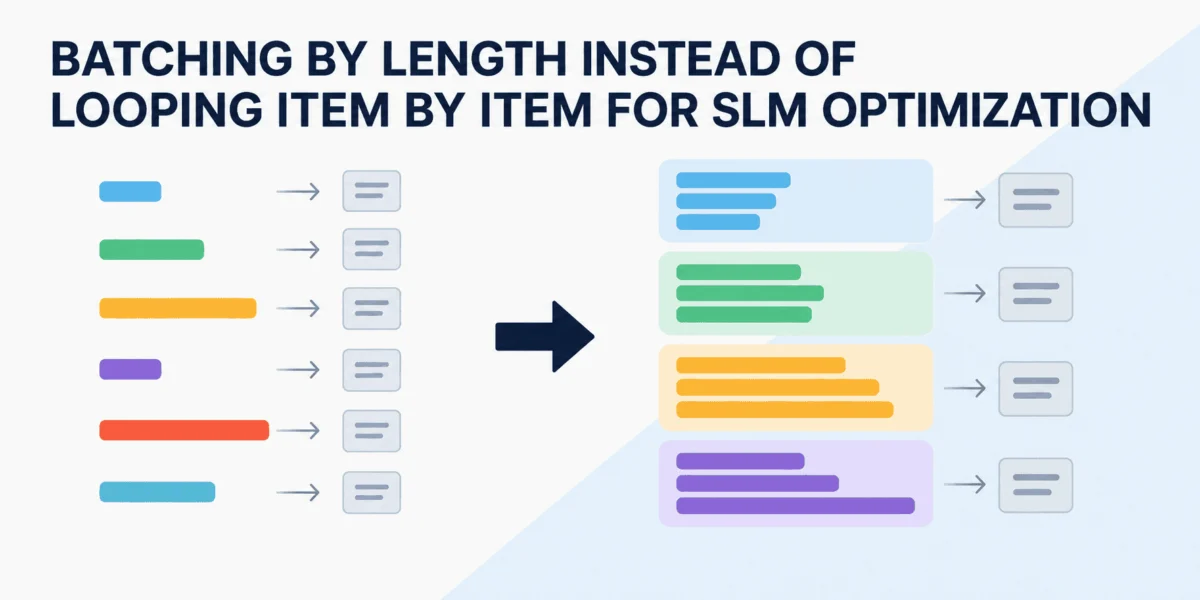
When dealing with large text corpora—whether from vast databases, data lakes, or streaming sources—the conventional approach of iterating over individual strings and calling the nlp object (e.g., [nlp(text) for text in texts]) is a recognized anti-pattern. This sequential processing method prevents spaCy from leveraging its internal optimizations for memory buffers, grouping operations, and, crucially, multi-core parallelization. The resulting performance degradation can be severe, transforming what should be a swift data ingestion process into a significant bottleneck.
The Pitfalls of Sequential Processing
Sequential processing incurs overhead for each document: each call to nlp(text) involves setting up the processing context, allocating memory, and performing operations independently. This per-document overhead accumulates rapidly, making it inefficient for large datasets. Moreover, in real-world data pipelines, text often comes accompanied by critical metadata—such as a record ID, timestamp, or category. Manually tracking and re-associating this metadata with the NLP output through brittle index tracking or external joins is error-prone and adds further complexity and latency.
Leveraging Parallelism and Metadata Flow with nlp.pipe
The solution lies in spaCy’s nlp.pipe() method, designed for high-throughput batch processing. This method processes documents as an optimized stream, internally buffering them and supporting multi-processing. By calling nlp.pipe(), developers can feed large batches of text to spaCy, allowing the library to efficiently group operations and distribute the workload across available CPU cores.
A key feature of nlp.pipe() for real-world applications is its ability to propagate metadata. By setting as_tuples=True, developers can feed tuples of (text, context) to spaCy. The method will then return (doc, context) pairs, seamlessly carrying metadata through the entire NLP pipeline. This eliminates the need for manual alignment, ensuring data integrity and simplifying downstream integration.
For instance, processing 1,000 database records sequentially might take around 2.74 seconds. While nlp.pipe() might initially show a slight overhead for smaller datasets due to the setup of parallel processes, its benefits become overwhelmingly clear at scale. When the workload increases to 10,000 documents, the sequential approach might take approximately 27.67 seconds. In stark contrast, nlp.pipe() with n_process=-1 (utilizing all available CPU cores) can complete the same task in approximately 11.54 seconds, demonstrating a speedup of over 2.4 times. These compounding savings are vital for data processing workflows that handle millions or even billions of documents, enabling real-time analytics and reducing operational costs significantly.
Enhancing Precision: Hybrid Named Entity Recognition with EntityRuler
While pre-trained statistical and transformer-based Named Entity Recognition (NER) models are incredibly powerful for identifying general entity types like ORG (organization), PERSON, or DATE based on contextual patterns, they frequently encounter limitations when confronted with domain-specific terminology. Custom product SKUs, legacy code IDs, proprietary project names, or highly specialized medical terms often remain unrecognized because they were absent from the models’ training data.
Bridging the Gap: Statistical vs. Rule-Based NER
Addressing these gaps typically involves fine-tuning the deep learning statistical model on custom entities. However, this approach demands extensive data labeling—often thousands of meticulously annotated sentences—which is a time-consuming and resource-intensive endeavor. Moreover, fine-tuning carries the inherent risk of "catastrophic forgetting," where the model, in learning to recognize new entities, inadvertently loses its ability to accurately identify standard entities it previously knew. This trade-off can undermine the overall performance and reliability of the NER system.
A more robust and highly efficient solution is to adopt a hybrid NER approach using spaCy’s EntityRuler. The EntityRuler component allows developers to define rule-based patterns, leveraging regular expressions or token-based dictionary lookups, and seamlessly inject them directly into the NLP pipeline. This component acts as a "smart overlay" that complements the statistical NER model without requiring costly retraining or risking catastrophic forgetting.
Integrating EntityRuler for Domain-Specific Entities
The EntityRuler can be strategically added to the pipeline either before or after the statistical NER component. When placed before="ner", it pre-tags deterministic entities, providing valuable context that can help the statistical model make more informed decisions about ambiguous tokens. When placed after="ner", it can act as a fallback mechanism to catch entities missed by the statistical model or serve as an override for specific cases where rule-based precision is paramount.
Historically, developers attempting to patch statistical NER gaps often resorted to running regex patterns on the raw text after the spaCy pipeline had completed. This manual post-processing is cumbersome, often requiring complex character-to-token offset conversions to integrate the rule-based matches into the spaCy Doc object, resulting in disconnected data structures and brittle code. The EntityRuler eliminates this complexity by consolidating both statistical and rule-based entities within a single, cohesive doc.ents sequence. For example, a statistical model might miss a custom ticket ID like "TKT-98421". By adding an EntityRuler with a pattern "label": "TICKET_ID", "pattern": ["TEXT": "REGEX": "^TKT-d+$"], this entity is reliably recognized and integrated into the Doc.ents list alongside entities identified by the statistical model.
This hybrid implementation is crucial for industries with highly specific terminologies, such as finance (e.g., recognizing unique financial product codes), healthcare (e.g., identifying specific drug compounds or medical device IDs), or legal tech (e.g., extracting specific clause numbers or case references). It ensures that critical, domain-specific information is accurately captured without compromising the broad applicability of the statistical model.
Industry Perspectives and Expert Commentary
The importance of spaCy optimization is a recurring theme among NLP practitioners and software architects. Developers at Explosion AI, the creators of spaCy, have consistently championed best practices for pipeline optimization. "Our foundational goal with spaCy was to deliver industrial-strength NLP capabilities," a spokesperson from Explosion AI reiterated in a recent developer forum. "This commitment extends to empowering our users with the necessary tools to fine-tune performance, ensuring spaCy excels in diverse production environments where efficiency and accuracy are non-negotiable."
Leading NLP engineers frequently highlight that overlooking these optimization techniques can be the difference between a successful deployment and a system plagued by performance issues. Dr. Elena Petrova, Head of AI Research at GlobalTech Solutions, commented, "In the age of big data, an unoptimized NLP pipeline quickly becomes a bottleneck. Understanding spaCy’s architectural nuances and applying these advanced techniques is no longer a luxury but a fundamental requirement for anyone serious about deploying scalable and robust NLP solutions." This sentiment underscores a broader industry consensus: effective NLP deployment necessitates a proactive approach to performance tuning.
Broader Implications for AI Development and Business Operations
The adoption of these advanced spaCy optimization techniques carries significant implications that extend beyond mere technical performance, influencing business operations, cost efficiency, and the strategic deployment of AI.
Cost Savings and Scalability: Efficient NLP pipelines translate directly into reduced cloud infrastructure costs. By minimizing CPU cycles and memory usage, businesses can process larger volumes of data with the same resources or achieve the same processing output with fewer resources. This scalability is critical for organizations dealing with ever-growing data volumes, enabling them to expand their NLP capabilities without incurring prohibitive expenses.
Real-time Applications: Faster processing capabilities are essential for real-time AI applications. Optimized spaCy pipelines enable more responsive chatbots, immediate customer service automation, dynamic content personalization, and rapid analysis of incoming data streams, all of which enhance user experience and operational agility.
Accuracy and Reliability: The hybrid NER approach, combining the power of statistical models with the precision of rule-based systems, significantly improves the overall accuracy and reliability of extracted information. This is particularly vital in regulated industries or for applications where misidentification of entities can have serious consequences.
Democratization of Advanced NLP: By providing clear, actionable methods for optimization, spaCy empowers a broader range of developers to build and deploy sophisticated NLP systems. This reduces the reliance on deep machine learning expertise for every aspect of pipeline development, fostering innovation and accelerating the adoption of AI across various sectors.
Future Trends: As the NLP landscape continues to evolve with increasingly complex models and multimodal AI, the principles of efficient pre-processing and post-processing will become even more critical. These optimization strategies lay the groundwork for building future-proof NLP architectures capable of handling the demands of next-generation AI applications.
In conclusion, transitioning from default spaCy configurations to meticulously optimized pipelines is a critical step for any developer aiming to build production-grade text processing solutions. By mastering selective pipeline loading, embracing high-throughput batch processing with nlp.pipe, and leveraging the precision of the EntityRuler for hybrid named entity recognition, developers can design systems that are not only faster and more memory-efficient but also perfectly tailored to the unique vocabulary and requirements of their business data. Deploying these design patterns ensures that NLP pipelines remain scalable, cost-effective, and highly reliable, serving as a robust foundation for advanced AI applications.