The Evolving Database Landscape and the Rise of Open Source
Historically, databases primarily served as static repositories for application records. The relational database model, pioneered in the 1970s, dominated for decades, providing structured storage and ACID (Atomicity, Consistency, Isolation, Durability) guarantees. However, the advent of the internet, the proliferation of big data, and the increasing demand for real-time interactions catalyzed the emergence of diverse database paradigms. NoSQL databases (document, key-value, graph, column-family) addressed scalability and flexibility challenges, while specialized systems began to cater to niche requirements like time-series data, search, and in-memory processing. This diversification has been paralleled by the explosive growth of the open-source movement, which has democratized access to powerful, cutting-edge technologies. Open-source projects foster rapid innovation, community collaboration, and transparent development, making them increasingly attractive to developers and enterprises alike. The shift towards cloud-native architectures and microservices has further amplified the need for flexible, performant, and easily deployable database solutions, many of which are now spearheaded by vibrant open-source communities on platforms like GitHub.
Deep Dive into Key Open-Source Database Innovations
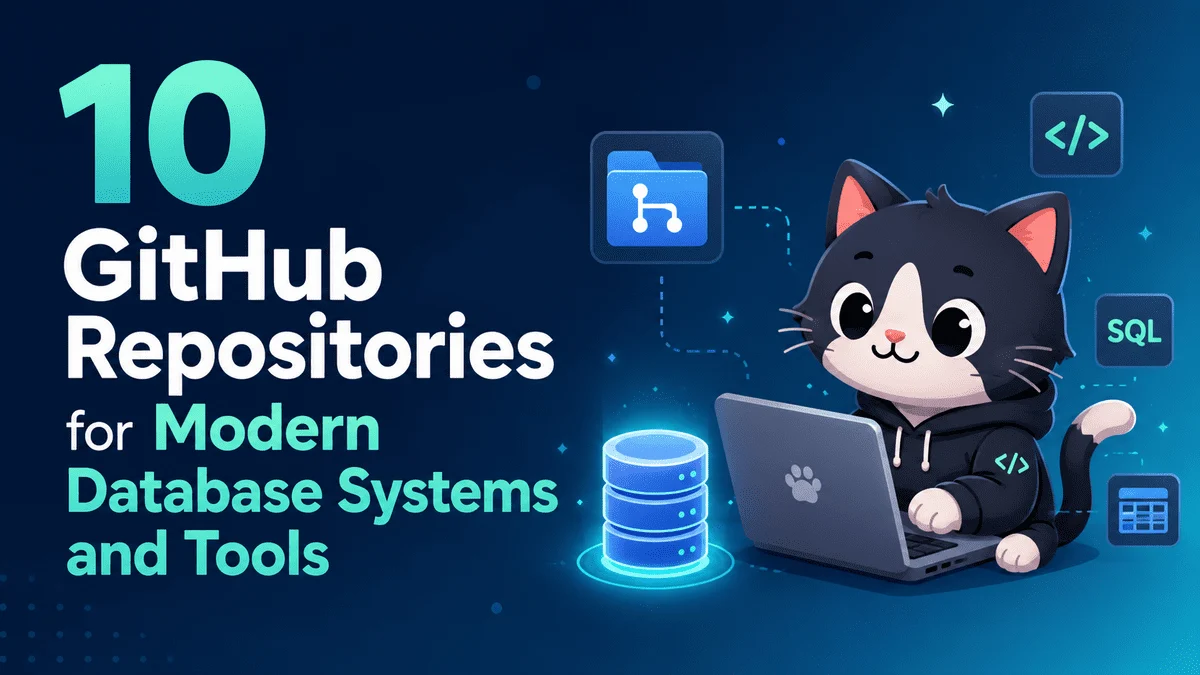
This article explores ten highly popular, practical, and community-loved open-source GitHub repositories that exemplify the modern database ecosystem. These tools offer robust, free-to-explore solutions that are easy to test locally and flexible enough for self-managed server deployments, empowering developers building everything from web applications and analytics dashboards to AI products and distributed systems.
1. ClickHouse: Real-time Analytics at Scale
- Repository: ClickHouse/ClickHouse
- Overview: ClickHouse is an open-source, column-oriented database management system renowned for its unparalleled speed in analytical queries on massive datasets. Developed by Yandex and released as open source in 2016, it has quickly gained traction for its ability to process billions of rows per second. Its architecture is optimized for OLAP (Online Analytical Processing) workloads, making it a go-to choice for scenarios where query speed is paramount.
- Best for: Real-time analytics databases, business intelligence, log analysis, event streaming, and observability platforms.
- Why it is useful: ClickHouse’s column-oriented storage and vectorized query execution engine enable it to achieve blazing-fast query performance. It efficiently handles high-throughput data ingestion and complex aggregations, providing instant insights from vast quantities of data. Its distributed architecture allows for horizontal scalability, supporting petabyte-scale data warehousing without compromising performance, a feature highly valued by enterprises handling large-scale operational analytics.
2. DuckDB: Embedded Analytics for Data Scientists
- Repository: duckdb/duckdb
- Overview: DuckDB is an in-process analytical SQL database designed to run directly within applications, notebooks, or local environments without requiring a separate server process. Often referred to as the "SQLite for analytics," it offers high performance for analytical queries on local files and tabular data, making it a favorite among data scientists and analysts.
- Best for: Local analytical SQL processing, data exploration in Python/R notebooks, embedded analytics, and single-machine ETL (Extract, Transform, Load) tasks.
- Why it is useful: DuckDB eliminates the overhead of server setup and management, allowing data professionals to perform complex SQL queries directly on local CSVs, Parquet files, or Pandas DataFrames with exceptional speed. Its tight integration with data science tools like Python (Pandas, Polars) and R streamlines workflows, enabling rapid data exploration, cleaning, and transformation within familiar programming environments, significantly accelerating the data analysis lifecycle.
3. Supabase: The Open-Source Firebase Alternative
- Repository: supabase/supabase
- Overview: Supabase is a comprehensive open-source platform that provides a full suite of backend services, centered around a dedicated PostgreSQL database. Launched in 2020, it aims to be an open-source alternative to Google’s Firebase, offering authentication, instant APIs, real-time subscriptions, storage, and serverless functions.
- Best for: Building web, mobile, and AI applications with a modern, full-stack developer experience, leveraging the power and reliability of PostgreSQL.
- Why it is useful: Supabase significantly accelerates application development by providing a robust PostgreSQL backend alongside essential tools like user authentication, file storage, and real-time data synchronization. Its "Postgres-first" philosophy means developers benefit from the reliability and feature richness of Postgres, while the platform handles the infrastructure, API generation, and real-time capabilities, allowing them to focus on core application logic. This integrated approach simplifies backend development, making it popular for rapid prototyping and production-ready applications.
4. Redis: The Versatile In-Memory Data Store
- Repository: redis/redis
- Overview: Redis (Remote Dictionary Server) is an open-source, in-memory data structure store used as a database, cache, and message broker. Created in 2009, it supports a wide range of data structures, including strings, hashes, lists, sets, sorted sets, streams, and more, making it incredibly versatile for various high-performance use cases.
- Best for: Caching, real-time applications (gaming, ad-tech, IoT), session management, message queues, and leaderboards.
- Why it is useful: Redis provides sub-millisecond latency for data access, making it indispensable for applications requiring high performance and responsiveness. Its in-memory nature ensures extremely fast read/write operations, crucial for caching frequently accessed data, managing user sessions, and enabling real-time features. Beyond simple caching, its support for complex data structures and atomic operations allows developers to implement sophisticated functionalities efficiently, enhancing overall application speed and user experience.
5. Prometheus: Monitoring the Modern Infrastructure
- Repository: prometheus/prometheus
- Overview: Prometheus is an open-source monitoring system and time-series database initially developed at SoundCloud in 2012 and later became a graduated project of the Cloud Native Computing Foundation (CNCF). It excels at collecting and storing metrics as time-series data, offering a powerful query language (PromQL) and flexible alerting capabilities.
- Best for: Monitoring application and infrastructure performance, service health, and creating comprehensive observability platforms in cloud-native environments.
- Why it is useful: Prometheus provides unparalleled visibility into the health and performance of production systems. Its pull-based metrics collection model, robust data model, and powerful PromQL enable developers and operations teams to define, query, and visualize metrics with high granularity. The flexible alerting system ensures that potential issues are identified and addressed proactively, making it a critical tool for maintaining the reliability and stability of distributed systems.
6. Vitess: Scaling MySQL with Cloud-Native Precision
- Repository: vitessio/vitess
- Overview: Vitess is a database clustering system for horizontally scaling MySQL. Developed at YouTube to handle massive traffic and data volumes, it was open-sourced in 2011 and is also a CNCF graduated project. Vitess intelligently shards MySQL databases, routes queries, and manages replication, allowing MySQL to operate as a highly scalable, cloud-native database.
- Best for: Scaling MySQL databases to accommodate very large datasets and high-traffic application workloads, particularly in cloud environments.
- Why it is useful: Vitess addresses the inherent scaling limitations of single MySQL instances by providing a sophisticated sharding and clustering layer. It automates database sharding, handles connection pooling, performs query rewriting, and manages replication, allowing applications to interact with what appears to be a single, massive MySQL database. This capability prevents database bottlenecks, ensures high availability, and significantly extends the lifespan of MySQL in demanding production environments.
7. LiteFS: Distributed SQLite for Edge Computing
- Repository: superfly/litefs
- Overview: LiteFS is a FUSE-based file system that enables replication of SQLite databases across a cluster of machines. SQLite is renowned for its simplicity, zero-configuration nature, and robustness as an embedded database. LiteFS, developed by Fly.io, extends SQLite’s capabilities into distributed environments, allowing it to be used in scenarios requiring data synchronization and high availability across multiple nodes.
- Best for: Replicating SQLite databases in distributed systems, edge computing applications, and building resilient local-first applications.
- Why it is useful: LiteFS bridges the gap between SQLite’s local-first design and the demands of distributed systems. It allows developers to leverage the simplicity and reliability of SQLite while gaining the benefits of data replication and high availability across a cluster. This is particularly valuable for edge deployments or applications where a lightweight, performant, and fault-tolerant database solution is required without the complexity of traditional distributed databases.
8. OpenViking: Architecting Memory for AI Agents
- Repository: volcengine/OpenViking
- Overview: OpenViking is an innovative open-source context database specifically designed for AI agents. It aims to manage an agent’s memory, resources, and skills in a structured, file system-like manner. As AI agents become more sophisticated and common, the ability to effectively manage their context and state becomes crucial for their performance and consistency.
- Best for: Context databases for AI agents, managing persistent memory for conversational AI, and orchestrating resources for autonomous systems.
- Why it is useful: As AI agents move beyond single-turn interactions, they require robust mechanisms to remember past conversations, access relevant resources, and apply learned skills. OpenViking provides a structured framework for this "agent memory," allowing developers to organize an agent’s context, knowledge, and capabilities effectively. This enables more intelligent, persistent, and context-aware agent behavior, crucial for building advanced AI applications that can learn and adapt over time.
9. pgAdmin: The Essential PostgreSQL Companion
- Repository: pgadmin-org/pgadmin4
- Overview: pgAdmin is the most popular and feature-rich open-source administration and development platform for PostgreSQL. It provides a comprehensive graphical interface that simplifies database management, query development, schema inspection, and performance monitoring for PostgreSQL databases.
- Best for: PostgreSQL database administration, development, and monitoring for database administrators and developers.
- Why it is useful: pgAdmin offers an intuitive and powerful interface that streamlines all aspects of PostgreSQL management. From creating and modifying databases and tables to writing and executing complex SQL queries, inspecting schema details, and monitoring server activity, pgAdmin provides a complete toolkit. Its graphical nature makes it accessible to both seasoned DBAs and developers new to PostgreSQL, significantly improving productivity and reducing the learning curve.
10. Adminer: Streamlined Database Management
- Repository: vrana/adminer
- Overview: Adminer is a lightweight, single-file PHP database management tool. Designed for simplicity and ease of deployment, it offers core database management functionalities across various database types, including MySQL, PostgreSQL, SQLite, MS SQL, Oracle, and MongoDB.
- Best for: Lightweight database management, quick administration tasks, and development environments where a full-fledged administration platform is overkill.
- Why it is useful: Adminer’s primary strength lies in its minimal footprint and ease of deployment. Packaged as a single PHP file, it can be dropped into any web server with PHP support and immediately provides a functional interface for managing databases. This makes it an ideal choice for developers who need a quick, portable, and simple way to perform common database operations without the complexity or resource demands of larger administration tools.
The Broader Impact of Open-Source Database Tools
The proliferation of these open-source database tools signifies a profound shift in how software is developed and scaled. The collective innovation fostered by communities on platforms like GitHub is democratizing access to enterprise-grade data infrastructure, making sophisticated capabilities available to individuals and startups that were once exclusive to large corporations.
- Democratizing Data Infrastructure: Open-source projects lower the barrier to entry for advanced database technologies. Startups and individual developers can leverage powerful tools like ClickHouse for analytics or Vitess for MySQL scaling without the prohibitive licensing costs associated with proprietary solutions. This fosters innovation by allowing more creators to experiment and build complex systems.
- Fostering Innovation and Community Collaboration: The open-source model encourages rapid iteration and feature development. Contributions from a global community ensure that these tools are continuously improved, bugs are quickly addressed, and new functionalities are integrated in response to real-world needs. This collaborative environment often leads to more robust, secure, and versatile solutions than closed-source alternatives.
- Addressing Modern Development Challenges: The diverse set of tools available addresses the multifaceted challenges of modern application development. From handling real-time data with Redis, ensuring application observability with Prometheus, to managing AI agent memory with OpenViking, these repositories provide tailored solutions for specific problems that traditional relational databases could not adequately cover. They empower developers to build resilient, high-performance, and intelligent applications capable of meeting contemporary user demands. Industry experts frequently commend the agility and adaptability offered by these open-source ecosystems, noting their crucial role in supporting the rapid evolution of cloud-native and AI-driven architectures.
Choosing the Right Tool: A Strategic Decision
The wealth of options available, while beneficial, also necessitates careful consideration. The goal is not to adopt every tool but to understand their unique strengths and weaknesses to select the most appropriate database stack for a given application. For those embarking on new projects, starting with versatile options like DuckDB for local analytics, Supabase for a full-stack backend experience, and Redis for caching and real-time features provides a strong foundation. As applications mature and face increased demands, exploring tools like ClickHouse for large-scale analytics, Prometheus for comprehensive monitoring, Vitess for MySQL scalability, and pgAdmin for professional PostgreSQL management becomes critical. The strategic integration of these tools can significantly enhance application performance, reliability, and developer productivity.
Conclusion: The Future is Open, Distributed, and Intelligent
The database ecosystem has undeniably transcended its traditional boundaries. Today, databases are dynamic, intelligent components central to building reliable, real-time, and high-performance applications. The tendency for some developers to prioritize frontend development while overlooking the strategic importance of a well-architected database backend often leads to scalability, performance, and maintenance issues as applications grow. The open-source repositories highlighted here underscore the essential role of robust data management in contemporary software engineering. They represent the vanguard of data innovation, enabling developers to overcome complex challenges in analytics, application development, infrastructure monitoring, and the burgeoning field of artificial intelligence. Embracing these open-source solutions is not merely a technical choice but a strategic imperative for any organization aiming to thrive in the increasingly data-intensive future.
Abid Ali Awan (@1abidaliawan) is a certified data scientist professional who loves building machine learning models. Currently, he is focusing on content creation and writing technical blogs on machine learning and data science technologies. Abid holds a Master’s degree in technology management and a bachelor’s degree in telecommunication engineering. His vision is to build an AI product using a graph neural network for students struggling with mental illness.