On March 29, Insilico Medicine, a pioneering company in artificial intelligence-driven drug discovery and development, announced a landmark collaboration with pharmaceutical giant Eli Lilly. This expansive drug discovery deal grants Eli Lilly an exclusive worldwide license to a comprehensive portfolio of preclinical oral therapeutics generated by Insilico’s proprietary AI platform. Beyond the immediate licensing, the agreement also establishes joint research and development programs spanning a multitude of therapeutic areas, underscoring a deepening strategic alliance between the two entities. The financial terms of the deal are substantial, with Insilico Medicine slated to receive an upfront payment of $115 million. Furthermore, the agreement includes significant milestone payments that could elevate the total value of the collaboration to approximately $2.75 billion, alongside tiered royalties on future sales of any successfully commercialized products.
This multi-faceted agreement represents a culmination of a progressive relationship that commenced in 2023 with a software licensing arrangement, which then expanded into a dedicated research collaboration two years later. The steady escalation of their partnership reflects a growing confidence in Insilico’s AI capabilities and the potential for these advanced computational tools to fundamentally transform the drug discovery landscape.
A Phased Evolution: Building Trust in AI-Native Discovery
The trajectory of the Insilico-Lilly partnership provides a compelling case study for how established pharmaceutical companies are increasingly integrating artificial intelligence into their core R&D strategies. The initial phase, beginning in 2023, saw Eli Lilly license Insilico’s cutting-edge software. This foundational step allowed Lilly to directly evaluate the efficacy and robustness of Insilico’s AI platforms in-house, likely focusing on aspects such as target identification, novel molecule generation, and predictive modeling. For a company like Lilly, renowned for its rigorous scientific standards and extensive R&D infrastructure, this initial software licensing was a crucial due diligence period, validating the computational power and predictive accuracy of Insilico’s AI tools.
By 2025, the relationship had matured into a more intensive research collaboration. This stage likely involved joint projects where Insilico’s AI engines were deployed to tackle specific drug discovery challenges identified by Lilly. This hands-on, collaborative research provided tangible proof points, demonstrating the AI’s ability to generate promising preclinical candidates, accelerate lead optimization, and potentially uncover novel biological pathways. It allowed Lilly to observe the "AI-native" process in action, verifying the speed, efficiency, and quality of the generated assets. This progression from software evaluation to active research collaboration was instrumental in establishing the mutual trust and scientific alignment necessary for a deal of the current magnitude. The successful outcomes and insights gained during these preceding phases laid the groundwork for the comprehensive commercialization and R&D alliance announced in March 2026, marking a significant vote of confidence in Insilico’s platform and the broader potential of AI-driven drug discovery.
The Financial Magnitude and Strategic Imperatives
The financial architecture of the deal—a $115 million upfront payment coupled with milestone payments potentially reaching $2.75 billion and subsequent royalties—underscores the high stakes and perceived value embedded in Insilico’s AI-generated portfolio. For Insilico Medicine, this immediate capital infusion provides substantial non-dilutive funding, enabling further investment in its proprietary AI platform, expansion of its robotic laboratories, and acceleration of its internal pipeline. It also serves as a profound validation of its business model and technological prowess within the highly competitive biotech landscape. The potential for billions in milestone payments and royalties offers a long-term revenue stream tied directly to the clinical and commercial success of the licensed assets, aligning Insilico’s incentives with Lilly’s.
From Eli Lilly’s perspective, this investment provides strategic access to a diverse portfolio of preclinical oral therapeutics, potentially enriching its pipeline across multiple therapeutic areas without the lengthy and costly initial discovery phases. Lilly, a global leader in pharmaceuticals with a strong focus on innovation, is continuously seeking to enhance its R&D productivity and accelerate the delivery of novel medicines to patients. The ability to leverage Insilico’s "AI-native" approach offers a potential shortcut, reducing the time and resources typically required to bring compounds to the preclinical stage. This collaboration aligns with Lilly’s broader strategy of embracing cutting-edge technologies to maintain its competitive edge and address unmet medical needs. The structure of the deal also allows Lilly to de-risk its investment, with the bulk of the financial commitment tied to the successful progression of these assets through the rigorous clinical development process.
The Dawn of AI-Native Pipelines: Zhavoronkov’s Vision
Alex Zhavoronkov, Ph.D., founder and CEO of Insilico Medicine, articulated the profound shift he observes in the industry: "The industry is moving from AI-assisted science to AI-native pipelines, and this partnership reflects that shift." This statement is central to understanding the transformative nature of the collaboration. Traditionally, AI has served as an assistive tool, aiding human scientists in analyzing data, identifying patterns, or predicting molecular properties. While valuable, this "AI-assisted" model still largely relies on human intuition and experimental design.
An "AI-native pipeline," as envisioned by Zhavoronkov, represents a paradigm where AI systems are not merely supporting but are actively generating, refining, and scaling therapeutic programs from the ground up. This involves AI autonomously identifying novel targets, designing de novo molecular structures, predicting their efficacy and safety profiles, and even guiding experimental validation in automated laboratories. This end-to-end AI integration aims to dramatically compress the drug discovery timeline and increase success rates by exploring a vast chemical and biological space that would be inaccessible to human researchers alone. The partnership with Lilly signals a mainstream pharmaceutical company’s full endorsement of this "AI-native" philosophy, moving beyond pilot projects to integrate AI at the very heart of pipeline generation.
Fusing "Superintelligence" with "Clinical Excellence": The Operational Blueprint
The operational framework of the collaboration exemplifies a powerful synergy, where Insilico provides the "Superintelligence" for discovery, and Lilly contributes the "Clinical Excellence" essential for development and commercialization. Zhavoronkov detailed the workflow, highlighting the integrated roles of Insilico’s core AI platforms:
-
Target Discovery with PandaOmics: Once Lilly identifies a therapeutic area of interest, Insilico leverages PandaOmics, its proprietary AI platform for target identification. PandaOmics delves into vast biological datasets, including genomics, transcriptomics, proteomics, and clinical data, to uncover novel, "multi-purpose" targets. These targets often represent what Zhavoronkov refers to as "biological dark matter"—pathways or molecules overlooked by traditional methods due to their complexity or subtle involvement in disease. The platform predicts target novelty, disease association, druggability, and potential for success, optimizing for targets that offer the highest probability of therapeutic impact.
-
Generative Design with Chemistry42: Following target identification, Insilico leads the generative design phase using Chemistry42. This AI-driven platform designs novel molecular structures de novo, optimized for the identified targets. Unlike traditional methods that often involve screening vast libraries of existing compounds, Chemistry42 can generate entirely new chemical entities with desired properties, such as potency, selectivity, and pharmacokinetics. This AI-driven approach significantly accelerates the lead optimization process, with Insilico aiming to reach a Preclinical Candidate (PCC) in an unprecedented 12 to 18 months, and in some cases, as rapidly as nine months—a dramatic reduction compared to the several years typically required in conventional drug discovery.
-
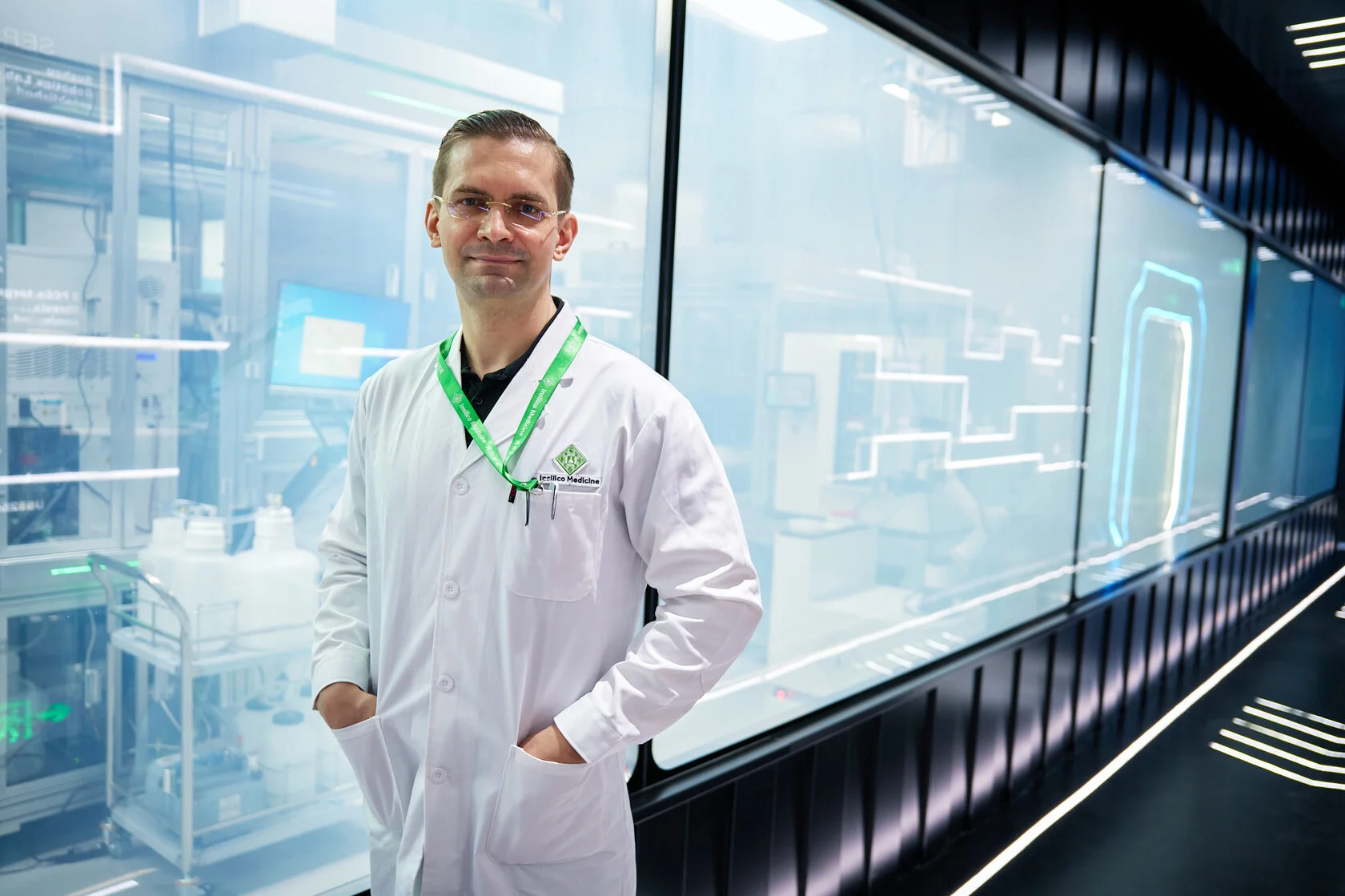
Closed-Loop Validation: The "From Prompt to Drug" Framework: A critical component of Insilico’s methodology is its "From Prompt to Drug" framework. This closed-loop validation system ensures rapid, high-fidelity iteration. AI-generated hypotheses regarding molecular design or biological activity are instantly tested in Insilico’s automated robotics labs. The experimental data generated then feeds back into the AI models, allowing for continuous learning and refinement. This iterative process allows for swift optimization, minimizing dead ends and maximizing the efficiency of drug candidate selection.
-
Clinical Development and Commercialization with Lilly: As an asset matures and enters the clinical stage, Eli Lilly assumes the lead role for global development and commercialization. Lilly’s extensive infrastructure, expertise in clinical trial design and execution, regulatory affairs, manufacturing, and global marketing capabilities are paramount for bringing these life-saving medicines to patients worldwide. Insilico provides strategic support through its InClinico platform, which leverages AI to optimize clinical trial design and increase the probability of success by predicting patient responses and identifying optimal patient populations.
This seamless integration, where AI excels at the complex, data-intensive discovery phase and pharma leverages its unparalleled expertise in human trials and market access, represents a powerful new model for accelerating drug development. "We are moving past the era of ‘AI experiments.’ This deal represents the industrialization of generative biology and chemistry to solve the most challenging human diseases at unprecedented speed," Zhavoronkov emphasized.
Impact on Insilico’s Pipeline Strategy and the Broader Industry
A deal of this scale significantly influences Insilico’s internal pipeline strategy, enabling the company to pursue both external partnerships and advance its wholly-owned assets with greater financial flexibility. Zhavoronkov outlined Insilico’s pipeline philosophy in three categories: partnered programs, internal high-conviction programs, and platform-driven programs. The Lilly partnership allows Insilico to externalize a substantial portion of its pipeline, generating revenue and validating its technology, without diminishing its capacity for internal innovation. This effectively funds continued platform scaling while allowing Insilico to strategically focus internal resources on potentially first-in-class programs where it retains full ownership.
The decision to partner versus retain assets is guided by several factors, including the strategic importance of the therapeutic area, the potential for a first-in-class or best-in-class profile, the estimated development timeline, and the financial and resource commitments required. This flexible approach allows Insilico to maximize the value of its AI platform and assets.
This collaboration also mirrors a broader industry shift, where AI is transitioning from an "assistive technology" to an "asset generator." The increasing number of significant deals between AI drug discovery companies and large pharmaceutical firms reflects a growing confidence in AI’s ability to reliably generate novel, high-quality drug candidates. Pharma companies are increasingly comfortable investing substantial capital in AI-designed assets, recognizing their potential to overcome the escalating costs, extended timelines, and high failure rates inherent in traditional drug discovery. This trend is accelerating the industrialization of generative biology and chemistry, positioning AI at the forefront of pharmaceutical innovation.
The Winning Architecture: Compute, Data, and Novel Biology
Zhavoronkov articulated what he believes to be the "winning architecture for modern drug discovery": the integration of frontier compute, proprietary data, and novel biology.
-
Frontier Compute: This refers to the massive computational power required to run sophisticated AI models, process vast datasets, and execute complex simulations. This includes high-performance computing, cloud infrastructure, and potentially specialized AI hardware. Eli Lilly’s recent investment in its own AI supercomputer underscores this recognition of compute as a critical enabler.
-
Proprietary Data: High-quality, diverse, and proprietary datasets are the lifeblood of effective AI. This includes biological, chemical, clinical, and phenotypic data, often curated from internal research, partnerships, or advanced experimental techniques. The quality and uniqueness of this data are paramount for training robust and accurate AI models that can generate truly novel insights.
-
Novel Biology: Beyond the technological prowess, the ability to identify and exploit novel biological targets and pathways remains fundamental. AI can accelerate this by sifting through complex biological networks and identifying previously overlooked disease drivers or therapeutic opportunities. Without grounding in sound, novel biology, even the most powerful AI and data will yield limited clinical impact.
Zhavoronkov emphasizes that no single component is sufficient; success stems from integrating all three into a continuous learning system. In this architecture, AI models improve as new experimental and clinical data are generated, and novel biology is explored more efficiently. This creates a virtuous cycle that continually enhances the drug discovery process. Partnerships like the one between Insilico and Lilly demonstrate this integration in practice, combining Insilico’s AI and novel biology expertise with Lilly’s extensive data, computational resources, and clinical development capabilities. This model sets a high bar for innovation in the pharmaceutical industry, suggesting a blueprint for how companies can leverage advanced technologies to outcompete and deliver breakthrough medicines.
Broader Implications and Future Outlook
This collaboration is more than just a significant business deal; it is a bellwether for the future of pharmaceutical R&D. The global AI in drug discovery market is projected to grow exponentially, driven by the promise of accelerated timelines, reduced costs, and improved success rates. Traditional drug discovery is notoriously expensive, with average costs per successful drug reaching billions of dollars and timelines often exceeding a decade. Failure rates in clinical trials remain exceptionally high, especially in early phases. AI offers a compelling solution to mitigate these challenges by enhancing target identification, optimizing molecular design, and predicting clinical outcomes with greater accuracy.
The Insilico-Lilly partnership validates the emergence of specialized AI drug discovery companies as crucial partners for established pharmaceutical giants. It highlights a growing trend where Big Pharma is increasingly willing to externalize parts of its early-stage R&D to leverage the agility and computational power of AI-first biotechs. This model allows pharma to focus its immense resources on later-stage development and commercialization, while AI partners push the boundaries of discovery.
Ultimately, the success of this and similar collaborations will be measured by their ability to bring safe and effective new medicines to patients faster and more affordably. By fusing Insilico’s "Superintelligence" with Eli Lilly’s "Clinical Excellence," this alliance has the potential to redefine what is possible in drug discovery, offering hope for tackling some of the most challenging diseases with unprecedented speed and precision. This partnership stands as a testament to the transformative power of artificial intelligence in advancing human health, charting a course for a new era of pharmaceutical innovation.