At its recent annual Science Day, Moderna signaled a profound strategic shift, moving beyond its foundational infectious disease vaccine and rare disease franchises to unveil ambitious new programs in in vivo CAR-T therapy and solid tumor oncology. The biotechnology pioneer also introduced an advanced AI-driven research platform, "Lucy," poised to dramatically accelerate the pace of drug discovery across its expanding pipeline. This pivot leverages Moderna’s established mRNA technology and manufacturing infrastructure, aiming to replicate its vaccine success in entirely new therapeutic arenas.
A Strategic Pivot Beyond Vaccine Triumphs
Moderna built its formidable commercial empire on the back of its lipid nanoparticle (LNP)-delivered mRNA technology, most notably with its highly effective COVID-19 vaccine, Spikevax. This success established mRNA as a rapid, scalable, and potent modality for infectious disease prevention. However, the company’s recent announcements indicate a deliberate and calculated expansion of this core technology into complex therapeutic areas that have historically posed significant challenges for drug developers. By deploying its proven mRNA delivery system and manufacturing base, Moderna aims to translate the properties that enabled large-scale vaccine efficacy to the intricate landscapes of oncology and autoimmune diseases. This strategic diversification is critical for Moderna as it seeks to sustain growth beyond the fluctuating demand for COVID-19 vaccines and solidify its position as a multi-modality biopharmaceutical leader. The company’s decade-plus of human clinical data provides an invaluable learning advantage, creating a high barrier to entry for potential rivals attempting to catch up in the rapidly evolving mRNA space.
Unveiling Novel Therapeutic Avenues: In Vivo CAR-T and Multiplexed T-Cell Engagers
The cornerstone of Moderna’s therapeutic expansion lies in two publicly revealed pipeline programs: mRNA-6007, an in vivo CAR-T candidate for autoimmune diseases, and mRNA-2151, a multiplexed T-cell engager designed for ovarian cancer. These programs represent a significant leap in applying mRNA technology to advanced cell and gene therapies.
mRNA-6007: Revolutionizing CAR-T with In Vivo Delivery
Moderna’s mRNA-6007 program represents its inaugural foray into in vivo Chimeric Antigen Receptor T-cell (CAR-T) therapy. This innovative approach seeks to address B-cell-mediated autoimmune diseases, with an initial focus on systemic lupus erythematosus (SLE), a chronic autoimmune condition where the immune system mistakenly attacks its own tissues and organs. Traditional CAR-T therapies, which have revolutionized the treatment of certain blood cancers, involve an arduous and expensive process: extracting a patient’s T-cells, genetically engineering them in a specialized lab to express a CAR that targets cancer cells, expanding these modified cells, and then reinfusing them back into the patient, often after a lymphodepleting chemotherapy regimen. This ex vivo process can take several weeks, is patient-specific, and carries significant logistical and financial burdens, including potential for severe side effects like cytokine release syndrome.
Moderna’s in vivo CAR-T strategy aims to bypass these complexities entirely. Instead of external manipulation, mRNA-6007 reprograms immune cells directly inside the body using targeted LNPs. This makes the therapy an "off-the-shelf," injectable product, potentially offering greater accessibility, scalability, and a significantly reduced burden on both patients and healthcare systems. The therapy employs a dual-CAR approach, encoding two distinct CARs to target both the full B-cell lineage and plasma cells. This multiplexed design is intended to achieve a broader and more profound immune reset compared to single-CAR approaches that might only target B cells, which could lead to more durable remission in autoimmune conditions.
mRNA-6007 is slated to enter clinical trials by the end of 2027, following the completion of IND-enabling studies and extensive engagements with health authorities. Preclinical studies conducted in mice and non-human primates have reportedly demonstrated encouraging safety, tolerability, and evidence of therapeutic response, though detailed data remains unpublished. The in vivo CAR-T landscape is nascent but highly competitive, with several players aggressively pursuing similar innovations. Companies like Capstan Therapeutics (now part of AbbVie), CREATE Medicines, Cartesian Therapeutics (partnered with WestGene Biopharma), and Kernal are all advancing in vivo CAR candidates for autoimmune and oncology indications. Academic groups have also published promising data using LNP-mRNA approaches for in vivo CD19 CAR-T in lupus patients. Moderna’s multiplexed design, encoding two CARs, could be a key differentiator in this rapidly evolving field, potentially offering a more comprehensive attack on the pathological B-cell populations responsible for autoimmune flares.
mRNA-2151: Targeting Solid Tumors with Multiplexed T-Cell Engagers
The second significant therapeutic revelation is mRNA-2151, a multiplexed T-cell engager specifically designed to combat ovarian cancer. This program marks Moderna’s first public disclosure and detailed description of this specific therapeutic candidate. T-cell engagers are a class of bispecific antibodies that physically bridge T-cells to cancer cells, activating the T-cells to kill the tumor. While these therapies have shown considerable success in liquid cancers, their efficacy in solid tumors has been limited, largely due to the highly immunosuppressive tumor microenvironment (TME) that renders T-cells exhausted and dysfunctional. Currently, only two FDA-approved T-cell engagers, tarlatamab and tebentafusp, target solid tumors, underscoring the significant challenges in this area.
mRNA-2151 distinguishes itself by encoding not only two kill T-cell engagers against undisclosed, clinically validated tumor-associated antigens but also a co-stimulatory molecule. This co-stimulatory addition is crucial for enhancing T-cell activation, proliferation, and persistence, particularly in the hostile TME of ovarian cancer. Preclinical studies have shown that while T-cell engagers alone could control tumor growth in a mouse xenograft model, the inclusion of the co-stimulatory molecule led to complete responses and significantly more durable tumor control. This suggests that the co-stimulatory signal can help T-cells retain their killing ability even under repeat stimulation, a critical factor for sustained anti-tumor immunity. Moderna is betting that encoding a potent co-stimulatory molecule alongside the kill signals within a single mRNA product will be the key to overcoming the historical struggles of T-cell engagers in solid tumors. The advancement of mRNA-2151 toward early development in ovarian cancer is bolstered by encouraging early clinical results from Moderna’s existing T-cell engager program, mRNA-2808, providing a degree of validation for the platform.
Accelerating Discovery with AI: The Lucy Platform
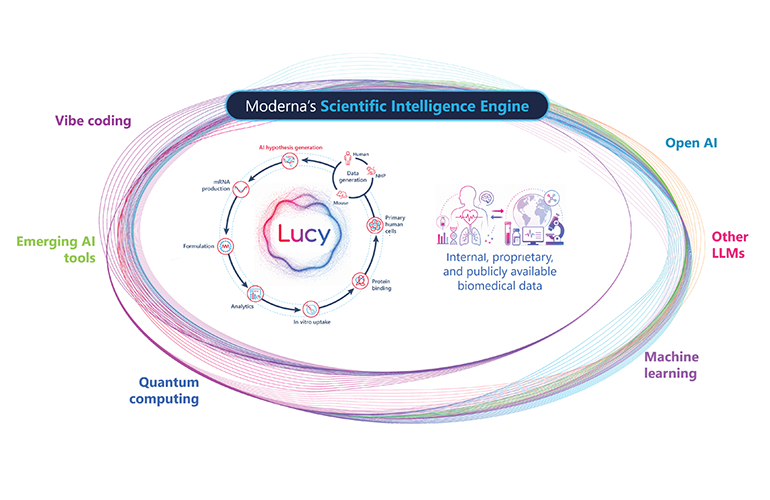
Central to Moderna’s ambitious expansion is the introduction of "Lucy," an internal machine learning platform designed to revolutionize and accelerate drug discovery. Lucy is positioned as the core of a closed-loop automation system operating within Moderna’s laboratories. This platform seamlessly connects data from lab notebooks and various experimental files, transforming disparate information into a continuously improving learning system.
What sets Lucy apart is its ability to run closed-loop experimental cycles with minimal human intervention. AI-driven hypothesis generation feeds directly into automated experimental execution, and the results are then fed back into the AI for refinement, creating a self-optimizing discovery engine. This system can test hundreds of thousands of iterations per learning cycle, a scale previously unattainable. A key feature is its multiplexed in vivo screening capability, allowing researchers to simultaneously introduce up to one thousand different candidate molecules into a single mouse or primate using sophisticated barcoding systems. Lucy then deconvolutes the results, precisely assessing each candidate’s performance.
To maximize its learning capacity, Lucy has access to Moderna’s extensive proprietary dataset, including all human mRNA clinical trials and data from ongoing studies. Furthermore, Moderna has strategically partnered with OpenAI, allowing Lucy to integrate vast public-domain datasets alongside its exclusive clinical information. This combination of proprietary and public data, coupled with its advanced algorithms, empowers Lucy to systematically vary mRNA design, LNP formulation, or explore combinatorial approaches with unprecedented speed and precision. David Huss, Chief Technology Officer for Research at Moderna, emphasized that Lucy enables exploration of design space at a scale previously impossible, fundamentally changing how drug candidates are identified and optimized. This AI platform is expected to provide Moderna with a significant competitive edge, allowing it to learn and adapt faster than any rival in the race to develop next-generation mRNA therapeutics.
The Commercial and Financial Outlook: Investor Confidence and Analyst Scrutiny
Moderna’s strategic announcements were met with a robust positive response from investors, building on an already significant upward trend. In the weeks leading up to Science Day, Moderna’s stock had climbed approximately 48%, buoyed by the FDA advisory committee’s unanimous vote in favor of mRNA-1010, its investigational flu vaccine, a week prior. The rally gained further momentum after the Science Day event on June 25, where shares closed at $59.75. The following day, the stock surged nearly 15% as investors absorbed the pipeline disclosures, particularly the plan to advance mRNA-6007 into the clinic by 2027. This upward trajectory continued into early July, with the stock touching a 52-week high of $85.60. As of midday July 7, it traded near $80, reflecting a slight daily dip but still a remarkable 75% increase from its early-June low.
Analysts closely tracked these developments. William Blair analyst Myles Minter noted that FDA briefing documents for mRNA-1010 revealed "no major deficiencies," significantly boosting confidence in the flu vaccine’s approval prospects. Leerink Partners’ Mani Foroohar similarly described the FDA’s analysis as indicative of a "less-harsh regulatory stance," suggesting a more favorable environment for Moderna’s regulatory submissions. Following the Science Day pipeline revelations, Piper Sandler raised its price target for Moderna to $77 from $69, while maintaining an "Overweight" rating. This upgrade specifically cited the potential of the company’s cancer antigen therapy and in vivo CAR-T programs as key drivers.
Despite the impressive rally and positive analyst revisions, a degree of caution persists on Wall Street. The majority of investment firms continue to rate Moderna as "Hold" or "Sell," with the average 12-month price target situated in the mid-$40s. Piper Sandler’s $77 target stands out as one of the most bullish, yet the stock’s recent trading near $80 means it is currently valued above almost every published analyst target. This disparity suggests that while investors are enthusiastic about the long-term potential of Moderna’s diversified pipeline and AI capabilities, some analysts remain reserved, possibly due to the early-stage nature of many of these programs, execution risks, or concerns about current valuation levels relative to near-term earnings.
An Expansive and Diverse Pipeline
Moderna’s pipeline is not merely expanding; it is a testament to the versatility of its mRNA platform, encompassing some three dozen programs across a wide spectrum of therapeutic areas. Beyond the newly announced in vivo CAR-T and multiplexed T-cell engagers, the company maintains robust franchises in respiratory vaccines (including commercial products like SPIKEVAX, mNEXSPIKE, mRESVIA, and mCOMBRIAX, alongside late-stage candidates like mRNA-1010 for flu and mRNA-1018 for pandemic flu), latent-virus vaccines (e.g., CMV, EBV, HIV), enteric viruses (Norovirus), and bacterial infections (Lyme disease).
In oncology, Moderna continues to advance mRNA-4157 (intismeran autogene), a personalized cancer vaccine partnered with Merck, which is being studied across multiple tumor types and settings, including adjuvant melanoma, non-small cell lung cancer (NSCLC), renal cell carcinoma (RCC), and bladder cancer. Other oncology programs include cancer antigen therapies (mRNA-4359, mRNA-4106, mRNA-4200) and cell therapy enhancers (mRNA-4203 + anzu-cel with Immatics). The rare disease portfolio also remains active with candidates for propionic acidemia (mRNA-3927), methylmalonic acidemia (mRNA-3705), and cystic fibrosis (mRNA-3692, partnered with Vertex). The addition of mRNA-6007 and mRNA-2151 further strengthens and diversifies this already extensive portfolio, positioning Moderna for sustained innovation and market presence across a broader range of medical needs.
Broader Implications for mRNA Technology and the Biopharma Landscape
Moderna’s bold strategic pivot carries significant implications for the broader biopharmaceutical industry and the future of medicine. By demonstrating the potential of mRNA beyond infectious disease vaccines, Moderna is validating the technology as a highly versatile therapeutic modality capable of addressing complex, non-communicable diseases. This expansion underscores the inherent advantages of mRNA – its speed of development, design flexibility, and the ability to leverage a single manufacturing base and LNP chemistry for diverse applications, which promises scalability and potential cost efficiencies previously unimaginable for highly specialized therapies.
This strategic move by a leading mRNA player is likely to catalyze increased investment and research from other biopharma companies into non-vaccine mRNA applications. The success of in vivo CAR-T and multiplexed T-cell engagers could usher in a new era of highly accessible and effective treatments for challenging conditions like autoimmune diseases and solid tumors, which currently face significant limitations in therapeutic options, often involving complex and invasive procedures. Moderna’s substantial advantage in accumulating over a decade of human mRNA clinical data, combined with its advanced AI discovery platform, positions it as a frontrunner in shaping this evolving landscape. The company’s vision for mRNA’s "second act" could fundamentally transform how we approach drug discovery and therapeutic intervention, ultimately offering novel and impactful solutions to patients worldwide.