If you happen to be swimming in the Salish Sea at night and imagine tiny, hairy legs creeping up your body, there is now at least one unsettling reason that image feels plausible. Researchers at the University of British Columbia (UBC) have officially identified two previously unknown species of sea spider inhabiting the coastal waters of British Columbia. These findings, which mark the first formal description of new sea spider species in the Salish Sea in nearly a century, provide a rare glimpse into a poorly understood group of marine arthropods that have occupied the planet’s oceans for half a billion years.
The study, published in the journal Organisms Diversity & Evolution, synthesizes advanced genetic sequencing with traditional morphological observation. By cataloging these distinct organisms, scientists are addressing a critical information vacuum that has historically hindered efforts to monitor the health of the Salish Sea’s benthic ecosystems.
A Century of Taxonomic Stagnation
The taxonomy of sea spiders—or pycnogonids—in the Pacific Northwest has remained largely stagnant since the early 20th century. While biological surveys were conducted in the region decades ago, the lack of modern genetic analysis meant that many species were either misidentified or overlooked entirely.
Cormac Toler-Scott, lead author of the study and a graduate of the UBC zoology program, initiated this research to address the lack of baseline data regarding marine invertebrates. "I was interested in how sea spiders are impacted by climate change and human disturbance, because marine invertebrates in the Salish Sea are particularly at-risk, and I couldn’t find anything," Toler-Scott explained. "That’s largely because people don’t know much about what species exist here and what their lifestyle is."
The research project spanned from September 2023 to August 2024, involving systematic diving operations at depths of up to 18 meters. Specimens were gathered from diverse marine environments surrounding Quadra Island, Vancouver, Bamfield, and Victoria. This geographical breadth was intentional, designed to capture the varied micro-habitats that characterize the Salish Sea’s complex coastline.
Evolutionary Anomalies: The Bizarre Biology of Pycnogonids
To understand the significance of these findings, one must consider the evolutionary lineage of the sea spider. Arising roughly 500 million years ago, pycnogonids represent an ancient branch of the arthropod family tree. While they share a common ancestor with land-based spiders, scorpions, and horseshoe crabs, they diverged early to remain entirely aquatic.
Their physiological structure is distinct from any other class of marine life. A pycnogonid body is essentially a collection of specialized appendages; in many species, the internal organs are so expansive that they must extend into the legs. Their respiratory systems are equally unconventional, as they lack gills or lungs, relying instead on diffusion to breathe directly through their porous cuticles.
The reproductive process of the sea spider is perhaps its most curious trait. The species exhibits paternal care, with males responsible for the protection and incubation of eggs. Females possess ovaries that extend into their limbs, where eggs develop until they are expelled through specialized pores. The male then gathers these eggs using the ‘ovigers’—appendages located near the head—coats them in a biological adhesive secreted from his legs, and carries the developing brood on his own body.
The Discovery: Callipallene pilosuspedes
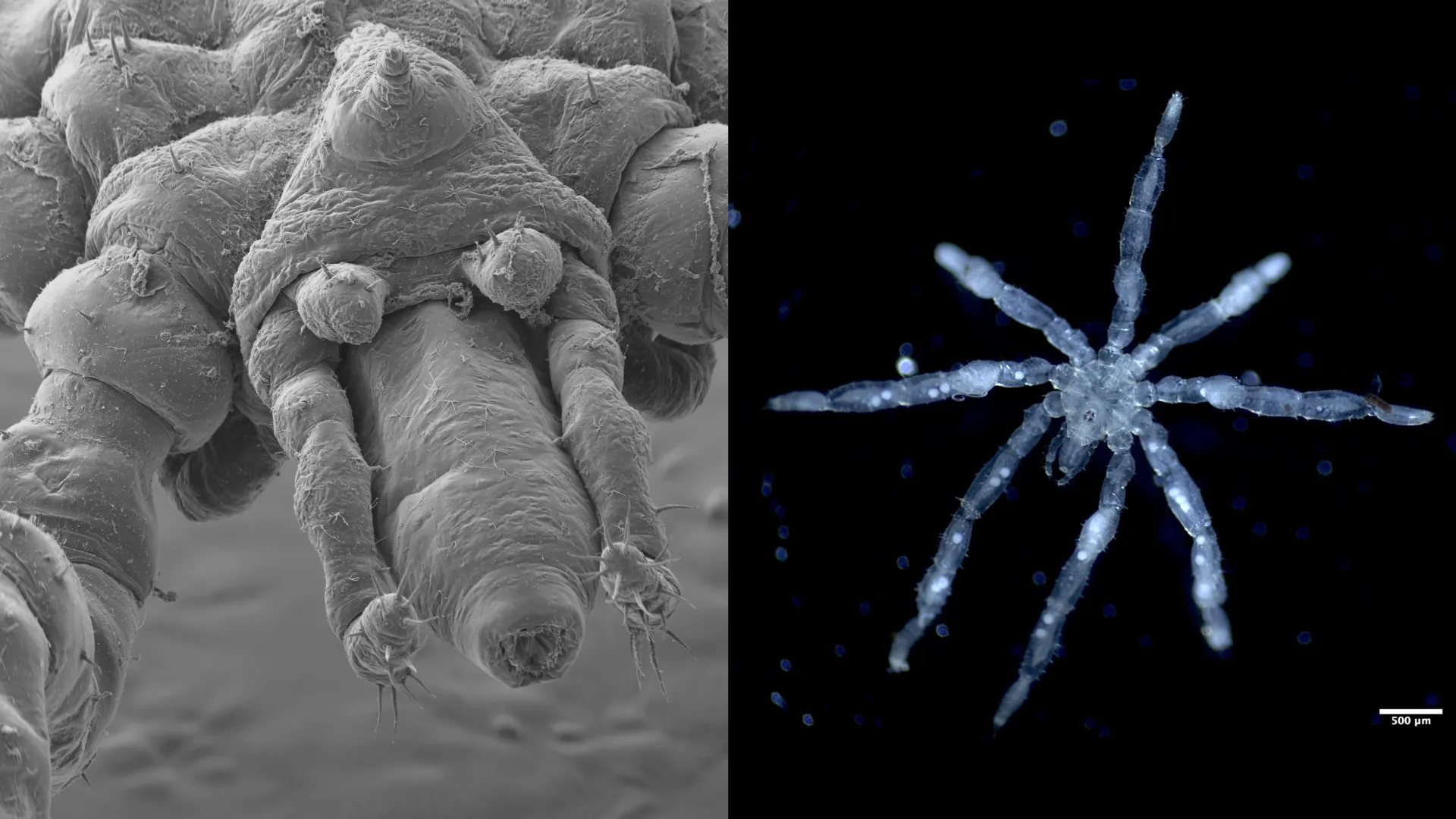
The first species described, Callipallene pilosuspedes, derives its name from the Latin term for "hairy feet." The designation is apt; the creature is characterized by long, curved spines that cover the distal segments of its legs.
Beyond its hirsute appearance, C. pilosuspedes possesses striking red eyes and a specialized proboscis. This feeding apparatus is relatively short but armed with robust claws, enabling the animal to secure prey before ingestion. The mouth structure is triangular, composed of three distinct lips and surrounded by sensory tendrils, an anatomy that allows for precise, albeit alien, consumption.
Perhaps the most fascinating observation regarding C. pilosuspedes relates to its grooming habits. Under microscopic analysis, researchers observed the spider using its agile ovigers to wrap around its own legs. By utilizing comb-like spines on these limbs, the spider effectively cleans its body, a necessary behavior for an animal living in the nutrient-rich, debris-heavy waters of the Pacific Northwest. Despite the scientific importance of the find, the team recovered only a single specimen, highlighting the potential scarcity or cryptic nature of the species.
The Micro-Ecosystem: Tanystylum kiixin
The second species, Tanystylum kiixin, represents a different survival strategy. Named after an ancient Indigenous village site near the collection location, the name ‘kiixin’ (pronounced ‘kee-hin’) honors the coastal heritage of the region, specifically referencing the rhythmic sound of waves against the shoreline.
Unlike its hairy-legged counterpart, T. kiixin possesses significantly less flexible egg-carrying appendages. This biological constraint appears to prevent the spider from performing the thorough self-grooming observed in C. pilosuspedes. Consequently, these individuals were frequently found covered in fine sediment, debris, and, in some cases, smaller parasitic organisms.
This observation led researchers to describe the animal as "an ecosystem within an ecosystem." The presence of external parasites on an organism that is itself a small invertebrate underscores the complex, multi-layered biodiversity of the seafloor—a layer of the food web that is often invisible to human observers.
Data-Driven Conservation and Future Implications
The UBC study marks the first time that comprehensive DNA sequencing has been paired with high-resolution imagery for Salish Sea pycnogonids. By generating genetic profiles for these species, the team has provided a molecular "barcode" that will allow future researchers to identify these animals without relying solely on physical characteristics, which can change due to age or environmental conditions.
The creation of an identification guide as part of this project is expected to be a vital resource for marine biologists and environmental regulators. As the Salish Sea faces increasing pressure from ocean acidification, rising temperatures, and anthropogenic pollutants, having the ability to monitor the presence and population density of indicator species is essential.
"In order to understand how marine invertebrates are being impacted by things like climate change and how we can better protect these key elements of the ecosystem, we have to be able to identify them," Toler-Scott noted. The urgency of this research is underscored by the current environmental climate; many marine invertebrates serve as the foundation of the local food web, supporting larger species like salmon and various rockfish. If these foundational species suffer due to environmental shifts, the cascading effects on the ecosystem could be severe.
The Road Ahead: What Lies Beneath?
While the registration of these two species in global databases is a milestone, the research team acknowledges that their work is far from complete. The Salish Sea is a vast and ecologically varied region, and the limited scope of a single field season likely only scratched the surface of the region’s hidden pycnogonid population.
"I only had one field season, but there’s definitely more diversity out there that we haven’t documented," Toler-Scott stated. The study suggests that as technology in underwater exploration and genetic sequencing advances, it is highly probable that additional species of sea spiders—and perhaps other undocumented marine invertebrates—will be found lurking in the dark, cold waters of the Pacific coast.
This research, funded by the Natural Sciences and Engineering Research Council of Canada (NSERC), serves as a reminder that the Salish Sea remains a frontier for scientific discovery. Even in well-traveled waters, the ocean continues to hold biological secrets that challenge our understanding of morphology, evolution, and ecological adaptation. As scientists continue to peer into the microscopic complexities of the benthic zone, the discovery of Callipallene pilosuspedes and Tanystylum kiixin serves as a critical first step in safeguarding the future of these ancient, bizarre, and essential members of the marine community.