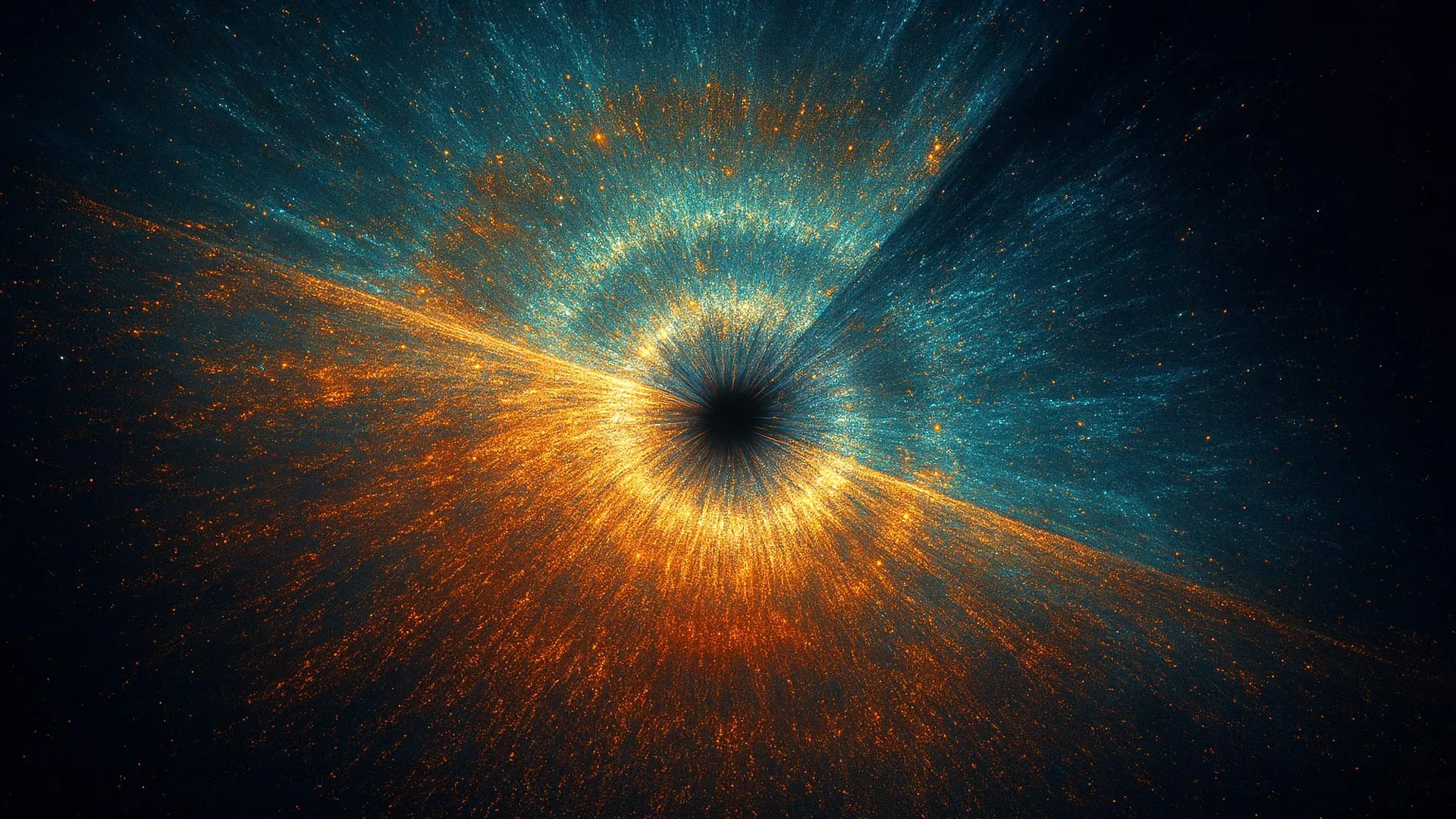
The enigma of dark matter, the invisible substance that constitutes approximately 85% of the matter in the universe, has long stood as the primary frontier of modern cosmology. While it does not emit, absorb, or reflect light, its presence is inferred through its gravitational grip on visible matter, dictating the rotation of galaxies and the intricate webbing of the cosmic structure. For decades, the "Cold Dark Matter" (CDM) model has served as the gold standard for understanding the universe’s evolution. However, as observational technology has advanced, the CDM model has faced increasing scrutiny due to its inability to account for specific small-scale phenomena. A breakthrough study from the Purple Mountain Observatory (PMO) of the Chinese Academy of Sciences (CAS) now proposes a revolutionary "two-component self-interacting dark matter" model that may finally reconcile these long-standing discrepancies.
The Small-Scale Crisis: A Conflict of Observations
For years, astrophysicists have grappled with what is often termed the "Small-Scale Crisis" in cosmology. According to the traditional CDM model, dark matter particles are "collisionless," meaning they only interact with one another through gravity. Simulations based on this model predict that the centers of galaxies, particularly small dwarf galaxies, should possess incredibly high densities of dark matter—a feature known as a "cusp."
However, actual observations of dwarf galaxies tell a different story. Astronomers have consistently found "cores"—regions at the centers of galaxies where dark matter density is surprisingly low and flat. This "core-cusp problem" suggested that the standard model was missing a fundamental piece of the puzzle.
Compounding this mystery is a seemingly contradictory observation involving strong gravitational lensing. When a massive foreground object, such as a galaxy cluster, acts as a lens, it magnifies and distorts the light from more distant background galaxies. Recent high-resolution lensing data have revealed the existence of extremely dense dark matter "clumps" or subhalos. While dwarf galaxies seem to have too little dark matter at their centers, these lensing events suggest that some small-scale structures are far denser than the CDM model predicts.
Until now, these two observations—low-density cores in dwarf galaxies and high-density clumps in lensing events—seemed to point toward different physical realities. The new research from the Purple Mountain Observatory suggests they are actually two sides of the same coin.
The Multi-Component Hypothesis: Mass Segregation in the Dark Sector
The research team, led by physicists Daneng Yang, Yi-Zhong Fan, Siyuan Hou, and Yue-Lin Sming Tsai, proposes that dark matter is not a monolith. Instead of being comprised of a single type of particle, the PMO model suggests that the dark sector consists of at least two distinct species of particles with different masses.
Crucially, these particles are "self-interacting." Unlike the collisionless particles of the CDM model, these dark matter particles can bump into one another, exchanging energy and momentum. This interaction triggers a physical process known as "mass segregation," a phenomenon well-documented in the study of globular star clusters.
In a system where particles of different masses interact, the heavier particles tend to lose kinetic energy during collisions and migrate toward the gravitational center of the system. Conversely, the lighter particles gain energy and are pushed toward the outer regions. When applied to the dark matter halos that surround galaxies, this process creates a dynamic internal structure that evolves over billions of years.
Reconciling the Density Paradox through Simulation
To test their hypothesis, the CAS researchers utilized high-resolution computer simulations and sophisticated theoretical modeling to track the evolution of dark matter halos under the two-component model. The results were striking, as the model naturally produced the exact "contradictory" features observed in the real universe.
In the context of dwarf galaxies, the self-interactions between the two types of dark matter particles lead to the expansion of the central region. As the particles collide and redistribute energy, the intense "cusp" predicted by the CDM model is smoothed out into a low-density "core." This matches the observational data that has puzzled astronomers for thirty years.
Simultaneously, the model accounts for the dense structures required for strong gravitational lensing. In larger, more massive environments or older halos, the process of mass segregation continues until the central regions become increasingly dominated by the heavier dark matter component. This concentration of mass leads to "gravitational collapse" in the central regions of subhalos, making them significantly more compact and dense than those in a single-component model. These ultra-dense clumps are precisely what is needed to explain the "anomalous" magnification seen in small-scale gravitational lensing events.
A Chronology of Dark Matter Theory
The quest to understand dark matter has undergone several paradigm shifts, and the PMO study represents the latest chapter in a century-long detective story:
- The 1930s: Swiss astronomer Fritz Zwicky observes the Coma Galaxy Cluster and realizes the visible mass is insufficient to hold the cluster together. He coins the term "dunkle Materie" (dark matter).
- The 1970s: Vera Rubin and Kent Ford provide definitive evidence for dark matter by measuring galaxy rotation curves, showing that stars at the edges of galaxies move as fast as those near the center.
- The 1980s: The Cold Dark Matter (CDM) paradigm is established, suggesting dark matter is made of slow-moving, weakly interacting massive particles (WIMPs).
- The 1990s-2000s: The "Core-Cusp" and "Missing Satellites" problems emerge as telescopes provide better data on small-scale structures, challenging the CDM model.
- The 2010s: Self-Interacting Dark Matter (SIDM) gains popularity as a way to solve the core-cusp problem, but single-component SIDM struggles to explain the high densities seen in lensing.
- 2023-2024: The Purple Mountain Observatory publishes a series of papers, including the latest in Science Bulletin, establishing the two-component SIDM model as a viable unified theory.
Institutional Significance: The Role of Purple Mountain Observatory
The Purple Mountain Observatory, located in Nanjing, is at the forefront of China’s ambitious space science program. As a key institute within the Chinese Academy of Sciences, PMO has been instrumental in shifting the focus of dark matter research from purely theoretical work to direct and indirect detection.
The observatory is the lead institution for the Dark Matter Particle Explorer (DAMPE), also known as "Wukong" (the Monkey King). Launched in 2015, the DAMPE satellite is designed to detect high-energy gamma rays and cosmic rays that might be produced by dark matter particles annihilating or decaying in space.
The theoretical work of Yang, Fan, Hou, and Tsai complements the data gathered by DAMPE. By refining the mathematical models of how dark matter behaves on a galactic scale, the PMO team provides a roadmap for what future missions should look for. If dark matter indeed consists of multiple components, the "signature" of its decay or interaction in cosmic ray data would be more complex than currently anticipated, potentially explaining some of the "noise" or anomalies found in previous datasets.
Implications for the Future of Cosmology
The shift from a single-component to a multi-component dark matter model has profound implications for our understanding of the universe’s "dark sector." If the PMO model is correct, it suggests that the invisible part of our universe may be just as diverse and complex as the visible part. Just as visible matter is composed of a variety of particles (protons, neutrons, electrons) that form complex structures, dark matter may have its own "periodic table" of sorts.
Furthermore, this model provides a new lens through which to view the data currently being returned by the James Webb Space Telescope (JWST). JWST has discovered massive, well-formed galaxies existing much earlier in cosmic history than the CDM model predicts. A multi-component dark matter model, with its different interaction scales and mass segregation processes, may offer a more flexible framework for understanding how these early structures formed so rapidly.
Expert Analysis and Global Reaction
While the scientific community is generally cautious regarding new models, the PMO study has been noted for its elegance in solving two problems with a single mechanism. Theoretical physicists not involved in the study have noted that "mass segregation" is a well-understood physical principle, and applying it to the dark sector is a logical, albeit complex, next step.
"The beauty of this model lies in its economy," says one independent researcher in the field. "We have been trying to solve the core-cusp problem and the lensing problem with separate, often convoluted fixes. This suggests that the complexity isn’t in the laws of physics, but in the composition of the dark matter itself."
However, the model also presents new challenges. To confirm the existence of two-component dark matter, scientists will need to detect the specific signatures of these interactions. This will require next-generation sky surveys, such as those planned for the Vera C. Rubin Observatory in Chile and the European Space Agency’s Euclid mission. These facilities will map the distribution of dark matter with unprecedented precision, looking for the tell-tale signs of mass segregation in the hearts of distant clusters.
Conclusion: A New Vision of the Invisible
As we move deeper into the 21st century, the "invisible universe" is beginning to come into focus. The research conducted at the Purple Mountain Observatory suggests that our previous models were perhaps too simplistic, viewing the dark sector as a uniform, featureless background. By introducing a multi-component framework, the CAS team has provided a potential bridge between theory and observation.
The coming decade of astronomical observation will be the ultimate test for this theory. As "cosmic magnifying glasses"—the gravitational lenses provided by nature—become clearer through better technology, they may reveal the intricate dance of heavy and light dark matter particles. If proven, the two-component model will not only resolve the paradoxes of dwarf galaxies and lensing but will redefine our fundamental understanding of the fabric of reality. The findings of Yang, Fan, Hou, and Tsai mark a significant step toward turning the "greatest mystery in astronomy" into a detailed map of the unknown.