

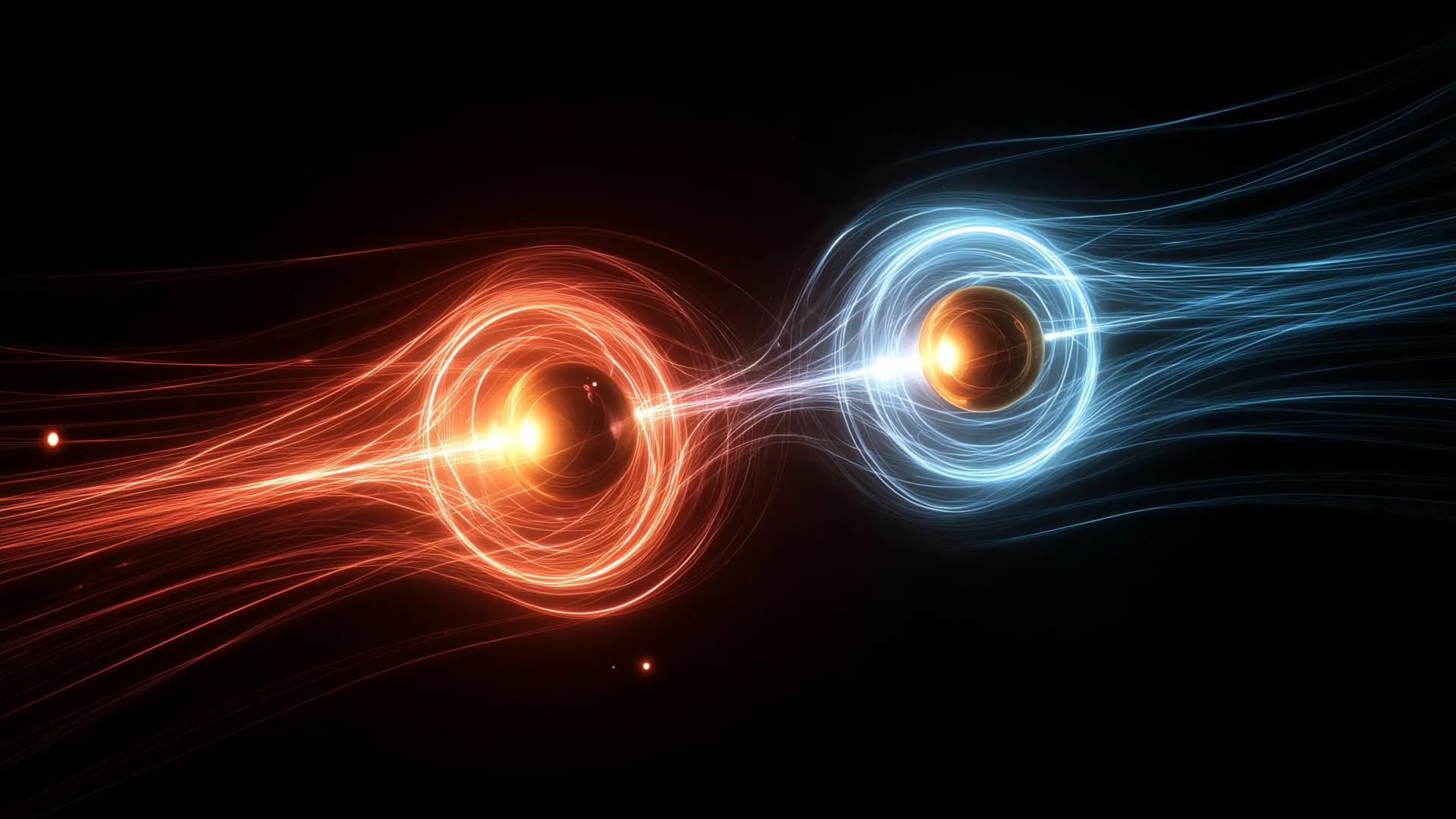
A collaborative research effort between experimental and theoretical physicists at Emory University has resulted in a significant breakthrough in the study of many-body systems, utilizing a specialized machine learning framework to decode the complex interactions governing dusty plasma. The study, recently published in the Proceedings of the National Academy of Sciences (PNAS), demonstrates that artificial intelligence can transcend its traditional role as a data-processing tool to become an instrument of scientific discovery, identifying nuanced physical laws that have previously eluded traditional modeling techniques. By focusing on non-reciprocal forces—interactions where particles do not influence one another equally—the team has provided a new template for understanding everything from industrial fluid dynamics to the movement of metastatic cancer cells.
The research was led by Justin Burton, a professor of experimental physics at Emory, and Ilya Nemenman, a professor of theoretical physics. Their work centers on the "fourth state of matter," plasma, specifically "dusty plasma," which contains ionized gas interspersed with microscopic charged grains. Through the implementation of a custom-designed, physics-informed neural network, the researchers achieved a predictive accuracy of over 99% regarding particle interactions, effectively correcting long-standing theoretical assumptions about how these particles behave in out-of-equilibrium environments.
The Science of Non-Reciprocal Forces and Dusty Plasma
To understand the magnitude of this discovery, one must first consider the nature of plasma. While solids, liquids, and gases dominate the terrestrial experience, plasma constitutes approximately 99.9% of the visible universe. It is formed when gas is energized to the point that electrons are stripped from atoms, creating a soup of positively charged ions and free-moving electrons. Dusty plasma adds another layer of complexity by introducing solid particles—typically micron-sized grains—that acquire a significant negative charge by collecting electrons from the surrounding medium.
In classical Newtonian physics, the Third Law states that for every action, there is an equal and opposite reaction. In many complex, open systems, however, this reciprocity breaks down. These "non-reciprocal forces" occur when one particle exerts a different force on a neighbor than it receives in return. A common analogy used by the Emory team is that of two boats traveling across a lake. The wake created by the lead boat significantly impacts the trajectory of the trailing boat, while the trailing boat’s wake may have a negligible effect on the leader. In the microscopic world of dusty plasma, these asymmetrical forces are driven by the flow of ions around the dust grains, yet they are notoriously difficult to measure due to the high-speed, three-dimensional nature of the system.
Experimental Methodology: From Vacuum Chambers to 3D Tracking
The experimental phase of the study, spearheaded by Justin Burton’s laboratory, involved recreating these cosmic conditions within a controlled terrestrial environment. The researchers utilized a vacuum chamber to suspend tiny plastic spheres in a plasma field. By manipulating gas pressure and electrical discharge, the team could simulate various environmental conditions, from the vacuum of space to the high-pressure environments of industrial processes.
A critical component of the experiment was the development of a high-precision tomographic imaging system. Tracking dozens of individual particles in a three-dimensional space requires more than standard photography. The team utilized a laser sheet that moved rapidly through the vacuum chamber, while high-speed cameras captured the reflections of the dust grains. By stacking these two-dimensional snapshots, the researchers reconstructed the exact trajectories of the particles over time. This high-fidelity data served as the foundation for the subsequent machine learning analysis.
The primary author of the study, Wentao Yu—a former Emory PhD student and current postdoctoral fellow at the California Institute of Technology—worked alongside co-author Eslam Abdelaleem to refine this data collection process. Their objective was to provide the neural network with a clean, high-resolution dataset that captured the subtle nuances of particle acceleration and deceleration.
Designing a "Glass Box" Neural Network
While modern AI often relies on "black box" algorithms—where the system reaches a conclusion through processes that remain opaque to human observers—the Emory team took a different approach. Recognizing that scientific discovery requires transparency, they spent over a year designing a neural network that incorporated known physical constraints while leaving room for the discovery of unknown variables.
Ilya Nemenman noted the unique challenge of the project: unlike large language models that train on trillions of words, physical experiments often yield limited datasets. The neural network had to be efficient and "physics-informed." The team structured the model to separate particle motion into three distinct components:
- Velocity-Dependent Drag: The resistance particles face as they move through the plasma.
- External Environmental Forces: The impact of gravity and the electrical fields within the chamber.
- Inter-Particle Interaction Forces: The specific ways particles push and pull on one another, including non-reciprocal effects.
This architectural decision allowed the AI to "learn" the underlying physics rather than simply memorizing the data. By forcing the AI to categorize its findings into these physical buckets, the researchers could interpret exactly what the machine was discovering about the system’s dynamics.
Correcting Theoretical Assumptions with 99% Accuracy
The AI’s findings yielded several surprises that challenged established scientific consensus. For decades, physicists have operated under certain assumptions regarding the charging of particles in plasma. One prevalent theory suggested that a particle’s electric charge increases in direct linear proportion to its size. However, the AI model revealed a far more complex relationship. While larger particles do indeed carry more charge, the scaling is non-linear and is heavily influenced by local plasma density and temperature.
Furthermore, the model provided unprecedented detail on the "shadowing" effect that creates non-reciprocity. In a dusty plasma, a leading particle creates an "ion wake"—a region of focused positive ion flow. This wake exerts an attractive force on a trailing particle. Conversely, the trailing particle tends to repel the leading one through electrostatic interaction. The Emory team’s AI was able to provide a precise mathematical approximation for these forces for the first time, reaching a level of detail that traditional analytical models had failed to achieve.
Another significant revelation concerned the decay of forces over distance. Previous theories assumed that inter-particle forces weakened exponentially at a rate independent of particle size. The machine learning model demonstrated that particle size significantly alters this decay rate, a finding that the researchers subsequently confirmed through follow-up experiments.
Broader Implications: From Wildfires to Cancer Research
The implications of this research extend far beyond the laboratory. Dusty plasma is a ubiquitous phenomenon with significant real-world consequences. On the Moon, the lack of a significant atmosphere and weak gravity allows charged dust to hover, creating the abrasive "lunar dust" that plagued Apollo astronauts. On Earth, dusty plasma is generated during massive wildfires when soot and smoke particles become charged. These particles can interfere with radio frequencies, creating "communication blackouts" for emergency responders—a problem that could be mitigated through a better understanding of particle interactions.
Beyond plasma, the "universal framework" developed by the Emory team has profound applications in the study of collective behavior. Ilya Nemenman, a specialist in biological physics, highlighted the potential for this AI method to revolutionize our understanding of living systems.
"In cancer research, we want to understand how the interaction of cells relates to metastasis," Nemenman explained. "How does a group of cells decide to break away from a tumor and move to a new location? These are essentially many-body systems governed by collective interactions."
The ability to infer the "physics" of cell movement—where cells also exert non-reciprocal forces on one another—could lead to new diagnostic tools or treatments that target the mechanical triggers of cancer spread. Similarly, the framework could be used to optimize industrial materials such as paints, inks, and pharmaceuticals, where the stability of the product depends on the complex interactions of suspended particles.
Chronology of the Research and Institutional Support
The project was the result of years of interdisciplinary dialogue. The timeline of the breakthrough includes:
- Phase 1 (Conceptualization): Weekly meetings between the Burton (experimental) and Nemenman (theoretical) labs began over two years ago to bridge the gap between plasma data and machine learning theory.
- Phase 2 (Experimental Setup): The development of the 3D tomographic imaging system in the Emory vacuum chamber.
- Phase 3 (Neural Network Refinement): A year-long iterative process to design the "physics-informed" architecture of the AI.
- Phase 4 (Validation): Running the AI on experimental data and conducting "sanity check" experiments to verify the AI’s surprising conclusions about particle charge and force decay.
- Phase 5 (Publication): The findings were peer-reviewed and published in PNAS in late 2024.
The research received primary funding from the National Science Foundation (NSF), with additional support from the Simons Foundation. Vyacheslav Lukin, program director for the NSF Plasma Physics program, lauded the study as a prime example of how interdisciplinary collaboration can drive innovation. "The dynamics of these complex systems are dominated by collective interactions that emerging AI techniques may help us to better describe, recognize, understand, and even control," Lukin stated.
Conclusion: The Future of AI-Human Collaboration in Science
The success of the Emory study underscores a pivotal shift in the scientific method. While the AI was responsible for identifying the mathematical nuances of the forces at play, the researchers emphasize that human expertise remains the indispensable catalyst. The "Star Trek" motto cited by Justin Burton—"to boldly go where no one has before"—reflects an optimistic view of AI as a compass for exploration.
The next steps for this research involve applying the neural network to even more complex systems. Nemenman is set to bring these techniques to the Konstanz School of Collective Behavior in Germany, where the focus will shift from plasma grains to flocks of birds and human crowds. As AI continues to evolve, its ability to uncover "new physics" suggests that we are entering an era where the most complex mysteries of the natural world may finally be decoded through the synergy of human logic and machine precision.











Leave a Reply