

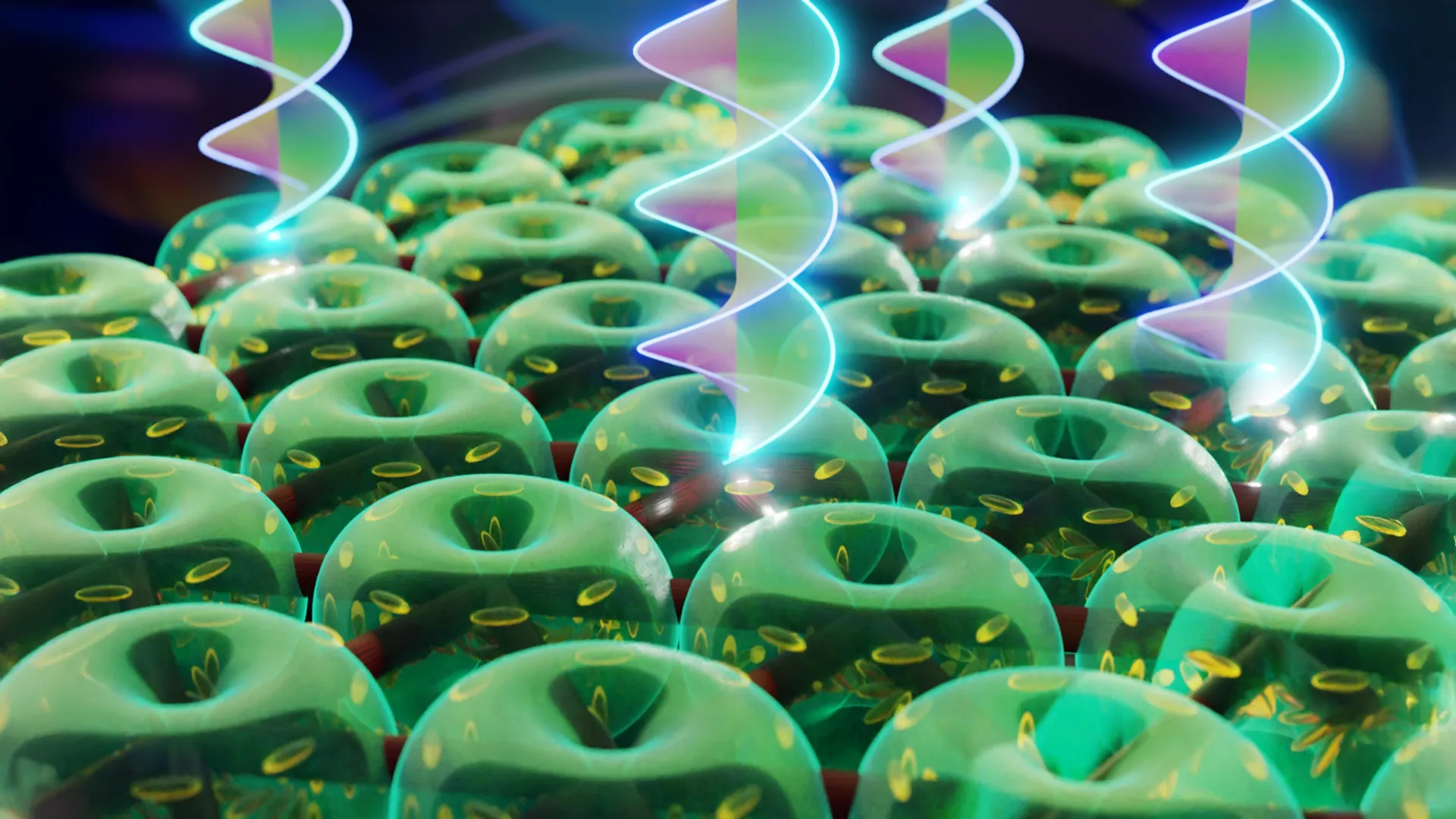
In a landmark achievement for the field of photonics, an international collaboration of physicists has successfully demonstrated the creation of stable "optical tornadoes"—complex swirling vortices of light—within microscopic structures. This breakthrough, led by the Faculty of Physics at the University of Warsaw in collaboration with the Military University of Technology in Poland and the Institut Pascal CNRS at Université Clermont Auvergne in France, represents a significant leap forward in the manipulation of structured light. By utilizing the self-organizing properties of liquid crystals, the team has bypassed the need for cumbersome and expensive nanostructure fabrication, paving the way for a new generation of scalable, miniature light sources for quantum computing and high-speed optical communications.
The research addresses a long-standing challenge in modern optics: the generation and stabilization of light states that possess both orbital angular momentum and complex polarization patterns. Traditionally, creating such "structured light" required massive laboratory setups or extremely intricate, custom-fabricated semiconductor environments. The new approach, however, leverages the inherent physical properties of liquid crystals to "trap" light in a way that mimics the behavior of subatomic particles, allowing these optical vortices to exist in their most stable, lowest-energy state.
The Science of Structured Light and Optical Vortices
To understand the magnitude of this discovery, one must first grasp the concept of an optical vortex. In a standard beam of light, such as that from a flashlight or a common laser, the phase of the light wave is uniform across the beam’s cross-section. In an optical vortex, however, the light wave twists around its central axis of propagation, much like a whirlwind or a tornado. This twisting creates a "phase singularity" at the center where the intensity of the light is zero, resulting in a characteristic doughnut-shaped beam.
Dr. Marcin Muszyński, the study’s first author affiliated with both the University of Warsaw and the City College of New York, describes the phenomenon as a multi-layered rotation. "The light wave twists around its axis, and its phase changes in a spiral manner," Muszyński explains. "Moreover, even the polarization—the direction of oscillation of the electric field—begins to rotate."
This rotation is not merely a visual curiosity; it carries what physicists call Orbital Angular Momentum (OAM). Because OAM can theoretically take an infinite number of integer values, it offers a way to encode vast amounts of data into a single beam of light, far exceeding the binary constraints of traditional fiber optics. Until now, the primary barrier to using OAM in practical technology has been the difficulty of generating these states in miniature, stable devices.
A Novel Approach: The Role of Liquid Crystals
The research team’s primary innovation lies in their choice of material. Rather than etching permanent structures into silicon or gallium arsenide—a process that is both rigid and difficult to scale—they turned to liquid crystals. These substances exist in a state of matter between a conventional liquid and a solid crystal. While they can flow, their molecules maintain a high degree of spatial orientation.
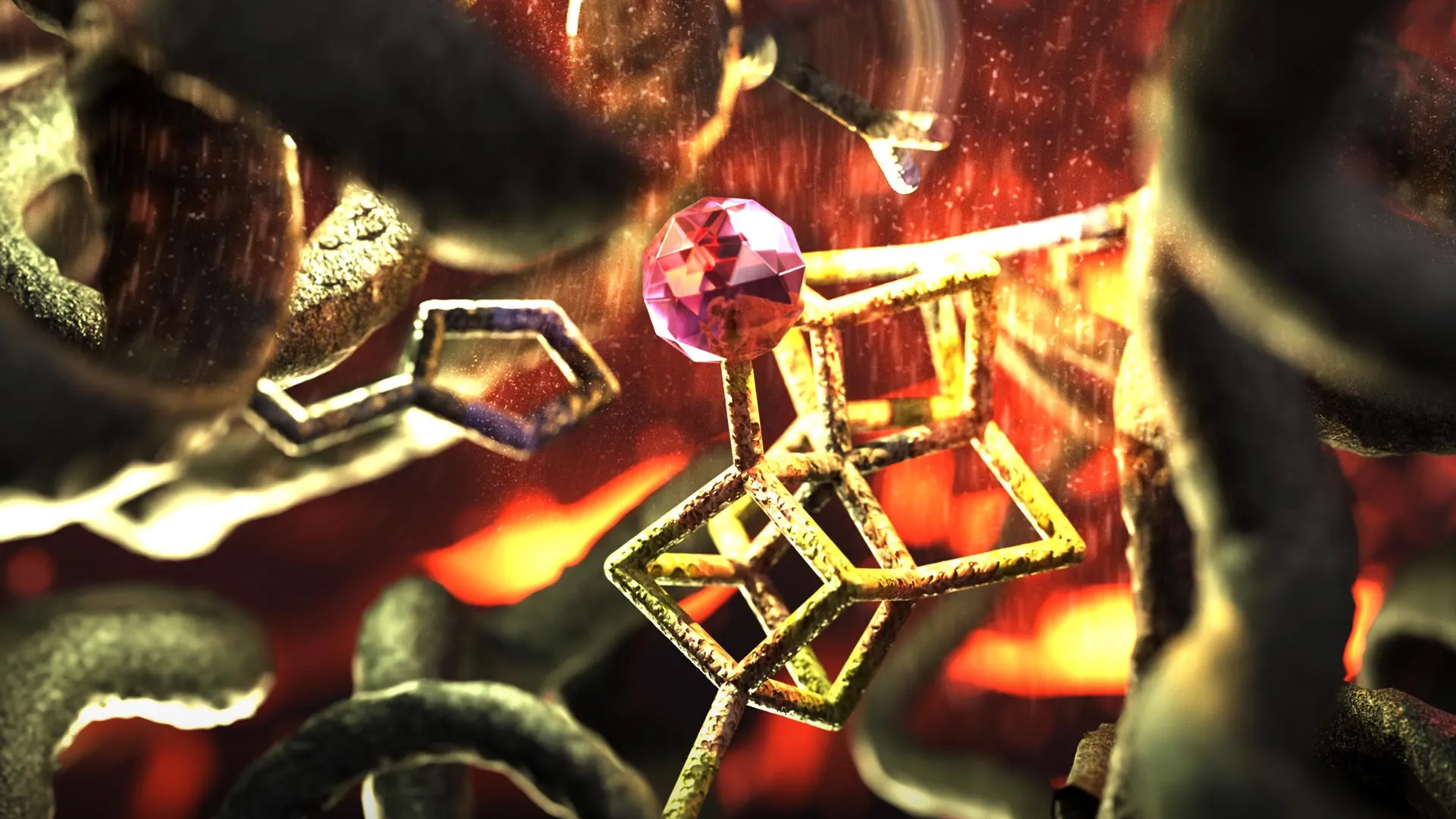
Joanna Mędrzycka, a nanotechnology student at the University of Warsaw who co-prepared the samples with Dr. Eva Oton from the Military University of Technology, highlights the self-organizing nature of the material. Within the liquid crystal, researchers can induce specific defects known as "torons." These torons are essentially microscopic, doughnut-shaped structures where the liquid crystal molecules are arranged in tightly twisted spirals, reminiscent of the double-helix structure of DNA.
"These structures act as microscopic traps for light," Mędrzycka notes. By placing these torons within an optical microcavity—a space between two highly reflective mirrors—the researchers were able to confine photons for extended periods, forcing them to interact with the twisted molecular structure of the liquid crystal.
Engineering a Synthetic Magnetic Field for Photons
One of the most complex aspects of the study involved creating a "synthetic magnetic field" for light. In the world of electronics, a magnetic field exerts a Lorentz force on moving electrons, causing them to move in circular "cyclotron" orbits. Photons, however, have no mass and no electric charge, meaning they do not naturally respond to magnetic fields.
To overcome this, the team utilized a property called birefringence—the way a material’s refractive index depends on the polarization and direction of light. Dr. Piotr Kapuściński of the University of Warsaw explains that by precisely controlling the spatial variation of this birefringence within the liquid crystal, they could mimic the effects of a magnetic field.
"We call it ‘synthetic’ because its mathematical description resembles the behavior of a magnetic field, even though physically it isn’t there," Kapuściński clarifies. This synthetic field causes the light to "bend" and circulate within the microcavity, effectively forcing the photons into the "tornado" configuration. This manipulation allows the light to behave as if it were a charged particle, a concept that bridges the gap between classical optics and quantum electrodynamics.
Achieving Ground-State Stability
The most significant technical milestone of the research is the observation of these vortices in the "ground state." In physics, the ground state is the lowest energy level of a quantum mechanical system. In previous experiments involving structured light, vortices were typically only achieved in "excited states"—higher energy levels that are inherently unstable and prone to decaying or collapsing.
Prof. Guillaume Malpuech and Prof. Dmitry Solnyshkov from the Institut Pascal CNRS developed the theoretical models that predicted this possibility. "For the first time, we managed to obtain this effect in the ground state," says Prof. Malpuech. This is a critical distinction because the ground state is where energy naturally accumulates and remains stable over time.
By achieving stability in the ground state, the researchers have made it significantly easier to create "vortex lasers." To prove this, the team introduced a laser dye into the liquid crystal system. Upon excitation, the system emitted light that was not only structured as a vortex but also possessed the coherence and defined directionality of a laser. Prof. Jacek Szczytko, the leader of the research group, emphasizes that because the light naturally "chooses" the ground state due to its lower energy losses, the process of lasing becomes much more efficient and easier to trigger.
Theoretical Implications: From Photons to Quarks
The implications of this research extend into the realm of fundamental particle physics. Prof. Dmitry Solnyshkov points out that the theoretical framework used to create these optical tornadoes draws inspiration from the concept of "vectorial charge." This is a sophisticated area of physics usually reserved for describing quarks—the fundamental particles that combine to form protons and neutrons.
"In a way, we’ve managed to make photons behave not even like electrons, but like quarks," Solnyshkov notes. This cross-disciplinary application of high-energy physics to tabletop optics suggests that liquid crystal microcavities could serve as a "laboratory on a chip" for simulating complex quantum phenomena that are otherwise impossible to observe directly.
Chronology of the Discovery
The development of these optical tornadoes was the result of a multi-year effort:
- Theoretical Foundation (2020-2021): The team at CNRS began developing the mathematical models for synthetic magnetic fields in liquid crystal cavities, predicting that ground-state vortices could exist.
- Material Synthesis (2021-2022): Researchers at the Military University of Technology in Warsaw perfected the creation of "torons" within liquid crystal layers, ensuring they could be consistently produced at the microscopic scale.
- Experimental Setup (2022-2023): The University of Warsaw team integrated the liquid crystals into optical microcavities and introduced laser dyes, testing the response of the system to external electric voltages.
- Observation and Verification (2023-2024): The final phase involved confirming the spiral phase and polarization rotation using advanced interferometry and polarimetry techniques, confirming the ground-state stability.
Broader Impact on Future Technologies
The ability to generate stable, miniature optical vortices has profound implications for several industries.
Quantum Technologies
In quantum computing, the "qubit" is the standard unit of information. However, using structured light allows for the creation of "qudits"—units of information that can exist in more than two states. The stability of the ground-state vortices produced by the Warsaw-led team makes them ideal candidates for carrying quantum information over long distances without the risk of data corruption or state collapse.
Optical Communications
Current fiber-optic networks are reaching their physical limits in terms of data bandwidth. By using the orbital angular momentum of light, multiple "tornadoes" of light could be sent through the same fiber simultaneously, each carrying a different stream of data. This technique, known as OAM multiplexing, could increase internet speeds by orders of magnitude.
Micro-Object Manipulation
Optical vortices are often referred to as "optical tweezers." The swirling force of the light can be used to trap and rotate microscopic biological cells or nanomachines without physical contact. The small size and low power requirements of the liquid crystal traps developed in this study could lead to new tools for non-invasive medical diagnostics and micro-manufacturing.
Conclusion: A Shift Toward Self-Organizing Materials
The success of this research highlights a shifting paradigm in high-tech manufacturing. While the last several decades have focused on "top-down" fabrication—shaving down materials to create nanostructures—this study proves the power of "bottom-up" self-organization.
"It shows that instead of relying on complex nanotechnology, we can use self-organizing materials," concludes Prof. Wiktor Piecek from the Military University of Technology. By letting the chemistry of liquid crystals do the "heavy lifting" of structural design, the team has created a blueprint for photonic devices that are not only more capable but also more scalable and easier to produce. As the world moves toward an era of quantum integration, these microscopic optical tornadoes may soon become the standard engine driving the next generation of light-based technology.










Leave a Reply