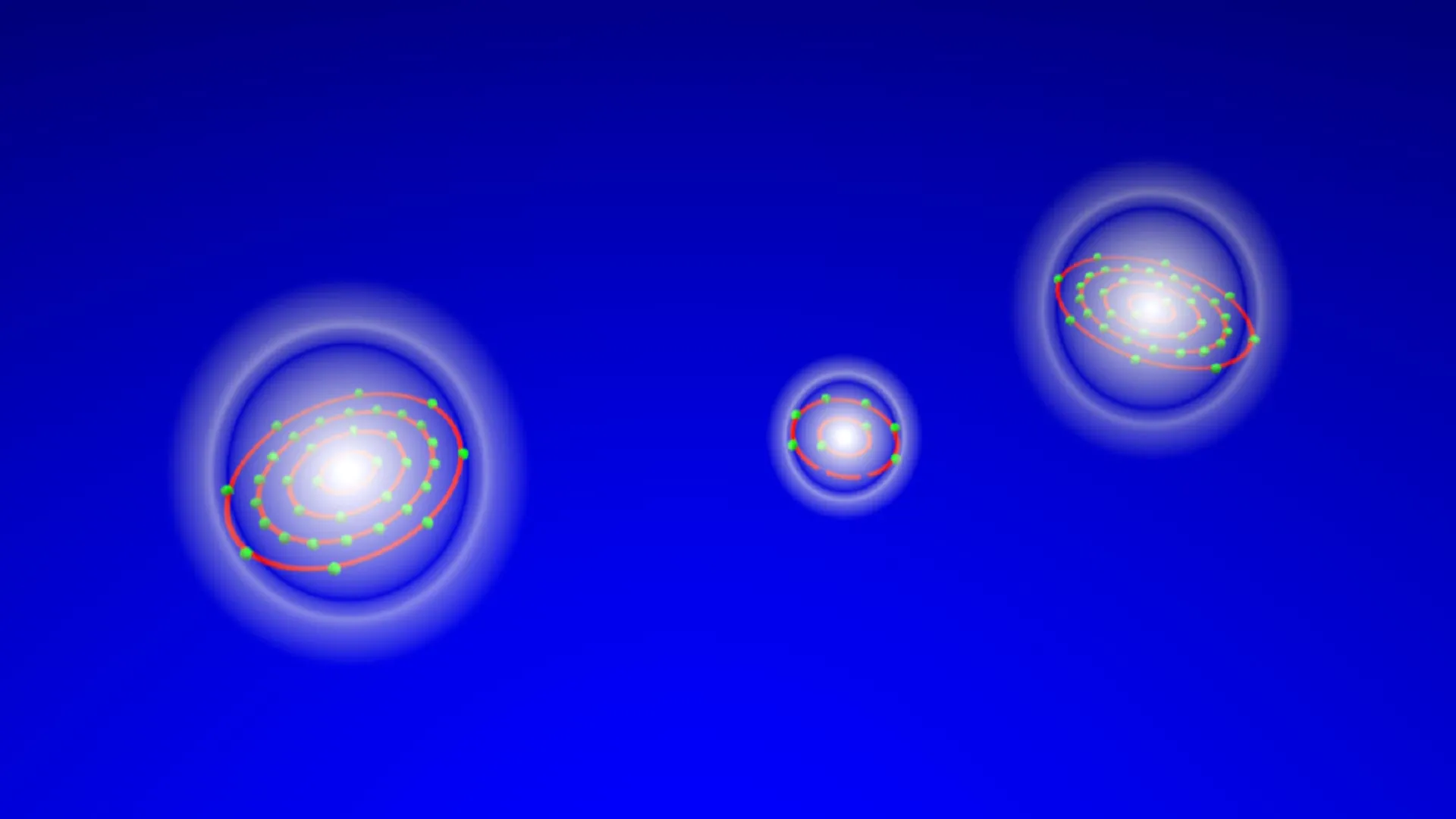
In a landmark achievement for the field of molecular physics, an international team of researchers has successfully captured the real-time "roaming" of atoms during the critical moments preceding an explosion triggered by high-energy radiation. This discovery, centered on the observation of a process known as electron-transfer-mediated decay (ETMD), reveals that the structural reorganization of atoms is a fundamental driver of radiation damage, rather than a secondary effect. By utilizing advanced imaging technology and synchrotron radiation, the team has provided the most detailed view to date of how matter responds to ionization at the sub-picosecond level, offering a new framework for understanding how radiation disrupts biological systems and complex chemical environments.
The Atomic Mechanism of Radiation Damage
Radiation damage is a multi-stage process that begins at the sub-atomic level. When high-energy particles, such as X-rays, interact with matter, they deposit energy into atoms and molecules, often by stripping away electrons or exciting them to higher energy states. This excitation renders the particles unstable. To regain stability, these "excited" atoms must shed excess energy, often through various decay pathways. If these atoms are part of a larger structure, such as a DNA molecule or a cellular membrane, the resulting energy release can break chemical bonds, leading to the fragmentation of essential biomolecules.
While scientists have long understood the broad strokes of this process, the specific intermediate steps—the "nanoscopic" dance that occurs between the initial radiation hit and the final molecular rupture—have remained largely obscured. The new study, led by researchers from the Molecular Physics Department in collaboration with international institutions, focuses on ETMD, a sophisticated decay mechanism where energy is transferred between neighboring atoms. Unlike simpler decay processes that occur within a single atom, ETMD involves a collaborative interaction across a cluster of atoms, making it a critical area of study for understanding radiation effects in condensed phases like liquids and tissues.
Experimental Framework: The NeKr2 Trimer Model
To observe these dynamics in high resolution, the research team utilized a simplified but highly effective model system: a trimer consisting of one neon (Ne) atom weakly bound to two krypton (Kr) atoms. This NeKr2 configuration serves as a "molecular laboratory" that allows scientists to isolate and track the interactions between three specific participants.
The experiment began by exposing the NeKr2 trimer to soft X-rays. These X-rays were tuned to knock an electron out of the inner shell of the neon atom, creating a highly unstable ion. In a vacuum, this neon ion would eventually stabilize, but in the presence of its krypton neighbors, it initiates the ETMD process. During this sequence, the neon atom pulls an electron from one of the adjacent krypton atoms to fill its own vacancy. The energy released by this transfer is then passed to the second krypton atom, which is ionized and emits a low-energy electron into the surrounding space.
This three-body interaction results in two positively charged krypton ions that, due to their like charges, repel each other violently, causing the system to explode. The researchers’ goal was to map what happens in the fleeting moments—measured in picoseconds—between the initial X-ray impact and the final Coulomb explosion.
Advanced Instrumentation and Chronology of Discovery
The study relied on the sophisticated COLTRIMS (Cold Target Recoil Ion Momentum Spectroscopy) reaction microscope. This device acts as a powerful camera capable of reconstructing the three-dimensional momentum of every particle resulting from a molecular breakup. By detecting the emitted electrons and the fragments of the ionized atoms simultaneously, the researchers can "back-calculate" the exact geometry of the atoms at the precise moment the decay occurred.
The experimental data was gathered at two of the world’s most advanced synchrotron facilities: BESSY II in Berlin and PETRA III in Hamburg. These facilities provided the high-intensity, tunable X-ray pulses necessary to trigger the ETMD process with extreme precision.
The chronology of the atomic "movie" captured by the team spans roughly one picosecond (one trillionth of a second). On the scale of atomic vibrations, a picosecond is a vast duration. The researchers observed that during this window:
- Initial Excitation (0-100 femtoseconds): The neon atom is ionized, and the system begins to respond to the sudden change in electronic potential.
- The Roaming Phase (100-500 femtoseconds): Instead of remaining in their original, neat triangular arrangement, the atoms began to "roam." One krypton atom would often swing closer to the neon, while the other moved further away, constantly reshaping the trimer’s geometry.
- Decay and Fragmentation (500-1,000+ femtoseconds): The probability of ETMD occurring was found to be highly dependent on these shifting positions. The decay finally takes place when the atoms reach a configuration that maximizes the efficiency of the energy transfer.
Supporting Data: Nuclear Motion as a Regulatory Force
The data revealed a surprising finding: the ETMD process is not purely an electronic event. Instead, it is "steered" by the physical movement of the nuclei. Through detailed ab initio simulations—complex mathematical models that calculate the quantum mechanical behavior of the system—the team tracked thousands of potential pathways the atoms could take.
The simulations confirmed that the decay rate fluctuated wildly based on the distance and angle between the three atoms. "The decay is not just an electronic process; it is steered by nuclear motion in a very direct and intuitive way," explained Florian Trinter, one of the study’s lead authors. The data showed that the atoms explore a large "configuration space," meaning they try out many different shapes and distances before the energy finally "leaks" out of the system.
This "roaming" behavior is significant because it challenges the traditional static view of molecular decay. Previously, models often assumed that atoms remained relatively stationary during the extremely fast process of electronic decay. This study proves that nuclear motion is a fundamental, rather than a minor, correction to the theory of radiation damage.
Official Responses and Scientific Context
The implications of the study have resonated across the molecular physics community. Senior author Till Jahnke emphasized that this research changes the understanding of how energy moves through matter. "The atoms explore large regions of configuration space before the decay finally takes place," Jahnke noted. "This shows that nuclear motion fundamentally controls the efficiency of non-local electronic decay."
Collaborating scientists from the synchrotron facilities noted that the ability to pair real-time experimental data with high-level simulations marks a new era in ultrafast science. The consensus among the researchers is that ETMD is likely a dominant pathway for damage in biological environments, such as the water-filled interior of a human cell. Because ETMD results in the emission of low-energy electrons, it is a primary suspect in the creation of "secondary" radiation damage.
Analysis of Broader Implications: Medicine and Environment
The discovery of atomic roaming has profound implications for several fields, most notably radiation therapy and DNA research.
1. Radiotherapy and Cancer Treatment:
In cancer treatment, radiation is used to destroy the DNA of malignant cells. However, much of the damage is caused not by the primary X-ray beam, but by the "secondary" low-energy electrons produced when the radiation interacts with the water surrounding the DNA. By understanding how ETMD produces these electrons and how atomic motion influences their energy levels, medical physicists can develop more accurate models for how radiation interacts with tumors, potentially leading to more effective and less harmful treatment protocols.
2. DNA and Biomolecular Integrity:
Low-energy electrons are known to be particularly effective at causing double-strand breaks in DNA, which are difficult for cells to repair. This study provides a "benchmark" for how these electrons are generated in multi-atom systems. It suggests that the movement of atoms within a protein or a DNA strand during radiation exposure could determine whether a "hit" results in a harmless energy dissipation or a catastrophic molecular break.
3. Atmospheric and Environmental Science:
The ETMD process also plays a role in atmospheric chemistry, particularly in how ions interact in aerosol droplets and the upper atmosphere. Understanding the "roaming" of atoms in these environments helps scientists model the chemical cycles that affect ozone depletion and cloud formation.
Future Research Directions
The study of the NeKr2 trimer is just the beginning. The research team intends to extend this methodology to more complex systems, including liquid jets and solvated ions. "This work opens the door to imaging ultrafast dynamics in weakly bound matter with unprecedented detail," the authors concluded.
By moving from a three-atom model to larger clusters and eventually to liquid-phase environments, scientists hope to create a comprehensive "atlas" of how radiation energy travels through the human body at the most fundamental level. The transition from observing "roaming" atoms in a vacuum to observing them in the complex, crowded environment of a living cell remains the next great frontier in radiation science.
This research underscores a vital truth in modern physics: to understand the large-scale effects of radiation—from the health of an astronaut in space to the success of a hospital patient’s oncology treatment—one must first master the sub-picosecond "roaming" of the atoms themselves. Through the lens of the COLTRIMS reaction microscope and the power of synchrotron radiation, the invisible dance of decay is finally being brought into the light.