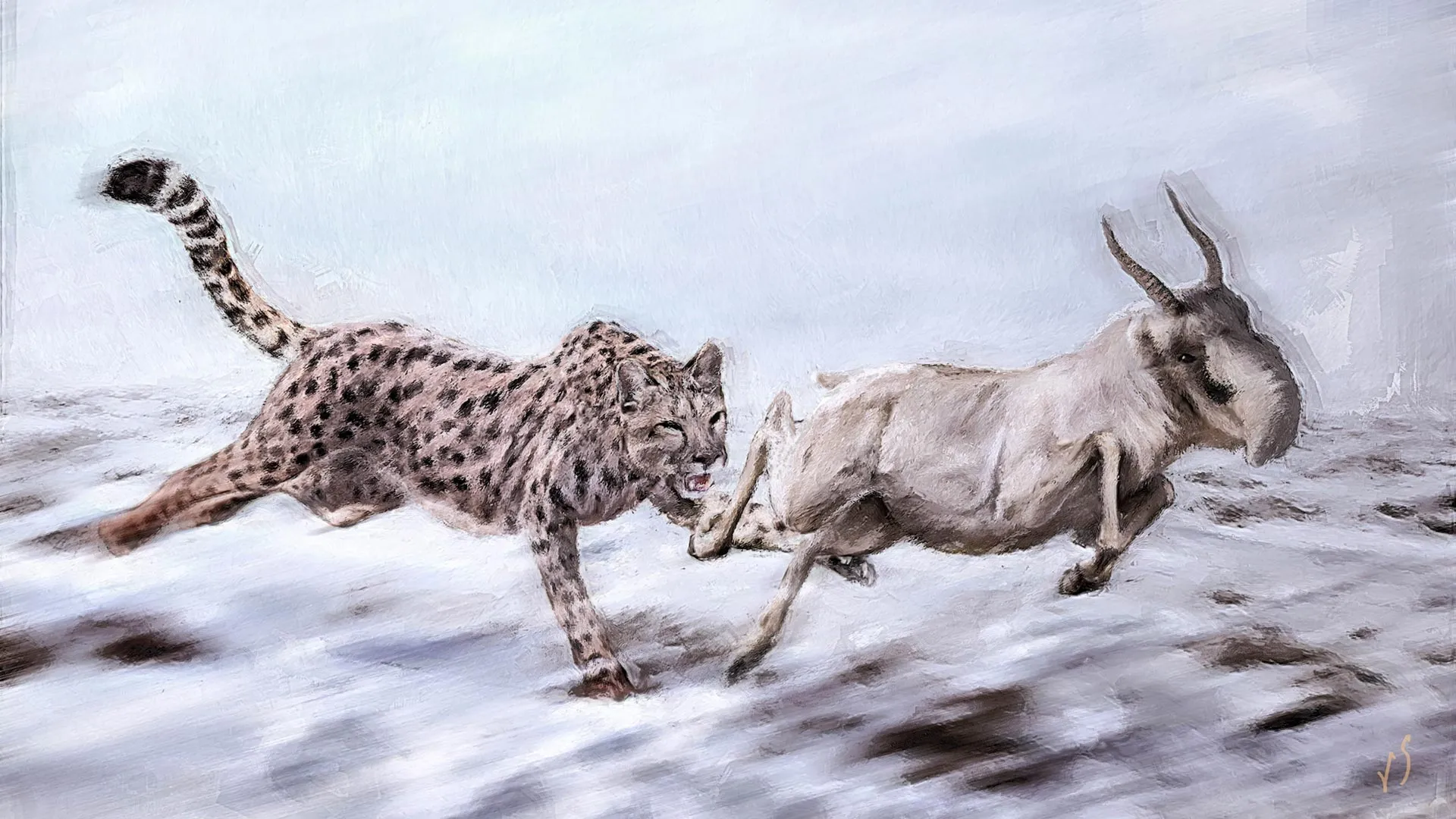
For decades, paleontologists and evolutionary biologists have categorized Miracinonyx trumani based on its striking morphological resemblance to the modern African cheetah (Acinonyx jubatus). Its slender frame, long limbs, and perceived specialization for high-speed terrestrial pursuit led to the long-standing assumption that the two species were closely related. However, a groundbreaking study published on September 4 in the journal Current Biology has dismantled this classification. By utilizing nuclear paleogenomics and stable isotope analysis on fossils dating between 23,000 and 31,000 years ago, researchers have confirmed that M. trumani was not a cheetah at all, but rather a highly adaptable, specialized sister species of the modern puma (Puma concolor).
Evolutionary Convergence and the Puma Connection
The genetic data reveals that the evolutionary lineage of M. trumani diverged from the puma ancestor approximately 2.6 million years ago. This discovery provides a definitive answer to a long-debated question in North American paleontology: whether the "American cheetah" was a result of close ancestry with Old World felids or an independent evolutionary development.
The study confirms that the cat’s "cheetah-like" morphology is a classic, vivid example of evolutionary convergence. Under this phenomenon, unrelated species independently evolve similar physical characteristics because they occupy comparable ecological niches. While M. trumani stood roughly 3 feet tall, measured 8 feet in length, and weighed approximately 150 pounds, its anatomical efficiency for running was not an indicator of a direct genetic link to African cheetahs, but rather an adaptive response to the open, expansive landscapes of Pleistocene North America.
Redefining the Ecological Role
The findings have significantly expanded the known range of this predator, pushing its presence roughly 20 degrees of latitude farther north than previously recognized. This expansion suggests a level of environmental flexibility previously underestimated by the scientific community.
In temperate regions like modern-day Florida and Wyoming, M. trumani functioned as a generalist predator within grasslands. However, in the Arctic Yukon—territories stewarded by the Tr’ondëk Hwëch’in and Vuntut Gwitchin First Nations—the cat adopted an entirely different ecological identity. Stable isotope analysis of fossils from these northern latitudes indicates that these populations occupied the role of tertiary consumers, likely subsisting on anadromous fish, such as salmon.
This dietary breadth highlights a degree of versatility that mirrors the modern puma, which remains one of the most geographically and ecologically adaptable felids in the Western Hemisphere. The research team identified loss-of-function mutations in genes regulating circadian rhythms, suggesting that M. trumani underwent specific physiological adaptations to survive the extreme light cycles and harsh seasonal shifts of the Arctic.
Genomic Insights into Sensory Evolution
Beyond dietary habits, the genetic sequencing uncovered an intriguing sensory adaptation. The analysis revealed that M. trumani lacked a functional gene responsible for producing the receptor necessary to detect sour tastes. While felids are already well-documented for their lack of "sweet tooth" receptors, this is the first recorded instance of a cat species losing the genetic capability to perceive acidity. Evolutionary biologists often associate such sensory losses with high-level dietary specialization, further supporting the theory that these predators were far more refined in their ecological niches than their skeletal structure suggested.
Revisiting the "Ghosts of Predators Past"
The reclassification of M. trumani has profound implications for the "ghosts of predators past" hypothesis. For years, the extraordinary speed of the American pronghorn (Antilocapra americana)—the fastest land mammal in the Western Hemisphere—was attributed to an evolutionary arms race with a high-speed, cheetah-like predator.
The logic suggested that because the pronghorn’s primary natural enemies today are much slower, its speed must be a relic of an ancient, intense predatory pressure that disappeared at the end of the Pleistocene. While the new genomic evidence clarifies that M. trumani was not a cheetah, it does not necessarily disprove the hypothesis. It does, however, fundamentally alter the model of the interaction. If the predator was a versatile, puma-like hunter rather than a specialized high-speed pursuer, the selective pressure on the pronghorn may have been based on a different set of survival strategies, forcing researchers to rethink the mechanics of Pleistocene predator-prey dynamics.
Chronology of Decline and Extinction
One of the most critical aspects of the study is the insight it provides into the species’ eventual extinction. By analyzing high-coverage genomes, researchers found evidence of low genetic diversity in populations across both Wyoming and the Yukon.
Unlike many other megafauna that experienced sharp, sudden population bottlenecks or severe inbreeding before extinction, M. trumani appears to have followed a different trajectory. The genomic record suggests a slow, protracted decline that spanned from the early to the late Pleistocene. This gradual reduction in population size may explain why fossils of the species are relatively rare compared to other contemporaneous predators like the saber-toothed cat or the dire wolf.
Senior author Beth Shapiro, a professor of ecology and evolutionary biology at UC Santa Cruz and co-director of the Paleogenomics Lab, emphasized that low genetic diversity alone was not the immediate cause of their disappearance. "They persisted for a very long time without the signs of inbreeding we would expect before a collapse," Shapiro stated. "The decline was slow, not sudden, which likely left the species unable to adapt when the climate and landscape underwent rapid, final shifts at the end of the Pleistocene."
Broader Implications for Paleontology
The collaborative effort, which included researchers from the University of Alaska Fairbanks (UAF), the Yukon Palaeontology Program, and Des Moines University, underscores the limitations of relying solely on physical appearance for taxonomic classification.
"These cats were remarkably flexible, much like pumas are across their range today," said lead author Molly Cassatt-Johnstone, a Ph.D. candidate in the Paleogenomics Lab at UC Santa Cruz. The study serves as a cautionary tale for paleontologists: the label "American cheetah" was not only factually incorrect regarding lineage, but it also pigeonholed the animal into a narrow hunting strategy that masked its true, broader ecological utility.
Matthew Wooller, a professor at the UAF College of Fisheries and Ocean Sciences and a co-author of the study, highlighted the importance of the species’ range. "They are demonstrating uber-specialization at two ends of their range, while also feeding on two completely different food sources," Wooller noted. This realization forces a recalibration of how scientists model food webs in the Late Pleistocene, acknowledging that predators were likely more integrated into aquatic ecosystems than previously assumed.
Looking Ahead
The legacy of Miracinonyx trumani now stands as a testament to the power of genomic research in correcting historical misconceptions. By moving beyond the reliance on morphological analogies, scientists have unearthed a complex, resilient, and highly specialized predator that successfully navigated the most extreme environments of the Ice Age.
The study concludes that the extinction of the species was not a failure of genetics, but a failure of opportunity—as the environment shifted, the gradual decline of the species became an irreversible trend. As modern climate change threatens existing ecosystems, the story of M. trumani provides a sobering look at how even highly adaptable species can struggle when the fundamental conditions of their habitat shift beneath them over millennia. The findings are expected to prompt a widespread review of other extinct felid classifications, as the field of paleogenomics continues to rewrite the history of North American biodiversity.