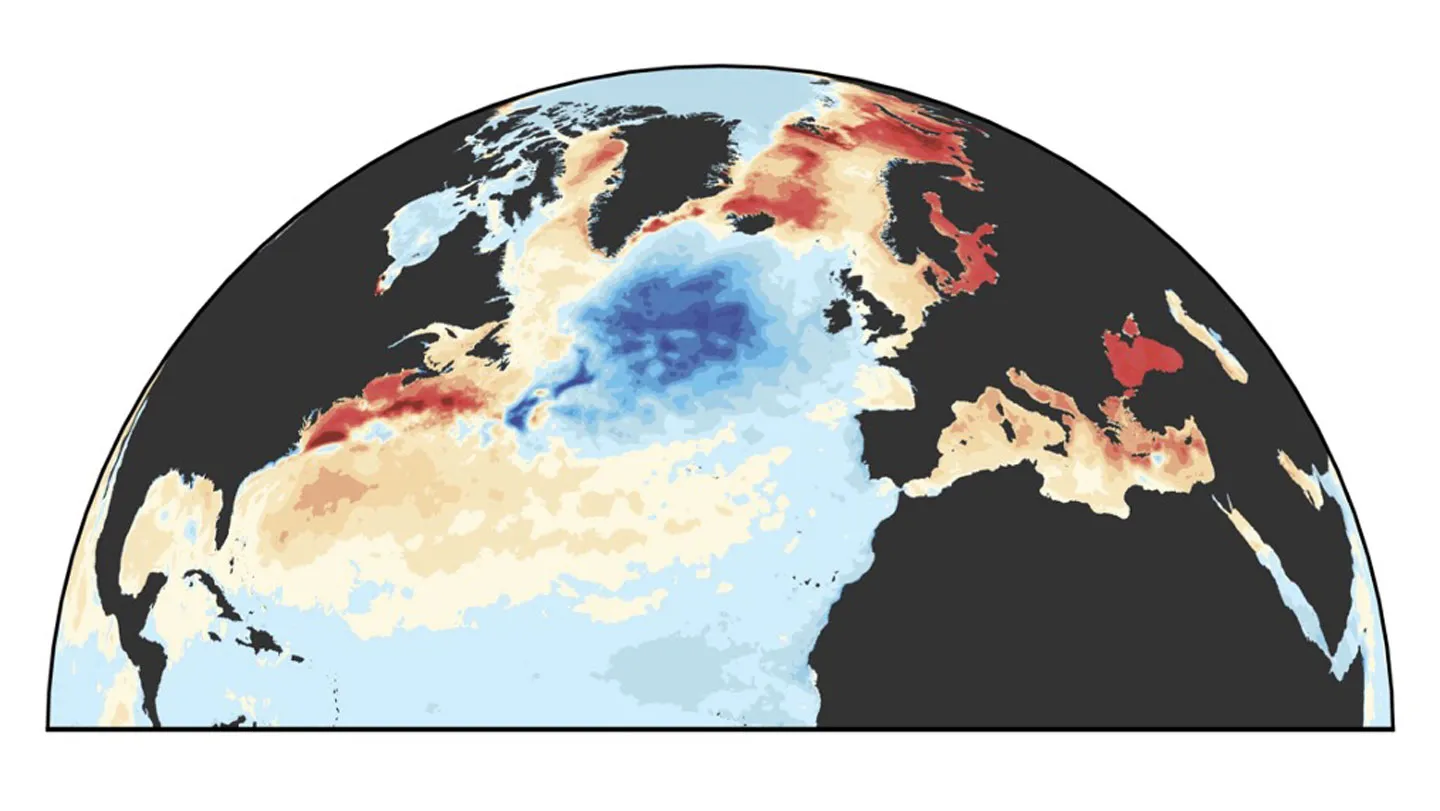
A dramatic cooling trend observed in a specific region of the North Atlantic Ocean, starkly contrasting with the global warming of Earth’s seas, has prompted scientists to issue a grave warning: a critical ocean current system, the Atlantic Meridional Overturning Circulation (AMOC), may be approaching a dangerous tipping point. This potential collapse could trigger profound and far-reaching climatic shifts across the Northern Hemisphere and beyond.
The Mysterious "Cold Blob" in the North Atlantic
For decades, oceanographers and climate scientists have been meticulously tracking the vast ocean currents that regulate global temperatures. Among these, the AMOC stands out as a pivotal component of Earth’s climate system. It functions as a massive oceanic conveyor belt, transporting warm, salty water from the tropics northward towards the North Atlantic. As this water reaches higher latitudes, it cools, becomes denser, and sinks, initiating a return flow southward at deeper ocean levels. This process plays a crucial role in distributing heat, influencing weather patterns, and maintaining the relatively mild climate of Western Europe.
However, recent data analysis has revealed a disconcerting anomaly: a significant patch of ocean south of Greenland and Iceland has experienced a cooling trend of approximately 1 degree Celsius since the 19th century. This phenomenon, often referred to as the "cold blob," is vividly illustrated in simulations that compare ocean temperatures from 1993 to 2021. While the rest of the planet’s oceans have demonstrably warmed, this specific area has defied the trend, exhibiting a steady decrease in temperature. This localized cooling is a potent indicator that something fundamental is changing within the AMOC.
A Deepening Concern: Evidence of AMOC Slowdown
The observed cooling of the North Atlantic is not an isolated incident but is believed to be a symptom of a broader weakening of the AMOC. Studies, including those published in the esteemed journal Geophysical Research Letters, have presented compelling evidence of this slowdown. Researchers, such as Stefan Rahmstorf and his colleagues, have utilized various methodologies, including analyses of ocean temperature, salinity, and sea level records, to reconstruct the historical behavior of the AMOC.
Their findings suggest that the AMOC has already weakened significantly over the past century, potentially by as much as 15 percent. This weakening is attributed to increased freshwater input into the North Atlantic. As the Earth’s climate warms, glaciers and ice sheets, particularly in Greenland, are melting at an accelerated rate, releasing vast quantities of freshwater into the ocean. This influx of less dense freshwater dilutes the salty surface waters, making them less likely to sink and thus disrupting the crucial sinking process that drives the AMOC.
Historical Context: A Long-Term Trend
The concept of the AMOC and its potential for dramatic shifts is not new to the scientific community. Paleoclimate records, which reconstruct past climates using proxies like ice cores and deep-sea sediments, offer glimpses into periods when the AMOC may have been weaker or even shut down entirely. The last major abrupt climate shift, known as the Younger Dryas event, which occurred approximately 12,900 to 11,700 years ago, is widely believed to have been triggered by a sudden shutdown of the AMOC. During this period, temperatures in Northern Europe plummeted by several degrees Celsius over a matter of decades, leading to a return to glacial-like conditions.
While the current warming trend is driven by anthropogenic greenhouse gas emissions, the underlying mechanisms of AMOC disruption remain similar: increased freshwater influx. The current weakening of the AMOC is therefore viewed as a potential precursor to more severe changes, raising concerns about the possibility of crossing a "tipping point."
Defining the Tipping Point
A tipping point, in the context of climate science, refers to a critical threshold beyond which a system undergoes a rapid and often irreversible change. For the AMOC, reaching a tipping point would mean a significant and potentially abrupt slowdown or even a complete shutdown of this vital ocean current system. The consequences of such an event are projected to be severe and widespread.
Projected Impacts of AMOC Collapse
The implications of a weakened or collapsed AMOC are multifaceted and deeply concerning:
- Cooling in Northern Europe: The most immediate and dramatic effect would be a significant cooling of temperatures across Northern Europe, potentially leading to colder winters and a shorter growing season. This could have devastating consequences for agriculture and ecosystems adapted to current climatic conditions.
- Sea Level Rise on the US East Coast: Paradoxically, while the AMOC’s weakening might lead to cooling in the north, it could also contribute to accelerated sea level rise along the eastern seaboard of the United States. As the AMOC weakens, the ocean currents that normally push water away from the coast would diminish, causing sea levels to rise more rapidly in this region.
- Altered Precipitation Patterns: The AMOC plays a role in regulating global precipitation patterns. Its disruption could lead to shifts in rainfall, potentially causing more extreme droughts in some regions and increased flooding in others, particularly in the tropics and subtropics.
- Impacts on Marine Ecosystems: The changes in ocean temperature, salinity, and nutrient distribution associated with an AMOC slowdown could have profound impacts on marine ecosystems, affecting fisheries and the biodiversity of marine life.
- Increased Extreme Weather Events: While the precise mechanisms are still being studied, some research suggests that a weakened AMOC could contribute to an increase in the frequency and intensity of extreme weather events, such as heatwaves and intense storms, in various parts of the world.
Scientific Consensus and Ongoing Research
The scientific community is increasingly focused on understanding the stability of the AMOC. While there is a consensus that the AMOC has weakened and that continued warming will further stress this system, there is ongoing debate about how close it is to a tipping point and how abrupt such a collapse might be.
Recent studies have employed sophisticated climate models to simulate the behavior of the AMOC under various scenarios of greenhouse gas emissions and freshwater input. These models, while still subject to uncertainties, increasingly point towards a heightened risk of crossing a tipping point in the coming decades.
Official Responses and Future Projections
While there have been no official declarations of imminent AMOC collapse from governmental bodies, the findings of these research studies are being closely monitored by climate agencies and intergovernmental organizations such as the Intergovernmental Panel on Climate Change (IPCC). The IPCC reports have consistently highlighted the AMOC as a system of high concern with the potential for abrupt changes.
Scientists are advocating for continued and enhanced monitoring of the AMOC through a network of buoys, oceanographic vessels, and satellite observations. Furthermore, they stress the urgent need for global efforts to mitigate climate change by reducing greenhouse gas emissions. The speed at which the world transitions to cleaner energy sources will be a critical factor in determining the future stability of the AMOC and, consequently, the global climate.
Broader Implications for Global Climate Stability
The potential tipping point of the AMOC serves as a stark reminder of the interconnectedness of Earth’s climate system. It underscores that climate change is not a uniform phenomenon but can manifest in regional variations and abrupt shifts. The AMOC is one of several critical Earth systems that are believed to be susceptible to tipping points, alongside phenomena like the melting of ice sheets and the dieback of rainforests.
The scientific endeavor to accurately predict the timing and magnitude of such events is a race against time. Understanding the AMOC’s behavior is not merely an academic exercise; it is crucial for informing policy decisions, developing adaptation strategies, and ultimately, for safeguarding the planet’s future habitability. The "cold blob" in the North Atlantic, a seemingly localized anomaly, may well be the harbinger of profound global climate transformations, emphasizing the critical need for immediate and decisive action on climate change.