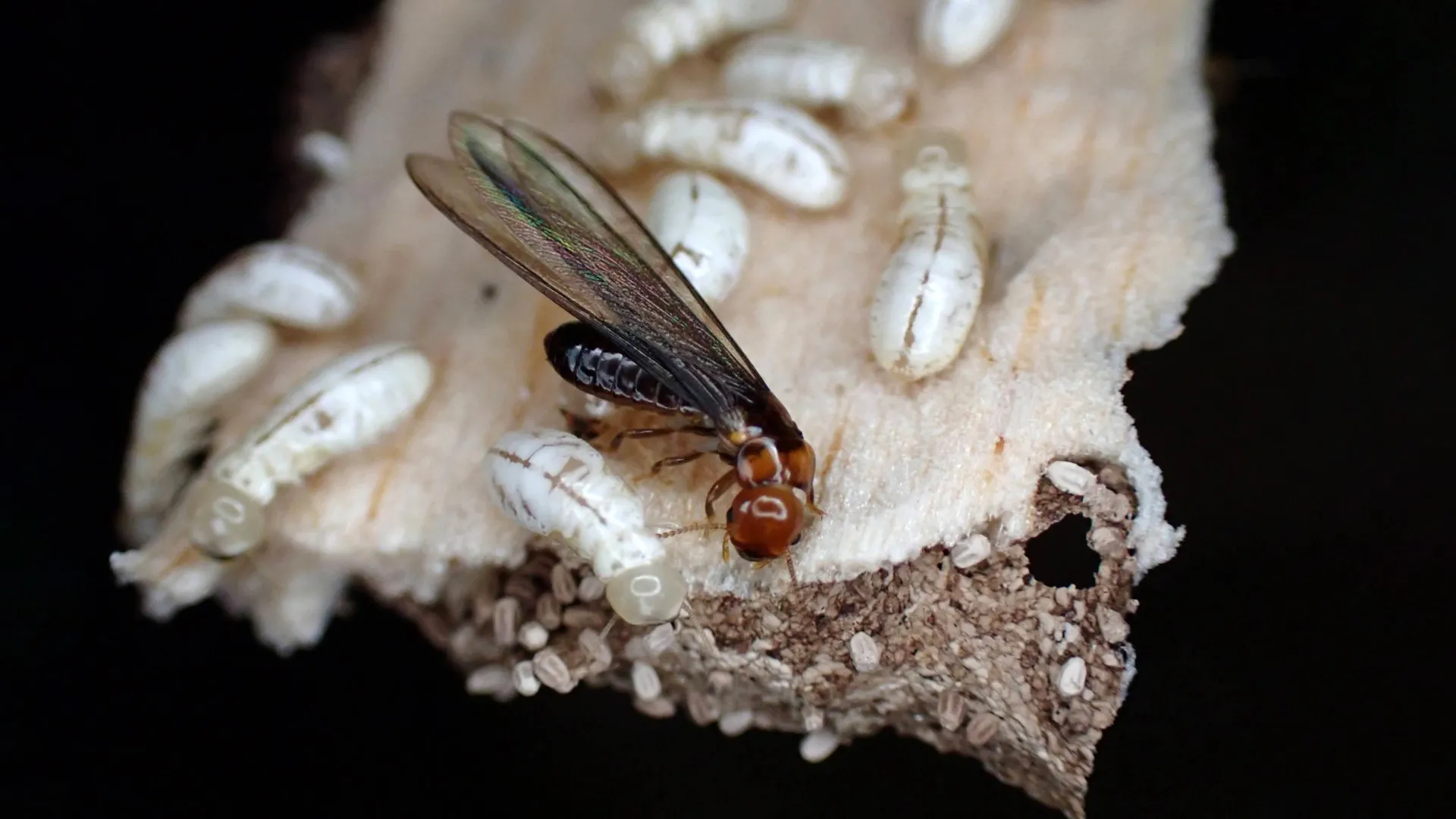
Researchers at the University of California, Riverside (UCR) have identified a groundbreaking approach to combating drywood termite infestations by targeting a fundamental biological process essential for their survival: molting. A new study published in the Journal of Economic Entomology details how bistrifluron, a chemical that inhibits the formation of new insect exoskeletons, can effectively decimate drywood termite colonies by disrupting their growth cycle. This innovative method promises a more environmentally sound and targeted solution compared to many traditional, broad-spectrum termite control strategies.
The findings from UCR’s entomology department highlight a significant advancement in pest management, offering a potent weapon against the elusive drywood termite, a notorious structural pest known for its ability to remain hidden within wooden structures for extended periods. Homeowners often only become aware of an infestation when considerable damage has already occurred, making early detection and effective eradication a persistent challenge. This new research provides a compelling alternative that could revolutionize how these destructive insects are managed.
A Targeted Assault on Insect Development
The core of the UCR research lies in understanding the unique biological vulnerability of insects, particularly termites, which rely on a rigid external skeleton, or exoskeleton, for support, protection, and muscle attachment. This exoskeleton, primarily composed of chitin, must be periodically shed and replaced as the insect grows – a process known as molting. Drywood termites, for instance, undergo this transformative shedding approximately seven times throughout their life cycle.
Bistrifluron directly interferes with this critical growth phase. Unlike conventional insecticides that aim to quickly poison the insect, bistrifluron operates by preventing the termite from synthesizing the necessary chitin to build its new exoskeleton. "Once the termites reach a certain stage, they have to molt. They cannot avoid that," explained Nicholas Poulos, the study’s corresponding author and a doctoral student at UCR. "With a lethal dose of this chemical, they’ll try to shed their old exoskeleton but won’t have a new one ready to protect them."
This targeted mechanism means that when a termite treated with bistrifluron attempts to molt, it is left without the protective outer shell, rendering it vulnerable and ultimately leading to its demise. This mode of action is a stark contrast to many older termite control methods that can pose risks to non-target organisms.
Environmental Friendliness and Mammalian Safety
A key advantage of bistrifluron, as emphasized by the UCR team, is its specificity to insects. "This chemical is more environmentally friendly than ones traditionally used for drywood termite infestations," stated Poulos. "It’s specific to insects and can’t harm humans." This specificity stems from the fundamental difference in skeletal structure between insects and mammals. Humans possess an internal skeletal system, while insects like termites depend on their external chitinous exoskeleton. Bistrifluron’s action on chitin synthesis bypasses mammalian biology, significantly reducing the risk of accidental poisoning to humans and other non-target animals. This addresses a major concern associated with many conventional pest control chemicals that often have broader toxicity profiles.
Laboratory Efficacy and Colony Collapse
The research involved rigorous laboratory testing of bistrifluron against the western drywood termite, Incisitermes minor. In controlled experiments, the chemical demonstrated remarkable efficacy, leading to substantial colony mortality. In one "no-choice" test, where termites had no alternative but to interact with treated wood, bistrifluron achieved a 99 percent mortality rate over a 60-day period. In a more realistic "choice" test, where termites could select between treated and untreated wood at a 0.1 percent concentration, the chemical still resulted in 96 percent mortality over the same timeframe.
The observed effect was not instantaneous. Researchers noted that initial exposure to bistrifluron led to a reduction in termite activity and feeding. Over time, the cumulative effect of inhibited molting caused the insects to weaken and die. This gradual but comprehensive elimination of the colony is a hallmark of effective termite control, ensuring that the infestation is thoroughly eradicated rather than merely suppressed.
Termites as Their Own Demise: The Power of Social Transfer
Perhaps one of the most compelling aspects of the UCR study is the discovery that termites themselves can act as vectors for the treatment, spreading it throughout the colony. After consuming wood treated with bistrifluron, termites effectively transfer the chemical to their nestmates through social interactions. In transfer tests, a critical finding emerged: even when only a small fraction of the colony (5 percent) was initially exposed to the treated material, the entire group achieved 100 percent mortality within 90 days.
This phenomenon of self-dissemination is attributed to the social feeding behaviors of termites. The study reported that treated food material was transferred from exposed "donor" termites to unexposed "recipient" termites within a remarkably short period of 24 to 48 hours. This social transfer mechanism is particularly significant for drywood termites, which exhibit complex social behaviors, including proctodeal trophallaxis – a form of food sharing that involves the transfer of gut contents from the anus to the mouth. While these hidden social behaviors make infestations difficult to detect, they now appear to be a powerful asset in spreading treatments effectively.
This discovery aligns with ongoing research at UC Riverside that has highlighted the importance of these social interactions, including the sharing of essential gut microbes, in maintaining termite colonies. The very mechanisms that allow drywood termites to thrive in their concealed environments are now being leveraged to facilitate the spread of a potentially colony-killing agent.
A New Era of Localized Treatment
The implications of this research extend to the practical application of termite control. Traditional methods, such as tenting and fumigation, are often disruptive, costly, and require homeowners to vacate their properties for extended periods. They also do not necessarily prevent future infestations. In contrast, the bistrifluron treatment offers the prospect of localized interventions.
"We believe this method of spot treatment can kill a larger colony and spread more easily than current termite control methods," stated Professor Dong-Hwan Choe, a senior author on the paper and a UCR entomology professor. "You don’t have to apply too much to get a very good result. The chitin synthesis inhibitors show promise as localized treatment for drywood termites."
This localized approach could significantly reduce the burden on homeowners, minimizing disruption and potentially lowering treatment costs. The slower collapse, occurring over approximately two months, is a trade-off for a less invasive and more targeted solution. Furthermore, the chemical’s persistence within the treated wood could offer residual protection against subsequent infestations, a benefit not typically provided by fumigation.
Enhancing Treatment Efficacy with Scent Lures
Adding another layer of innovation to termite management, the UCR team has also explored the use of olfactory cues to enhance the effectiveness of insecticide treatments. In prior research, Professor Choe’s lab identified pinene, a chemical compound commonly found in pine trees, as a scent that attracts western drywood termites, signaling potential food sources.
By integrating pinene into insecticide treatments, researchers have observed a marked improvement in efficacy. A 2025 patent application from UCR details the use of pinenes to boost the effectiveness of localized insecticide injections against western drywood termites. The inclusion of pinene not only accelerated termite mortality but also increased the overall kill rate, with treatments combining insecticide and pinene achieving over 95 percent mortality compared to approximately 70 percent with insecticide alone.
This scent-based enhancement has practical implications for treatment strategies. It suggests that pinene could enable wider spacing between injection points, potentially reducing the labor, time, and amount of insecticide required for effective control. This dual-pronged approach – combining a targeted growth inhibitor with an attractive lure – represents a sophisticated and highly promising strategy for drywood termite eradication.
Towards Practical Application and Broader Impact
While the laboratory results are highly encouraging, the UCR team is actively working to translate these findings into practical, real-world applications. The current method of dissolving bistrifluron in acetone for application, while effective in research settings, presents challenges for widespread use due to acetone’s flammability and strong odor.
"We are working to make it more feasible for practical application in real life scenarios," Poulos noted, highlighting the next crucial step in the research and development process. This involves exploring alternative solvents or delivery systems that are safer, more user-friendly, and cost-effective for pest control professionals and homeowners alike.
The urgency for such solutions is underscored by the widespread presence and impact of western drywood termites. Native to parts of Mexico and California, these termites have been transported globally through the movement of lumber and wood products. Their ability to conceal themselves within wood makes them particularly difficult to manage. Infestations have been reported in regions including Hawaii, New York, Florida, Canada, China, Japan, Korea, and Australia, underscoring their status as a significant international pest.
Climate Change and the Expanding Threat
Adding to the complexity of termite management, climate change may further exacerbate the problem. Shifting temperature patterns could allow drywood termites to expand their range into previously unsuitable territories. As Professor Choe observed, "As we move lumber around the world, the termites are constantly transported to new locations. If they find the climate there acceptable, the problem will spread."
This potential expansion necessitates proactive and innovative control strategies. The UCR research into bistrifluron and pinene-based treatments represents a significant step forward, offering the promise of more sustainable and effective methods for managing these destructive pests. The study’s initial findings provide a strong foundation for developing new approaches that are not only potent but also environmentally responsible, offering a glimmer of hope in the ongoing battle against drywood termites. The development of low-impact, localized strategies like these will become increasingly attractive options as the global challenges of pest management and climate change continue to evolve.