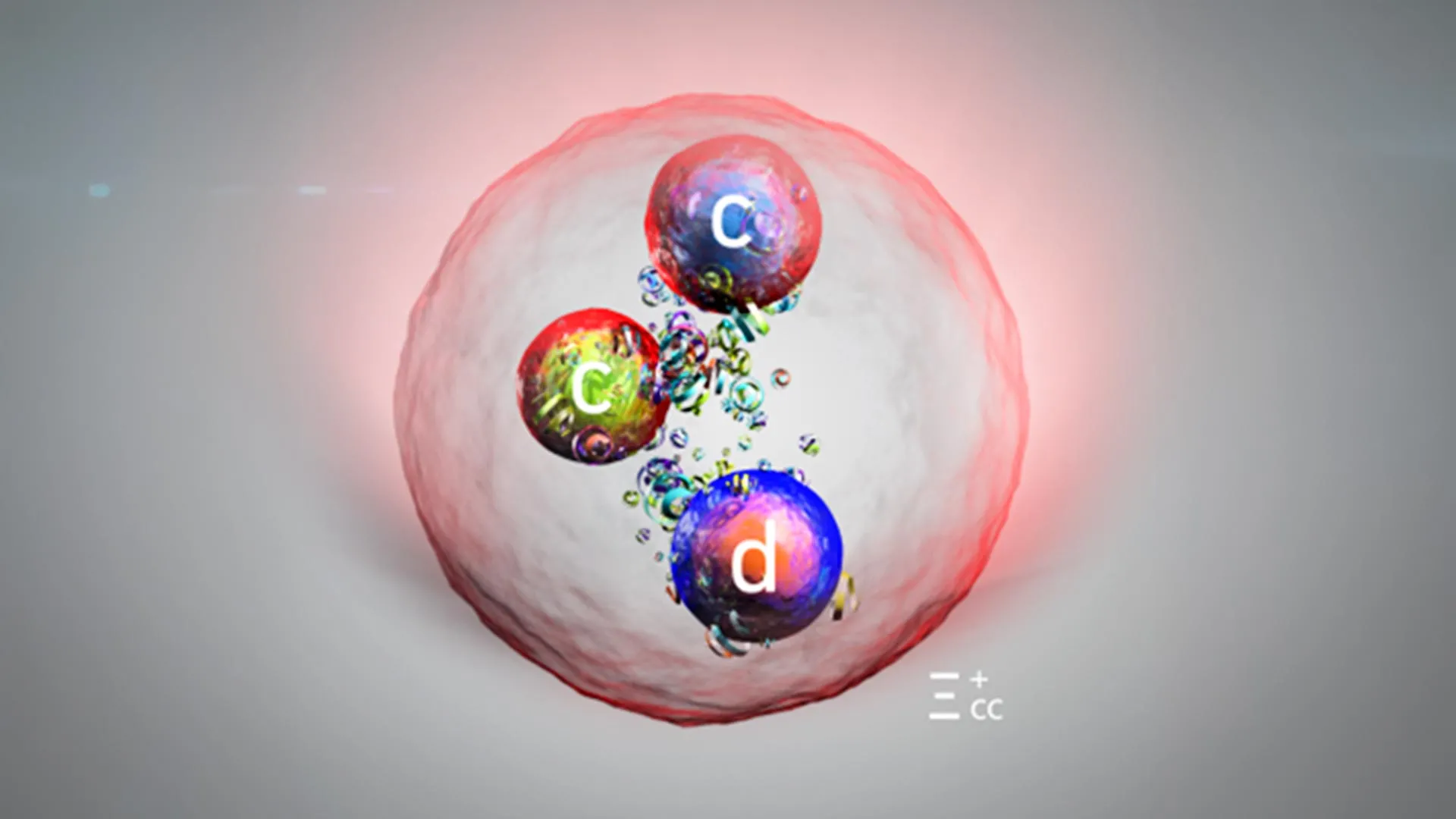
In a landmark achievement for the field of high-energy physics, researchers from The University of Manchester have played a pivotal role in the identification of a previously unobserved subatomic particle at the European Organization for Nuclear Research, commonly known as CERN. The discovery of the particle, designated as the $Xicc^+$ (pronounced Xi-cc-plus), was made using the Large Hadron Collider beauty (LHCb) experiment. This particle represents a significant addition to the "particle zoo," providing scientists with a new laboratory to test the theories of quantum chromodynamics—the study of the strong force that binds the nuclei of atoms. The $Xicc^+$ is characterized as a doubly charmed baryon, a heavy relative of the proton, composed of two heavy charm quarks and one lighter down quark.
This breakthrough marks the first new particle discovery facilitated by the recently upgraded LHCb detector, a sophisticated instrument designed to study the slight differences between matter and antimatter. The upgrade was the culmination of an extensive international collaboration involving more than 1,000 scientists and engineers from 20 countries. Within this global framework, the United Kingdom emerged as the largest national contributor, with The University of Manchester providing essential leadership and technical expertise that spanned over a decade of planning, construction, and implementation.
The Anatomy of a Heavy Proton Relative
To understand the significance of the $Xi_cc^+$, one must look at the fundamental building blocks of matter. In the Standard Model of particle physics, baryons are particles made of three quarks. The most famous baryons are the proton and the neutron, which make up the nuclei of every atom in the universe. A proton consists of two "up" quarks and one "down" quark, while a neutron consists of one "up" quark and two "down" quarks. These light quarks are held together by the strong nuclear force, mediated by particles called gluons.
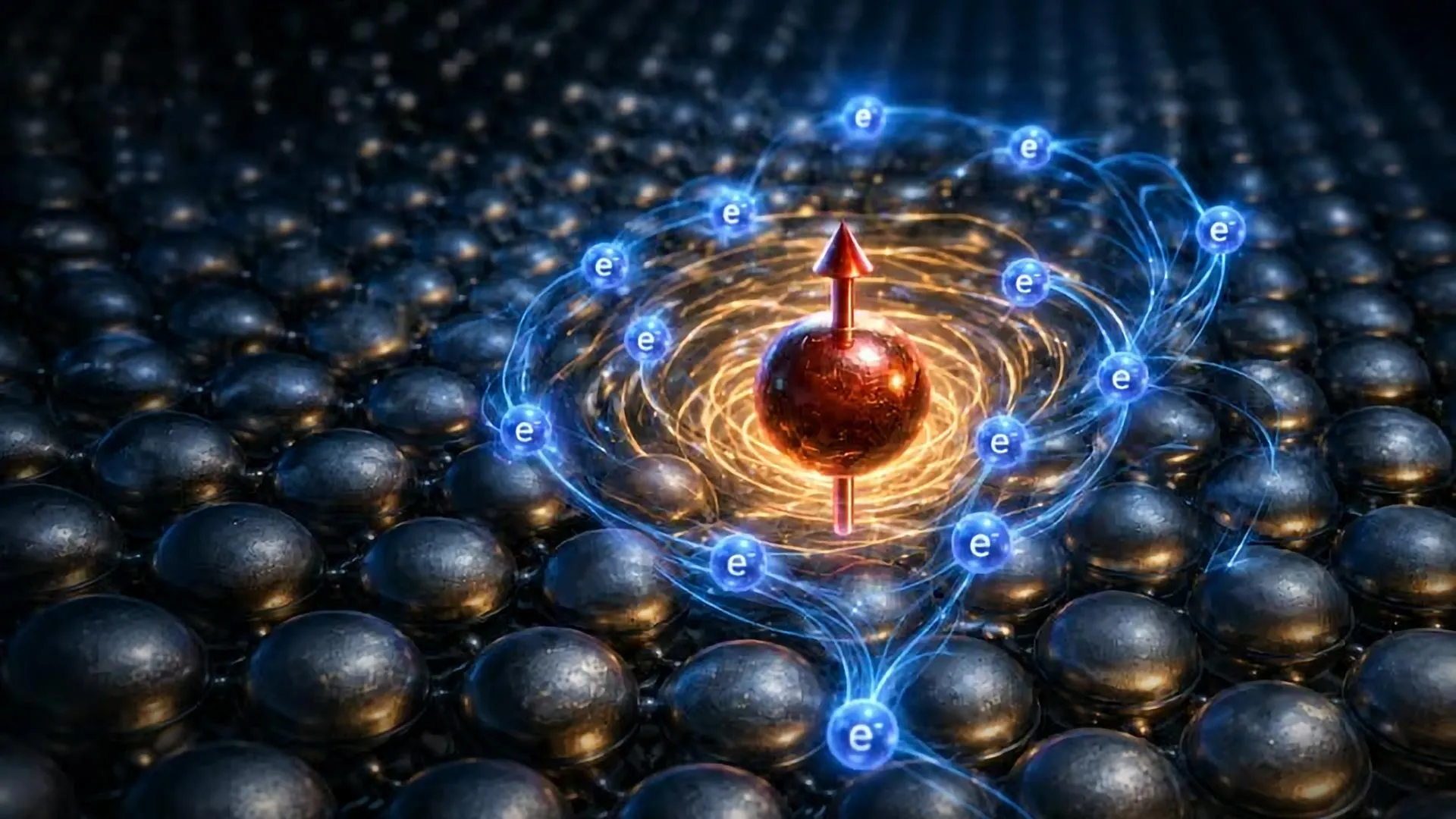
The newly discovered $Xicc^+$ belongs to the same family as the proton but is significantly more massive. Instead of the light "up" quarks found in a proton, the $Xicc^+$ contains two "charm" quarks. Charm quarks are much heavier than up or down quarks, meaning the $Xicc^+$ functions as a heavy-duty version of the proton. The presence of two heavy quarks creates a unique internal dynamic; while a proton is like three dancers of equal weight moving together, the $Xicc^+$ is more akin to two heavy stars being orbited by a lighter planet. This configuration allows physicists to test the "strong force" in extreme conditions that are not present in ordinary matter.
A Century of Particle Physics at Manchester
The discovery of the $Xi_cc^+$ is not merely a modern success but a continuation of a storied legacy of physical science at The University of Manchester. The university’s connection to the heart of the atom dates back to the early 20th century. Between 1917 and 1919, Ernest Rutherford, working at Manchester, conducted the experiments that led to the identification of the proton. Rutherford’s work fundamentally shifted the human understanding of the universe, proving that the mass of an atom is concentrated in a tiny, dense nucleus.
The university’s contributions continued into the mid-20th century. In the 1950s, Manchester researchers were instrumental in the first identification of a member of the $Xi$ (Xi) particle family, which were then referred to as "strange" particles because they lived much longer than expected. This historical foundation laid the groundwork for the modern era of CERN collaborations. By identifying the $Xi_cc^+$, the current generation of Manchester physicists has bridged a gap of over 100 years, moving from the discovery of the simplest baryon—the proton—to one of the most complex and elusive heavy baryons ever recorded.
Engineering the Upgraded LHCb Detector
The identification of such a rare particle would have been impossible without the recent technological overhaul of the LHCb detector. Professor Chris Parkes, head of the Department of Physics and Astronomy at The University of Manchester, served as the spokesperson for the international LHCb collaboration during the critical period of the detector’s installation and initial operation. His leadership over the last decade guided the UK’s involvement from the conceptual design phase through to the successful delivery of high-quality data.
A central component of this upgrade was the development of a new tracking system. The Manchester LHCb team was responsible for the design and construction of the silicon pixel detector modules. These modules were meticulously assembled within the University’s Schuster Building, a facility equipped with specialized cleanrooms for high-precision instrumentation. These silicon sensors act as the "eyes" of the experiment, positioned just millimeters away from the proton-proton collision point.
These modules are essential for tracking the paths of particles as they decay. Because particles like the $Xicc^+$ are highly unstable, they exist for only a fraction of a trillionth of a second before transforming into other, lighter particles. The silicon pixel detector allows researchers to trace these "decay products" back to a single point of origin, effectively allowing them to reconstruct the existence of the $Xicc^+$ from its remnants.
Data Acquisition and the "High-Speed Camera" Analogy
The technical complexity of the LHCb detector is difficult to overstate. Dr. Stefano De Capua, a senior researcher at The University of Manchester who led the production of the silicon detector modules, describes the instrument as a high-speed camera of unprecedented capability. In the LHC, protons are accelerated to near the speed of light and collided 40 million times per second. The detector must take a "photograph" of each of these collisions to determine if anything unusual has occurred.
The silicon chips used in these detectors are custom-designed to withstand the intense radiation environment inside the LHC. Interestingly, the technology developed for these high-energy physics experiments often finds utility elsewhere; variants of these Manchester-designed silicon chips are currently being adapted for use in medical imaging, potentially improving the resolution of X-rays and PET scans. This cross-pollination of technology highlights the broader societal benefits of fundamental research.
Identifying the Signal: The 2024 Measurements
The discovery of the $Xi_cc^+$ was the result of a rigorous analysis of data collected during the 2024 run of the Large Hadron Collider. This was the first year the upgraded LHCb experiment operated at its full design capacity, benefiting from a "trigger-less" readout system that allows the detector to process data at a much higher rate than previously possible.
Researchers identified the particle by looking for its specific decay signature. The $Xi_cc^+$ decays into a $Lambda_c^+$ (Lambda-c-plus) baryon, a $K^-$ (Kaon), and a $pi^+$ (Pion). By calculating the energy and momentum of these three "daughter" particles, physicists can work backward to determine the mass of the "parent" particle.
The analysis revealed a clear signal of approximately 915 events, appearing as a sharp peak on a graph of mass distribution. The measured mass was determined to be 3619.97 MeV/c². This result was particularly satisfying for the team because it aligned perfectly with theoretical predictions based on the $Xi_cc^++$ (Xi-cc-plus-plus), a related "isospin partner" particle discovered previously. The consistency between the observed mass and the theoretical models provides strong evidence that our understanding of quark interactions is accurate.
Resolving a Two-Decade Mystery
For the global physics community, the discovery of the $Xicc^+$ brings an end to a period of uncertainty that lasted more than 20 years. In the early 2000s, an experiment known as SELEX at Fermilab in the United States reported the observation of a particle they believed to be the $Xicc^+$. However, their reported mass and the rate at which the particle was produced did not align with theoretical expectations, and subsequent experiments at other facilities failed to confirm the finding.
The new results from CERN effectively resolve this discrepancy. The mass measured by the LHCb team (3619.97 MeV/c²) is significantly different from the mass reported by the SELEX collaboration. Because the LHCb measurement is based on a much larger dataset and matches the theoretical predictions of the Standard Model, it is now considered the definitive observation of the particle. This underscores the importance of the scientific method, where independent verification and advanced technology are required to confirm or refute earlier claims.
Future Implications and the Road to Upgrade 2
The discovery of the $Xicc^+$ is just the beginning of a new chapter for CERN and The University of Manchester. The current phase of the LHC is designed to collect massive amounts of data, which will allow physicists to study the properties of the $Xicc^+$ in even greater detail, such as its precise lifetime and how often it decays into different combinations of particles.
Looking further ahead, Manchester scientists are already preparing for the next evolution of the experiment: LHCb Upgrade 2. This project will coincide with the High-Luminosity Large Hadron Collider (HL-LHC) initiative, which aims to increase the "luminosity"—or the number of collisions—by a factor of ten. This will provide an even more powerful "microscope" to look for rare decays that could point to "New Physics" beyond the Standard Model, such as dark matter candidates or new fundamental forces.
The findings were presented at the prestigious Rencontres de Moriond Electroweak conference, a gathering where the world’s leading physicists share the latest results from particle accelerators. The presentation highlighted not only the technical success of the LHCb upgrade but also the enduring strength of the UK’s scientific infrastructure.
As Professor Parkes noted, the journey from Rutherford’s basement experiments to the multi-billion-euro infrastructure of CERN is a testament to the power of human curiosity. The discovery of the $Xi_cc^+$ reinforces Manchester’s position as a global hub for physics, proving that the quest to understand the smallest components of our universe continues to yield profound insights. The data gathered today will serve as the foundation for the next century of physical discovery, ensuring that the legacy of Manchester’s "heavy proton" research continues to evolve alongside our understanding of the cosmos.