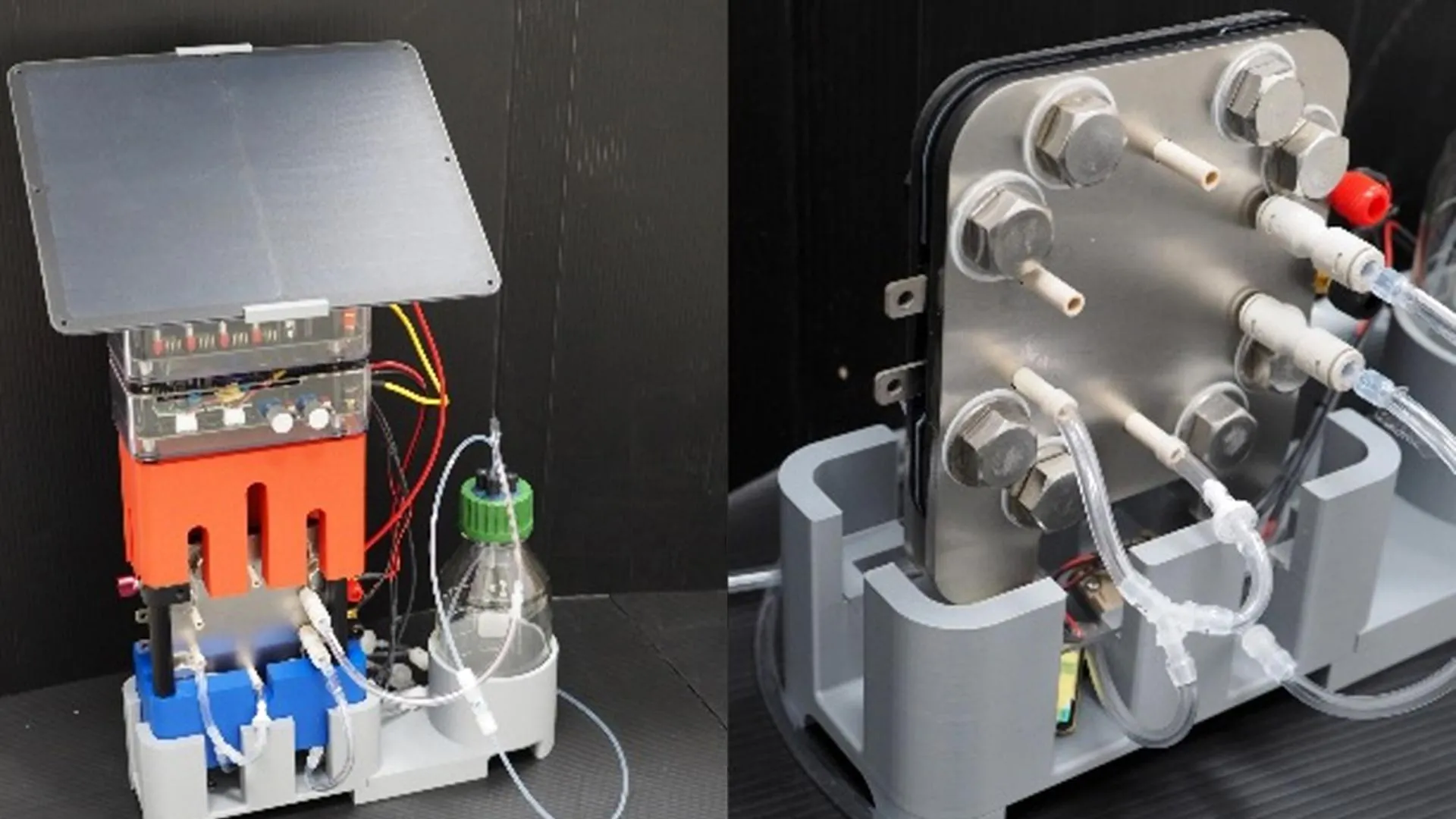
A research team at Osaka Metropolitan University (OMU) has achieved a significant breakthrough in the field of renewable energy by developing an artificial photosynthesis system that functions autonomously without the need for external battery-based control mechanisms. This innovative technology, developed in collaboration with Iida Group Holdings Co., Ltd., marks a departure from traditional solar-to-fuel systems which often rely on complex electronic components to manage the fluctuating nature of solar energy. By integrating self-regulating chemical properties directly into the electrolyzer, the researchers have created a more streamlined, cost-effective, and durable method for producing formic acid—a high-density energy carrier—from carbon dioxide and water.
The advancement addresses one of the most persistent hurdles in the commercialization of artificial photosynthesis: the instability of solar power. Unlike natural plants, which have evolved sophisticated biological mechanisms to handle varying light intensities, artificial systems typically require Maximum Power Point Tracking (MPPT) systems. These electronic controllers, paired with storage batteries, ensure that the solar cells provide a steady voltage to the electrolyzer regardless of whether the sun is obscured by clouds or positioned at a low angle. By eliminating these external requirements, the OMU team has paved the way for decentralized, maintenance-free energy production that could eventually be integrated directly into residential and industrial infrastructure.
The Mechanism of Artificial Photosynthesis and Formic Acid Production
Artificial photosynthesis is a chemical process that replicates the natural ability of plants to convert sunlight, water, and carbon dioxide into energy-rich carbohydrates. In the context of green technology, the goal is to produce "solar fuels" that can be stored, transported, and used on demand. The OMU system focuses on the production of formic acid (HCOOH). Formic acid is increasingly viewed by the scientific community as a superior alternative to hydrogen gas for energy storage. While hydrogen requires high-pressure tanks or cryogenic cooling for transport, formic acid is a liquid at room temperature, making it significantly safer and easier to integrate into existing liquid-fuel infrastructure.
The core of the OMU innovation lies in the electrolyzer, the component responsible for the electrochemical conversion. In a standard setup, solar panels capture photons to generate electricity, which is then fed into the electrolyzer. Inside the electrolyzer, a catalyst facilitates the reduction of CO2 and the oxidation of water. The resulting chemical reaction produces formic acid. However, the efficiency of this reaction is highly sensitive to the electrical input. If the voltage is too low, the reaction stalls; if it is too high, the system can overheat or damage the catalysts. The self-regulating system designed by Associate Professor Yasuo Matsubara and Professor Yutaka Amao utilizes a unique solid electrolyte that adjusts its own electrical resistance in response to temperature changes caused by solar intensity.
Technical Breakthrough: Eliminating the MPPT and Battery Bottleneck
To understand the significance of the OMU research, one must consider the limitations of current solar-to-fuel technologies. Most contemporary systems are burdened by the "intermittency problem." Because solar radiation fluctuates throughout the day, the electrical output of photovoltaic cells is rarely constant. To maintain peak efficiency, engineers use MPPT controllers—specialized DC-to-DC converters that match the load of the electrolyzer to the output of the solar panels. While effective, these controllers require sophisticated circuitry and are often paired with lithium-ion batteries to "buffer" the energy flow.
The OMU team’s design bypasses this entire electronic layer through a principle of thermal-electrical synchronization. As sunlight becomes more intense, the solar cells generate more heat alongside electricity. The researchers developed a solid electrolyte whose impedance (electrical resistance) decreases as its temperature rises. Consequently, when the sun is at its peak and the solar cells are producing the most current, the electrolyzer’s resistance naturally drops, allowing it to process the increased electrical load without external intervention. Conversely, when sunlight fades, the system cools, resistance increases, and the reaction slows down in a controlled manner.
This "passive" MPPT function ensures that the system always operates near its maximum potential efficiency. By removing batteries and converters, the researchers have significantly reduced the "Bill of Materials" (BOM) for the system, lowering the barrier to entry for large-scale deployment. Furthermore, the removal of batteries eliminates the environmental concerns associated with lithium mining and the limited lifecycle of chemical battery cells.
Chronology of Development and the Osaka Kansai Expo 2025
The journey toward this self-regulating system began several years ago at the Research Center for Artificial Photosynthesis (ReCAP) at Osaka Metropolitan University. ReCAP has long been a global leader in catalyst research, specifically focusing on the reduction of CO2 into usable fuels. The partnership with Iida Group Holdings Co., Ltd., a major Japanese homebuilder, was established to bridge the gap between laboratory-scale science and real-world architectural application.
In 2023, the team moved from theoretical modeling to prototype testing. Initial laboratory results confirmed that the solid electrolyte could indeed mimic the behavior of an MPPT controller. Following these successes, the project gained momentum as a featured technology for the upcoming Osaka Kansai Expo 2025. The researchers participated in the "Joint Pavilion Iida Group × Osaka Metropolitan University," where they demonstrated a pilot version of the system.
During the exhibition, the technology was put to a practical test: powering a miniature diorama. The artificial photosynthesis system captured CO2 from the air and used sunlight to produce formic acid, which was then converted back into electricity via a fuel cell to illuminate the display. This end-to-end demonstration proved that the system could operate autonomously in a public setting. The latest findings, recently published in the prestigious journal EES Solar (Energy & Environmental Science: Solar), represent the formal scientific validation of the data collected during these outdoor trials.
Supporting Data and Performance Metrics
The data published in EES Solar highlights the stability of the system under fluctuating outdoor conditions. During testing, the researchers monitored the "Solar-to-Fuel" (STF) efficiency—a critical metric that measures how much of the incoming solar energy is successfully stored in chemical bonds. While traditional experimental systems often see a sharp drop in STF efficiency when clouds pass over, the OMU system maintained a remarkably consistent conversion rate.
Key data points from the research include:
- Temperature-Resistance Correlation: The solid electrolyte demonstrated a predictable linear decrease in impedance as temperatures rose from 25°C to 55°C, perfectly matching the output curve of standard silicon solar cells.
- Formic Acid Purity: The system produced formic acid with high selectivity, meaning very few unwanted byproducts (such as carbon monoxide or methane) were generated during the process.
- Operational Longevity: Because the system lacks moving parts or complex microelectronics that are prone to heat-induced failure, the electrolyzer showed minimal degradation over extended outdoor exposure cycles.
Professor Yutaka Amao noted that the simplicity of the design is its greatest strength. "By using the physical properties of the materials themselves to regulate the process, we eliminate the points of failure that usually plague high-tech solar installations," he stated.
Official Responses and Industry Implications
The reaction from the scientific and industrial communities has been overwhelmingly positive. Environmental analysts suggest that this technology could be a "game-changer" for the decentralized energy market. Representatives from Iida Group Holdings have expressed interest in integrating these self-regulating electrolyzers into the design of "Carbon Neutral Homes." In such a scenario, the exterior walls or roofs of houses could act as solar fuel factories, scrubbing CO2 from the atmosphere and storing energy in liquid form in underground tanks.
"This is not just about producing fuel; it is about creating a circular carbon economy," said Associate Professor Yasuo Matsubara. "We are transforming a greenhouse gas that causes global warming into a resource that can power our daily lives."
Industry experts point out that the elimination of batteries is particularly relevant for the "Global South" and remote areas where maintenance of complex electronic systems is difficult. A robust, self-regulating system could provide a reliable source of fuel for cooking, heating, or local power generation without the need for a stable power grid or expensive replacement parts.
Broader Impact and Future Prospects
The broader implications of the OMU research extend into the realm of global decarbonization efforts. As nations strive to meet the targets set by the Paris Agreement, the ability to capture and utilize CO2 becomes paramount. Most current Carbon Capture and Storage (CCS) technologies focus on burying CO2 underground, which is a costly process with no immediate economic return. The OMU system, however, represents Carbon Capture and Utilization (CCU), turning a liability into an asset.
Furthermore, the transition to a "formic acid economy" could solve the long-standing problem of seasonal energy storage. Solar energy is abundant in the summer but scarce in the winter. Unlike batteries, which lose charge over time, formic acid can be stored indefinitely in simple plastic or metal containers. During the winter months, the stored formic acid can be fed into a fuel cell to generate heat and electricity, providing a truly sustainable year-round energy solution.
Looking forward, the research team at Osaka Metropolitan University plans to scale up the electrolyzer units to handle larger volumes of CO2. They are also exploring the use of different catalysts to see if the self-regulating principle can be applied to the production of other green chemicals, such as methanol or ethylene. With the Osaka Kansai Expo 2025 serving as a global stage, the team is optimistic that their "battery-free" approach will set a new standard for the next generation of renewable energy technology.
As the world seeks to move away from fossil fuels, the OMU breakthrough offers a vision of a future where energy production is as simple and autonomous as the growth of a leaf. By stripping away the complexity of modern electronics and returning to the fundamental principles of material science, Matsubara, Amao, and their team have moved artificial photosynthesis one step closer to being a practical reality for homes and industries worldwide.