For the past several years, success has grown increasingly elusive for American biotech firms, a stark contrast to the boom period that characterized much of the preceding decade. Even in the more robust investment climates prior to 2022, developing and growing a biotech company always demanded a unique combination of risk appetite and patient capital, factors that inherently distinguished it from the rapid exits typical of other areas of technology investing. The inherently long development cycles, high failure rates in clinical trials, and immense capital requirements for drug discovery and approval meant that biotech was never a sector for the faint of heart or those seeking quick returns.
However, the investment landscape has dramatically shifted since 2022, ushering in an era of heightened caution from both U.S. regulators and investors. This domestic recalibration has dovetailed with a concurrent and significant strategic acceleration in China, marked by both a surplus of capital directed towards its biopharmaceutical sector and increased regulatory streamlining designed to foster rapid drug development. This confluence of factors has created an even more challenging and complex environment for innovative biotech firms operating within the United States, compelling them to re-evaluate traditional business models and forge novel pathways to ensure long-term viability and competitive advantage.
A Shifting Investment Climate and Global Competition
The U.S. biotech sector, a global leader in innovation, has historically thrived on robust venture capital (VC) funding and a supportive regulatory framework. However, the post-2022 period witnessed a significant cooling of the investment market. According to industry reports, venture capital funding for biotech companies experienced a noticeable contraction, with 2023 figures showing a marked decrease compared to the record-breaking levels of 2021 and early 2022. Factors contributing to this downturn include rising interest rates, inflationary pressures, broader economic uncertainties, and a general market correction following the speculative highs of the pandemic era. Investors, now more risk-averse, are scrutinizing pipelines more intensely, demanding clearer paths to market, and favoring later-stage companies with de-risked assets.
Simultaneously, the global competitive landscape has intensified, with China emerging as a formidable force in biopharmaceutical innovation and manufacturing. The Chinese government has made biotech a strategic priority, investing heavily in research and development infrastructure, talent acquisition, and creating a more efficient regulatory environment. The National Medical Products Administration (NMPA), China’s equivalent of the FDA, has implemented reforms that have significantly shortened drug approval times, making China an increasingly attractive market and development hub for pharmaceutical companies. This strategic push has not only fostered an explosion of domestic innovation but has also amplified concerns among U.S. firms regarding intellectual property (IP) appropriation and the ability of lower-cost Chinese firms to rapidly develop "fast-follower" drugs.
Strategic Imperatives for U.S. Biotech: Forging New Paths
In this dynamic and challenging environment, the key for U.S. biotech lies in forging new strategic paths. These strategies must effectively navigate the dual pressures of intense global competition, particularly from Chinese firms leveraging cost advantages and regulatory speed, and the evolving domestic investment climate. American firms must find ways to maximize investment in drug development areas that are perceived as popular and lower risk, or, more innovatively, establish models that open new markets and create significant cost efficiencies. Each approach carries inherent risks but also brings the potential for critical differentiation, not only from crowded markets dominated by existing drugs and their derivatives but also from the burgeoning challenge posed by Chinese competition. This strategic imperative is not merely about survival but about maintaining global leadership in a rapidly evolving scientific and economic arena.
Three distinct examples illustrate different solutions to this complex conundrum, each demonstrating a unique approach to overcoming market saturation, IP challenges, and the need for sustainable innovation.
Strategy 1: The Power of Secrecy and Novel Targets – The Variant Bio Model
The concept of "biopharma modality commodification" has been eloquently discussed by experts like Elliott Hershberg, who notes its inexorable link to the modern phenomenon of "target herding." This describes a scenario where, once a promising new drug target emerges publicly with initial clinical data, a multitude of companies, often dozens, rapidly pivot to pursue the same idea. The progress China has made in streamlining regulatory constraints on drug development has not only led to a surge in innovation within its borders but has also incredibly amplified this target-herding phenomenon globally. Given their often-lower development costs and expedited regulatory pathways, these fast followers are increasingly originating from China, posing a direct threat to the first-mover advantage traditionally enjoyed by U.S. innovators.
The problem of target herding is not entirely new. A decade ago, the industry witnessed a similar rush, notably with over 200 programs focused on PD-(L)1 inhibitors at one point. This intense competition led to market saturation and significant resource duplication. However, the advent of artificial intelligence (AI) has supercharged this phenomenon. AI-driven drug discovery platforms can now rapidly identify potential drug candidates, predict molecular interactions, and even design novel compounds. For protein therapeutics, and even more so for chemical drugs, it has become trivially easy to work around existing patent claims by designing slightly modified molecules that achieve the same therapeutic effect. At this juncture, the profound development cost and speed advantages offered by China’s regulatory system mean that a copycat program can potentially beat the innovator to market or, at the very least, fast-follow in a manner that effectively shortens the patent exclusivity period. This truncation of exclusivity directly undermines the innovator’s ability to recover the substantial clinical development costs, jeopardizing future R&D investments.
Variant Bio offers a compelling solution to this challenge: develop technology that uncovers truly novel targets that others cannot easily identify, and then strategically withhold patent filings until the last possible moment. Variant Bio achieves this by leveraging privileged access to genomic sequencing data derived from very rare, isolated human populations. These unique populations, often with distinct genetic profiles shaped by centuries of isolation, can reveal novel genetic clues linked to human diseases that are not evident in broader, more diverse populations. By identifying these unique genetic markers and their associated biological pathways, Variant Bio gains access to genuinely novel drug targets. This approach allows the company to operate in relative quiet and isolation throughout much of the development period, bypassing the crowded commodity target space and establishing a durable competitive advantage built on proprietary biological insights. The ethical considerations of working with isolated populations are paramount, requiring robust consent processes and community engagement, which Variant Bio prioritizes to ensure responsible research.
Strategy 2: Maximizing Funds with Polypharmacology – The Spyre and Kailera Case Studies
There is a significant silver lining to the increasing commodification of drug modalities: as an industry, biopharma has become exceptionally adept at developing certain kinds of drug molecules, particularly monoclonal antibodies and peptide therapeutics. This accumulated expertise translates into lower inherent development risk for these established modalities, prompting innovative minds to explore the idea of combining them for enhanced efficacy. This strategy, known as polypharmacology or combinatorial therapy, offers several layers of advantages. Firstly, combinations can generate an extra layer of patent protection on the specific combination itself, even if the individual components are off-patent or well-known. Secondly, developing and manufacturing effective combinatorial therapies often requires a superior level of execution and scientific understanding that is likely beyond the capabilities of most would-be copycats. Crucially, the better therapeutic efficacy unlocked by combinatorial synergies allows the developer to capture significant market share from existing incumbents, even those offering cheaper generic versions of single-agent drugs.

Spyre Therapeutics exemplifies this strategy aggressively, pursuing a portfolio of "bio-better" monoclonal antibody drugs aimed at inflammatory bowel disease (IBD). Their pipeline targets well-established, "old-school" targets such as IL-23, TL1A, and α4β7. While individual monoclonal antibodies against these targets have been on the market for years, and even widely accessible, for example, with Mark Cuban’s initiative selling generic Humira (an anti-TNFα drug) for a fraction of its original price, Spyre’s premise is that significantly enhanced efficacy through strategic combinations can command premium pricing. If a combinatorial therapy can double or substantially improve the efficacy or durability of response compared to single agents, the U.S. healthcare system, driven by unmet patient needs and long-term cost savings from better disease management, will still be willing to pay a premium for such innovation. The market for IBD therapies is substantial and growing, with millions of patients globally seeking more effective and durable treatments.
Similarly, Kailera is applying much the same logic to the burgeoning market for weight-loss peptides. While drugs like semaglutide have revolutionized obesity treatment by targeting GLP-1 receptors, Kailera is developing bivalent, trivalent, or even quadrivalent peptide constructs. These multi-target or multi-agonist peptides are designed to hit several metabolic pathways simultaneously, generating significantly better efficacy in terms of weight loss. While the article notes that these advanced constructs may not alleviate side effects like vomiting, the profound improvement in efficacy represents a substantial clinical and commercial advantage. The global market for obesity drugs is projected to reach hundreds of billions of dollars, and companies that can deliver superior outcomes are poised for massive success. Like Spyre, Kailera’s strategy does not rely on discovering novel targets but rather on innovating around existing, validated biological pathways through sophisticated molecular engineering.
However, there is a significant caveat to this "funds-maxxing polypharmacology" approach: while development risk may be lower due to working with established modalities, development costs are anything but. The complexity of designing, manufacturing, and clinically testing combination therapies, especially those involving multiple biologics, is immense. Both Spyre and Kailera have raised over a billion dollars each to pursue their sprawling clinical programs, highlighting the substantial capital requirements for this strategy. This approach is best suited for well-capitalized firms or those with strong investor backing, capable of sustaining large-scale, multi-component clinical trials.
Strategy 3: Pioneering with Novel Platforms – The Lumen Bio Paradigm
A more cost-efficient yet potentially transformative approach is embodied by Seattle-based Lumen Bio (co-founded by co-author Brian Finrow). Similar to Spyre and Kailera, Lumen Bio’s pipeline includes biologic cocktail drugs designed to yield powerful therapeutic synergies. However, Lumen Bio distinguishes itself by leveraging a completely novel biomanufacturing platform technology. This innovative platform promises far greater scalability and significantly reduced delivered costs, which in turn makes previously challenging market segments, such as preventive drugs and broad international markets, far more addressable. By fundamentally altering the economics of biologic production, Lumen Bio aims to democratize access to advanced therapies.
This commitment to a novel biomanufacturing platform, however, comes with its own set of pros and cons. A notable disadvantage is that novel biomanufacturing platforms have largely fallen out of favor with investors since the end of the COVID-19 era in 2022. During the pandemic, there was immense interest and investment in novel manufacturing approaches (like mRNA vaccines), but post-pandemic, investors have largely retreated to more conventional, de-risked strategies. Relatedly, established biopharma companies generally prefer to work with technologies compatible with their existing manufacturing footprints – in essence, commodified modalities. Adopting a completely new platform often requires significant capital expenditure, re-tooling, and re-training, which can be deterrents for large incumbents.
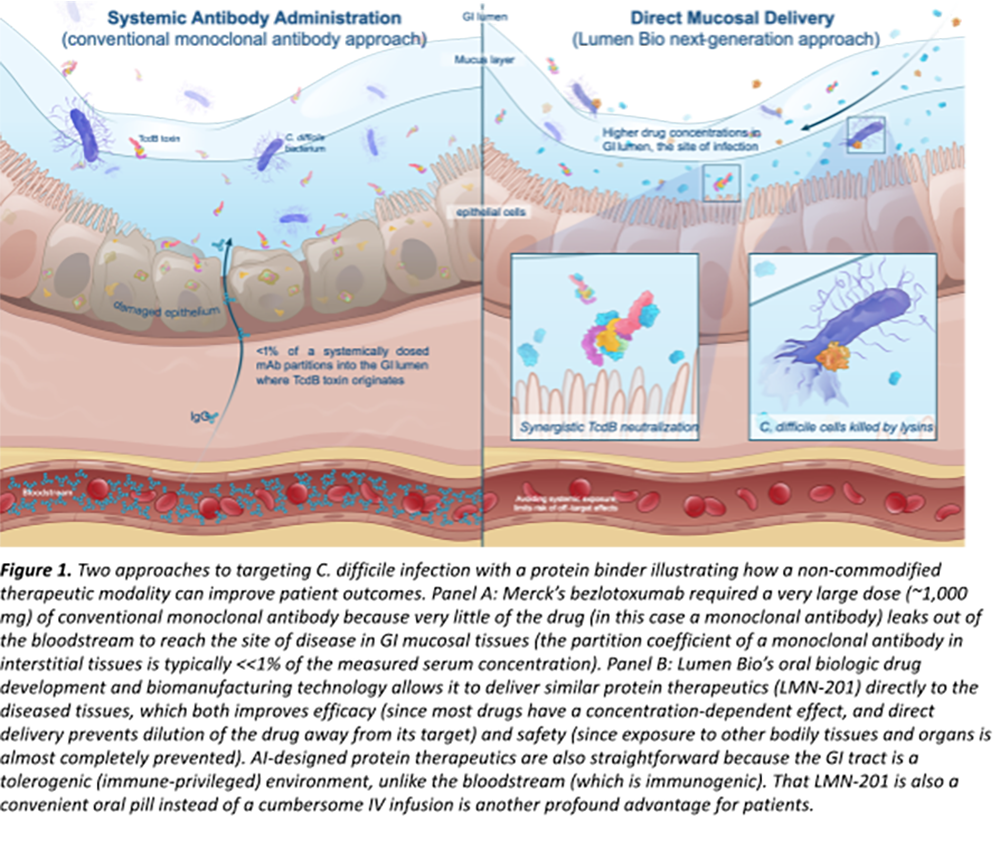
Nevertheless, for companies like Lumen Bio, the competitive advantages inherent in a novel platform can decisively outweigh these considerations. Beyond just competitive differentiation, new therapeutic modalities and manufacturing platforms represent entirely new ways of addressing unmet medical needs. For example, Lumen Bio’s LMN-201, an investigational oral biologic, targets the same pathogen as the IV-infused Merck antibody bezlotoxumab: Clostridioides difficile (C. diff) infection. However, LMN-201 is administered orally, not by injection, which dramatically simplifies treatment, especially for outpatient settings, and improves patient adherence. This shift from an intravenous to an oral delivery method is a game-changer for C. diff patients, offering a far more convenient and accessible treatment option.
Moreover, the lack of pre-existing manufacturing capacity for a novel platform creates a substantial barrier to entry for potential competitors. Would-be copycats or fast followers face a much steeper hill to climb when trying to catch up to a novel product launch. They must not only develop the therapeutic molecule but also establish an entirely new manufacturing infrastructure. Moderna’s triumph with its COVID-19 mRNA vaccine vividly illustrates this huge upside potential. While traditional vaccine manufacturers struggled to scale up production using legacy approaches, Moderna’s novel mRNA platform allowed for unprecedented speed and scalability, ultimately proving indispensable in addressing a global health crisis. This historical precedent underscores the transformative power and market disruption potential of truly novel platforms.
Broader Implications for Global Health and Innovation
The strategic adaptations undertaken by U.S. biotech firms carry profound implications not only for their own commercial success but also for global health and the future of pharmaceutical innovation. The push for novel targets, enhanced combinatorial therapies, and revolutionary manufacturing platforms promises to unlock treatments for diseases that remain intractable or underserved. By navigating the complexities of IP protection, cost efficiencies, and market differentiation, American biotech can continue to drive breakthroughs that improve patient outcomes worldwide. The ability to deliver more effective, accessible, and affordable drugs, especially for preventive care and in underserved international markets, could redefine global healthcare access.
The competition from China, while challenging, also serves as a catalyst for innovation, forcing U.S. firms to be more agile, strategic, and innovative in their R&D and business models. This dynamic interplay will likely lead to a more diversified global biotech landscape, where different regions specialize in distinct aspects of drug discovery, development, and manufacturing. However, maintaining a strong domestic biotech ecosystem in the U.S. remains crucial for national health security, economic prosperity, and preserving a leadership role in cutting-edge scientific discovery.
Conclusion: The Future of American Biotech in a Competitive World
In an increasingly competitive and capital-constrained landscape, deep, durable innovation for American biotech requires not only an appetite for significant risk but also a clear vision for identifying both a potential market and a viable pathway to delivery. The strategies discussed – maintaining secrecy around novel targets, maximizing funds through polypharmacology, and pioneering novel manufacturing platforms – each offer a distinct approach to achieving this.
Keeping a product secret through proprietary biological insights provides a huge potential payoff, contingent on the ability to maintain that secrecy and attract patient investors. Modality commodification, while reducing initial development risk, necessitates proving both increased efficacy and successful market differentiation to justify premium pricing. Developing a new platform also runs real risks, as any fully novel approach does, but carries with it the transformative opportunity for opening entirely new markets and dramatically reducing product costs. The key to American biotech retaining its competitive edge amidst the formidable challenge posed by Chinese competition lies in the artful balancing of the tradeoffs inherent in these three approaches, ensuring a future of continued innovation and global leadership.
Brian Finrow is CEO, co-founder, and co-chair of Lumen Bioscience, a clinical-stage biotechnology company in Seattle. Kevin Klowden is an economist and principal at Melcene Advisory and senior fellow at the Milken Institute.