The Evolution of Quantum Entanglement and State Engineering
Quantum entanglement is the cornerstone of the second quantum revolution. It is a phenomenon where the quantum states of two or more particles become inextricably linked, such that the state of one particle cannot be described independently of the others, regardless of the distance separating them. This "spooky action at a distance," as Albert Einstein famously termed it, allows for correlations that exceed the limits of classical physics. In the context of technology, entanglement is the fuel that powers quantum advantage. It allows quantum sensors to surpass the standard quantum limit of precision and enables quantum computers to perform calculations that would take classical supercomputers millennia to complete.
Historically, the generation of these states has been a delicate and arduous process. Scientists have traditionally relied on two primary methods: "top-down" approaches using external controls to drive specific interactions, or "bottom-up" approaches where systems are allowed to naturally evolve into desired states under extreme conditions. Both methods often struggle with scalability and susceptibility to environmental noise. The University of Chicago Pritzker School of Molecular Engineering (UChicago PME) team, led by Professor Aashish Clerk, sought to bridge this gap by finding a "minimalist" approach that utilizes common physical platforms to achieve high-level complexity.
The research was conducted under the auspices of Q-NEXT, a U.S. Department of Energy (DOE) National Quantum Information Science Research Center. As one of five such centers established by the National Quantum Initiative Act, Q-NEXT focuses on developing the next generation of quantum interconnects and sensors. This institutional backing highlights the strategic importance of the UChicago PME findings in the broader context of American quantum research goals.
Breaking the Symmetry of Cavity QED Systems
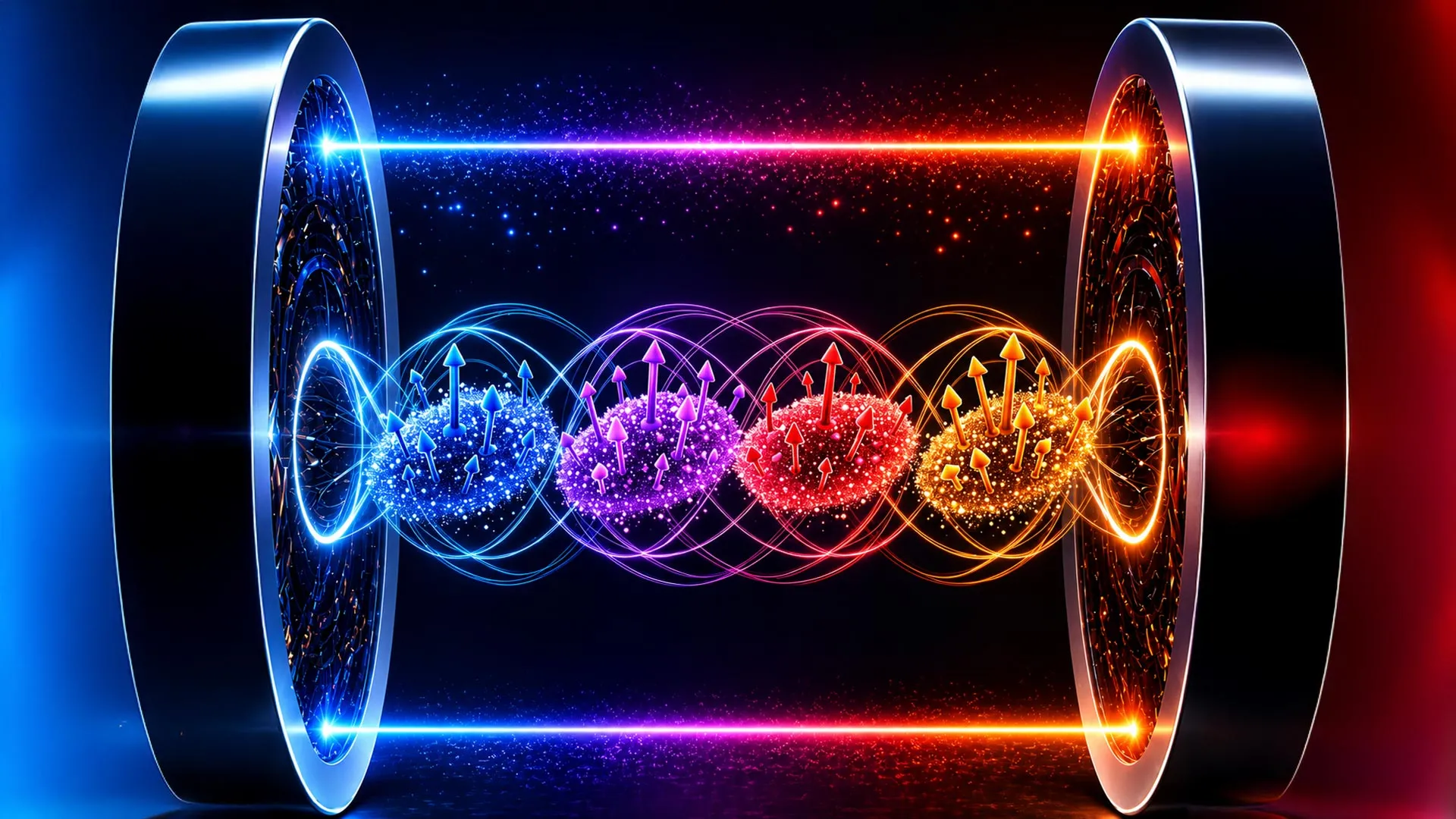
The theoretical model proposed by Clerk and his team is centered on a platform known as cavity quantum electrodynamics, or cavity QED. In a standard cavity QED experiment, atoms or other quantum emitters are placed within a high-finesse optical cavity—essentially a space between two highly reflective mirrors. When light is introduced into the cavity, it bounces back and forth, interacting repeatedly with the atoms. This interaction allows for the exchange of energy and the creation of quantum correlations between the light and the matter.
However, a persistent challenge in cavity QED has been the inherent symmetry of the system. In most setups, all atoms are positioned such that they interact with the light field in an identical manner. While this uniformity makes the system easier to describe mathematically, it severely limits the variety of entangled states that can be produced. The atoms act as a collective "super-atom," which prevents the creation of the more nuanced, spatially varied entangled states required for sophisticated applications.
The UChicago PME team’s breakthrough lies in a simple yet profound modification to this setup. Instead of treating all atoms as identical, they propose using external lasers or magnetic fields to shift the energy levels of specific groups of atoms. Specifically, the researchers found that by arranging atoms in pairs—where one atom’s excited state is shifted up in energy by a certain amount and its partner’s state is shifted down by an equal amount—they could "break" the symmetry of the system without losing control over it.
This method allows the atoms to behave differently from one another while remaining part of a cohesive, predictable quantum system. By tuning these external lasers, researchers can effectively "dial in" different types of entanglement. The system is designed to be "dissipative," meaning it naturally settles into a stable, highly entangled state over time. As first author Anjun Chu, a postdoctoral researcher in the Clerk group, noted, the system essentially stabilizes itself into interest-bearing quantum states that were previously thought to be inaccessible in such simple setups.
Chronology of Development and Theoretical Validation
The development of this theory follows nearly a decade of progress in the field of open quantum systems and dissipative engineering. In the early 2010s, physicists began exploring the idea that environmental noise and dissipation—traditionally seen as the enemies of quantum coherence—could actually be harnessed to "pump" a system into a desired quantum state.
The UChicago PME research team spent several years refining the mathematical models necessary to prove that a simplified cavity QED system could achieve this. The timeline of the project involved:
- Phase I: Mathematical Modeling (2021-2022): The team developed the initial equations to describe how energy-level shifts in atomic ensembles would affect the collective coupling to a cavity mode.
- Phase II: Symmetry Analysis (Late 2022): The researchers identified the specific "parity-time" or "balance" requirements needed to ensure the system remained stable rather than collapsing into decoherence.
- Phase III: Application Simulation (2023): The team simulated the use of these states for specific tasks, such as gradient sensing and the simulation of the AKLT (Affleck-Kennedy-Lieb-Tasaki) state.
- Phase IV: Peer Review and Publication (2024): The findings were rigorously vetted and published in Physical Review X, signaling the transition from a niche theoretical concept to a viable experimental roadmap.
Implications for Quantum Sensing and Noise Resilience
One of the most immediate and impactful applications of this new method is in the realm of quantum sensing. Quantum sensors are designed to detect minute changes in physical constants, such as magnetic fields, gravity, or time. The sensitivity of these sensors is often limited by "common-mode noise"—disturbances that affect the entire sensor at once, such as temperature fluctuations or vibrations.
The UChicago PME team demonstrated that their system could be configured to measure "field gradients"—the difference in a field’s strength between two points—with unprecedented precision. By placing two groups of entangled atoms in different locations, the system becomes highly sensitive to the difference in the environment between those two points while remaining completely indifferent to noise that hits both locations simultaneously.
This "built-in" noise resilience is a major milestone. Traditionally, entanglement is notoriously fragile; the slightest environmental interaction can cause a state to "decohere" and lose its quantum properties. The UChicago PME approach flips this dynamic. Because the entanglement is generated through a continuous process of stabilization, the state is inherently more robust. Furthermore, the information can be read out using Ramsey interferometry, a standard technique in atomic physics that involves pulses of radiation to measure the transition frequencies of atoms. This means that experimentalists do not need to invent new measurement protocols to utilize this technology.
Exploring Fundamental Physics: The AKLT State
Beyond practical sensing applications, the new method offers a powerful tool for fundamental physics research. The researchers showed that their platform could generate the AKLT state, a landmark model in condensed matter physics. First proposed in 1987 by Ian Affleck, Tom Kennedy, Lieb, and Tasaki, the AKLT state describes a specific type of one-dimensional spin chain that exhibits "topological order."
Topological states of matter are of intense interest because they possess properties that are "protected" against local perturbations. In the context of quantum computing, topological states could be used to create "qubits" that are naturally immune to certain types of errors. By providing a simple way to create and study AKLT-like states in a controlled laboratory environment, the UChicago PME team has opened a new window into the study of quantum magnetism and exotic phases of matter. This could eventually lead to the discovery of new materials with properties that cannot be found in nature.
Strategic Impact and Future Experimental Directions
The implications of this research extend to the broader strategy of quantum development in the United States. By focusing on "simple ingredients," the team is addressing one of the primary bottlenecks in the quantum industry: the high cost and complexity of hardware. If complex entanglement can be achieved using existing cavity QED setups—which are already standard in many university and national labs—the pace of quantum innovation could accelerate significantly.
Reactions from the scientific community have been focused on the "elegance" of the solution. While the team’s work remains theoretical for the moment, the response from experimentalists has been one of cautious optimism. Several leading quantum optics laboratories are reportedly in discussions with the Clerk group to begin the first physical tests of the energy-shifting method.
The next steps for the research involve expanding the complexity of the atomic arrangements. While the current paper focuses on pairs and small groups of atoms, the mathematical framework suggests that more elaborate geometries could produce even more exotic quantum states. The researchers are also investigating how this method could be integrated into superconducting circuits, another popular platform for quantum computing that utilizes microwave cavities rather than optical ones.
Conclusion: A New Paradigm for Quantum Control
The work of Professor Aashish Clerk and his colleagues at the University of Chicago Pritzker School of Molecular Engineering marks a shift in how physicists approach the challenge of quantum state preparation. By moving away from the need for perfect symmetry and specialized hardware, they have demonstrated that complexity can emerge from simplicity.
The ability to generate highly entangled, noise-resilient states using standard laboratory tools brings the "quantum advantage" one step closer to reality. Whether it is used to detect the subtle gravitational pull of underground mineral deposits, measure the magnetic signatures of the human brain, or unlock the secrets of topological matter, this new theoretical approach provides a versatile and powerful foundation for the future of quantum science. As the research transitions from theory to experiment, the global scientific community will be watching to see if these "simple ingredients" can indeed deliver the complex quantum future that has long been promised.