Artificial intelligence has evolved from a novel computational tool into an essential pillar of modern cosmology, providing researchers with the ability to parse through petabytes of galactic data. However, a new study published in the Journal of Cosmology and Astroparticle Physics (JCAP) suggests that while advanced machine learning techniques can drastically reduce the cost of exploring the universe’s mysteries, they also introduce a subtle and potentially misleading form of "algorithmic prejudice." The research, led by scientists at Princeton University and the Flatiron Institute, demonstrates that a technique known as transfer learning can accelerate the search for physics beyond the Standard Model by more than tenfold, yet it simultaneously risks blinding researchers to genuinely new phenomena by over-relying on established theories.
The Standard Model and the Computational Bottleneck
For decades, the $Lambda$CDM (Lambda Cold Dark Matter) model has served as the "Standard Model" of cosmology. It provides a remarkably accurate framework for understanding the evolution of the universe, from the Big Bang to the current distribution of cosmic webs and galaxy clusters. By balancing the effects of dark energy (represented by the Greek letter Lambda) and cold dark matter, $Lambda$CDM explains the large-scale structure of the universe with high precision.
Despite its successes, the model is increasingly viewed as an incomplete picture. Recent astronomical observations have revealed "tensions" in the data—most notably the Hubble tension, a discrepancy in the measured expansion rate of the universe depending on which method of measurement is used. To resolve these inconsistencies, cosmologists are investigating "Beyond the Standard Model" (BSM) theories. These include the effects of massive neutrinos, modified theories of gravity that diverge from Einstein’s General Relativity, and dynamic models of dark energy that evolve over time.
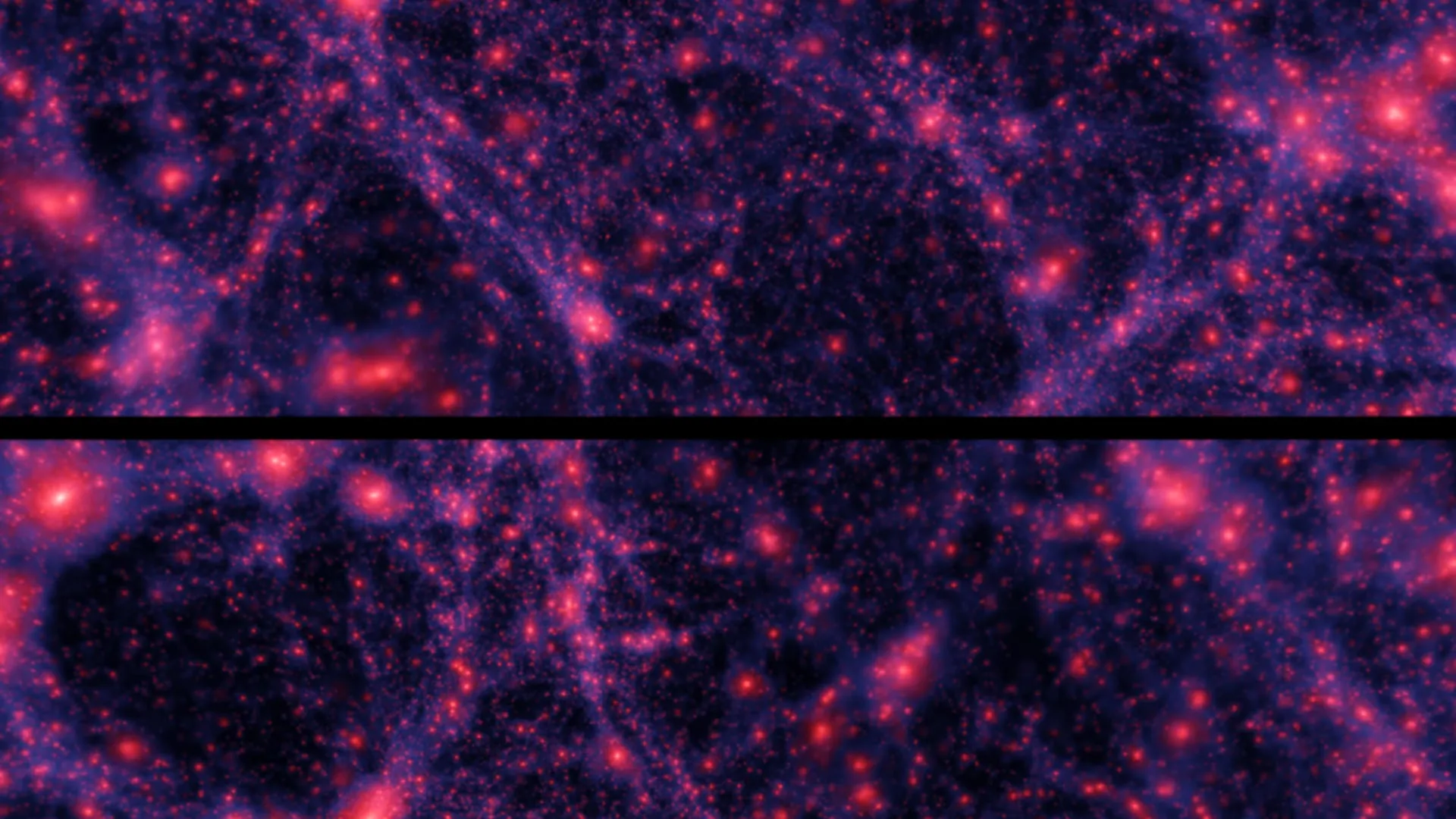
Investigating these BSM theories requires a Herculean computational effort. Traditionally, scientists must generate tens of thousands of N-body simulations—massive digital universes where billions of virtual particles interact according to specific physical laws. Each simulation is a "what if" scenario: What if neutrinos are heavier than we think? What if gravity weakens at cosmic distances? Running these simulations on supercomputers is notoriously expensive, consuming millions of CPU hours and requiring significant financial and energy resources. This "computational bottleneck" has long limited the speed at which new physical theories can be tested against observational data.
The Promise of Transfer Learning
To overcome these constraints, the research team, including first author Veena Krishnaraj and co-author Adrian Bayer, turned to transfer learning. In the realm of artificial intelligence, transfer learning is a method where a model developed for one task is reused as the starting point for a model on a second, related task. This is the same logic behind many Large Language Models (LLMs) and generative AI systems, which are pretrained on massive datasets of general text before being "fine-tuned" for specific tasks like medical diagnosis or legal analysis.
In the context of cosmology, the researchers proposed a two-stage training process. First, the AI is pretrained on a large volume of simulations based on the well-understood $Lambda$CDM model. These simulations are relatively "cheap" to produce because the physics is established and the parameters are constrained. During this phase, the AI learns the fundamental relationships between matter distribution and gravitational forces.
Once the AI has a "foundational" understanding of the universe, it undergoes a second phase of training with a much smaller set of expensive, complex simulations that incorporate BSM physics.
"It’s basically a shortcut," explained Adrian Bayer, a cosmologist at the Flatiron Institute and Princeton University. "Usually, people train the AI directly on the most computationally expensive simulations. What we do instead is first use simpler and less expensive $Lambda$CDM simulations to give the AI an idea of what’s happening, and only afterward move to the more complex models."
The results of this approach were significant. The study found that transfer learning allowed the neural networks to reach a high level of accuracy using ten times fewer complex simulations than would be required by traditional training methods. This efficiency gain could potentially save years of supercomputing time and allow researchers to explore a much wider array of theoretical models for the universe.
The "Textbook" Analogy and the Risk of Negative Transfer
While the efficiency gains were undeniable, the study uncovered a significant scientific caveat. The researchers identified a phenomenon known as "negative transfer," where the AI’s prior knowledge of the Standard Model actually hindered its ability to correctly identify new physics.
Veena Krishnaraj, an undergraduate student at Princeton University and the study’s lead author, used a pedagogical analogy to describe the process. She compared the pretraining phase to a student reading a basic introductory textbook to grasp the core concepts of a subject before moving on to a specialized, highly complex volume. However, the study found that if the "basic textbook" (the Standard Model) and the "complex volume" (New Physics) contained overlapping or similar patterns, the AI tended to default to its original training.
This is particularly problematic due to "physical degeneracies." In cosmology, a degeneracy occurs when two different physical processes produce nearly identical observable effects. The researchers specifically highlighted the case of massive neutrinos.
Neutrinos are subatomic particles that were long thought to be massless, but recent particle physics experiments have proven they possess a tiny, non-zero mass. In cosmological simulations, increasing the mass of neutrinos has an effect on the "clustering" of matter in the universe. Specifically, it can look very similar to a change in a Standard Model parameter called $sigma_8$ (sigma-eight), which measures the amplitude of matter fluctuations.
Because the AI was pretrained so thoroughly on $Lambda$CDM, it had a strong "bias" toward interpreting changes in matter clustering as shifts in $sigma_8$. When presented with simulations containing massive neutrinos, the AI initially struggled to recognize the new physics, instead attempting to "force" the data to fit the $sigma_8$ patterns it had already mastered.
"The negative transfer is not random," Krishnaraj noted. "It is driven by underlying physical degeneracies in the model. Different physical processes can produce very similar observable signatures, making it challenging for the AI to correctly identify which parameter is responsible."
Implications for Future Cosmological Surveys
The findings of the study come at a critical juncture for the astronomical community. A new generation of massive sky surveys is currently beginning or nearing completion, including the European Space Agency’s Euclid mission, the Dark Energy Spectroscopic Instrument (DESI), and the Vera C. Rubin Observatory’s Legacy Survey of Space and Time (LSST).
These projects are expected to generate unprecedented amounts of high-precision data, mapping billions of galaxies across cosmic time. The sheer volume of data makes the use of AI and machine learning non-negotiable; human researchers and traditional statistical methods simply cannot keep pace. However, the JCAP study serves as a cautionary tale: if the AI tools used to analyze this data are too heavily "anchored" to the Standard Model, they may inadvertently filter out the very "new physics" that these multi-billion-dollar missions were designed to find.
The research suggests that while foundation models—AI systems trained on vast amounts of data to be adaptable to many tasks—hold great promise for the physical sciences, they must be designed with "physical awareness." This means developing techniques to specifically mitigate negative transfer and ensuring that AI models are tested for their ability to distinguish between degenerate physical parameters.
Conclusion and Future Directions
The study, "Transfer Learning Beyond the Standard Model," authored by Veena Krishnaraj, Adrian E. Bayer, Christian Kragh Jespersen, and Peter Melchior, marks a significant step forward in the integration of AI and astrophysics. It proves that the "foundation model" approach, which has revolutionized natural language processing and image generation, is equally applicable to the study of the cosmos.
However, the discovery of negative transfer emphasizes that science is not merely about finding patterns, but about correctly attributing those patterns to the right physical causes. As AI becomes more deeply embedded in the scientific method, the challenge for researchers will be to leverage the speed of machine learning without sacrificing the skepticism and rigor required to recognize the unknown.
The research team plans to move beyond simulations in the next phase of their work, applying their transfer learning frameworks to real-world astronomical observations. If they can successfully tune these models to navigate the pitfalls of negative transfer, the "shortcut" provided by AI may finally lead cosmologists to the answers they seek regarding dark energy, the nature of gravity, and the ultimate fate of the universe. For now, the study serves as a reminder that in the search for the new, what we already know can sometimes be our greatest obstacle.