In a significant advancement for the field of condensed matter physics, researchers at the University at Buffalo have unveiled a theoretical framework for a new quantum sensing technique designed to identify and characterize altermagnets. This third category of magnetic materials, which was only formally conceptualized within the last decade, represents a potential paradigm shift in the development of spintronics and high-speed, low-power computing. By utilizing the hypersensitive properties of microscopic defects within diamonds, the proposed method offers a non-invasive pathway to distinguish altermagnets from their more common cousins, ferromagnets and antiferromagnets. The study, recently published in the prestigious journal Physical Review Letters, marks a critical step in transitioning altermagnetism from a theoretical curiosity to a functional component of future technological infrastructure.
The Evolution of Magnetic Understanding: From Lodestones to Altermagnets
For the vast majority of human history, magnetism was synonymous with what scientists now call ferromagnetism. This is the phenomenon observed in iron, nickel, and cobalt, where the internal "spins" of electrons—essentially tiny magnetic moments—align in a uniform direction. This alignment creates a macroscopic magnetic field capable of sticking to a refrigerator door or storing data on a hard drive. However, as the field of quantum mechanics matured in the early 20th century, physicists began to realize that magnetism was far more complex than simple alignment.
In the 1930s, French physicist Louis Néel proposed the existence of antiferromagnetism, a discovery that eventually earned him the Nobel Prize. In these materials, neighboring electron spins point in opposite directions, effectively canceling each other out. To the naked eye or a standard compass, an antiferromagnet appears non-magnetic. Yet, at the atomic level, the magnetic order is intense. While antiferromagnets were long considered "interesting but useless," they have recently become the focus of intense research because their spins can be flipped much faster than those of ferromagnets, promising faster data processing speeds.
The emergence of altermagnetism in 2019 added a new dimension to this landscape. Researchers at the Johannes Gutenberg University of Mainz, led by Libor Šmejkal and Jairo Sinova, identified a class of materials that seemed to defy the traditional binary. These materials, such as ruthenium dioxide (RuO2), exhibited the zero net magnetization characteristic of antiferromagnets, yet their electronic structures behaved like those of ferromagnets. This "altermagnetic" state allows for a unique combination of traits: the high-speed switching of antiferromagnets and the easily readable electronic properties of ferromagnets.
The Challenge of Identification and the Diamond Solution
Despite the excitement surrounding altermagnets, identifying them in a laboratory setting has proven notoriously difficult. Because they possess no external magnetic field, they cannot be detected by conventional magnetometers. Current methods for identifying them often involve complex techniques like Angle-Resolved Photoemission Spectroscopy (ARPES), which requires high-energy X-rays and large-scale facilities, or Hall effect measurements that can sometimes yield ambiguous results.
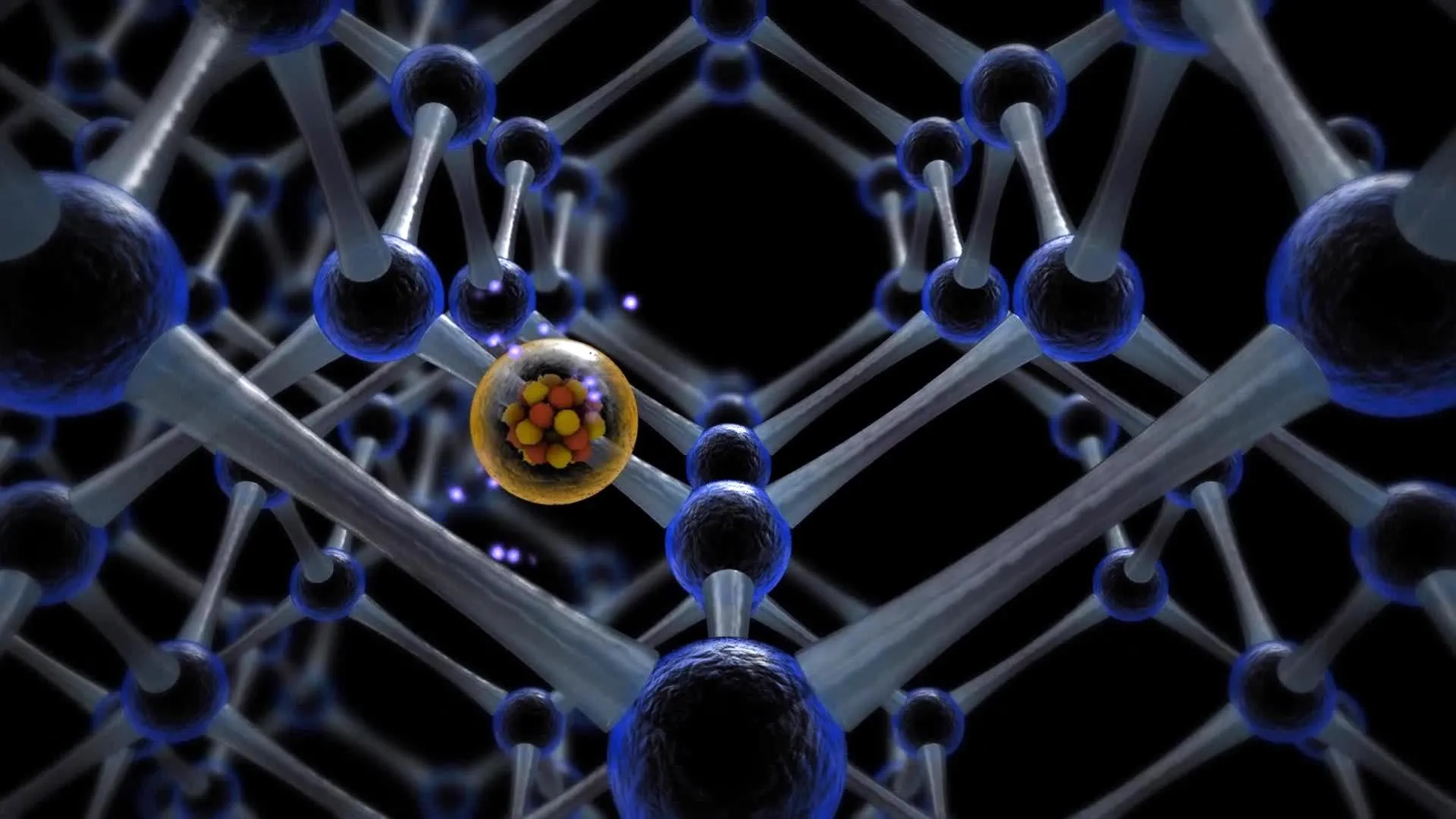
The University at Buffalo (UB) team, led by Assistant Professor Jamir Marino, PhD, proposed a more accessible and elegant solution: quantum sensing. The approach leverages Nitrogen-Vacancy (NV) centers in diamonds. An NV center is a point defect in a diamond’s carbon lattice where a nitrogen atom replaces a carbon atom, and an adjacent lattice site is left empty. This defect acts as a single atom-sized quantum system that is incredibly sensitive to local magnetic fluctuations.
"The beauty of this sensing technique is its precision and its non-invasive nature," says Dr. Marino. "By placing a diamond tip containing an NV center near a candidate material, we can observe how the magnetic environment of the material interacts with the quantum state of the diamond defect. It’s like having a microscopic stethoscope that can hear the ‘heartbeat’ of the material’s magnetic spins."
Technical Mechanics: How the Quantum Sensor Works
The proposed UB experiment involves placing a diamond probe just nanometers above the surface of a suspected altermagnet. The NV center within the diamond has a specific spin state that can be initialized and read out using laser pulses. When the NV center is brought near the material, the thermal and quantum fluctuations of the altermagnet’s spins create a "magnetic noise" that affects the NV center.
The key to identification lies in the "relaxation time" of the NV center’s spin. Researchers would rotate the spin of the NV center into different orientations and measure how quickly it loses its quantum information—a process known as decoherence or T1 relaxation. Because altermagnets have a specific, direction-dependent symmetry in their spin arrangement, the NV center will relax at different rates depending on how its spin is oriented relative to the material’s crystal axes.
This directional dependence is the "smoking gun" for altermagnetism. In a standard antiferromagnet, the relaxation would likely be more isotropic (uniform), or follow a different symmetry pattern. In a ferromagnet, the strong external field would overwhelm the subtle relaxation signals. The UB model suggests that by mapping these relaxation rates, physicists can confirm the presence of altermagnetic order with high confidence.
Chronology of the Discovery and Research Milestones
The path to this theoretical breakthrough has been paved by nearly a decade of collaborative international effort:
- 2019: Theoretical physicists in Mainz, Germany, first identify ruthenium dioxide as a candidate for a new type of magnetic order that is neither purely ferromagnetic nor antiferromagnetic.
- 2020-2021: The term "altermagnetism" is coined to describe this phase of matter. Computational models suggest that over 200 materials, including common semiconductors and insulators, could be altermagnets.
- 2022: Experimental groups begin using ARPES to look for "spin-splitting" in the electronic bands of these materials, a hallmark of altermagnetism.
- 2023: Early experimental evidence of altermagnetism is reported in several materials, but the need for more versatile and less destructive sensing tools becomes apparent.
- 2024: The University at Buffalo team publishes their quantum sensing proposal in Physical Review Letters, providing a roadmap for the next generation of table-top experiments.
Broader Implications for the Electronics Industry
The identification of altermagnets is not merely an academic exercise; it has profound implications for the future of the global electronics industry. As traditional silicon-based transistors approach their physical limits—a phenomenon often cited as the "End of Moore’s Law"—the industry is looking for new ways to process information.
Spintronics, or spin-transport electronics, is a leading candidate. Instead of using the flow of electric charge (which generates heat and consumes significant energy), spintronics uses the "spin" of electrons to carry information. Altermagnets are considered the "Holy Grail" for this field for several reasons:
- Energy Efficiency: Because altermagnets have no external magnetic field, they do not produce stray fields that interfere with neighboring bits. This allows for much denser packing of components on a chip without the risk of data corruption.
- Speed: The switching speed of altermagnets is predicted to be in the terahertz (THz) range, which is thousands of times faster than the gigahertz (GHz) speeds found in current silicon processors.
- Readability: Unlike antiferromagnets, which are notoriously difficult to "read" electronically, altermagnets naturally produce spin-polarized currents, making them compatible with existing electronic read-out technologies.
"If we can reliably identify and control these materials, we are looking at a future where data centers consume a fraction of the power they do today, and handheld devices are significantly faster," Dr. Marino explains.
Analysis of Potential Challenges and Future Directions
While the UB proposal has been met with enthusiasm in the physics community, several hurdles remain before diamond-based sensors become a standard laboratory tool for altermagnetism. The primary challenge is the "noise" inherent in quantum systems. Distinguishing the subtle signals of altermagnetic relaxation from background thermal noise requires extremely low temperatures and highly controlled environments.
Furthermore, the sensing technique currently exists as a sophisticated mathematical model. The next phase of research will involve experimental physicists building the physical apparatus to validate Marino’s theories. This will require precise nanometer-scale control over the diamond probe’s position and the ability to synthesize high-purity altermagnetic crystals.
Collaborators like Jairo Sinova and Libor Šmejkal are optimistic. Their involvement in the UB study ensures that the sensing technique is perfectly tuned to the theoretical predictions of the materials they first identified. The cross-pollination between the Mainz group’s material expertise and the UB group’s quantum dynamics expertise has created a robust framework for the coming years.
Conclusion: A New Era of Material Science
The work of the University at Buffalo physicists represents a vital bridge between theoretical physics and practical engineering. By providing a clear, detectable signature for altermagnetism, they have cleared one of the most significant obstacles to the development of this new technology.
As the scientific community begins to implement these quantum sensing techniques, the number of confirmed altermagnets is expected to grow rapidly. This could lead to a "gold rush" in material science, as researchers hunt for the specific altermagnetic compounds that are most stable at room temperature and easiest to integrate into existing manufacturing processes.
The discovery of ferromagnetism gave us the compass and the hard drive. The discovery of antiferromagnetism gave us advanced sensors and the promise of spintronics. With the advent of altermagnetism and the tools to find it, the third chapter of magnetic history is currently being written, promising a revolution in how we move, store, and process the world’s information.