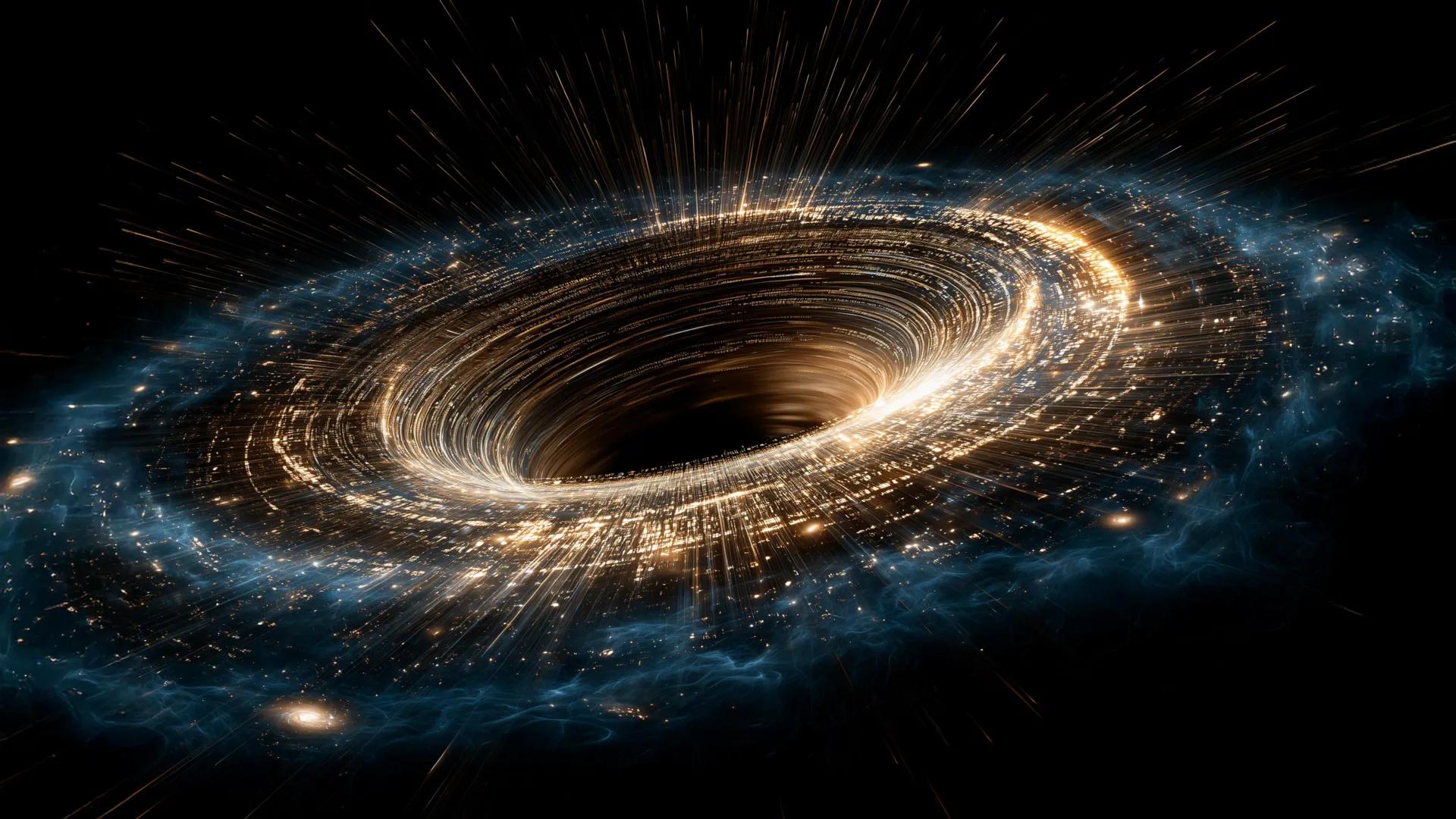
The fundamental nature of reality has long been viewed through two distinct and often contradictory lenses: Einstein’s general relativity, which describes the macro-scale universe as a smooth fabric of spacetime warped by gravity, and quantum mechanics, which defines the micro-scale world of discrete particles and probabilistic fields. For over a century, these two pillars of modern physics have functioned independently within their respective domains, yet they fail to reconcile at the most extreme points of existence, such as the centers of black holes or the initial moments of the Big Bang. A research team has recently proposed a transformative framework known as the Quantum Memory Matrix (QMM), which suggests that the most fundamental ingredient of the universe is not matter, energy, or even spacetime, but information itself. By reframing the cosmos as a self-recording system, the QMM framework offers potential solutions to the black hole information paradox, the nature of dark matter and dark energy, and the ultimate fate of the universe.
The Information-First Paradigm and the Discrete Nature of Spacetime
The Quantum Memory Matrix is built upon the premise that spacetime is not a continuous, smooth background as Einstein’s equations suggest, but is instead composed of discrete, infinitesimal "cells." This concept aligns with the requirements of quantum mechanics, which posits that at the smallest scales—specifically the Planck scale—physical quantities are quantized rather than continuous. According to the QMM framework, each of these spacetime cells functions as a storage unit capable of holding a quantum imprint of every interaction that occurs within or through it. Whether it is the passage of a photon, the tug of a gravitational field, or the influence of nuclear forces, every event leaves a permanent, albeit minute, change in the local quantum state of the spacetime cell.
This "imprint" mechanism effectively turns the universe into a cosmic archive. While traditional physics views the evolution of the universe as a series of states where the present is determined by the immediate past, the QMM suggests a universe that "remembers" its history through a persistent informational ledger. This shift from a purely dynamical view to an informational one addresses one of the most significant conflicts in theoretical physics: the conservation of information.
Resolving the Black Hole Information Paradox
The first major application of the Quantum Memory Matrix addresses the black hole information paradox, a problem that has challenged physicists since Stephen Hawking’s work in the 1970s. General relativity suggests that any matter or energy falling into a black hole is crushed into a singularity, with its specific properties effectively erased from the observable universe. However, quantum mechanics dictates the principle of "unitarity," which states that information can never be truly destroyed. If a black hole were to evaporate via Hawking radiation without returning the information it consumed, the fundamental laws of quantum physics would be violated.
The QMM framework provides a resolution by utilizing the "imprint operator," a reversible mathematical rule that ensures information conservation. As matter approaches and crosses the event horizon, the surrounding spacetime cells record its quantum signature. Even if the physical matter is lost to the singularity or the black hole eventually evaporates, the information is not destroyed; it remains written into the "memory" of the local spacetime fabric. This mechanism suggests that the information is encoded in the geometry of spacetime itself, effectively bypassing the need for the information to be physically contained within the radiation or the interior of the black hole.
The Geometry-Information Duality: Redefining Dark Matter and Dark Energy
The research team has extended the QMM framework to propose a "geometry-information duality." This principle suggests that the curvature of spacetime is not only influenced by the distribution of mass and energy—as established by Einstein’s general relativity—but also by the distribution and entanglement of quantum information. This duality provides a novel explanation for two of the greatest mysteries in modern astronomy: dark matter and dark energy.
Current astronomical observations show that galaxies rotate at speeds that cannot be explained by the visible matter they contain. To account for this, scientists have long theorized the existence of dark matter, an invisible substance that provides extra gravitational pull. The QMM framework offers an alternative: what we perceive as dark matter may actually be "clumps of imprints." As information accumulates in specific regions of spacetime, these informational imprints exert a gravitational influence. Preliminary studies by the QMM researchers indicate that these informational clusters behave identically to dark matter, explaining galactic rotation curves without the need for undiscovered exotic particles.
Similarly, the framework addresses dark energy, the mysterious force driving the accelerated expansion of the universe. In the QMM model, spacetime cells have a finite capacity for information. When these cells become "saturated" and can no longer record new, independent quantum imprints, they contribute to a residual, baseline energy. This leftover energy takes the mathematical form of the "cosmological constant" found in Einstein’s field equations. The researchers found that the scale of this informational saturation matches the observed density of dark energy, suggesting that the expansion of the universe is a byproduct of the informational limits of spacetime itself.
A Chronology of Cosmic Cycles and the Big Bounce
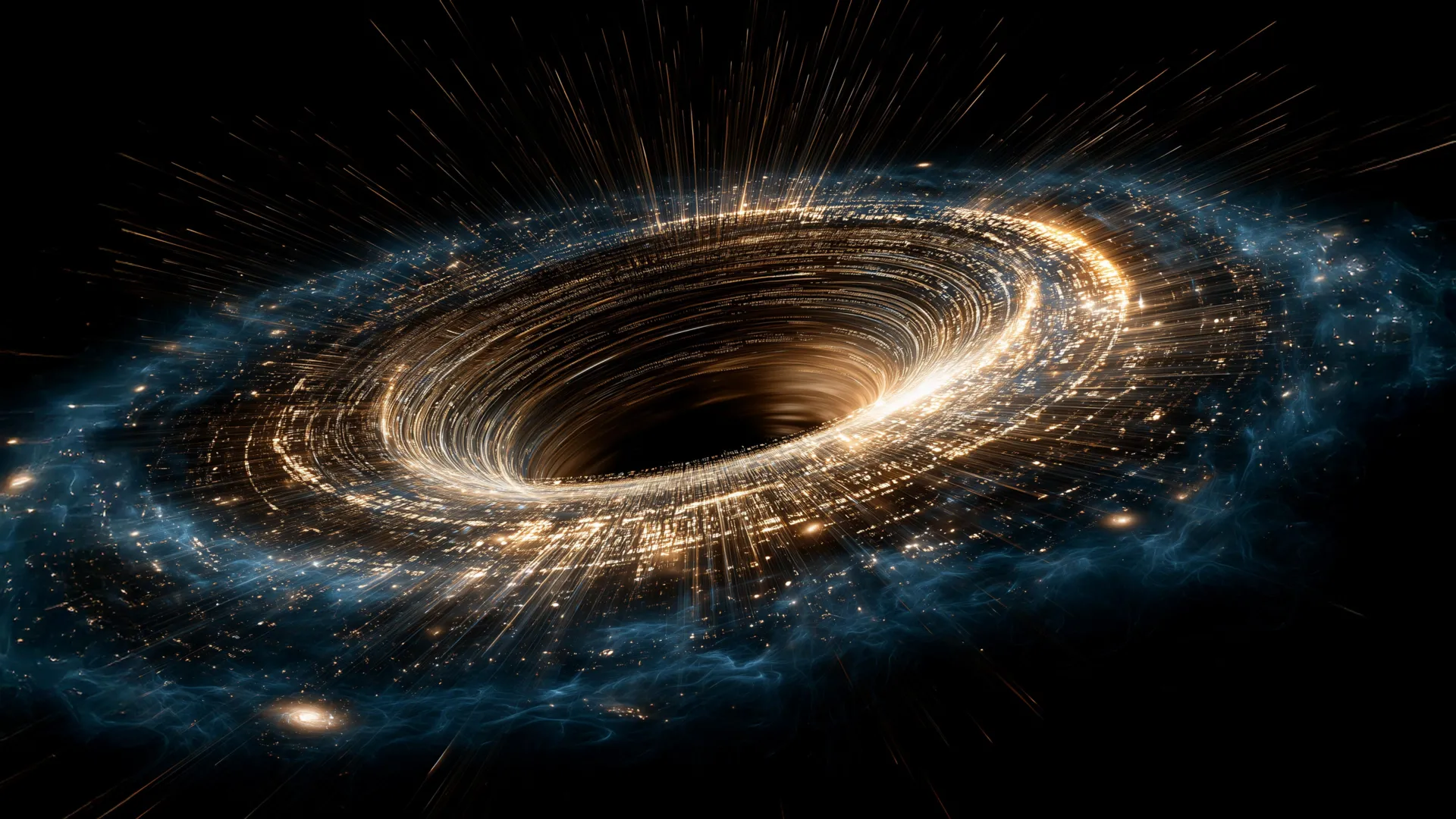
The implications of the Quantum Memory Matrix extend to the very beginning and end of time. Standard cosmological models suggest the universe began with a Big Bang approximately 13.8 billion years ago. However, if spacetime has a finite memory capacity, the QMM model points toward a cyclic universe characterized by successive phases of expansion and contraction, often referred to as a "Big Bounce."
According to the team’s latest research, published in The Journal of Cosmology and Astroparticle Physics, each cycle of the universe deposits a specific amount of entropy—a measure of informational disorder—into the spacetime ledger. As the universe expands and eventually contracts, it reaches a point where the informational capacity (entropy bound) of spacetime is maxed out. At this threshold, the equations of the QMM framework show that a singularity is avoided. Instead of collapsing into a point of infinite density, the stored entropy drives a reversal, triggering a new phase of expansion.
Based on comparisons with current observational data from the cosmic microwave background and galactic distributions, the researchers estimate that our universe has already completed three or four of these cycles. They project that fewer than ten cycles remain before the informational capacity of spacetime is fully and permanently saturated. Once this limit is reached, the "bounces" will cease, and the universe will enter a final, permanent phase of slowing expansion. Under this model, the true "informational age" of the cosmos is estimated to be approximately 62 billion years, far older than the 13.8 billion years observed in our current expansionary phase.
Validation through Quantum Computing
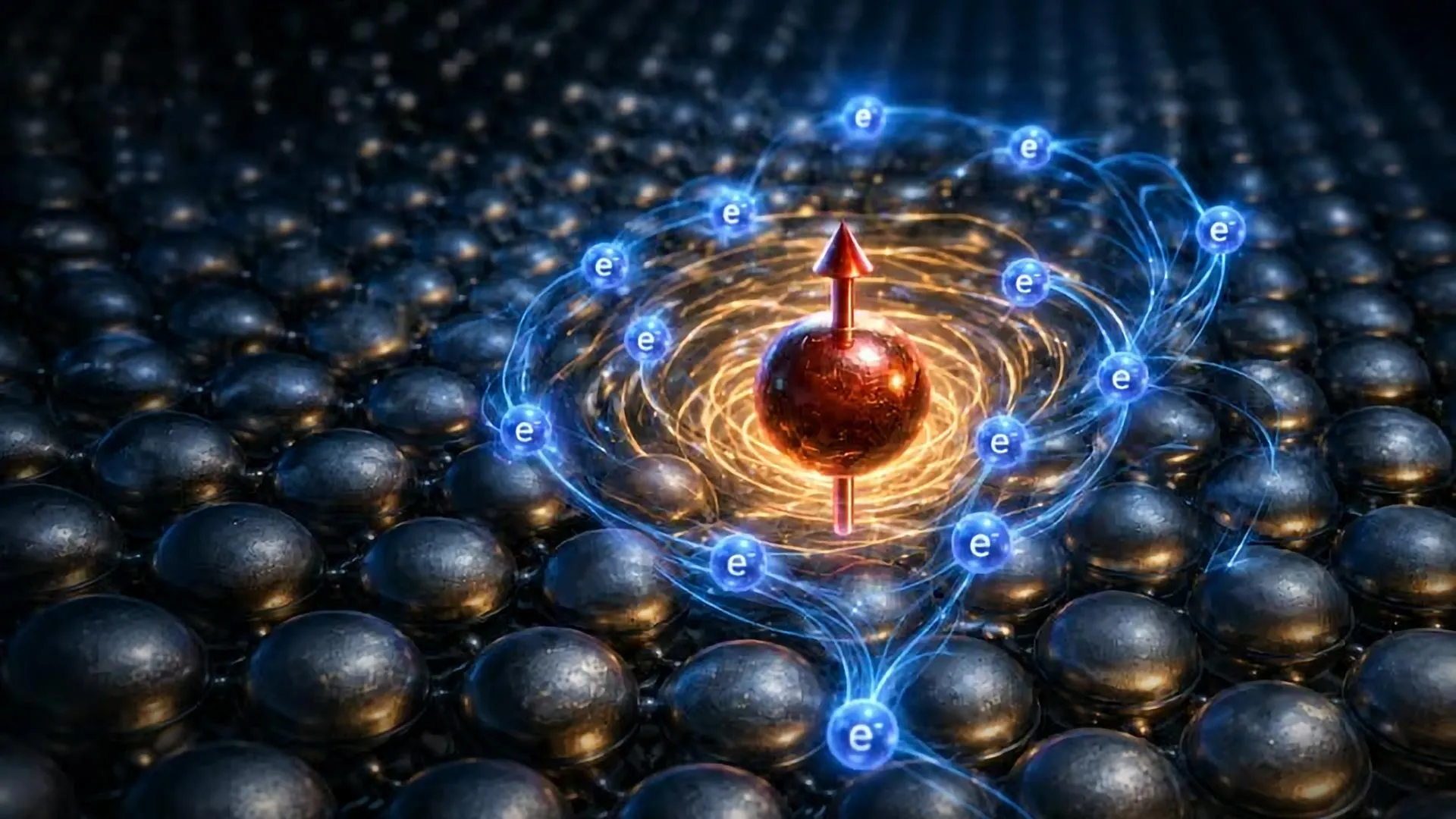
While the QMM framework addresses the largest scales of the cosmos, it has also been subjected to empirical testing in the laboratory using quantum computers. In these experiments, the researchers treated qubits—the fundamental units of quantum information—as analogs for individual spacetime cells. By applying the "imprint and retrieval" protocols derived from QMM equations, the team attempted to store and then recover quantum states.
The results demonstrated a recovery accuracy of over 90%, proving that the imprint operator can effectively manage information in real-world quantum systems. Beyond theoretical physics, this discovery has practical implications for the development of quantum technology. By integrating QMM-based imprinting with standard error-correction codes, the researchers were able to significantly reduce logical errors in quantum computations. This suggests that the same laws governing the memory of the universe could be harnessed to build more stable and powerful quantum computers.
Scientific Context and Broader Implications
The Quantum Memory Matrix arrives at a time when the scientific community is increasingly exploring "it from qubit" theories—the idea that physical reality arises from underlying quantum information. The QMM framework shares conceptual space with the Holographic Principle, which suggests that the description of a volume of space can be thought of as encoded on a lower-dimensional boundary to the region. However, QMM distinguishes itself by proposing a localized, cellular memory within the fabric of spacetime itself.
If the QMM framework continues to withstand peer review and further observational testing, it would represent a paradigm shift in our understanding of the arrow of time. In a universe that remembers, the passage of time is not merely a change in the position of matter, but the accumulation of imprints on the cosmic ledger. This provides a physical basis for the "one-way" nature of time, as the total information and entropy stored in spacetime cells must continually increase until saturation is reached.
The broader scientific community remains cautious but intrigued. Critics note that while the mathematical models are compelling, definitive proof will require more precise measurements of the "saturation" effects of dark energy and more rigorous testing of the cyclic nature of the cosmos. Nevertheless, the ability of the QMM to unify gravity, nuclear forces, and electromagnetism under a single informational rule provides a promising path toward the long-sought "Theory of Everything."
As the research moves forward, the Quantum Memory Matrix reframes the universe not as a cold, mechanical void, but as a vast, interconnected memory bank. Every particle interaction and every force exerted since the dawn of the first cycle remains etched into the very structure of existence. In this view, the history of the cosmos is not lost to the past; it is written into the very cells of the space we inhabit.