Moderna, the biotechnology firm that gained global prominence for its mRNA-based COVID-19 vaccine, is embarking on a significant strategic pivot, signaling a bold expansion beyond its established infectious disease and rare disease franchises. At its recent annual Science Day, the company unveiled ambitious new programs in in vivo CAR-T therapy for autoimmune diseases and multiplexed T-cell engagers for solid tumor oncology, alongside the introduction of an advanced AI-driven research platform named "Lucy." This strategic move underscores Moderna’s intent to leverage its core mRNA technology and manufacturing infrastructure to address a broader spectrum of complex diseases, aiming to replicate its vaccine success in new therapeutic areas.
Strategic Imperative: Diversifying Beyond Vaccines
Moderna’s rapid rise was propelled by its pioneering mRNA vaccine technology, which proved instrumental in combating the COVID-19 pandemic. The success of its SPIKEVAX® vaccine not only generated substantial revenue but also validated the potential of mRNA as a potent therapeutic modality. However, as the pandemic’s intensity wanes and the vaccine market normalizes, the company faces the imperative to diversify its pipeline and revenue streams. This strategic shift is a natural evolution, designed to capitalize on the foundational mRNA delivery system – specifically, lipid nanoparticle (LNP) chemistry – and the extensive clinical data accumulated over more than a decade of human trials. The company’s leadership emphasizes that the properties that enabled mRNA vaccines to be developed and scaled rapidly, such as speed of design, manufacturing flexibility, and robust immunogenicity, are transferable to other disease categories.
The Science Day event served as a critical platform for Moderna to articulate this expanded vision to investors, scientists, and the broader healthcare community. It highlighted the company’s confidence in its ability to translate its mRNA platform into novel treatments for conditions historically challenging to address, such as specific cancers and severe autoimmune disorders. This diversification is crucial for Moderna’s long-term growth trajectory and its ambition to remain a leading force in biotechnology.
Unpacking the New Pipeline Programs: Expanding Therapeutic Horizons
Central to Moderna’s expanded strategy are two publicly revealed pipeline programs: mRNA-6007 and mRNA-2151. These candidates represent significant forays into high-impact therapeutic areas with substantial unmet medical needs.
mRNA-6007: Pioneering In Vivo CAR-T for Autoimmune Disease
Moderna’s announcement of mRNA-6007 marks its entry into the nascent yet rapidly evolving field of in vivo CAR-T (Chimeric Antigen Receptor T-cell) therapy. This program is specifically designed to target B-cell-mediated autoimmune diseases, with systemic lupus erythematosus (SLE) identified as the initial focus. SLE is a chronic autoimmune disease affecting millions worldwide, characterized by inflammation and tissue damage across various organ systems, driven by dysfunctional B cells and autoantibodies. Current treatments often involve broad immunosuppressants with significant side effects, highlighting a critical need for more targeted and durable therapies.
The traditional, or ex vivo, CAR-T therapy involves extracting a patient’s T cells, genetically engineering them in a laboratory to express a CAR that recognizes specific cancer antigens, expanding these modified cells, and then reinfusing them into the patient. This process is complex, time-consuming, expensive, and often requires lymphodepletion (chemotherapy to reduce existing immune cells) before infusion. Moderna’s in vivo approach with mRNA-6007 seeks to circumvent these challenges by directly reprogramming immune cells inside the body using targeted LNPs carrying mRNA instructions. The goal is to create an "off-the-shelf," injectable mRNA product that can achieve therapeutic effects comparable to ex vivo CAR-T, but without the logistical burdens of cell extraction, external manufacturing, and pre-treatment lymphodepletion.
mRNA-6007 employs a dual-CAR strategy, encoding two distinct CARs to target both the full B-cell lineage and plasma cells. This multiplexed approach aims to achieve a broader and deeper immune reset compared to single-CAR strategies that might only target B cells. Deep B-cell depletion with transient CAR expression is hypothesized to "reset" the immune system, potentially leading to long-term remission in autoimmune conditions. The program is scheduled to enter human clinical trials by the end of 2027, following ongoing IND-enabling studies and regulatory engagements. Preclinical studies in mice and non-human primates have reportedly shown promising safety, tolerability, and evidence of response, although detailed data remains unpublished.
The in vivo CAR-T space is highly competitive and rapidly advancing. Several other companies, including Capstan Therapeutics (now part of AbbVie), CREATE Medicines, Cartesian Therapeutics, and Kernal, are actively developing candidates in this area, targeting both autoimmune and oncology indications. Academic groups have also published encouraging data on in vivo CD19 CAR-T using LNP-mRNA approaches for lupus patients. Moderna’s multiplexed design, encoding two CARs, could offer a significant differentiating factor, potentially enhancing efficacy and durability of response. The market for autoimmune disease therapeutics is substantial, estimated to be hundreds of billions of dollars globally, making this a highly attractive area for diversification.
mRNA-2151: Tackling Solid Tumors with Multiplexed T-Cell Engagers
Moderna also unveiled mRNA-2151, its first publicly detailed multiplexed T-cell engager program, with an initial focus on ovarian cancer. Ovarian cancer remains a formidable challenge in oncology, often diagnosed at advanced stages with high recurrence rates and limited durable treatment options, particularly in the context of an immunosuppressive tumor microenvironment. T-cell engagers are bispecific antibodies or similar constructs designed to bring T cells into close proximity with cancer cells, activating the T cells to destroy the tumor. While successful in some blood cancers, T-cell engagers have largely struggled in solid tumors due where physical barriers, immune suppression, and T-cell exhaustion limit their effectiveness. Only a few T-cell engagers, such as tarlatamab and tebentafusp, have received FDA approval for solid tumors.
mRNA-2151 is designed to encode two kill T-cell engagers that target two clinically validated tumor-associated antigens relevant to ovarian cancer, alongside a co-stimulatory molecule. The specific antigen targets have not been disclosed. The inclusion of a co-stimulatory molecule is a critical differentiating factor, aimed at overcoming T-cell exhaustion, a common problem in the highly immunosuppressive tumor microenvironment of ovarian cancer. Preclinical studies in mouse xenograft models have indicated that while T-cell engagers alone could control tumor growth, the addition of the co-stimulatory molecule led to complete responses and more durable tumor control. This suggests a potential breakthrough in enhancing T-cell function and persistence within the challenging solid tumor environment.
Moderna is betting that by delivering these multiple therapeutic components via a single mRNA product, it can achieve a synergistic effect that improves T-cell activation, proliferation, and anti-tumor activity. The advancement of mRNA-2151 is supported by encouraging early clinical results from a related program, mRNA-2808, a T-cell engager for multiple myeloma currently in Phase 1 trials. The oncology therapeutics market, particularly for novel immunotherapies, is one of the largest and fastest-growing segments in pharmaceuticals, representing another strategic area for Moderna to leverage its platform.
Lucy: The AI Engine Driving Drug Discovery and Development
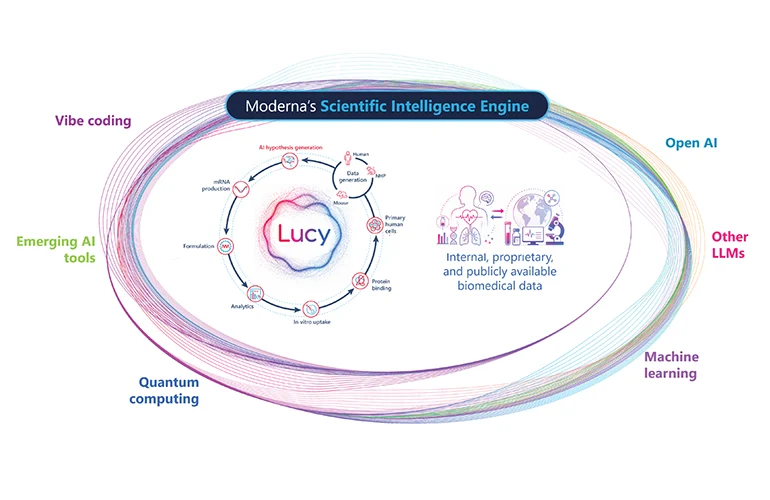
A cornerstone of Moderna’s expanded R&D strategy is the introduction of "Lucy," an internal machine learning (ML) platform designed to accelerate drug discovery across its entire pipeline. Lucy represents a significant investment in artificial intelligence and automation, aiming to streamline and optimize the experimental design, execution, and analysis phases of drug development.
Lucy is envisioned as the central intelligence of a closed-loop automation platform operating within Moderna’s laboratories. This system connects data from lab notebooks and various experimental files into a continuously improving learning system. The most innovative aspect is its ability to run experimental cycles with AI-driven hypothesis generation and analysis, potentially with minimal human intervention between cycles. This "closed-loop" system allows for rapid iteration and optimization of mRNA designs and LNP formulations.
According to David Huss, Chief Technology Officer for Research at Moderna, Lucy can test hundreds of thousands of iterations per learning cycle. This includes multiplexed in vivo screening in mice and primates, where barcoding systems allow for the simultaneous evaluation of up to one thousand candidates in a single animal. Lucy then deconvolutes the results to assess each candidate’s performance, generating data at an unprecedented scale and speed.
Crucially, Lucy has access to all of Moderna’s proprietary human mRNA clinical trial data, alongside data from ongoing trials. This vast repository of real-world clinical experience provides an invaluable training dataset for the AI, allowing it to learn from successful and unsuccessful clinical outcomes. Furthermore, Moderna has partnered with OpenAI, integrating public-domain datasets to enrich Lucy’s learning capabilities and provide a broader context for its predictive models. This combination of proprietary clinical data and public-domain knowledge, processed by advanced ML algorithms, is expected to give Moderna a significant "learning advantage" over competitors, potentially accelerating the pace of drug discovery and development across its diverse pipeline, from vaccines to oncology and autoimmune therapies.
The integration of AI into drug discovery is a burgeoning trend across the pharmaceutical industry, with companies investing heavily to improve efficiency, reduce costs, and identify novel targets and molecules. Lucy positions Moderna at the forefront of this trend, leveraging its unique data assets to potentially unlock new therapeutic possibilities and optimize existing programs.
Market Reaction and Analyst Perspectives
Moderna’s strategic announcements at Science Day significantly impacted its stock performance. The company’s shares had already climbed approximately 48% in the weeks leading up to the event, buoyed by positive news regarding its investigational flu vaccine, mRNA-1010. An FDA advisory committee’s unanimous vote in favor of mRNA-1010 a week prior to Science Day instilled confidence in its approval prospects, with analysts like William Blair’s Myles Minter noting "no major deficiencies" in FDA briefing documents. Leerink Partners’ Mani Foroohar described the FDA analysis as indicative of a "less-harsh regulatory stance," further fueling investor optimism.
The rally continued after Science Day. Shares closed at $59.75 on June 25 and then jumped nearly 15% the following day as investors absorbed the pipeline disclosures, including the ambitious plan to move mRNA-6007 into the clinic by 2027. The stock sustained its upward momentum into early July, reaching a 52-week high of $85.60. As of mid-July, the stock traded near $80, reflecting an approximate 75% increase from its early-June low, even after a slight daily dip.
Analyst firms reacted to the news with adjustments to their outlooks. Piper Sandler, for instance, raised its price target for Moderna to $77 from $69, while maintaining an "Overweight" rating. This upward revision was explicitly attributed to the company’s promising cancer antigen therapy and in vivo CAR-T programs, underscoring the market’s recognition of the potential of these new ventures.
Despite the recent surge, Wall Street maintains a cautious stance. The majority of firms rate Moderna as "Hold" or "Sell," and the average 12-month price target sits in the mid-$40s. With the stock trading near $80, it currently exceeds every published analyst target, indicating a degree of market exuberance that outpaces the conservative estimates of many financial institutions. This divergence highlights the inherent risks and uncertainties associated with early-stage clinical programs and the long development timelines in biotechnology, even for a company with Moderna’s validated platform. The significant capital investment required for these new programs and the intense competitive landscape are factors contributing to analyst caution.
The Broader Vision: Moderna’s mRNA Platform Strategy
Moderna’s expansive pipeline now encompasses some three dozen programs, ranging from respiratory vaccines (COVID-19, RSV, Flu, combination vaccines) and latent-virus vaccines (CMV, EBV, HIV) to bacterial vaccines (Lyme disease), oncology therapeutics, and rare disease treatments. The new forays into in vivo CAR-T and multiplexed T-cell engagers further demonstrate the versatility and adaptability of its mRNA platform.
The core of Moderna’s strategy lies in its ability to leverage a single modality – LNP-delivered mRNA – across diverse disease categories. This foundational technology, coupled with a robust manufacturing base and deep understanding of LNP chemistry, allows for a degree of infrastructural logic and efficiency that is difficult for competitors to match. The company’s decade-plus of human clinical data, derived from thousands of patients treated with mRNA therapeutics and vaccines, provides a unique learning advantage. This data not only informs the design of new candidates but also refines the understanding of mRNA’s safety, immunogenicity, and therapeutic potential in the human body.
This platform approach allows Moderna to pursue a wide array of indications, from preventing infectious diseases to treating complex cancers and autoimmune conditions, all while utilizing a common technological backbone. The potential for rapid design and manufacturing, as demonstrated during the pandemic, could enable faster iteration and clinical translation for these new therapeutic areas.
Challenges and Future Outlook
While Moderna’s strategic expansion is ambitious and promising, it is not without significant challenges. The development of in vivo CAR-T and multiplexed T-cell engagers for solid tumors represents highly complex scientific and clinical endeavors. The competitive landscape is fierce, with numerous established pharmaceutical companies and innovative biotechs vying for market share in oncology and autoimmune diseases. Technical hurdles related to in vivo delivery, off-target effects, and the precise control of gene expression remain formidable. Regulatory pathways for these novel modalities are also evolving, requiring careful navigation.
Furthermore, translating preclinical success into safe and effective human therapies, especially for complex diseases like ovarian cancer and systemic lupus erythematosus, is a lengthy and costly process. The cautious stance of many Wall Street analysts reflects these inherent risks.
Despite these challenges, Moderna’s strategic pivot highlights a growing confidence in the broader applicability of mRNA technology. If successful, these new programs could transform patient care for difficult-to-treat conditions, offering less invasive, more accessible, and potentially more effective therapeutic options. The integration of advanced AI through Lucy could accelerate this journey, providing Moderna with a significant edge in the race to develop next-generation medicines. The coming years will be critical in determining whether Moderna can truly replicate its vaccine triumph in these new, demanding therapeutic arenas, solidifying its position as a diversified biotechnology powerhouse.