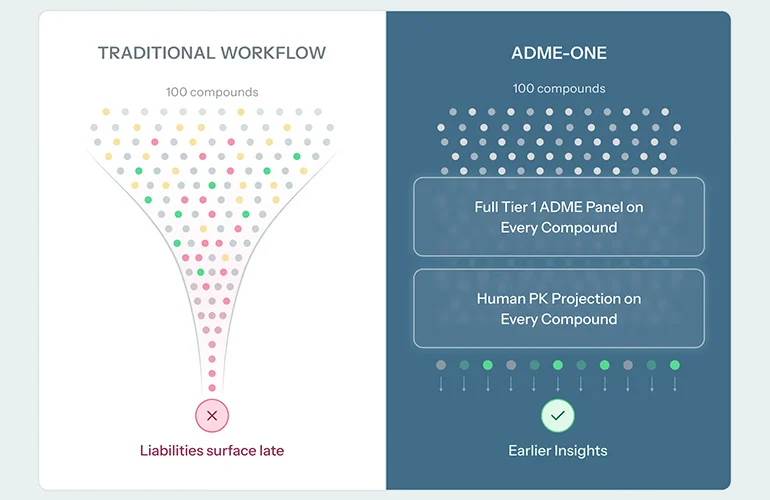
A significant shift is underway in small-molecule drug discovery, as a new collaboration between Ginkgo Datapoints, Tangible Scientific, and Inductive Bio seeks to fundamentally alter how pharmaceutical companies approach critical Absorption, Distribution, Metabolism, and Excretion (ADME) decisions. Traditionally, comprehensive ADME profiling has been relegated to the lead optimization phase, a resource-intensive stage where significant investment is made after a promising lead series has already been identified. However, the newly launched ADME-One platform aims to leverage artificial intelligence (AI), advanced automation, and streamlined compound logistics to push these crucial pharmacokinetic (PK) insights much earlier into the drug discovery pipeline—specifically, to the hit identification stage.
This strategic move represents a paradigm shift, challenging the long-standing "screening funnel" methodology that often defers comprehensive ADME analysis until later, more costly stages. By integrating predictive modeling with high-throughput experimental validation at the outset, ADME-One promises to empower medicinal chemists with an unprecedented early understanding of a compound’s potential potency, ADME properties, projected human pharmacokinetics, and even an initial estimation of therapeutic dose. The ultimate goal is to prevent months of costly synthesis cycles from being invested in compounds that are ultimately destined for failure due to unfavorable ADME characteristics, thereby accelerating drug development and reducing attrition rates.
The Critical Role of ADME in Drug Discovery
ADME properties are fundamental to a drug’s efficacy and safety. Absorption describes how a drug enters the bloodstream, distribution refers to how it spreads throughout the body, metabolism details how it is broken down, and excretion explains how it is eliminated. Collectively, these processes dictate the concentration of a drug at its target site, its duration of action, and its potential for adverse effects. Historically, poor ADME characteristics have been a leading cause of drug candidate failure in preclinical and clinical development, contributing significantly to the exorbitant costs and lengthy timelines associated with bringing a new medicine to market. Estimates suggest that issues related to pharmacokinetics and toxicity account for over 50% of drug candidate failures in clinical trials, underscoring the profound impact of inadequate early ADME assessment.
The traditional approach, often driven by budget constraints and technical limitations, involved a tiered screening process. Initial screens focused on target binding affinity (potency), with more complex and expensive ADME assays reserved for a smaller number of selected lead compounds. This "fail late, fail big" scenario meant that compounds with excellent potency but poor ADME profiles could advance significantly through the pipeline before their inherent flaws were uncovered, leading to wasted resources, time, and potential intellectual property dead ends.
Unveiling the ADME-One Platform: A Collaborative Innovation
The ADME-One platform is the culmination of a synergistic collaboration, bringing together the distinct strengths of three innovative companies:
- Ginkgo Datapoints: Contributes its state-of-the-art automated laboratories in Boston, equipped to perform a suite of five Tier 1 ADME assays end-to-end. These include microsomal stability, cell permeability, kinetic solubility, CYP inhibition, and plasma protein binding. The automation ensures high-throughput, reproducibility, and rapid turnaround times for experimental data generation.
- Tangible Scientific: Manages the crucial compound logistics. This involves the intake of physical samples, precise plating for high-throughput screening, and real-time tracking of each order. Efficient and error-free compound management is paramount in automated workflows, ensuring data integrity and seamless transitions between experimental stages.
- Inductive Bio: Powers the predictive intelligence through its Compass platform. This AI-driven engine integrates the individual experimental ADME readouts from Ginkgo’s assays and translates them into a single, actionable human pharmacokinetic projection. This allows drug discovery teams to rank compounds based on their predicted human PK and even estimate an initial therapeutic dose.
Dr. Alex Taylor, Ph.D., head of medicinal chemistry at Inductive Bio, articulated the core philosophy behind the platform: "We asked: Could we pull together all the assays needed to get your first projection of human PK at a price point where you’d now be doing this on most, if not all, of the compounds coming through?" This question encapsulates the platform’s ambition: to make comprehensive early ADME and PK profiling economically viable and routinely accessible for a much broader range of early-stage compounds, moving this capability into the "first tier of assays a program runs."
Optimizing for Human Dose: A Paradigm Shift
A growing consensus within medicinal chemistry emphasizes the importance of optimizing for human dose as early as possible. As Dr. Taylor noted, "Experienced medicinal chemists will tell you up front that dose is ultimately the thing you want to optimize for." This insight is supported by extensive research highlighting the multifaceted implications of drug dosage.
For instance, a significant Hepatology analysis led by FDA-affiliated researchers identified a correlation between high daily dose, particularly when combined with high lipophilicity (fat-solubility), and a significantly elevated risk of drug-induced liver injury (DILI). This observation, often referred to as the "rule-of-two," serves as a critical risk signal for potential toxicity, though the study also prudently cautions that many high-dose drugs are safe, meaning the relationship is an indicator rather than a definitive verdict. Complementary research from a separate registry study further reinforced this, finding that drugs dosed at 50 mg per day or more were associated with higher rates of liver failure, transplant, and death compared to those dosed below 10 mg.
Beyond safety, lower doses generally offer practical advantages, including easier formulation, improved patient compliance due to simpler dosing regimens, and reduced manufacturing costs. Historically, however, aggregating all the necessary data to accurately project human dose early in discovery has been a formidable challenge due to data integration complexities and the sheer volume of experimental work required.
The ADME-One platform directly addresses this by integrating various ADME parameters into a unified PK projection, allowing chemists to assess the overall profile of a compound rather than evaluating individual parameters in isolation. Dr. Taylor emphasized this point, noting that "sometimes compounds you think aren’t good enough to go forward, because they don’t meet your criteria for potency or metabolic stability, actually have a balance of all the properties such that they could go forward." The examples of triazole antifungals, fluconazole and itraconazole, vividly illustrate this principle. Despite their vastly different ADME profiles—fluconazole being small and polar with renal clearance, and itraconazole being highly lipophilic with extensive hepatic metabolism—both became widely used oral antifungals. This highlights that a holistic understanding of a compound’s PK, rather than rigid adherence to individual assay cutoffs, is crucial.
The Economic and Technological Imperative
The current economic climate in the pharmaceutical industry, marked by intense pressure to "stay lean, be cost-competitive, be cost-conscious," as Dr. Taylor described, has further amplified the need for more efficient drug discovery processes. This pressure has traditionally justified the tiered "screening-funnel" approach, which, while cost-conscious in its initial stages, often leads to much larger financial losses when failures occur late in development.
The advent of advanced laboratory automation, particularly robotics, has been a pivotal factor in changing the economics of early ADME profiling. The ability to "run many compounds, a whole plate full, using the robotics on a weekly basis and turn that around in an automated way," has dramatically reduced the per-compound cost and increased the speed of data generation. This technological advancement is a cornerstone of the ADME-One platform’s ability to offer comprehensive ADME profiling at a competitive price point.
Furthermore, the ADME-One platform’s pricing strategy is designed to be "below industry standard" and competitive even with offshore Contract Research Organizations (CROs). This strategic positioning is particularly relevant in the context of recent geopolitical developments, such as the BIOSECURE Act in the U.S. The BIOSECURE Act aims to reduce the reliance of the U.S. biomedical research base on foreign adversaries, particularly China, by restricting federal funding for certain foreign biotechnology companies. This legislation, coupled with a broader demand for data sovereignty and supply chain resilience, is driving a trend for U.S. and European developers to repatriate preclinical work. By operating entirely in the U.S. and delivering results in days rather than weeks, ADME-One directly caters to this growing demand for secure, efficient, and domestically performed drug discovery services.
The Consortium Model: Powering AI with Secure Data
A critical element of Inductive Bio’s contribution, and a key innovation for the ADME-One platform’s long-term success, is its unique consortium model for powering its machine learning (ML) algorithms. The challenge lies in enhancing the shared ML models with customer chemistry data without compromising the confidentiality of any single customer’s proprietary compounds.
Inductive Bio’s founders addressed this by establishing a robust legal framework. Within this consortium, participating partners can securely pool their data without any single partner gaining visibility into another’s proprietary information. This aggregated, anonymized data then serves to train Inductive Bio’s global ML models, continuously improving their predictive capabilities across a broad chemical space. When a customer contributes its own experimental results, Inductive Bio then fine-tunes a localized model on top of the global one, a process that Dr. Taylor noted typically yields "a strong performance gain" for that specific customer’s chemistry.
The integrity and security of this data pooling are paramount. Dr. Taylor affirmed that "substantial engineering" has been invested to ensure the pooled data is impossible to reverse-engineer, stating, "you can’t look at what’s similar to your compounds as a way of backing out what’s in the consortium." This commitment to data security builds trust and encourages broader participation, which is essential for the "virtuous cycle" of model improvement.
Towards a Virtuous Cycle in Drug Discovery
The ADME-One platform envisions a self-reinforcing "flywheel" effect that continuously improves drug discovery outcomes. As more partners contribute data to Inductive Bio’s consortium, the breadth of chemical matter informing the global models expands. This enrichment of the underlying dataset leads to more robust and accurate predictions, benefiting all participants.
This "flywheel" translates into a "virtuous cycle" for individual drug discovery programs. Chemists begin by designing molecules on the Inductive Bio platform, where they can immediately visualize predicted ADME parameters and observe how these predictions coalesce into a projected human PK curve. Armed with these early insights, they can make more informed decisions about which compounds to prioritize for synthesis.
Selected compounds then move through the experimental pipeline, utilizing the combined capabilities of Inductive Bio, Tangible Scientific, and Ginkgo’s ADME-One platform. The experimental results generated at this stage provide crucial feedback, demonstrating how well the initial ADME and human PK predictions held up against empirical data. "That helps train the models, makes them better the next time people are designing compounds, and it improves from there," Dr. Taylor explained. This continuous feedback loop of prediction, synthesis, testing, and model refinement is designed to iteratively enhance the efficiency and success rate of drug discovery.
AI as a Prioritization Tool, Not a Replacement for Science
Despite the transformative potential of AI and automation, Dr. Taylor grounded their role firmly within the scientific process. "Drug discovery is science at the end of the day, and science is not engineering," he asserted. This perspective underscores that while AI can significantly augment human capabilities, it does not replace the fundamental need for empirical experimentation and scientific rigor. "There’s still so much that needs to happen empirically. You can give your best guess of what a compound is going to do, but at the end of the day you need to reduce it to practice, synthesize it, and test it."
In this context, AI’s most valuable contribution is as a powerful prioritization tool. Drug discovery is inherently a resource-constrained endeavor, where compounds are "always expensive" and "always take longer than you want to make." The ability to accurately predict key ADME and PK parameters early on enables teams to make smarter decisions about which compounds are most likely to succeed, thereby allocating their limited budgets and time more effectively. This strategic prioritization, driven by predictive intelligence and validated by rapid empirical testing, is poised to reshape the landscape of early-stage drug discovery, leading to faster, more cost-efficient, and ultimately more successful development of new therapeutic agents.