The global pursuit of sustainable energy has reached a significant milestone as researchers at Osaka Metropolitan University (OMU) successfully engineered an artificial photosynthesis system capable of autonomous regulation. This breakthrough addresses one of the most persistent hurdles in the field of renewable energy: the intermittent nature of solar power and the prohibitive cost of managing it. By integrating a self-regulating chemical mechanism directly into the electrolyzer, the research team has eliminated the need for external battery-based control systems and complex electronic hardware. This innovation not only simplifies the architecture of solar fuel production but also significantly reduces the capital and operational expenditures required to convert sunlight into storable chemical energy.
The Evolution of Artificial Photosynthesis and the Solar Fuel Challenge
Artificial photosynthesis is a biomimetic process designed to replicate the natural ability of plants to convert sunlight, water, and carbon dioxide into energy-rich organic compounds. While natural photosynthesis sustains biological life, artificial versions aim to sustain industrial and residential energy needs by producing "solar fuels." One of the most promising products of this process is formic acid (HCOOH). Unlike hydrogen gas, which requires high-pressure storage or cryogenic cooling, formic acid is a liquid at room temperature, making it an ideal candidate for long-term energy storage and transport. It can be utilized in fuel cells to generate electricity or serve as a precursor in various industrial chemical processes.
Despite the conceptual elegance of artificial photosynthesis, practical implementation has historically been hindered by the volatility of sunlight. Solar intensity fluctuates throughout the day due to cloud cover, atmospheric conditions, and the changing angle of the sun. To capture the maximum amount of energy, traditional systems rely on Maximum Power Point Tracking (MPPT). MPPT is a sophisticated electronic technique that continuously monitors and adjusts the voltage and current of solar cells to ensure they operate at their peak efficiency.
In conventional setups, MPPT requires a suite of external components, including DC-to-DC converters, sensors, and, most crucially, battery arrays. These batteries act as a buffer, smoothing out the erratic energy flow from the solar panels before it reaches the electrolyzer. While effective, these electronic "middlemen" introduce significant drawbacks. Batteries are expensive, have a limited lifespan, and require complex management systems. Furthermore, the conversion of energy through multiple electronic stages results in thermodynamic losses, reducing the overall efficiency of the system.
Engineering a Passive Regulation Solution
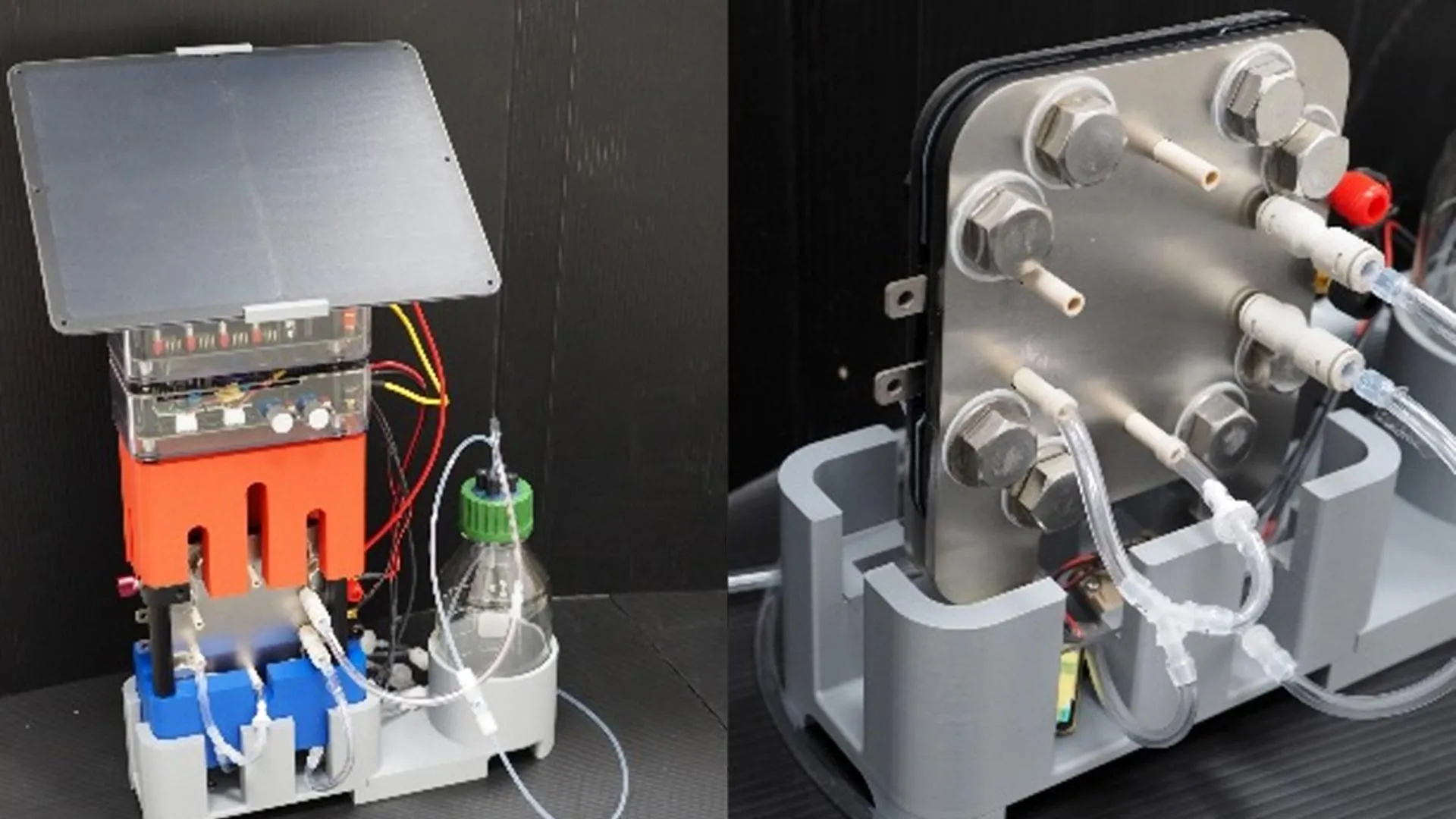
The research team, led by Associate Professor Yasuo Matsubara and Professor Yutaka Amao from the OMU Research Center for Artificial Photosynthesis, sought to bypass these electronic dependencies by redesigning the electrolyzer’s internal physics. In collaboration with Iida Group Holdings Co., Ltd., a major Japanese firm specializing in residential construction and sustainable development, the team developed an electrolyzer that utilizes its own physical properties to perform the MPPT function.
The core of this innovation lies in the use of a specially designed solid electrolyte. Rather than relying on external sensors to detect changes in solar input, the electrolyzer responds directly to the thermal energy generated during operation. As solar intensity increases, the photovoltaic cells deliver more current to the electrolyzer, which naturally causes the device’s internal temperature to rise.
Under standard conditions, increased heat can sometimes degrade electrochemical performance. However, the OMU team engineered the solid electrolyte so that its electrical resistance (impedance) drops as the temperature rises. This inverse relationship creates a self-correcting feedback loop. When the sun is at its peak, the reduced resistance allows the electrolyzer to process the higher electrical load efficiently. Conversely, when sunlight dims, the system cools, resistance increases, and the electrolyzer maintains stability without the "jitter" that typically plagues unregulated systems.
"As sunlight increases, the electrolyzer naturally heats up," explained Professor Amao. "The system is designed so that this warming causes the electrical resistance to drop, allowing electricity to flow more freely. This makes the system automatically adjust its electrical behavior."
Chronology of Development and the Osaka Kansai Expo 2025
The development of this self-regulating system followed a multi-year trajectory of lab-scale testing and prototype refinement. The project gained significant momentum through its partnership with Iida Group Holdings, which provided the industrial perspective necessary to transition the technology from a laboratory curiosity to a functional utility.
A pivotal moment in the technology’s public debut occurred at the "Joint Pavilion Iida Group × Osaka Metropolitan University" exhibition, a precursor event for the upcoming Osaka Kansai Expo 2025. During this exhibition, the researchers demonstrated the practical viability of the system by using it to power a miniature diorama. The system successfully synthesized enough formic acid under variable conditions to maintain the diorama’s operations, proving that the technology could handle real-world fluctuations without the safety net of a battery bank.
Professor Matsubara noted that the success at the exhibition provided the empirical validation needed to move toward residential applications. "We were confident that it would be successful," he stated. "It successfully generated enough formic acid to power a miniature diorama in the pavilion, showing its potential as an efficient artificial photosynthesis system that could potentially be used to charge applications in our homes."
Technical Analysis and Supporting Data
The findings, published in the prestigious journal EES Solar (Energy & Environmental Science), detail the electrochemical efficiency and stability of the device. According to the study, the self-regulating electrolyzer maintained a consistent Faradaic efficiency—the measure of how effectively electrical charge is converted into the desired chemical product—even during rapid transitions in light intensity.
Key data points from the research include:
- Impedance Matching: The system achieved near-perfect impedance matching with the solar cells across a temperature range of 25°C to 65°C. This range covers typical operating conditions for outdoor solar installations.
- Formic Acid Concentration: Under continuous outdoor testing, the system produced formic acid at a rate that matched or exceeded traditional MPPT-controlled systems, despite the absence of external electronics.
- Durability: The solid electrolyte showed minimal degradation over extended cycles, suggesting that the "passive" regulation method puts less mechanical and chemical stress on the components than high-frequency electronic switching.
By removing the battery, the researchers also addressed a significant environmental concern. Modern batteries rely on critical minerals like lithium, cobalt, and nickel, the mining of which involves substantial environmental and ethical costs. A battery-free artificial photosynthesis system represents a "purer" form of green energy, reducing the ecological footprint of the hardware itself.
Broader Implications for Carbon Neutrality and Residential Energy
The implications of this research extend far beyond the laboratory. Japan, like many industrialized nations, has committed to achieving carbon neutrality by 2050. Achieving this goal requires decentralized energy solutions that can be integrated into the existing built environment. The partnership with Iida Group Holdings suggests a future where artificial photosynthesis units are standard features in residential homes.
In such a scenario, a house’s roof would not only generate electricity for immediate use but would also house a self-regulating electrolyzer. During the day, the system would silently convert excess sunlight and atmospheric (or captured) CO2 into liquid formic acid stored in a safe, low-pressure tank. At night or during periods of low solar generation, this formic acid would be fed into a small fuel cell to provide heat and power to the household.
This "circular" energy economy reduces reliance on the centralized power grid and provides a solution for seasonal energy storage—a feat that batteries, which lose charge over time, struggle to achieve. Furthermore, the reduction in system complexity means lower maintenance costs for homeowners, making green technology more accessible to the general public.
Official Reactions and Industry Perspective
Industry analysts have reacted positively to the OMU findings, noting that the "passive" approach to power management is a growing trend in sustainable engineering. By utilizing the inherent properties of materials rather than adding layers of digital control, engineers can create more robust and "elegant" solutions.
Representatives from Iida Group Holdings emphasized that this technology aligns with the growing demand for "Net Zero Energy Houses" (ZEH). The ability to produce fuel on-site without the bulky and expensive battery installations currently required for off-grid living could revolutionize the real estate and construction sectors.
Professor Amao highlighted the automation aspect as a key victory for the project. "This self-regulating behavior helps keep fuel production more stable throughout the day and automates the system, while reducing dependence on batteries and costly external components," he added.
Future Research and Scaling
While the results published in EES Solar are promising, the team at Osaka Metropolitan University is already looking toward the next phase of development. Future research will focus on scaling the electrolyzer for industrial-sized applications and exploring the use of different catalysts to further increase the rate of formic acid production.
There is also interest in adapting the self-regulating mechanism for other types of solar-to-fuel conversions, such as the production of green hydrogen or methanol. If the thermal-impedance regulation principle can be applied broadly across the field of electrochemistry, it could lead to a new generation of "smart" materials that manage energy autonomously.
As the Osaka Kansai Expo 2025 approaches, the OMU and Iida Group team plans to showcase even more advanced iterations of their system. Their work stands as a testament to the power of interdisciplinary collaboration, combining advanced material science with practical engineering to solve one of the most pressing challenges of the 21st century. In the race to save the planet from the effects of climate change, the ability to harvest the sun’s energy as simply and efficiently as a leaf may be the most important innovation of all.