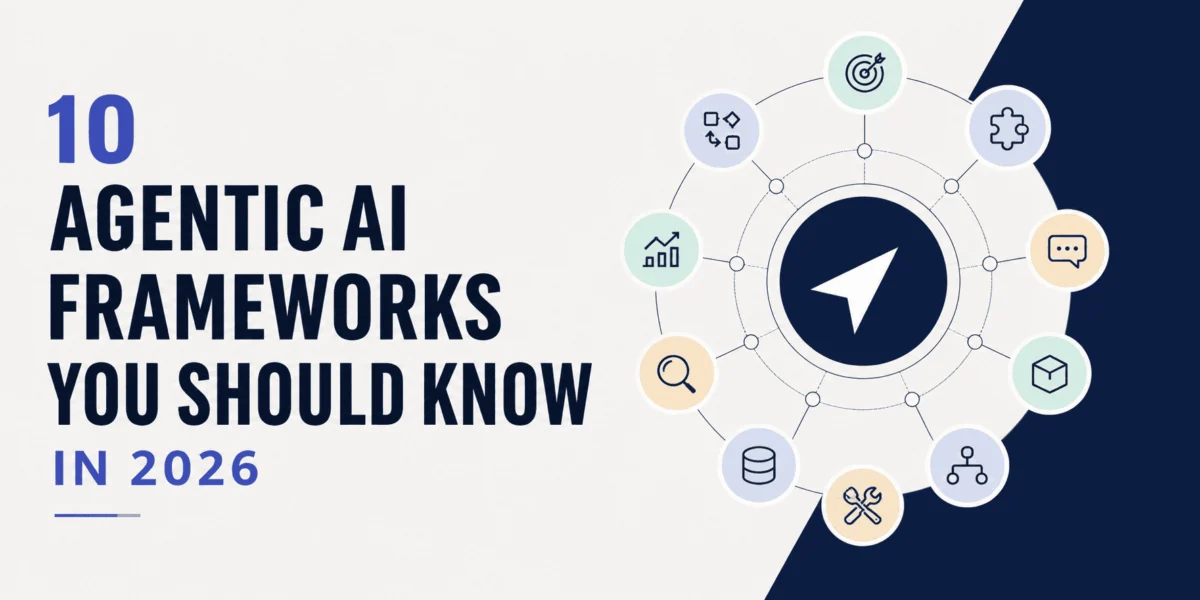
The landscape of artificial intelligence development has undergone a significant transformation, moving beyond foundational large language models (LLMs) to embrace sophisticated agentic AI frameworks. These advanced tools are no longer mere wrappers for LLMs; they represent a crucial evolutionary step, offering developers robust capabilities for managing complex aspects such as state, memory, tool usage, evaluation, and deployment without the need to build every component from scratch. The strategic selection of an agentic framework has become paramount for AI developers aiming to construct intelligent systems capable of sustained, autonomous, and reliable operation. This report delves into ten leading agentic AI frameworks poised to define the development paradigm in 2026, examining their core functionalities, strategic advantages, and ideal use cases within the rapidly evolving AI ecosystem.
The Maturation of Agentic AI Frameworks: A Paradigm Shift
The journey of AI agent development has been marked by a rapid progression from rudimentary scripting to highly sophisticated, modular architectures. Initially, AI agents often comprised an LLM paired with a few hardcoded tools, executing linear tasks with limited adaptability. However, as the demand for more intelligent, context-aware, and persistent AI systems grew, the limitations of these early approaches became evident. Developers grappled with challenges related to maintaining conversational state over long interactions, managing tool access securely, ensuring consistent performance, and deploying agents reliably in production environments. This necessitated the emergence of comprehensive frameworks designed to abstract away much of this complexity, allowing developers to focus on agent logic and application-specific intelligence.
The market for AI software, including tools and frameworks for agent development, is experiencing exponential growth. Industry analysts project the global AI software market to exceed several hundred billion dollars by the mid-2020s, with agentic AI components forming an increasingly significant segment. This growth is driven by the potential for AI agents to automate complex business processes, enhance customer service, accelerate research, and provide personalized experiences across diverse sectors. The current generation of frameworks reflects a maturity in addressing these enterprise-grade requirements, emphasizing features like inspectability, durability, human-in-the-loop capabilities, and seamless integration with existing IT infrastructures. The differentiation among frameworks often lies in their philosophical approach – some prioritize explicit control and deterministic workflows, while others favor rapid prototyping and model-driven autonomy.
Key Innovations and Trends in Agentic AI Development
The leading agentic AI frameworks for 2026 demonstrate several converging trends and innovative approaches that are shaping the future of intelligent system development. These include:
- Advanced State and Memory Management: Moving beyond simple short-term memory, frameworks now offer sophisticated mechanisms for long-term memory, contextual recall, and persistent state management, crucial for long-running and conversational agents.
- Enhanced Tool Orchestration: Frameworks provide structured ways to define, manage, and invoke external tools and APIs, often incorporating validation and access control to ensure secure and effective tool usage.
- Multi-Agent Collaboration: The concept of "crews" or "teams" of specialized agents working together on complex tasks has gained traction, allowing for the decomposition of problems and leveraging diverse AI capabilities.
- Human-in-the-Loop Capabilities: Recognizing the need for oversight and intervention, many frameworks integrate mechanisms for human approval, review, and feedback, enabling hybrid human-AI workflows.
- Observability and Evaluation: Built-in tracing, logging, and evaluation tools are becoming standard, providing developers with insights into agent behavior, decision-making processes, and performance metrics.
- Ecosystem Integration and Deployment: Frameworks increasingly offer seamless integration with cloud platforms, development environments, and existing software stacks, simplifying the deployment and scaling of agentic applications.
- Type Safety and Reliability: A growing emphasis on structured inputs/outputs and validated data types ensures greater reliability and reduces errors in agent interactions, particularly for critical business applications.
The diverse offerings underscore a crucial point: no single framework is universally superior. The optimal choice hinges on project requirements, developer expertise, existing technology stacks, and long-term strategic goals.
Deep Dive into Leading Frameworks for 2026
Here, we explore the top 10 agentic AI frameworks, detailing their unique contributions and strategic positioning in the evolving AI landscape.
LangGraph: Precision and Control for Complex Workflows (~36k GitHub Stars)
LangGraph has solidified its position as a cornerstone for developers demanding granular control over agent behavior and workflow execution. By modeling applications as directed graphs of states and transitions, LangGraph empowers the construction of highly resilient and inspectable AI systems. This graph-based paradigm is particularly advantageous for applications requiring intricate branching logic, iterative processes, fault recovery, and the ability to pause for human intervention or resume from saved checkpoints. Its utility spans long-running agents, sophisticated customer support systems, in-depth research assistants, and complex coding workflows where an agent cannot simply restart upon failure.
The primary appeal of LangGraph lies not in making agents more autonomous but in rendering them profoundly more inspectable and governable. Developers explicitly define where an LLM can operate freely, where deterministic logic must prevail, when tool actions require approval, and what state persists across runs. This level of control, while necessitating a steeper learning curve, is consistently praised by the developer community for enabling robust production-grade solutions. While it may not be the fastest route to a rudimentary demo, LangGraph is the preferred path for workflows that must withstand the complexities and demands of real-world deployment, where reliability and auditability are paramount. It offers a strategic advantage for enterprises building critical AI applications.
CrewAI: Simplifying Multi-Agent Collaboration through Roles (~55k GitHub Stars)
CrewAI has garnered immense popularity due to its intuitive and accessible mental model for multi-agent systems. It simplifies the design of collaborative AI by allowing developers to define agents with distinct roles, assign specific tasks, and organize them into cooperative "crews." This abstraction makes it straightforward to conceptualize and implement workflows where specialized AI entities work in concert. For instance, one can easily configure a crew comprising a researcher, an analyst, a writer, and a reviewer, enabling them to execute a structured process for information gathering, synthesis, and content generation.
This framework excels in scenarios requiring rapid prototyping of multi-agent workflows for tasks like automated research, report generation, business process automation, and internal operational support. Its strength lies in its ability to quickly demonstrate the power of role-based collaboration, especially when each agent’s purpose is clearly defined and the overall workflow is easily articulated to non-technical stakeholders. However, a potential consideration is that overly intricate role-based systems can sometimes introduce unnecessary complexity, requiring careful validation of outputs, controlled access to tools, and mechanisms to prevent redundant work. While an excellent starting point for collaborative AI, not every multi-step task inherently requires a full "crew," and simpler orchestration might suffice in some instances.
OpenAI Agents SDK: Streamlined Tooling for Focused Agents (~27k GitHub Stars)
The OpenAI Agents SDK presents a clean and focused approach for developers aiming to build tool-using agents without the overhead of larger orchestration frameworks. Its design prioritizes simplicity and directness, with core building blocks including agents, tools, handoffs, guardrails, sessions, human approval, and tracing. This minimalist philosophy makes it an ideal choice for projects that begin with a single, focused agent and only gradually introduce specialists as genuine needs arise. The inclusion of "handoffs" facilitates efficient routing of work between agents, while "sessions" and "tracing" provide crucial insights into system behavior over time, aiding debugging and performance optimization.
Despite its association with OpenAI, the SDK is designed to support various model providers, offering flexibility beyond the OpenAI ecosystem. Users frequently commend its relatively compact API surface and straightforward developer experience, which accelerates development cycles. The primary limitation, however, is its less opinionated stance on durable workflow design compared to frameworks like LangGraph. While highly effective for clean, tool-centric agents, it may require additional architectural considerations for highly complex or long-running stateful applications. It naturally aligns with development teams already deeply integrated with OpenAI APIs, offering a familiar and efficient pathway to agent development within that ecosystem.
Google ADK: An Integrated Ecosystem for Gemini and Vertex AI (~20k GitHub Stars)
Google’s Agent Development Kit (ADK) has rapidly emerged as a significant framework, particularly for teams operating within the Google Cloud ecosystem. It offers a comprehensive, code-first toolkit for defining agents, tools, sessions, memory, evaluations, and multi-agent patterns, alongside integrated deployment workflows. A standout feature is its local development UI, which significantly streamlines the inspection and testing of agents prior to deployment in cloud environments. This holistic approach makes ADK a natural fit for teams leveraging Gemini, Vertex AI, Google Cloud Run, or other Google enterprise services.
Beyond simple demonstrations, ADK supports advanced patterns such as agent-as-workflow, robust tool authentication, asynchronous execution, and integrations with the Model Context Protocol (MCP). The community has provided positive feedback on Google’s rapid pace of development and the framework’s all-in-one lifecycle management capabilities. However, due to its rapid evolution, teams are advised to manage dependencies carefully by pinning versions and thoroughly testing upgrades to avoid potential breaking changes. While primarily optimized for the Google ecosystem, its comprehensive feature set and commitment to a full lifecycle approach position it as a powerful contender for sophisticated agent development.
PydanticAI: Ensuring Reliability with Type-Safe Agent Outputs (~18k GitHub Stars)
PydanticAI represents a powerful choice for Python developers who prioritize type safety, validated tool inputs, and rigorously structured outputs in their agentic applications. It extends the renowned developer experience of Pydantic and FastAPI into the domain of agent development, allowing developers to define schemas, validate outputs, and interact with agents using strongly typed Python objects. This paradigm shifts the focus from hoping an agent returns valid JSON to explicitly ensuring it does, significantly enhancing reliability and maintainability.
This framework proves invaluable for real-world applications where data integrity is critical, such as automated support-ticket creation, generation of structured research reports, database updates, API payload construction, and financial or operational workflows. PydanticAI is less concerned with elaborate multi-agent role-playing and more focused on robust software engineering practices. Community feedback frequently highlights that typed objects and validation mechanisms make failures significantly easier to identify, diagnose, and rectify. It is an excellent fit when an incorrect field, an invalid tool argument, or a malformed output could lead to downstream system failures. The trade-off is that it might not be the most immediate solution for teams seeking to quickly demonstrate complex, role-playing multi-agent scenarios without a strong emphasis on data validation.
smolagents: Code-Centric Agents for Transparency and Experimentation (~28k GitHub Stars)
Hugging Face’s smolagents offers a lightweight and distinctive framework for agents that "think in code." Rather than constraining every action within a large JSON object, smolagents enables models to generate compact Python code capable of calling tools, combining outputs, and flexibly solving tasks. The core agent logic is intentionally kept small and inspectable, making smolagents highly suitable for experimentation, academic research projects, local model deployment, and for developers who seek a deep understanding of the agent loop without immediately adopting a monolithic platform.
Users appreciate the clarity and composability afforded by its code-first approach. However, this defining feature also introduces significant security considerations: executing model-generated code demands robust sandboxing, stringent permissions, carefully designed tools, and clear boundaries around file system, network, and shell access. While an exceptional tool for learning, rapid prototyping, and transparent agent development, its deployment in production environments necessitates a proactive and thorough security design phase, rather than attempting to retrofit security measures later. It embodies a philosophy of minimal abstraction, offering maximum insight into the agent’s decision-making process.
Mastra: TypeScript-First for Full-Stack AI Applications (~25k GitHub Stars)
Mastra stands out as one of the most compelling TypeScript-first frameworks, catering specifically to full-stack development teams. It provides a comprehensive suite of features including agents, workflows, memory management, MCP support, Retrieval-Augmented Generation (RAG), evaluations, observability, and deep integrations with modern web technologies like React, Next.js, and Node.js. Mastra introduces a practical distinction between agents, which offer models the flexibility to decide actions, and workflows, which mandate predictable, pre-defined steps. This hybrid approach is particularly beneficial for building production web applications that require both the adaptive intelligence of AI and the reliability of structured application logic.
Mastra is a strong contender for TypeScript teams seeking a unified framework for both backend agent logic and frontend product development. Its ability to bridge these two critical development areas streamlines the creation of AI-powered web experiences. However, the framework is undergoing rapid development, necessitating careful version management and dependency hygiene, especially given the dynamic nature of the JavaScript ecosystem. Despite these considerations, its full-stack capabilities and TypeScript-first design position Mastra as a strategic choice for modern web application development incorporating sophisticated AI agents.
Microsoft Agent Framework: Enterprise-Grade AI for Hybrid Environments (~12k GitHub Stars)
The Microsoft Agent Framework is emerging as a pivotal platform for enterprise teams navigating both Python and .NET development environments. It represents a strategic consolidation of concepts previously distributed across AutoGen and Semantic Kernel, offering support for agents, multi-agent workflows, sessions, middleware, telemetry, graph-based orchestration, and deep enterprise integrations. The appeal extends beyond Microsoft branding; it lies in a strong emphasis on predictable software engineering practices: explicit orchestration, robust observability, flexible middleware, type safety, seamless Azure integrations, and governance-friendly deployment pathways.
This framework is exceptionally well-suited for internal business agents, assistants integrated with Microsoft 365, Azure-hosted workflows, and organizations with established .NET expertise. While newer than some long-established Python-first frameworks, its ecosystem is rapidly expanding. This relative newness suggests it should be considered a strategic platform choice for long-term enterprise AI initiatives rather than a default for every small prototype. For organizations deeply invested in the Microsoft ecosystem, it is poised to become the logical successor to managing disparate AutoGen and Semantic Kernel stacks, offering a cohesive and enterprise-ready solution for agent development.
Strands Agents: Model-Driven Flexibility for Open-Ended Tasks (~6.3k GitHub Stars)
Strands Agents adopts a distinctive model-driven approach, empowering the underlying LLM to reason about which tools to utilize and how to proceed, rather than requiring developers to pre-define every step of a workflow. This framework is designed to seamlessly scale from simple conversational assistants to more autonomous workflows, offering support for multiple model providers and Model Context Protocol (MCP) tools. Its low-ceremony design makes it attractive for developers seeking less prescriptive orchestration than graph-based tools.
Strands Agents can be a particularly good fit for users within the Amazon Web Services (AWS) and Amazon Bedrock ecosystems, although its deployment is not strictly limited to AWS. The inherent trade-off in a model-driven approach is a degree of control. While convenient for open-ended tasks, developers must ensure strong tool boundaries, rigorous validation, and appropriate approval steps when agents are capable of executing significant actions. Community discussions also indicate a desire for more explicit lifecycle control and enhanced multi-agent hooks, factors worth considering before deploying it for highly regulated or safety-critical workflows where deterministic behavior is paramount.
LlamaIndex Workflows: Data-Centric Agents and RAG Specialization (~400 GitHub Stars)
While LlamaIndex is renowned for its retrieval and data application capabilities, its Workflows framework warrants significant attention for agentic systems. It employs an event-driven model where workflow steps receive, process, and emit new events, facilitating the expression of complex branching, looping, parallel, and asynchronous tasks, particularly within multi-stage research pipelines. This architecture is exceptionally valuable when the primary challenge for an agent involves not just deciding which tool to call, but effectively finding, extracting, organizing, and grounding answers in relevant data.
LlamaIndex Workflows is therefore a natural fit for enterprise search applications, sophisticated document analysis, advanced Retrieval-Augmented Generation (RAG) systems, knowledge assistants, and multi-step research systems. The community often perceives LlamaIndex as stronger for retrieval and document workflows than for general-purpose agent orchestration. This specialization is not a weakness; rather, it indicates that LlamaIndex Workflows should be the framework of choice when the core problem an agent needs to solve revolves around intelligent data access, contextualization, and knowledge synthesis, rather than merely building a complicated state machine. It empowers agents to leverage vast datasets effectively, transforming raw information into actionable insights.
Strategic Considerations for Developers and Enterprises
The proliferation of sophisticated agentic AI frameworks underscores a critical shift in AI development: the focus has moved from merely building intelligent components to orchestrating them into reliable, production-ready systems. For developers and enterprises, the selection of an appropriate framework is a strategic decision that extends beyond mere GitHub stars or current hype. It necessitates a thorough evaluation of factors such as:
- Level of Control: Does the project demand explicit, deterministic control over every step, or is a more autonomous, model-driven approach acceptable?
- State and Memory Management Needs: Are long-running, conversational agents requiring complex memory recall central to the application?
- Tooling and Integration: How seamlessly does the framework integrate with existing APIs, databases, and cloud services? What are the security implications of tool access?
- Observability and Evaluation: Are built-in tracing, logging, and evaluation tools sufficient for monitoring and debugging agent behavior in production?
- Deployment and Scalability: How well does the framework support deployment across target environments and scale to meet anticipated user loads?
- Developer Experience and Ecosystem: Does the framework align with the team’s existing language proficiencies (Python, TypeScript, .NET) and integrate with preferred development tools?
- Reliability and Governance: For critical applications, are features like type safety, validation, and human-in-the-loop mechanisms robust enough to ensure dependable operation and compliance?
The evolving skill set for AI developers now includes not just proficiency in LLMs but also a deep understanding of agent architectures, workflow orchestration, and the nuances of various frameworks.
The Future Outlook: Towards More Autonomous and Robust AI Systems
The rapid evolution of agentic AI frameworks indicates a clear trajectory towards more autonomous, robust, and domain-specialized intelligent systems. We can anticipate continued specialization, with frameworks becoming even more adept at solving particular classes of problems (e.g., highly regulated workflows, real-time control systems, creative content generation). Concurrently, there will likely be a push for greater interoperability and standardization, allowing components from different frameworks to be combined more easily.
The emphasis on security, ethical AI development, and human oversight will only intensify. As AI agents become more integrated into critical infrastructure and decision-making processes, the need for transparent, auditable, and controllable systems will become paramount. This includes advancements in sandboxing for code-generating agents, more sophisticated guardrails, and intuitive interfaces for human intervention. The ultimate goal remains the deployment of reliable, scalable, and beneficial AI agents that can seamlessly augment human capabilities and automate complex tasks across industries, ushering in a new era of intelligent automation.
The agentic AI space remains exceptionally dynamic, with continuous innovation driving new capabilities and refinements. The frameworks highlighted here represent some of the strongest options available in 2026, offering diverse approaches to building the next generation of intelligent applications. Informed selection, aligned with specific project requirements and long-term strategic objectives, will be key to unlocking the full potential of agentic AI.