For the past several years, success has grown more elusive for American biotech firms, navigating a dramatically altered landscape that demands innovation not just in science, but in business strategy. Even in the more robust investment climates prior to 2022, developing and growing a biotech always required a combination of significant risk appetite and patient capital that did not lend itself to the rapid exits typical of other areas of tech investing. This inherent challenge has been magnified by a confluence of factors, creating an unprecedentedly complex environment for an industry vital to global health and economic competitiveness.
The investing weather has changed considerably since the post-pandemic boom, shifting from a period of abundant, speculative capital to one characterized by greater caution from both U.S. regulators and investors. This domestic recalibration has dovetailed with a stark contrast in the global arena: a surplus of capital and increased regulatory streamlining in China, actively fostering its burgeoning biopharmaceutical sector. This dual pressure creates an even more challenging environment for innovative biotech firms in the United States, forcing them to rethink traditional models and seek novel avenues for growth and differentiation. The stakes are high, as the ability of American biotech to maintain its competitive edge hinges on its capacity to adapt to these evolving market dynamics and geopolitical realities.
The Shifting Sands of Biotech Investment and Global Competition
The period leading up to 2022 saw a surge in biotech investment, fueled by low interest rates, a robust venture capital ecosystem, and the perceived urgency of medical innovation highlighted by the COVID-19 pandemic. Funding rounds were larger, valuations soared, and companies could often secure capital based on promising preclinical data. However, the subsequent tightening of monetary policy, rising interest rates, and a broader economic slowdown have led to a significant contraction in venture capital funding for early-stage and even clinical-stage biotech companies. Investors are now demanding clearer paths to market, stronger clinical data, and more immediate returns, making the long, expensive road of drug development even harder to finance. According to a recent report from PitchBook, biotech venture funding in the U.S. saw a decline of approximately 30% in 2023 compared to its peak in 2021, a trend expected to persist through 2024 and 2025 as the market corrects and matures.
Concurrently, China has strategically positioned itself as a formidable player in the global biopharma landscape. Driven by ambitious national strategies like "Made in China 2025" and a massive domestic market, the Chinese government has invested heavily in R&D infrastructure, offered significant incentives for drug development, and critically, streamlined its regulatory approval processes through agencies like the National Medical Products Administration (NMPA). This has dramatically reduced the time and cost associated with bringing new drugs to market within China, attracting both domestic and international capital. "China’s regulatory reforms have been a game-changer," notes Dr. Chen Li, a senior analyst at Bio-Insights Group. "They’ve created an environment where drug development can progress at an unprecedented pace, often at a fraction of the cost seen in Western markets. This isn’t just about internal growth; it’s about global competition."
This creates a critical imperative for U.S. biotech: to forge a new path that navigates the challenge of intellectual property (IP) appropriation by lower-cost Chinese firms, maximizing investment in drug development areas viewed as popular and low risk, or finding an innovative model to operate under that can both open up new markets and create potential cost efficiencies. Each approach carries distinct risks, but also brings the potential to differentiate not only from crowded markets for existing drugs and their derivatives, but also to effectively differentiate from burgeoning Chinese competition. The future of American leadership in biotechnology hinges on the industry’s ability to creatively address these multifaceted pressures.
The Commodification Conundrum and the Rise of Target Herding
A significant challenge exacerbating the current environment is what industry experts refer to as "modality commodification" and "target herding." Elliott Hershberg eloquently describes how biopharma modality commodification has led inexorably to the modern world of target herding. The substantial progress China has made in streamlining the regulatory constraints on drug development has led to an explosion of innovation within its borders, but also an incredible amplification of the target-herding phenomenon. Put simply, the instant a good, new target emerges publicly with clinical data, a dozen companies spring up overnight to pursue the same idea, often with slightly modified molecules or approaches. Given their inherent development cost advantages and expedited regulatory pathways, these fast followers are increasingly coming from China, threatening the market exclusivity and profitability of original innovators.
This isn’t a new problem. Even 10 years ago, it was a significant issue – at one point, there were over 200 PD-(L)1 inhibitor programs globally, leading to a crowded market where many programs ultimately failed to differentiate or gain significant market share. However, the advent of artificial intelligence (AI) and advanced computational biology has now supercharged this phenomenon. For protein therapeutics, and even more so with chemical drugs, it is now trivially easy for well-resourced teams to work around patent claims and come up with a new molecule that achieves the same therapeutic effect through similar mechanisms. AI algorithms can rapidly analyze existing patent landscapes, identify structural modifications, and even design novel compounds that circumvent established intellectual property while retaining efficacy.
At that point, the profound development cost and speed advantages of China’s regulatory system mean that a copycat program may beat the innovator to market, or at least fast-follow in a way that effectively shortens the patent exclusivity period that makes it possible to recover clinical development costs. "AI’s dual nature is clear," comments Dr. Anya Sharma, a patent attorney specializing in biotech. "It accelerates discovery, but also accelerates circumvention. Companies must innovate not just in the lab, but in their IP strategy to stay ahead." This dynamic forces U.S. biotech firms to either pursue targets that are genuinely novel and difficult to replicate, or to find ways to build unassailable advantages around more common targets.
Three examples illustrate different solutions to this conundrum, showcasing the strategic ingenuity required to thrive in this new era.
Strategy 1: The Stealth Innovator – Variant Bio’s Secrecy Model
Variant Bio offers a compelling solution: develop technology that uncovers truly novel targets that others cannot easily see, and crucially, withhold patent filings until the last possible minute. This "keep secret" approach leverages a unique competitive advantage to avoid the pitfalls of target herding. Variant uses its privileged access to genomic sequencing data from very rare, isolated human populations to reveal novel genetic clues for human diseases. These populations, often with unique genetic architectures due to prolonged isolation, can provide powerful insights into disease resistance or susceptibility that are difficult to find in broader, more heterogeneous populations.
By focusing on these obscure yet highly informative genetic insights, Variant Bio identifies targets that are not yet public knowledge and are thus shielded from the immediate scrutiny of competitors and AI-driven reverse engineering efforts. "Our approach is about finding the needle in a haystack, but in a haystack that very few others even know exists," explains Dr. Ethan Cross, Chief Scientific Officer at Variant Bio. "The biological insights from these unique cohorts provide a durable advantage, allowing us to pursue drug discovery in relative quiet." Rather than scrapping it out in the commodity target space, this allows Variant Bio to work in quiet isolation throughout most of the development period, a durable advantage that buys crucial time to advance their programs. The strategy relies on maintaining tight control over proprietary data and delaying public disclosure, including patent applications, until the latest feasible stage, maximizing the period of unassailable lead time. This high-risk, high-reward strategy demands meticulous operational security and deep scientific expertise, but offers the potential for profound market leadership if successful.
Strategy 2: Maximizing Established Modalities – Polypharmacology Pioneers Spyre and Kailera

There is a silver lining to modality commodification: as an industry, we are now exceptionally adept at developing certain kinds of drug molecules, particularly monoclonal antibodies and peptides. The extensive knowledge base, established manufacturing processes, and accumulated clinical experience translate into lower development risk for these well-understood modalities. This expertise has led minds to turn to the idea of combining these established modalities for better efficacy, a strategy known as polypharmacology or combination therapy.
In turn, combinations can generate an extra layer of patent protection (on the combination itself, even if individual components are off-patent or commoditized) and require a superior level of execution that is likely beyond most would-be copycats. Furthermore, the better therapeutic efficacy that combinatorial synergies unlock allows the developer to grab market share from incumbents and justify premium pricing, even for drugs targeting well-known biological pathways.
Spyre Therapeutics is pursuing this strategy aggressively with its portfolio of bio-better Inflammatory Bowel Disease (IBD) monoclonal antibody drugs targeting the established targets IL-23, TL1A, and α4β7. While individual antibodies against these targets are already on the market or in advanced development, Spyre aims to create superior, potentially combination-based therapies. For instance, while biosimilars to established blockbusters like Humira (adalimumab) are now available at significantly reduced prices – Mark Cuban may be selling generic Humira for 95% off – if efficacy can be doubled or side effect profiles improved through strategic combinations, the U.S. healthcare system will still pay up for superior outcomes. The IBD market alone is projected to exceed $25 billion by 2027, indicating substantial room for differentiated products.
Similarly, Kailera is doing much the same with weight-loss peptides. Semaglutide, targeting GLP-1, has revolutionized obesity treatment, but much better efficacy is generated by bivalent, trivalent, or even quadrivalent peptide constructs that engage multiple receptors or enhance single-receptor activity. This multi-target or enhanced-target approach aims to significantly boost weight loss outcomes, even if, sadly, it doesn’t always alleviate side effects like nausea and vomiting, as anecdotal evidence suggests. Like Spyre, none of Kailera’s core targets are novel; their innovation lies in the sophisticated design and combination of existing modalities to achieve superior clinical profiles.
There’s a catch though: while development risk may be lower due to well-understood biology and manufacturing, development costs are not necessarily reduced, and often increase. The extensive clinical trials required for combination therapies, especially large-scale Phase 3 studies, are immensely expensive. Both Spyre and Kailera have reportedly raised over a billion dollars each to pursue these sprawling clinical programs, highlighting the significant capital investment required for this "funds-maxxing" strategy. This approach is attractive to investors seeking lower biological risk, but it demands substantial financial backing and flawless execution.
Strategy 3: Disrupting with Novel Platforms – Lumen Bio’s Transformative Approach
A more cost-efficient yet higher-risk approach is represented by Seattle’s Lumen Bio (disclosure: co-founded by co-author Brian Finrow). Like Spyre and Kailera, its pipeline includes biologic cocktail drugs that yield powerful therapeutic synergies, but it leverages a completely novel biomanufacturing platform technology. This platform, based on genetically engineered algae, promises far greater scalability and delivered cost advantages than traditional mammalian cell culture systems. These efficiencies also make preventive drugs and international markets, particularly in low- and middle-income countries, far more addressable, opening up entirely new commercial opportunities previously constrained by manufacturing costs.
However, this novelty comes with both pros and cons. A significant disadvantage is that novel biomanufacturing platforms have been out of fashion with investors since the end of the COVID-era investment frenzy in 2022. The initial excitement for new manufacturing approaches, spurred by the pandemic’s urgency, has waned, with investors preferring more proven, albeit less efficient, methods. Relatedly, established biopharma companies generally prefer to work with technologies that are compatible with their existing manufacturing footprints – commodified modalities, as it were – reducing the immediate appetite for radical change. Nevertheless, for Lumen Bio, the competitive advantages of its platform, including rapid scalability, lower capital expenditure, and significantly reduced cost of goods, are argued to outweigh these market-perception considerations.
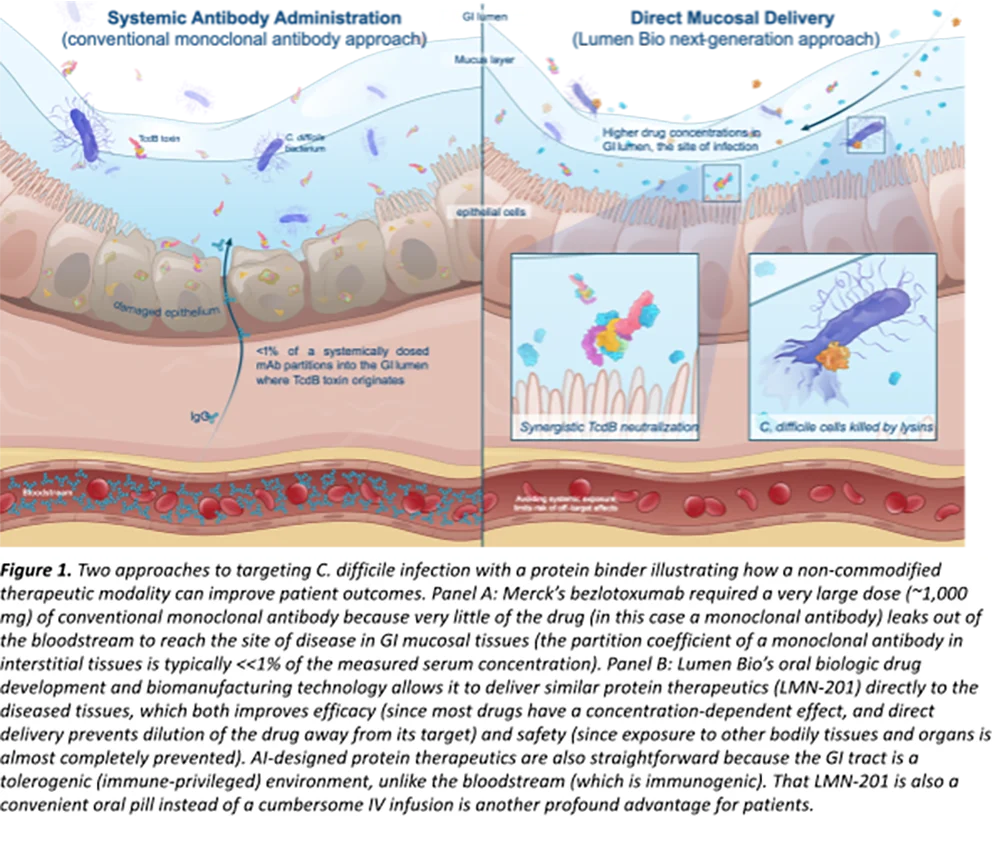
Beyond just the competitive considerations, new therapeutic modalities and manufacturing platforms represent new ways of addressing unmet medical needs. For example, Lumen Bio’s LMN-201 attacks the same target as the IV-infused Merck antibody bezlotoxumab for Clostridioides difficile (C. diff) infection. However, LMN-201 is administered orally, not by injection, which makes it far easier to treat the disease, improving patient access and adherence. C. diff infection, a serious and recurrent bacterial illness, often requires prolonged hospital stays and complex treatment regimens. An oral biologic could revolutionize its management, shifting treatment from specialized hospital settings to outpatient clinics or even home care. Moreover, the lack of pre-existing manufacturing capacity for Lumen Bio’s algal platform means that would-be competitors have a much steeper hill to climb when they try to catch up to a novel product launch. This creates a significant barrier to entry, safeguarding the innovator’s market position.
The triumph of Moderna with its COVID-19 mRNA vaccine illustrates the huge upside potential of novel platforms. When traditional vaccine manufacturing approaches struggled to meet the urgent global demand, Moderna’s mRNA platform, despite its novelty and initial investor skepticism, proved to be highly adaptable, scalable, and effective, ultimately delivering a life-saving solution and cementing its place as a biopharma powerhouse. This historical precedent underscores the transformative power of a truly innovative platform.
Broader Implications for Global Biotech Leadership
The strategic choices being made by American biotech firms today have profound implications not only for their individual success but for the broader landscape of global biotech leadership. The competitive pressure from China is not a transient phenomenon; it represents a fundamental shift in the industry’s geopolitical and economic dynamics. The U.S. has historically been the undisputed leader in biopharmaceutical innovation, driven by robust academic research, strong venture capital, and a well-defined regulatory framework. However, the strategies being deployed by companies like Variant Bio, Spyre, Kailera, and Lumen Bio illustrate a critical adaptation phase.
The "keep secret" model, exemplified by Variant Bio, highlights the growing importance of proprietary data assets and unique biological insights that are difficult to replicate, even with advanced AI. This strategy, while risky, could secure enduring advantages in truly novel therapeutic areas. The "funds-maxxing polypharmacology" approach taken by Spyre and Kailera demonstrates that there is still significant value in optimizing established modalities, provided that the improvements in efficacy and patient outcomes are substantial enough to command market leadership and justify high development costs. This path requires significant capital, but offers a relatively lower scientific risk profile. Finally, the "novel platform" strategy of Lumen Bio showcases the potential for disruptive innovation, not just in drug discovery, but in manufacturing and delivery, opening up new markets and significantly lowering costs, which could democratize access to advanced therapeutics globally.
Conclusions
Deep, durable innovation in American biotech requires not only an appetite for scientific risk, but also identifying both a potential market and a pathway to delivery that is defensible against rapidly evolving global competition. Keeping a product secret provides a huge potential payoff, if the secrecy can be maintained and investors are patient enough to wait for the eventual market reveal. Modality commodification can reduce development risk, but it then requires proving both increased efficacy and successful market differentiation, often through sophisticated combination therapies. Developing a new platform also runs real risks, as any fully novel approach does, facing initial investor skepticism and the challenge of industry adoption, but it also carries with it the opportunity for creating entirely new markets and dramatically reduced product costs. The key to American biotech keeping its competitive edge amidst intense Chinese competition and a cautious investment climate lies in the artful balancing of the tradeoffs among these three distinct yet equally vital approaches. The next decade will define whether U.S. biotech can not only maintain its innovative prowess but also translate it into sustained global leadership.
Brian Finrow is CEO, co-founder, and co-chair of Lumen Bioscience, a clinical-stage biotechnology company in Seattle. Kevin Klowden is an economist and principal at Melcene Advisory and senior fellow at the Milken Institute.