Researchers at Nanyang Technological University, Singapore (NTU Singapore) have achieved a significant breakthrough in the field of photonics by developing a streamlined method to generate optical skyrmions—complex, swirling patterns of light that hold the potential to redefine the future of data storage and high-speed communications. By revisiting and reviving a classic optics experiment that dates back more than two centuries, the team has successfully bypassed the need for expensive, highly engineered metamaterials, which were previously considered essential for the creation of these "hedgehog-like" light structures. This discovery, led by Assistant Professor Shen Yijie from NTU’s School of Physical and Mathematical Sciences and School of Electrical and Electronic Engineering, marks a pivotal shift in how topological light is studied and utilized in modern physics.
The findings, recently published in the prestigious journal Optica, demonstrate that optical skyrmions can be produced by simply shining a coherent laser beam at a small circular disc. This approach utilizes the Poisson spot phenomenon, a cornerstone of wave theory that helped settle a centuries-old debate regarding the nature of light. By harnessing this fundamental optical effect, the NTU team has not only simplified the production process but also lowered the technical and financial barriers that have historically hindered research into topological photonics.
Understanding the Nature of Optical Skyrmions
To appreciate the significance of the NTU discovery, one must first understand what skyrmions are and why they are so highly prized in the scientific community. Originally proposed by British physicist Tony Skyrme in the 1960s within the context of nuclear physics, skyrmions are localized, particle-like configurations of a field. In the realm of magnetism and condensed matter physics, they appear as stable vortices of magnetic moments. In recent years, scientists have translated this concept into the field of optics, creating "optical skyrmions."
These structures are often described as having a "hedgehog" configuration because the properties of light—such as its polarization, phase, and intensity—swirl in a way that resembles the quills of a hedgehog radiating from a central point. The most critical characteristic of a skyrmion is its topological stability. Because the swirling pattern is mathematically "knotted," it remains remarkably stable even when the light field is stretched, compressed, or subjected to external interference. This robustness makes optical skyrmions ideal candidates for "bits" in next-generation computing, as they can encode information in a way that is far more resistant to data loss or corruption than traditional electronic signals.
The Poisson Spot: A Historical Foundation for Modern Innovation
The methodology employed by the NTU researchers is rooted in a famous episode in the history of science known as the "Poisson spot" or "Arago spot" debate. In 1818, the French Academy of Sciences held a competition to explain the properties of light. Physicist Augustin-Fresnel submitted a paper proposing that light behaved as a wave. Siméon Denis Poisson, a judge who supported the particle theory of light (championed by Isaac Newton), attempted to disprove Fresnel’s wave theory by pointing out a seemingly "absurd" logical consequence: if light were a wave, then a bright spot should appear at the exact center of a shadow cast by a circular object.
Poisson argued that common sense dictated the center of a shadow should be dark. However, when fellow physicist François Arago performed the experiment, the bright spot—now known as the Poisson spot—appeared exactly as the wave theory predicted. This was a watershed moment that confirmed the wave-particle duality of light and established diffraction as a fundamental property of physics.
By using this 200-year-old setup, the NTU team found that the diffraction patterns created by the Poisson spot naturally organize themselves into the complex configurations required for skyrmions. Instead of needing to fabricate microscopic, man-made metamaterials—which can cost tens of thousands of dollars and require specialized cleanroom facilities—the researchers achieved the same results using basic optical components and a laser.
Breaking Down the NTU Methodology
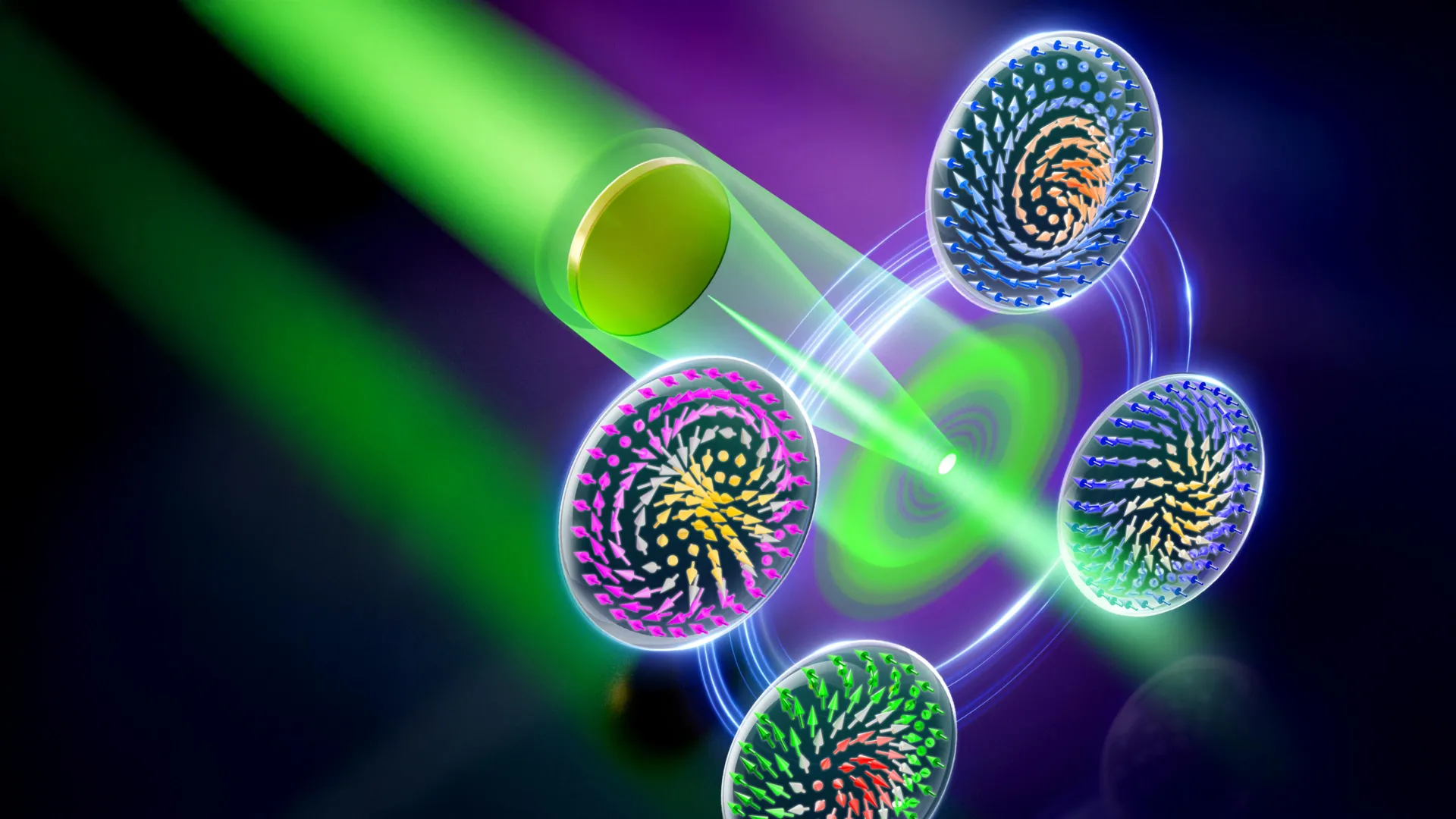
The NTU team’s experimental setup involved a coherent laser source directed toward a precision-manufactured circular disc. As the light waves encountered the edge of the disc, they underwent diffraction, bending around the object and interfering with one another on the other side. This interference created a structured light field within the shadow zone.
Assistant Professor Shen Yijie and his team discovered that by carefully controlling the parameters of the incoming laser and the geometry of the disc, they could induce the light to form topological patterns. "What is remarkable is that optical skyrmions can now be generated using a simple effect where light bends around an object, without relying on expensive, complex man-made metamaterials or highly specialized techniques," Asst Prof Shen explained.
The simplicity of this method allows for a high degree of reproducibility. Furthermore, because the Poisson spot is a naturally occurring phenomenon of wave diffraction, the resulting skyrmions are inherently stable and can be easily manipulated by adjusting the laser’s intensity or the distance between the disc and the observation plane.
A Quadruple Discovery: Simultaneous Skyrmion Generation
One of the most surprising outcomes of the study was the simultaneous generation of four distinct types of topological field patterns within a single Poisson spot setup. The researchers identified:
- Spin Skyrmions: Patterns based on the intrinsic angular momentum or "spin" of the light.
- Stokes Skyrmions: Structures defined by the Stokes parameters, which describe the polarization state of light waves.
- Electric Field Skyrmions: Patterns formed by the orientation and magnitude of the electric field vectors.
- Magnetic Field Skyrmions: Patterns formed by the magnetic field components of the electromagnetic wave.
Previously, generating even one of these types required specific, dedicated optical setups. The ability to produce all four at once provides a unique laboratory for scientists to observe how different physical properties of light interact. Computer simulations accompanying the experiment visualized these structures as intricate, swirling arrays of arrows, illustrating how the direction of light’s properties changes across the Poisson spot.
"In the light spot that we created, several types of optical vectors could form topological structures at the same time," said Asst Prof Shen. "Being able to produce and compare several skyrmions within one system could help researchers uncover new links between light’s electric, magnetic, and other physical properties."
Economic and Technical Implications for the Research Community
The transition from metamaterial-based skyrmion generation to a Poisson spot-based method represents a significant democratization of the field. Metamaterials are artificially engineered microscopic structures that manipulate electromagnetic waves in ways that natural materials cannot. While effective, their production involves high-precision lithography and nanotechnology, making them inaccessible to many research institutions with limited budgets.
By demonstrating that these complex structures can be created with "off-the-shelf" optical principles, NTU has lowered the barrier to entry. This is expected to trigger a surge in topological photonics research globally. Smaller laboratories and universities can now participate in the development of skyrmion-based technologies, potentially accelerating the timeline for commercial applications in computing and data storage.
The Future of Data Storage and Computing
The implications of this research extend far beyond the laboratory. As the world approaches the physical limits of traditional silicon-based electronics—a phenomenon often discussed in relation to the slowing of Moore’s Law—scientists are searching for alternative ways to process and store information.
Optical skyrmions offer several advantages:
- Information Density: Because skyrmions are incredibly small and can be packed closely together without interfering with one another, they could lead to data storage devices with capacities far exceeding current hard drives or solid-state drives.
- Speed: Light-based computing operates at much higher frequencies than electron-based computing, promising faster processing speeds and lower latency.
- Energy Efficiency: Photonic systems generally produce less heat than electronic systems, which could solve one of the primary challenges facing modern data centers.
- Security: The topological stability of skyrmions makes them difficult to disrupt, offering potential benefits for secure, "unhackable" quantum communications.
Chronology of Topological Light Milestones
The NTU discovery is the latest in a series of milestones that have brought topological photonics to the forefront of modern physics:
- 1818: Discovery of the Poisson spot, proving the wave nature of light.
- 1962: Tony Skyrme proposes the existence of skyrmions in particle physics.
- 2009: Magnetic skyrmions are experimentally observed in solids, sparking interest in their use for memory storage.
- 2018-2020: First experimental realizations of optical skyrmions using complex metamaterials and spatial light modulators.
- 2024: NTU Singapore researchers demonstrate that optical skyrmions can be produced via the classic Poisson spot experiment, simplifying the field.
Broader Impact and Conclusion
The work of Assistant Professor Shen Yijie and his team at NTU Singapore serves as a reminder that the most advanced solutions in science are sometimes found by looking back at foundational principles. By bridging 19th-century optics with 21st-century information theory, they have provided a robust platform for the future of light-based technology.
The ability to control and study optical skyrmions with such ease opens the door to "topological light-matter interaction," where these stable light structures could be used to manipulate atoms or molecules at the nanoscale. As researchers continue to explore the nuances of spin, Stokes, and field skyrmions within the Poisson spot, the transition from theoretical physics to practical, everyday technology—such as ultra-fast computers and indestructible data storage—becomes increasingly tangible.
This breakthrough positions NTU Singapore at the leading edge of optical research and sets a new standard for how scientists might approach complex problems by re-evaluating the "classic" experiments that built the foundations of modern science. The "hedgehog" of light, once a difficult and expensive curiosity, is now a tool that is more accessible than ever before.