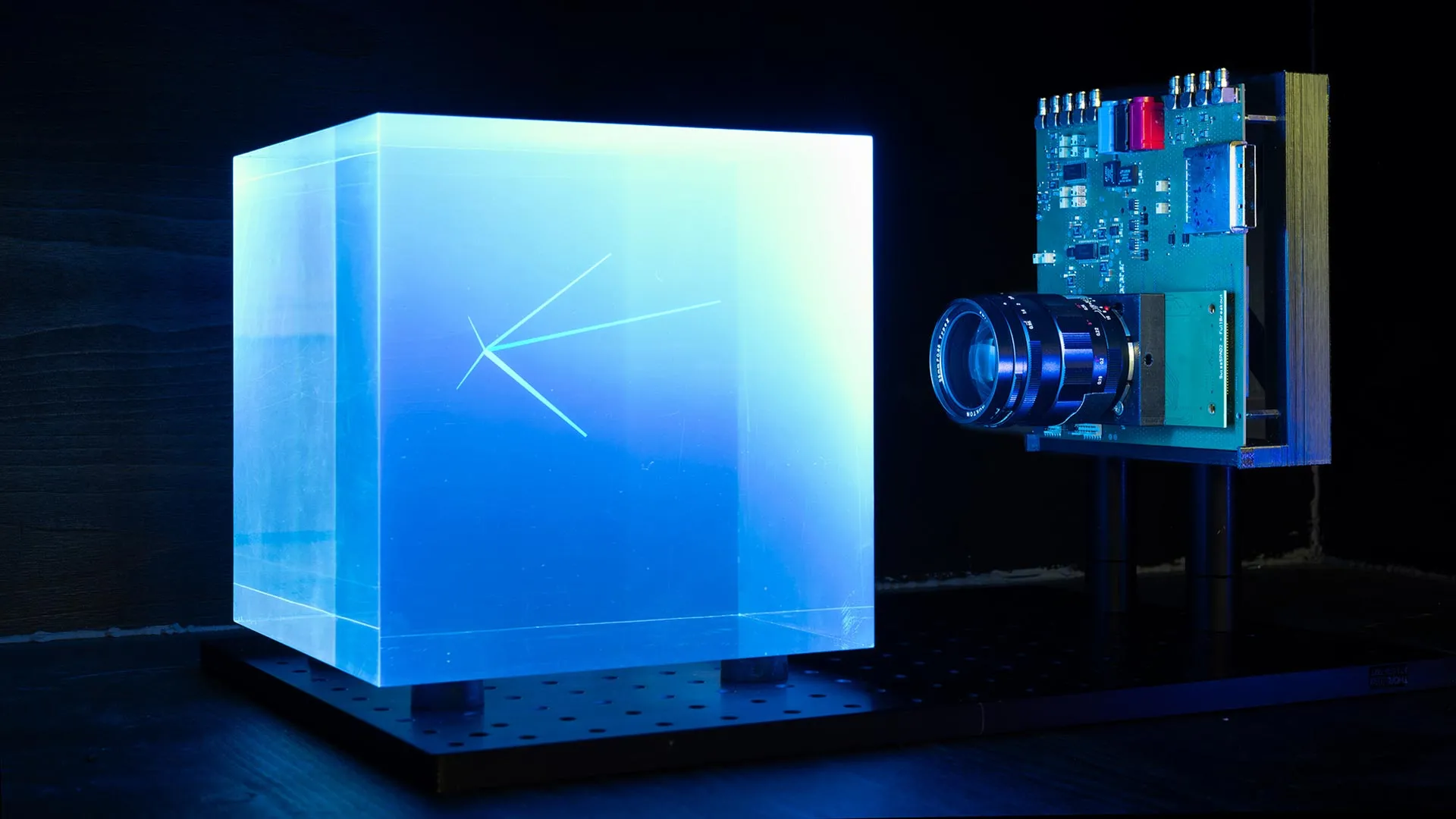
The field of experimental particle physics is currently undergoing a paradigm shift as researchers move away from increasingly complex, segmented detector designs toward integrated, high-resolution imaging systems. A collaborative team from ETH Zurich and EPFL (École polytechnique fédérale de Lausanne) has successfully demonstrated a radical new approach to particle detection that combines light field photography with ultra-fast single-photon sensors. This innovation, developed under the PLATON (Plenoptic Imaging for Particle Tracking) project, allows for the reconstruction of three-dimensional particle tracks within a solid, unsegmented block of scintillating material. By eliminating the need for millions of individual fibers and cubic segments, the technology promises to reduce the financial and logistical bottlenecks that currently plague large-scale physics experiments, such as those searching for neutrinos and dark matter.
The Challenge of Scaling Modern Particle Detectors
To understand the significance of the PLATON project, one must first consider the immense complexity of current state-of-the-art detectors. Experiments like the T2K (Tokai to Kamioka) neutrino-oscillation experiment in Japan rely on massive volumes of sensitive material to catch the rarest interactions in the universe. The T2K detector utilizes approximately two tons of plastic scintillator, which is painstakingly divided into two million individual cubes, each connected by a network of 60,000 optical fibers. Similarly, experiments at CERN’s Large Hadron Collider (LHCb) and the Paul Scherrer Institute (Mu3e) use millions of thin scintillating fibers to achieve sub-millimeter spatial resolution.
While these segmented systems are highly effective, they have reached a point of diminishing returns regarding scalability. As detectors grow in size to increase the probability of capturing weakly interacting particles, the cost of manufacturing, assembling, and reading out millions of individual components becomes astronomical. Each fiber must be precisely aligned, and each sensor channel requires dedicated electronics, leading to a "complexity wall" that threatens the feasibility of next-generation, multi-ton detectors.
A Convergence of Technologies: Plenoptic Cameras and SPAD Sensors
The PLATON project, led by Professor Davide Sgalaberna’s group at ETH Zurich and Professor Edoardo Charbon’s Advanced Quantum Architecture Lab at EPFL, breaks this wall by utilizing "light field" or plenoptic imaging. Unlike a standard camera that captures a flat two-dimensional map of light intensity, a plenoptic camera records the "light field"—the intensity of light at every point in space and the direction in which it is traveling.
This is achieved through a micro-lens array (MLA) placed between the main objective lens and the imaging sensor. In the PLATON prototype, this MLA was designed by Raytrix GmbH. Each microscopic lens captures the scene from a slightly different perspective, effectively acting as an array of thousands of tiny cameras. By processing these overlapping perspectives, the system can mathematically reconstruct the depth and origin of every photon emitted within the scintillator block.
The hardware backbone of this system is the SwissSPAD2, a Single-Photon Avalanche Diode (SPAD) array sensor developed at EPFL. SPAD sensors are capable of detecting individual photons with incredible temporal precision. The SwissSPAD2 features "gated detection," allowing researchers to activate the sensor only during specific nanosecond windows when a particle interaction is expected. This capability is crucial for filtering out "dark counts" (random thermal noise) and background radiation, ensuring that even the fantiest flashes of scintillation light—sometimes involving as few as five photons—can be accurately localized in 3D space.
Chronology of Development and Experimental Validation
The development of the PLATON system followed a rigorous timeline of theoretical modeling, prototype construction, and laboratory testing. The project was initiated under the auspices of the Swiss National Science Foundation (SNSF) to find a more efficient way to image particle tracks.
- Conceptual Design and Simulation: The team first used Monte Carlo simulations to determine if a plenoptic system could resolve tracks in a dense, unsegmented medium. These simulations suggested that sub-millimeter resolution was theoretically possible.
- Prototype Assembly: The researchers integrated the Raytrix MLA with the SwissSPAD2 sensor and a block of plastic scintillator. This created the first-ever plenoptic particle tracking demonstrator.
- Laboratory Testing (Electrons): Using a strontium-90 source, the team bombarded the scintillator with electrons. They successfully reconstructed the position of these electrons, confirming that the hardware could handle real-world particle interactions.
- Sensitivity Thresholds: Experiments were conducted to find the lower limits of the system. The team demonstrated that the detector could maintain spatial resolution even when the light level dropped to just a few hundred photons, and in some cases, as low as five detected photons.
- Publication: The results of these tests and the accompanying simulations were recently published in Nature Communications, marking the official introduction of plenoptic tracking to the scientific community.
Data-Driven Performance and AI Integration
A critical component of the PLATON project’s success is its use of advanced computational methods to interpret the raw data from the SPAD sensor. Because the light field generated by a particle track is highly complex, traditional image processing is often insufficient. To solve this, the researchers implemented a neural network based on the Transformer architecture—the same underlying technology used in large language models (LLMs) like GPT-4.
In this context, the Transformer does not process words; instead, it processes "tokens" of light. It analyzes the spatial and temporal correlations between individual photon hits recorded by the SPAD array. By "learning" the patterns associated with different types of particle interactions, the AI can reconstruct the original 3D track with high fidelity.
Simulations of an upgraded PLATON system with a 10x10x10 cm³ volume showed that this AI-driven approach could achieve a spatial resolution of less than 1 mm. Furthermore, the system demonstrated high purity and efficiency in identifying neutrino interactions that produce low-momentum protons. This is a vital capability for neutrino physics, as these low-energy protons are often "invisible" to coarser, segmented detectors but hold the key to understanding the underlying physics of the interaction.
Analysis of Implications for Large-Scale Physics
The transition to unsegmented detectors has profound implications for the future of high-energy physics. If a single camera system can monitor a large volume of scintillator, the need for complex internal wiring and mechanical segmentation is eliminated. This leads to several direct benefits:
- Cost Reduction: Removing thousands of kilometers of optical fibers and millions of individual sensor channels significantly lowers the material and labor costs of detector construction.
- Structural Integrity: Unsegmented blocks are easier to house in pressurized or cryogenic environments, which are often required for dark matter and neutrino experiments.
- Higher Active Volume: In segmented detectors, the "dead material" (cladding, support structures, and fibers) can account for a significant portion of the detector’s volume. An unsegmented block is almost 100% active material, increasing the "target mass" for particle interactions.
The team’s simulations for a one-cubic-meter detector suggest that even at this larger scale, the system could achieve a resolution of a few millimeters. This performance is already on par with the most advanced segmented detectors currently in operation, but with a fraction of the mechanical complexity.
Beyond Physics: Revolutionizing Medical Imaging
While the PLATON project was born out of a need for better particle detectors, its most immediate societal impact may be in the field of medicine. The researchers, including Till Dieminger, Saúl Alonso-Monsalve, and Davide Sgalaberna, have already filed three patents for the application of this technology in Positron Emission Tomography (PET).
PET scans are a cornerstone of modern oncology and neurology, used to detect cancer and map brain activity by tracking radioactive tracers. Current PET scanners use rings of segmented crystals to detect gamma rays. By applying the PLATON plenoptic approach, medical physicists could potentially create PET scanners with much higher spatial resolution and better "depth-of-interaction" information. This would lead to clearer images, allowing doctors to detect smaller tumors or more precisely map the neural pathways involved in neurodegenerative diseases.
The patents cover not only the hardware design of a plenoptic PET scanner but also the specific neural network architectures used to process the signals. This reflects a growing trend where fundamental research in "blue-sky" physics provides the technological breakthroughs necessary for life-saving medical advancements.
Future Outlook and Next Steps
The ETHZ-EPFL team is currently working on the next iteration of the PLATON system. The primary goal is to improve the Photon Detection Efficiency (PDE) and temporal resolution of the SPAD arrays. Future versions of the sensor will move away from "gated windows" to a system where every single photon is given a precise, sub-nanosecond timestamp. This "time-stamped" light field will provide an even richer dataset for the Transformer-based AI to analyze, likely pushing the spatial resolution into the sub-millimeter range for even larger detector volumes.
As the scientific community looks toward the next generation of experiments—such as the Deep Underground Neutrino Experiment (DUNE) or the Hyper-Kamiokande—technologies like PLATON offer a glimpse of a more efficient, data-driven future. By combining the century-old science of scintillation with 21st-century quantum sensors and artificial intelligence, researchers are opening a new window into the subatomic world, with the potential to transform both our understanding of the universe and our ability to diagnose disease.