The dawn of the cosmos was long thought to be a barren, hostile epoch dominated exclusively by gargantuan, short-lived stars. However, a groundbreaking computer simulation suggests that the universe’s first rocky planets may have emerged a mere 100 million years after the Big Bang, challenging long-standing astrophysical models regarding the timeline of planetary formation. This discovery shifts our understanding of the chemical evolution of the early universe, proposing that the prerequisites for planetary construction were present far earlier than previously estimated.
The Primordial Environment: Setting the Stage
Following the Big Bang approximately 13.8 billion years ago, the universe was composed almost entirely of hydrogen, helium, and trace amounts of lithium. This pristine environment lacked the "metals"—astronomers’ term for any element heavier than helium, such as carbon, oxygen, iron, and silicon—that are essential for forming rocky planets.
Under the standard model, these heavy elements were synthesized in the cores of stars and dispersed into the interstellar medium via supernova explosions. Traditionally, it was believed that several generations of stellar life and death were required to enrich the cosmic gas to a density sufficient to trigger the gravitational collapse necessary for planetesimal formation. The new findings, published in the Astrophysical Journal Letters, indicate that the universe did not wait billions of years for this process. Instead, localized environments created by the first generation of massive stars—known as Population III stars—may have reached the necessary chemical thresholds much faster.
The Mechanism of Early Enrichment
The core of this research rests on the behavior of Population III stars. These stars were colossal, potentially hundreds of times the mass of our sun, and burned through their nuclear fuel in just a few million years. Their explosive deaths, or supernovas, acted as the universe’s first chemical factories.
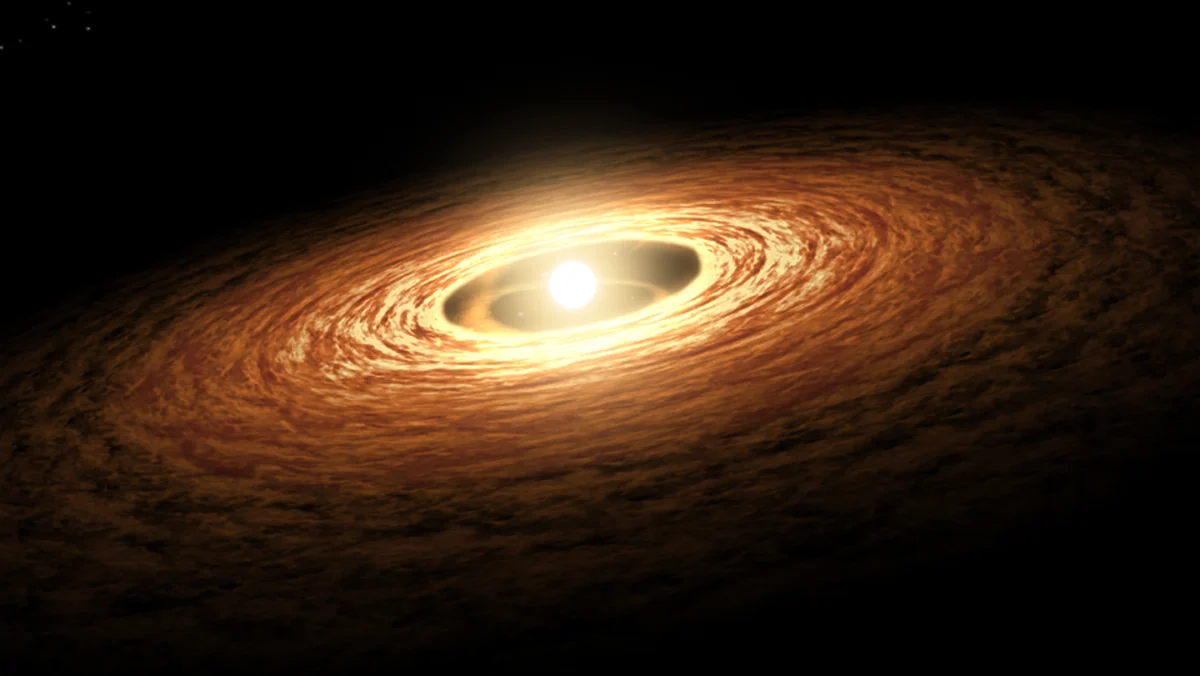
The simulation demonstrates that if these early supernovas were sufficiently energetic and localized, they could have enriched small, isolated pockets of the surrounding primordial gas with enough iron, carbon, and oxygen to initiate the formation of dusty disks. These disks are the cosmic nurseries where gravity pulls gas and dust together, eventually coalescing into protoplanets. By accelerating the enrichment process, these regions could have bypassed the need for the prolonged stellar recycling that characterized later cosmic epochs.
Chronology of Cosmic Evolution
To understand the significance of this timeline, it is necessary to examine the epochal milestones of the early universe:
- T=0 (The Big Bang): The birth of the universe.
- T+380,000 years (Recombination): The universe cools enough for neutral atoms to form, emitting the Cosmic Microwave Background.
- T+10 to 100 million years (Cosmic Dawn): The era of the first stars. According to the new simulation, it is within this window that the very first rocky, perhaps even water-rich, planets may have begun to coalesce.
- T+200 million to 1 billion years: The formation of the first protogalaxies and the rapid growth of the universe’s structural scaffolding.
If the simulation is accurate, the "habitability clock" of the universe was set running significantly earlier than current astronomical surveys suggest.
Supporting Data and Theoretical Framework
The researchers utilized high-resolution hydrodynamic simulations to track the movement of gas and heavy elements following a simulated Population III supernova. The data revealed that the turbulence and shockwaves from these explosions were not merely destructive; they were efficient at mixing the heavy elements into nearby gas clouds.
Quantitatively, the study shows that even a single, well-placed supernova could have increased the metallicity of its immediate vicinity to a level comparable to the conditions found in the Milky Way billions of years later. This is a critical finding because it implies that planet formation is not necessarily a function of time, but rather a function of local chemical enrichment.
"This is a fundamental shift in our perspective," says an independent astrophysicist familiar with the research. "We used to think of the early universe as a chemical desert. We now have to view it as a patchy landscape where some regions could have been quite fertile for planetary development, even while the rest of the universe remained primitive."
Implications for Water-Rich Worlds
The mention of "water-rich" worlds is perhaps the most tantalizing aspect of the new study. While rocky planets require silicates and iron, the presence of oxygen—which is abundant in the debris of supernovas—makes the formation of water ice almost inevitable in cold, dusty disks.
If these early planets were indeed rich in water, they would have been fundamentally different from the dry, rocky worlds we often imagine as the first of their kind. The early universe’s density and the specific elemental yields of the first stars might have created a "wet" environment from the start. While these worlds would likely have been uninhabitable due to the intense radiation environment of the young universe and the lack of complex organic molecules, their existence provides a proof of concept for the early development of planetary systems.
Broader Impact on Modern Astronomy
The implications of this discovery ripple through several fields of physics and astronomy:
- Observational Targets: The James Webb Space Telescope (JWST) and future next-generation observatories may now be tasked with looking for the "chemical signatures" of these early, metal-enriched pockets. While imaging a 13-billion-year-old planet is currently beyond our technical capability, identifying the chemical markers of early, localized enrichment is not.
- Exoplanet Demographics: If planets formed this early, the total number of planets in the universe may be significantly higher than current estimates. This suggests that the universe has been "busy" forming planetary systems for the vast majority of its existence.
- Refining the Drake Equation: The timeline for the emergence of life—or at least the precursors to life—may be shifted. If rocky planets were common in the early universe, the "window of opportunity" for life to have potentially developed is wider than previously assumed.
Expert Analysis and Peer Perspectives
The academic community has received these findings with a mix of cautious enthusiasm and rigorous scrutiny. Critics point out that while the simulation is robust, it relies on assumptions about the initial mass function of the first stars—the distribution of sizes of those first, massive celestial bodies. If the first stars were smaller on average than the simulation assumes, the enrichment process would have been significantly slower.
Conversely, supporters of the study argue that the methodology aligns with current theories of galactic chemical evolution. By accounting for the localized nature of early supernovae, the research team has solved a common mathematical discrepancy in previous models that treated the early universe as a homogeneous medium.
"The model provides a plausible pathway," noted a planetary science researcher. "It doesn’t require new physics or exotic particles; it simply requires us to accept that the early universe was more chaotic and heterogeneous than we previously modeled. When you account for that chaos, planet formation becomes a natural, rather than exceptional, outcome."
Conclusion
The prospect that the universe hosted rocky, water-rich planets just 100 million years after the Big Bang forces a recalibration of cosmic history. As scientists continue to peer deeper into the past, the lines between the "pristine" early universe and the "complex" modern universe are blurring.
Whether these ancient worlds still exist, or whether they were long ago consumed by the very stars that birthed them, remains a mystery. What is clear, however, is that the cosmic stage was set for planetary formation much earlier than we dared to imagine. As we refine our simulations and observational techniques, the search for the oldest planets in the universe will undoubtedly become a cornerstone of 21st-century astrophysics, forever changing our understanding of our place in the cosmic timeline.