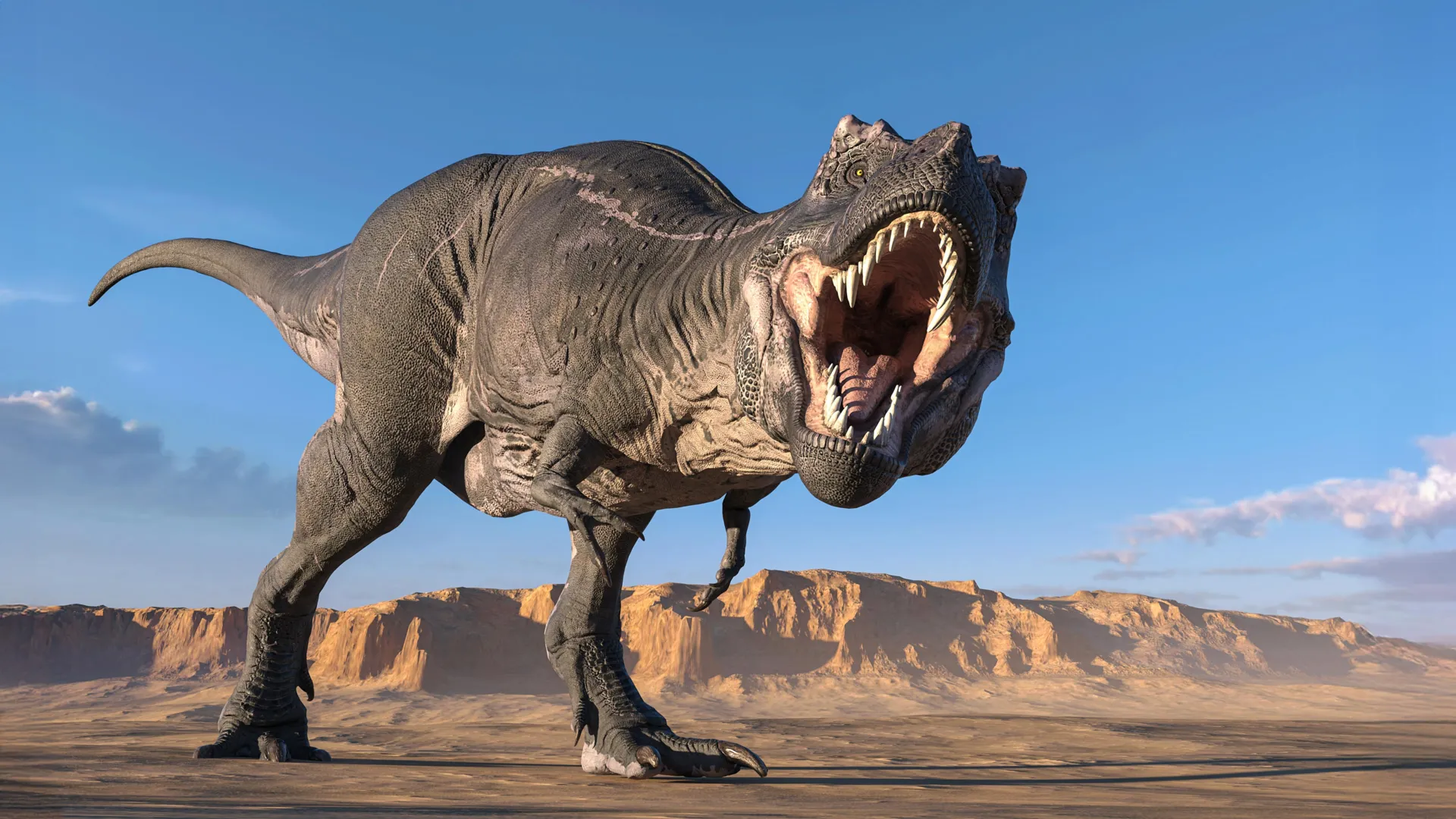
For over a century, the scientific community has grappled with one of the most enduring mysteries in vertebrate paleontology: the metabolic nature of the Tyrannosaurus rex. While these apex predators have been portrayed in popular culture as lumbering, reptilian behemoths, modern research has increasingly pivoted toward a more dynamic, bird-like physiology. A groundbreaking study published on September 16 in the journal Science Advances has finally provided the empirical data necessary to settle this debate, revealing that the T. rex maintained a body temperature of approximately 97 degrees Fahrenheit—remarkably similar to that of modern humans.
A Decade of Technical Evolution
The quest to determine the thermoregulation of extinct dinosaurs began in earnest at the University of California, Los Angeles (UCLA) over ten years ago. Researchers aimed to develop a "fossil thermometer," a method that could reliably distinguish between warm-blooded and cold-blooded organisms by analyzing the chemical bonds within skeletal remains.
However, the initial iterations of this technology faced a significant logistical hurdle: the scale of the required sample. To achieve an accurate reading, the process necessitated a volume of fossil material that most museum curators deemed prohibitive, as it would require the partial destruction of priceless, irreplaceable specimens. Between 2014 and 2024, the UCLA team, led by geobiologist Robert Eagle and lead author Randy Flores, embarked on a rigorous refinement process. By enhancing the sensitivity of mass spectrometry and optimizing chemical extraction, the team successfully reduced the amount of enamel required for testing by 90%. This technological leap finally provided the leverage needed to secure access to one of the most significant specimens in the world: "Thomas," the nearly complete T. rex skeleton housed at the Natural History Museum of Los Angeles County (NHM).
The Chemistry of Prehistoric Life
The methodology employed by the researchers relies on the microscopic chemical architecture of tooth enamel. Within the enamel, carbon and oxygen isotopes form unique chemical bonds. The rate at which these bonds form is intrinsically linked to the ambient temperature of the organism at the time the tissue was deposited. In cooler environments, these bonds form with higher frequency, whereas warmer conditions inhibit their formation.
Unlike bones, which are subject to constant biological remodeling, dissolution, and mineral replacement—processes that can obscure original chemical signals—tooth enamel is composed of large, highly durable crystalline structures. This makes it an ideal "time capsule" for paleoclimatologists and biologists. To extract these signals, the team utilized high-precision dental drills to collect minute amounts of powdered enamel. This powder was then dissolved in phosphoric acid, releasing carbon dioxide gas. By pressurizing this gas into a dense stream and subjecting it to mass spectrometer analysis, the researchers were able to derive a precise thermal profile for the dinosaur.
Validating the Data: The Crocodilian Control
To ensure the integrity of their findings, the research team conducted a comparative analysis of crocodilian fossils excavated from the same geological strata in Montana’s Hell Creek Formation. If the environmental conditions of the burial site had somehow altered the isotopic ratios, both the T. rex and the ancient crocodilians would have shown similar temperatures.
Instead, the results were distinct: the crocodilian specimens registered at approximately 86 degrees Fahrenheit, while the T. rex samples consistently measured 97 degrees Fahrenheit. This 11-degree discrepancy serves as a critical control, confirming that the temperature readings are a genuine reflection of biological metabolic heat production rather than environmental contamination or geological "noise."
The Evolutionary Implications of Warm-Bloodedness
The confirmation of a 97-degree body temperature provides a definitive answer to a long-standing question regarding the T. rex’s lifestyle. A metabolism capable of sustaining such a temperature suggests an active, high-energy animal. This refutes the older, outdated hypothesis that the T. rex was a "sluggish" predator dependent on sun-basking to fuel its massive frame.
From an evolutionary standpoint, this finding places the T. rex firmly on the developmental trajectory toward modern Aves (birds). While modern birds typically operate at significantly higher temperatures—often between 104 and 109 degrees Fahrenheit—the T. rex’s 97-degree measurement indicates an advanced, intermediate metabolic state. It represents a significant departure from the 82–86 degree range typical of extant cold-blooded reptiles.
Expanding the Range: Survival in the Cretaceous North
One of the most compelling aspects of this research is its ability to explain the geographical distribution of tyrannosaurs. Paleontologists have long puzzled over the presence of T. rex fossils in Alaska, where, even during the "hothouse" conditions of the Cretaceous period, winters would have been harsh for a strictly cold-blooded creature.
Alessandro Chiarenza, a paleontologist at University College London and co-author of the study, notes that the absence of other reptilian fossils—such as turtles and crocodiles—in northern Cretaceous latitudes underscores the inhospitable nature of those regions. "Now we have empirical evidence," Chiarenza stated. "By using paleoclimate models, we can map exactly where a 97-degree animal could survive. It effectively confirms that the T. rex’s metabolic capabilities were a prerequisite for its dominance in high-latitude environments."
Ethics and the Museum Mandate
The decision to grant access to the Thomas specimen was not made lightly. Luis Chiappe, curator of the NHM’s Dinosaur Institute, emphasized the careful balance between preservation and scientific discovery. In the world of museum curation, every request for destructive analysis is subjected to intense scrutiny. The decision to permit the drilling of two teeth from a non-exhibited portion of the Thomas specimen was a calculated risk, justified by the potential for a paradigm-shifting discovery.
"We hold millions of specimens in trust for the public and for future researchers," Chiappe explained. "We must be certain that the science is sound and the method is refined before we allow any alteration to an irreplaceable object. In this case, the trade-off—sacrificing a tiny amount of material to solve a century-old biological mystery—was unequivocally worth it."
Broader Impact and Future Directions
The publication of these findings in Science Advances has already triggered a broader re-evaluation of dinosaur physiology. If the T. rex, an apex predator, possessed a metabolic rate that allowed for such thermal regulation, it is highly probable that other theropods exhibited similar, if not more advanced, adaptations.
Furthermore, this research opens the door to using the refined "fossil thermometer" on a wider variety of species. By applying this technique to other dinosaurs across the geological record, scientists may soon be able to map the evolution of metabolism across the entire Mesozoic era. This could provide insights into how dinosaurs weathered mass extinction events, particularly those driven by rapid climate shifts.
The study, which received support from the National Science Foundation, serves as a masterclass in the convergence of technology and paleontology. By leveraging the durability of tooth enamel and the precision of mass spectrometry, researchers have successfully "reached back" through 66 million years of history. The T. rex, once a creature of myth and conjecture, is now better understood as a warm-blooded, metabolically active animal that was uniquely equipped to dominate the diverse landscapes of the Cretaceous period. As the scientific community continues to digest these results, the image of the T. rex as a "sluggish reptile" has been firmly consigned to the history books, replaced by a picture of a complex, high-energy organism that paved the way for the avian success story we observe today.