The artificial intelligence landscape has spent the past several years dominated by general-purpose, text-generating models designed to mimic human conversation, write software code, and solve complex multi-step reasoning problems. However, a significant shift in enterprise adoption is moving toward efficiency, specialization, and deterministic utility. Enter Jev, a newly introduced offering from TypeSafe AI that has captured the attention of machine learning engineers, social media influencers, and technology commentators alike. Billed by its creators as a "System One Model," Jev has sparked intense debate regarding its novelty, utility, and actual technical architecture. While online commentators have rushed to label the model as a revolutionary breakthrough that redefines machine learning, a closer examination reveals a more nuanced reality: Jev is an expertly engineered iteration of existing natural language processing paradigms, optimized specifically for fast, structured decision-making rather than open-ended text generation.
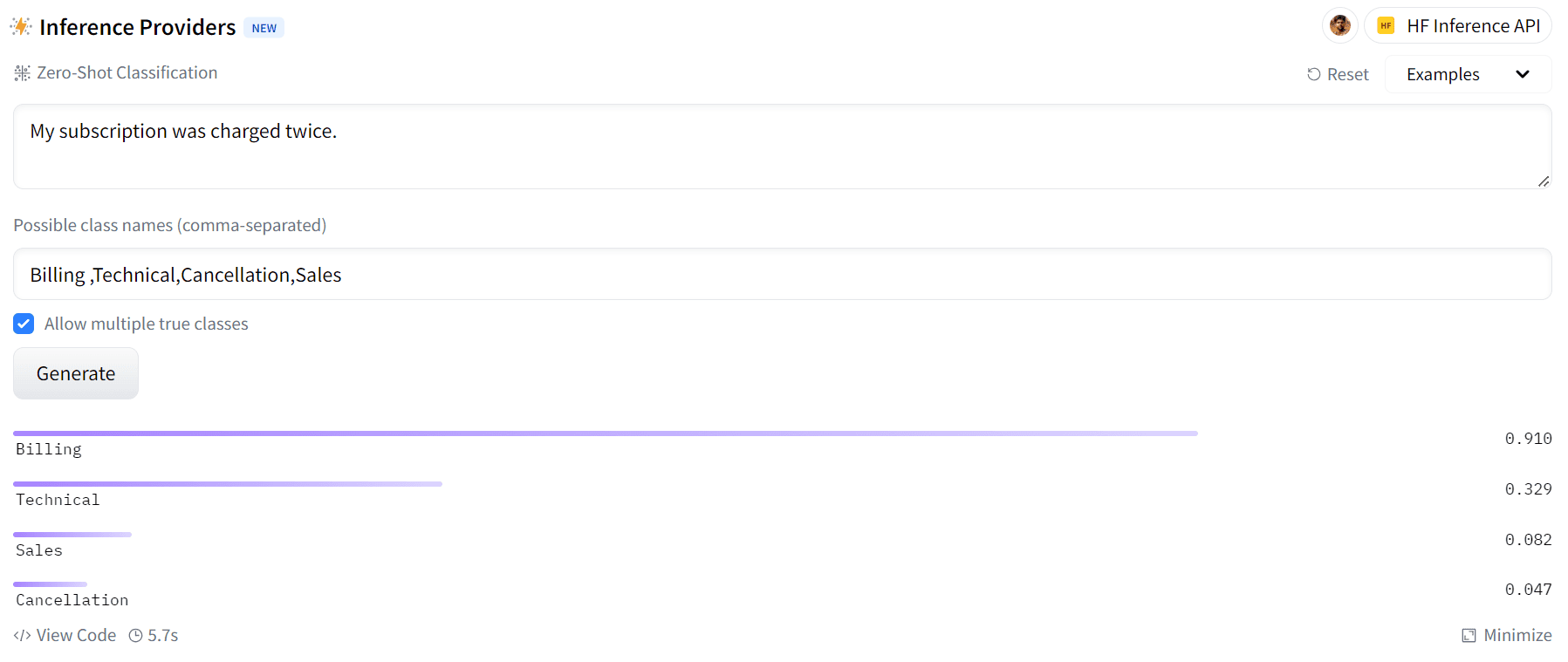
To understand the current discourse surrounding Jev, one must examine the broader evolution of natural language processing over the past decade. For years, machine learning practitioners have utilized classification models, zero-shot classifiers, and intent-detection systems to parse unstructured text into actionable data categories. Technologies such as Natural Language Inference (NLI) based zero-shot classification gained widespread popularity in the 2019 to 2020 timeframe, allowing engineers to feed text and arbitrary candidate labels into a model without requiring dedicated training for every single category. Modern large language models, including OpenAI’s GPT series, Anthropic’s Claude, and Google’s Gemini, have largely overshadowed these lightweight tools. Companies began utilizing massive frontier models for simple tasks like customer support ticket routing or sentiment analysis, often relying on structured outputs or constrained decoding. While effective, this approach introduced significant computational overhead, higher latency, and increased financial costs for businesses executing millions of simple classification tasks daily. TypeSafe AI developed Jev to address this exact market inefficiency, positioning the model as a specialized alternative designed exclusively for structured probability distributions rather than expansive token generation.
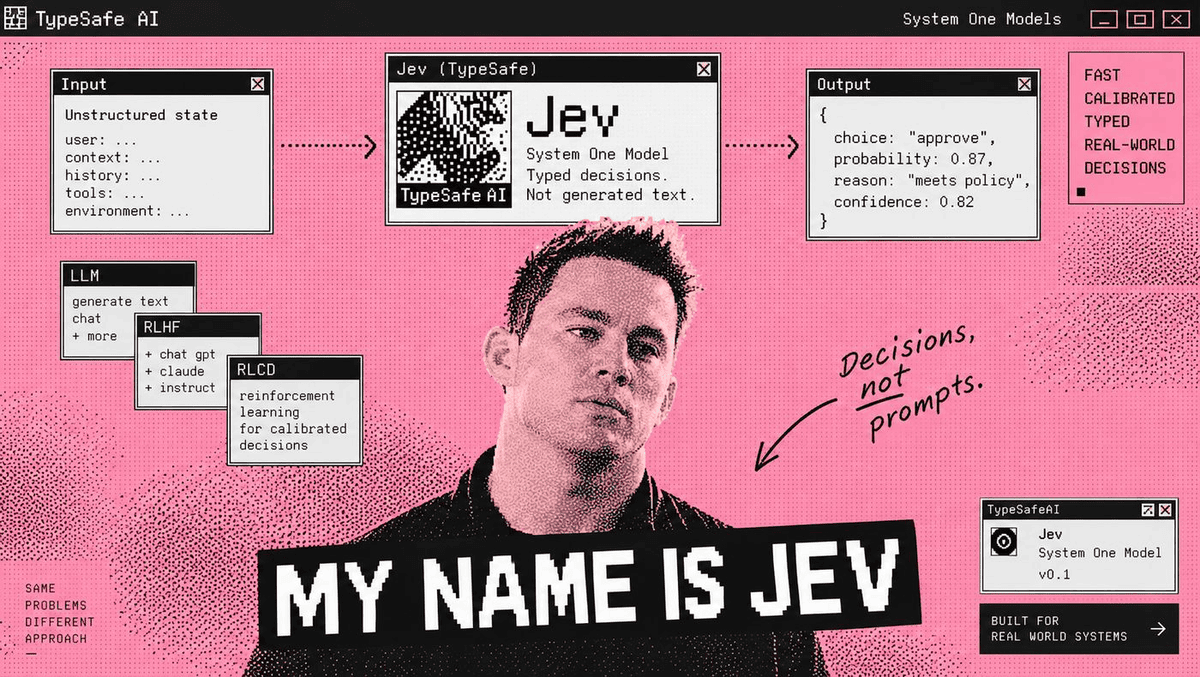
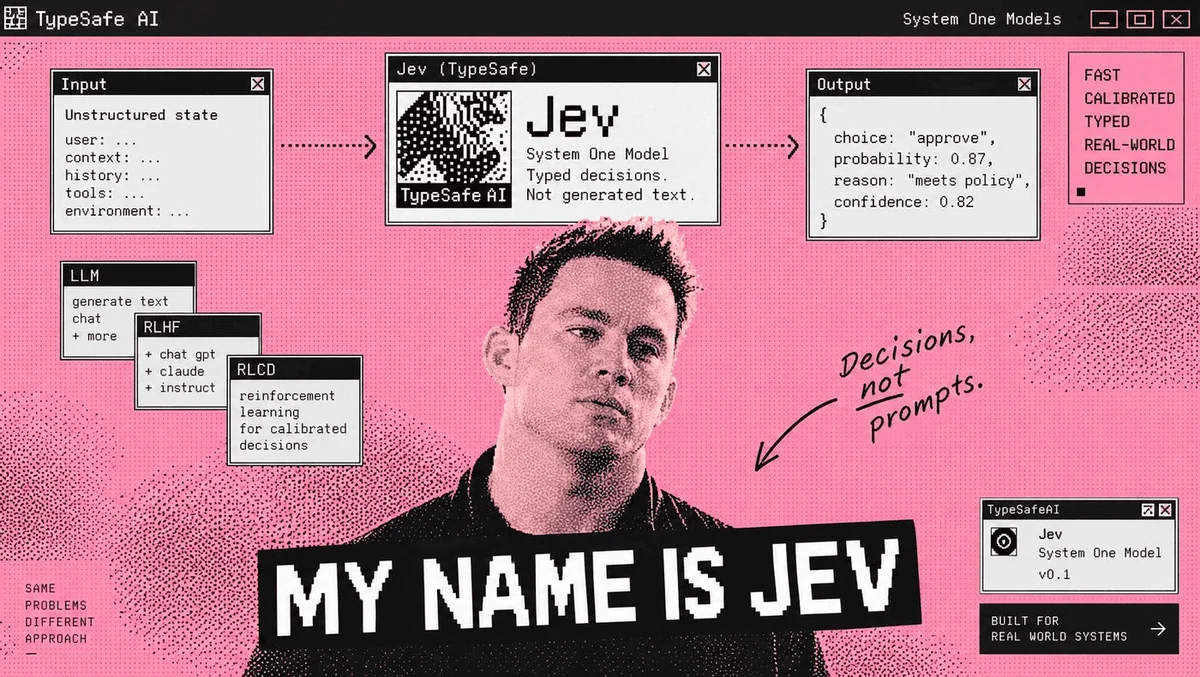
The core distinguishing feature of Jev is its categorization by TypeSafe AI as a "System One Model," drawing inspiration from behavioral psychology’s conceptualization of System 1 and System 2 thinking. In cognitive science, System 1 represents fast, instinctive, and automatic decision-making, whereas System 2 involves slow, deliberate, and analytical reasoning. Within the AI ecosystem, contemporary reasoning-focused LLMs align with System 2 when they plan multiple steps or work through complex logic puzzles. Conversely, Jev operates as a System 1 mechanism. When presented with a natural language input—such as a customer complaint regarding inaccessible digital features—Jev bypasses the generation of a lengthy text response. Instead, it evaluates the input against a predefined, rigid schema of choices, outputting a numerical probability distribution across those categories. For instance, a query might return a breakdown designating a 64 percent probability of a technical issue, 23 percent for sales, 13 percent for billing, and zero percent for cancellation. This granular output allows downstream software applications to automatically execute programmatic workflows based on both the primary classification and the model’s assigned confidence score.
Despite the marketing terminology surrounding System One Models, technical analysts and machine learning veterans emphasize that the underlying computational tasks are not entirely unprecedented. Jev functions in a manner conceptually similar to advanced zero-shot text classifiers, yet it introduces proprietary architectural refinements that optimize performance. TypeSafe AI attributes Jev’s high operational speed and cost-effectiveness to a specialized architecture, a parallel sampler, and a training methodology known as Reinforcement Learning for Calibrated Decisions, or RLCD. Unlike Reinforcement Learning from Human Feedback (RLHF), which trains models to align with human aesthetic preferences and conversational tone, RLCD focuses explicitly on probability calibration. In machine learning, a well-calibrated model produces uncertainty estimates that accurately reflect its true likelihood of correctness. If Jev assigns a specific confidence score to a decision, a properly calibrated system ensures that decisions at that confidence threshold are correct at a corresponding statistical frequency. This calibration is crucial for enterprise software integration, enabling automated systems to autonomously handle high-confidence predictions while routing ambiguous or low-confidence queries to human operators.
Evaluating the true performance capabilities of Jev remains a complex undertaking due to a current scarcity of large-scale, independent benchmark testing. TypeSafe AI has reported an approximate 68 percent accuracy rate on its internal workflow evaluations. However, industry experts caution that these figures are derived from reference answers generated by frontier LLMs rather than independently verified absolute ground truths. Early independent evaluations conducted by external developers have yielded mixed observations, with some small-scale fact-checking tests reporting exceptionally high accuracy rates across limited document sets, while broader assessments remain sparse. Consequently, the machine learning community largely views TypeSafe AI’s initial performance metrics as promising indicators rather than definitive proof of universal applicability across diverse enterprise sectors.

A frequent point of discussion in the tech community centers on the claim that Jev achieves "zero hallucinations." While technically accurate within the strict parameters of its design, this phrasing requires careful contextualization. Jev operates within a closed schema; if a developer defines allowable output categories as Billing, Technical, and Sales, the model is architecturally incapable of outputting an arbitrary category like Legal. However, this does not grant the model immunity from error. Jev can still incorrectly categorize a technical support ticket as a billing inquiry if the input text contains ambiguous phrasing. Therefore, the absence of hallucinations is more accurately understood as a guarantee of zero out-of-schema outputs rather than absolute infallibility in decision-making. This distinction is vital for enterprise architects designing automated pipelines where classification errors can disrupt business operations.
The economic and operational implications of models like Jev point toward a significant evolution in how software applications integrate artificial intelligence layers. Frontier LLMs are intentionally constructed as general-purpose powerhouses capable of complex coding, tool orchestration, and nuanced creative writing. Deploying these massive models for routine administrative tasks—such as routing emails, scoring lead generation forms, or categorizing customer feedback—introduces unnecessary latency and expenditure. Jev addresses this friction by trading generalized linguistic versatility for hyper-specialized computational efficiency. By processing inputs in parallel and outputting structured numerical probabilities instead of lengthy text strings, Jev requires significantly fewer computational resources. This efficiency positions Jev not as a replacement for frontier LLMs, but as an upstream decision layer capable of filtering, routing, and structuring data before it ever reaches a more expensive generative model.
Industry reaction to the launch of Jev reflects a healthy skepticism tempered by pragmatic optimism. While some social media discourse has prematurely hailed the technology as an unprecedented paradigm shift, seasoned data scientists and AI researchers argue that classifying Jev as revolutionary overstates the case. The individual components of Jev—classification, intent detection, zero-shot inference, and calibrated probability scoring—have existed in the machine learning toolkit for years. What TypeSafe AI has successfully accomplished is the synthesis of these established concepts into a cohesive, highly optimized product offering with a refined developer experience and specialized training architecture. By packaging these capabilities into a cohesive platform, TypeSafe AI has streamlined the deployment of probabilistic decision-making systems for software engineers who previously had to construct and maintain custom classification pipelines from scratch.
Ultimately, the trajectory of Jev and similar specialized inference models will depend on rigorous, independent validation and widespread enterprise adoption. As organizations increasingly seek to optimize operational expenditures and reduce the latency associated with large language model API calls, the demand for fast, reliable, and cost-effective classification layers is expected to grow. Whether Jev ultimately establishes a permanent category within modern software architecture or merely inspires a new wave of optimized classification models from larger AI labs, its introduction highlights a maturing industry. The artificial intelligence sector is transitioning away from the pursuit of monolithic models that attempt to solve every computational problem through general text generation, moving instead toward a modular future where specialized systems operate in concert to build faster, smarter, and more efficient software applications.