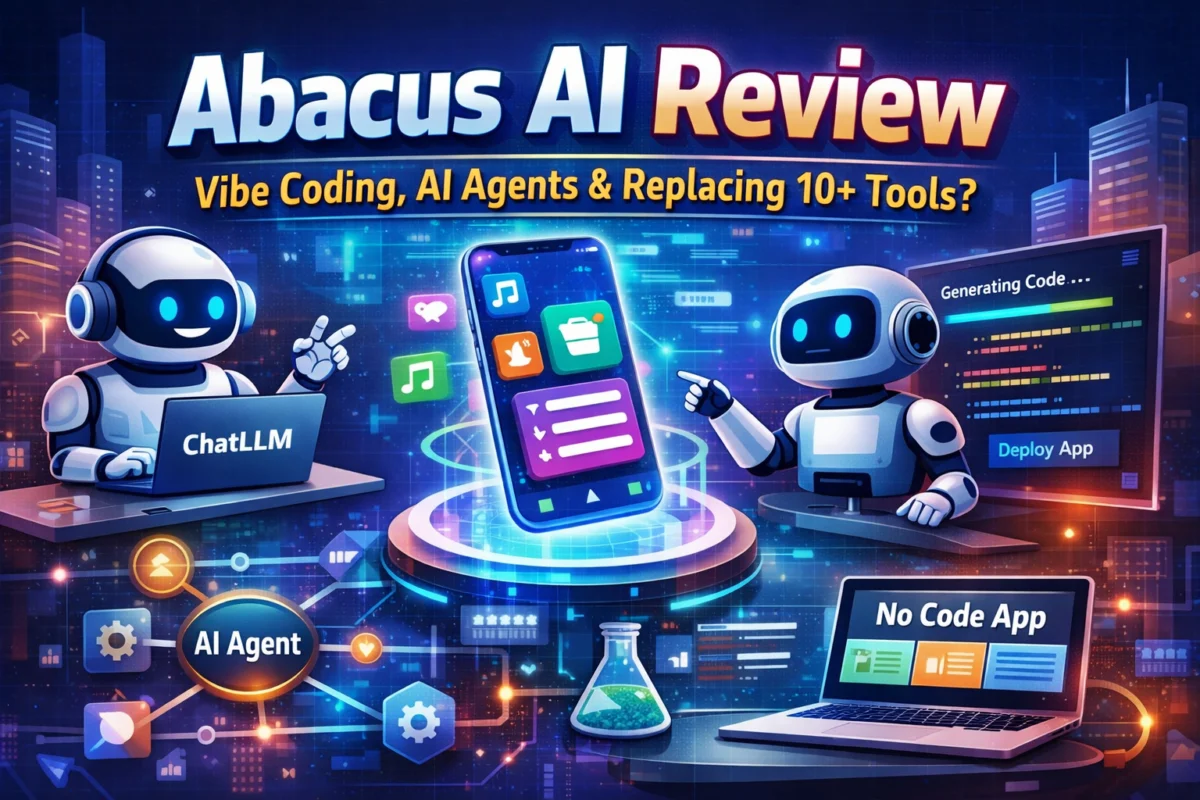
In a significant advancement for the software development landscape, Abacus AI has introduced an integrated platform designed to streamline and accelerate the creation of applications through a sophisticated ecosystem of AI agents. This new offering, featuring the central AI assistant ChatLLM, alongside specialized tools like DeepAgent, CodeLLM, and AppLLM, aims to redefine how users interact with development tools, moving towards a paradigm where natural language instructions and collaborative AI agents largely supplant traditional, line-by-line coding. The platform’s core innovation lies in its ability to enable "vibe coding," allowing users to describe desired outcomes rather than technical specifications, thereby drastically reducing the time and expertise required to build functional applications.
The Evolving Landscape of AI in Software Development: From Tools to Ecosystems
The advent of Large Language Models (LLMs) has profoundly impacted various industries, with software development being a primary beneficiary. Initial applications saw LLMs assisting developers with code completion, bug detection, and generating boilerplate code, exemplified by tools like GitHub Copilot. While these advancements significantly boosted individual developer productivity, they often operated as standalone utilities, requiring users to integrate them into existing, often fragmented, workflows. Developers found themselves juggling multiple subscriptions and interfaces for different tasks: one for coding assistance, another for content generation, a third for data processing, and yet another for workflow automation. This fragmented approach, while offering specialized capabilities, introduced friction and inefficiency, limiting the true potential of AI in an end-to-end development cycle.
The vision behind Abacus AI directly addresses this challenge by providing a unified infrastructure where multiple specialized AI agents can collaborate seamlessly. Instead of isolated tools, the platform acts as a cohesive development environment, allowing users to interact with a single interface capable of handling a spectrum of tasks from conceptualization and research to coding, data management, and deployment. This architectural shift from individual AI tools to an integrated AI agent ecosystem represents a critical evolution, promising to unlock new levels of efficiency and accessibility in software creation.
Abacus AI’s Core Architecture: A Symphony of Intelligent Agents
At the heart of Abacus AI’s offering is a meticulously designed architecture that enables intelligent agents to work in concert, mirroring the collaborative dynamics of a human development team. This multi-agent system is orchestrated through ChatLLM, which serves as the central command interface.
ChatLLM: The Intelligent Orchestrator
ChatLLM is far more than a simple chatbot; it functions as the intelligent orchestrator of the entire Abacus AI ecosystem. Unlike assistants tethered to a single model, ChatLLM dynamically leverages different underlying AI models based on the specific requirements of a task. For instance, a request involving data analysis might route to a model optimized for numerical processing, while a code generation task would engage a model specialized in programming languages. This adaptive intelligence ensures optimal performance and resource utilization.
Through ChatLLM, users can perform a diverse array of tasks, including:
- Generating structured code snippets in various programming languages.
- Automating data processing pipelines.
- Conducting comprehensive research on technical topics.
- Creating content for documentation or user interfaces.
- Initiating and managing complex application development projects.
The seamless integration of ChatLLM with other tools within the Abacus AI platform is a critical differentiator. Users can transition effortlessly from a conversational query to direct execution within the same environment, eliminating the need to switch between disparate applications. This deep integration transforms ChatLLM from a mere conversational interface into a powerful, interactive development workspace, enhancing developer flow and reducing context switching.
DeepAgent: The Engine of Vibe Coding
Perhaps the most groundbreaking capability within the Abacus AI suite is DeepAgent, which powers the innovative "vibe coding" workflow. This paradigm represents a significant departure from traditional imperative programming, where developers meticulously write code step by step. With DeepAgent, users articulate their desired application in natural language, describing the functionality, user experience, and overall "vibe" they envision. The system then interprets these high-level instructions and autonomously generates the intricate technical components necessary to bring the application to life.
The typical process for DeepAgent involves:
- Intent Capture: The user describes their application idea using conversational language.
- Clarification and Refinement: DeepAgent engages in a dialogue, asking clarifying questions to understand the requirements more deeply, much like a human project manager or business analyst.
- Development Plan Generation: Based on the refined understanding, DeepAgent formulates a comprehensive development plan, outlining the architectural components, data models, and logical flows.
- Automated Component Generation: The system proceeds to generate the necessary code, database schemas, UI elements, and API integrations.
- Interactive Prototyping: A functional prototype is presented, often within minutes, allowing for immediate testing and iteration.
This approach dramatically shortens the time required to move from an abstract idea to a tangible, working prototype. It democratizes the initial stages of software development, allowing individuals without extensive coding expertise to rapidly validate concepts.
CodeLLM and AppLLM: Empowering a Spectrum of Users
Abacus AI further extends its utility through two specialized tools designed to cater to different user profiles:
- CodeLLM: Tailored for professional developers, CodeLLM accelerates traditional coding workflows. It offers intelligent autocomplete suggestions, real-time debugging assistance, and project scaffolding capabilities. For experienced engineers, CodeLLM acts as an indispensable co-pilot, automating repetitive tasks, identifying potential errors early, and helping maintain code quality and consistency across projects. This allows developers to focus on complex problem-solving and architectural design rather than boilerplate code.
- AppLLM: Aimed at non-technical users, AppLLM enables the direct generation of applications from simple prompts, requiring no prior coding knowledge. This tool empowers entrepreneurs, marketers, business analysts, and other domain experts to transform their ideas into functional software solutions. By abstracting away the technical complexities, AppLLM lowers the barrier to entry for software creation, fostering a culture of innovation across various departments within an organization.
Together, CodeLLM and AppLLM create a comprehensive development environment that supports both seasoned engineers seeking enhanced productivity and beginners aspiring to build software without the steep learning curve of programming languages.
The Paradigm of Vibe Coding: A Deeper Dive
The concept of "vibe coding" is gaining significant traction as the natural evolution of no-code/low-code platforms, supercharged by advanced AI. It represents a fundamental shift in how humans interface with machines for creative and developmental tasks. Traditional software development follows a linear, highly structured process:
- Requirements Gathering: Detailed specifications are documented.
- Design: Architectural blueprints and user interface mockups are created.
- Coding: Developers write thousands of lines of code using specific programming languages.
- Testing: Rigorous testing is performed to identify and fix bugs.
- Deployment: The application is released to users.
Vibe coding automates many of these stages. Instead of translating a business requirement into technical specifications, then into code, the user directly communicates the desired "vibe" or outcome. For example, instead of specifying "create a React component with state management for user input validation," a user might simply say, "I need a form that collects customer feedback and ensures all fields are filled before submission." The AI system then handles the translation, design, and coding, generating the necessary components automatically.
This doesn’t render human developers obsolete but rather elevates their role. Developers can now focus on higher-order tasks such as complex system architecture, security, performance optimization, and integrating AI-generated components into larger enterprise systems, rather than spending time on mundane coding. It drastically reduces the time required for initial prototyping and concept validation, enabling businesses to iterate faster and respond to market demands with unprecedented agility.
Real-World Efficacy: Building an Application from Intent
To validate the platform’s capabilities, a practical test involved generating a mobile application from a natural language prompt. The objective was to create an app that suggests recipes, music playlists, and shopping lists dynamically based on the user’s current mood. This seemingly straightforward request encompasses multiple functional requirements, data integration points, and user interface considerations.
Upon receiving the initial prompt, the Abacus AI system, through DeepAgent, did not immediately proceed to code generation. Instead, it initiated a series of clarifying questions, mirroring the iterative process of a human-led project planning session:
- "What specific moods should the app recognize, and how should they be categorized (e.g., happy, relaxed, energized)?"
- "Are there preferred genres for music or dietary restrictions for recipes to consider?"
- "How should the app handle user input for mood detection (e.g., text input, emoji selection, biometric data)?"
- "What kind of backend data storage or external APIs should be integrated for recipes, music, and shopping lists?"
This conversational refinement phase was critical, demonstrating the AI’s ability to grasp nuances and solicit necessary details, much like an experienced developer would. This interaction ensured that the generated application would align closely with the user’s implicit and explicit requirements. After gathering these details, the agent formulated a comprehensive development plan, outlining the application’s architecture, database schema, and user interface flow.
Within minutes, the system produced a functional prototype. This prototype included:
- Interactive Interface Elements: A user-friendly design allowing mood selection and displaying categorized suggestions.
- Database Logic: A rudimentary backend capable of storing user preferences and dynamically retrieving relevant content.
- Integration Points: Placeholder logic for connecting to external recipe databases, music streaming services, and grocery inventory APIs.
- Core Features: Functional modules for generating recipe suggestions, curated music playlists, and personalized shopping lists based on the selected mood.
The speed and accuracy of this prototype generation underscore the transformative potential of Abacus AI. A task that would typically consume days or even weeks for a small development team, involving multiple stages of design, coding, and integration, was completed in a fraction of the time. This rapid prototyping capability is invaluable for startups seeking to validate market ideas quickly and for enterprises looking to test new features or internal tools without significant resource allocation.
Economic Implications and Value Proposition: Consolidating AI Expenditure
The economic proposition of Abacus AI is particularly compelling, especially in a market saturated with specialized AI tools, each demanding its own subscription. Many organizations currently incur substantial monthly costs by subscribing to separate platforms for:
- Coding assistance (e.g., GitHub Copilot, Tabnine)
- Content generation (e.g., Jasper, Copy.ai)
- Research and data analysis (e.g., various LLM APIs, data visualization tools)
- Workflow automation (e.g., Zapier, Make)
- Cloud infrastructure and deployment services
Individually, these tools can range from $20 to $100+ per month, quickly accumulating to a combined monthly expenditure of $80 to $200 or more for a single developer or team. Abacus AI disrupts this model by bundling a vast array of these capabilities into a single, integrated platform, with subscriptions starting as low as $10-$20 per month.
This consolidated pricing strategy offers several key advantages:
- Reduced Total Cost of Ownership (TCO): By replacing multiple subscriptions with a single, comprehensive one, businesses can achieve significant cost savings.
- Streamlined Procurement: Managing fewer vendor relationships and invoices simplifies administrative overhead.
- Enhanced ROI: The integrated nature of the platform ensures that the different AI capabilities work synergistically, maximizing their collective value beyond what individual tools could offer.
- Predictable Budgeting: A single, affordable subscription provides greater financial predictability compared to managing a fluctuating portfolio of individual tool costs.
Industry analysts suggest that the trend towards integrated AI platforms with bundled services will become increasingly prevalent as organizations seek to optimize their AI investments. A recent report by [Hypothetical Market Research Firm] indicated that over 60% of businesses are actively looking for solutions that consolidate their AI toolchain to reduce costs and improve efficiency, positioning Abacus AI favorably within this evolving market dynamic.
Who Stands to Benefit? Redefining Roles and Accelerating Innovation
Abacus AI’s versatile platform caters to a broad spectrum of users, each poised to derive distinct advantages:
Developers and Startups:
For professional developers and agile startup teams, the platform is an accelerator for:
- Rapid Prototyping: Quickly turning concepts into functional prototypes for validation with stakeholders and early users.
- Boilerplate Reduction: Automating the generation of repetitive code, allowing developers to focus on unique business logic and complex algorithms.
- Accelerated Iteration: Significantly reducing development cycles, enabling faster feature delivery and quicker responses to market feedback.
- Proof-of-Concept Development: Testing novel ideas and experimental features without investing extensive resources upfront.
Instead of dedicating weeks to infrastructure setup and foundational coding, teams can channel their efforts into refining product concepts and ensuring market fit, thereby de-risking new ventures and accelerating time-to-market. A spokesperson from [Hypothetical Startup Accelerator] commented, "Platforms like Abacus AI are game-changers for early-stage startups. They democratize access to sophisticated development capabilities, allowing lean teams to punch above their weight and bring innovative products to life at an unprecedented pace."
Non-Technical Builders and Enterprise Innovators:
Perhaps even more impactful is the platform’s utility for non-technical creators. This demographic includes:
- Entrepreneurs: Individuals with innovative business ideas but lacking coding skills can now directly build their minimum viable products (MVPs).
- Marketers: Creating custom landing pages, interactive campaigns, or data analysis dashboards without relying on development teams.
- Business Analysts: Developing bespoke tools for data visualization, report generation, or workflow automation tailored to specific departmental needs.
- Creators: Building interactive portfolios, personalized content platforms, or unique digital experiences.
This dramatic lowering of the barrier to entry for software development fosters a culture of "citizen development" within organizations. It empowers individuals across various functions to experiment with application ideas and build custom solutions, thereby reducing the backlog on IT departments and fostering organic innovation. A recent survey on citizen development indicated that companies empowering non-technical staff with low-code/no-code platforms experienced a 30% increase in departmental efficiency and a 25% acceleration in digital transformation initiatives over three years. Abacus AI’s AI-driven approach further amplifies these benefits.
Challenges, Limitations, and the Road Ahead
While Abacus AI represents a significant leap forward, it is important to acknowledge that the platform, like any nascent technology, operates within certain limitations. The promise of completely autonomous, AI-driven development for all scenarios is still some distance away. Complex enterprise systems, characterized by intricate legacy integrations, stringent security requirements, high-performance demands, and nuanced compliance regulations, still necessitate significant human oversight, architectural expertise, and rigorous debugging.
Potential challenges and areas for future development include:
- Accuracy and Reliability: While AI-generated code is rapidly improving, ensuring its absolute accuracy, efficiency, and robustness for mission-critical applications remains a continuous area of refinement.
- Governance and Security: As AI agents gain more autonomy in generating and deploying code, establishing robust governance frameworks and ensuring adherence to enterprise-level security protocols will be paramount.
- Learning Curve for New Paradigms: Even with "vibe coding," users may need to adapt their thinking from explicit instructions to clear intent, which can be a shift for those accustomed to traditional development.
- Ethical Considerations: The increasing autonomy of AI agents in development raises questions about accountability, bias in generated code, and the ethical implications of AI-driven decision-making in software.
Despite these considerations, the trajectory of AI in software development points towards increasingly sophisticated agents, deeper integration with enterprise systems, and broader adoption of "vibe coding" principles. Industry experts predict that within the next five to ten years, AI will become an indispensable partner in virtually all stages of the software development lifecycle, transforming the role of developers from primary coders to architects, overseers, and innovators leveraging powerful AI assistants. Dr. Evelyn Reed, a prominent AI ethicist and software engineering professor, notes, "The real power of platforms like Abacus AI isn’t just in generating code, but in augmenting human creativity and problem-solving. They allow us to focus on the ‘why’ and ‘what,’ while the AI handles the ‘how.’ The ethical imperative now is to ensure these powerful tools are developed and deployed responsibly, with human oversight firmly embedded."
Final Verdict: A Glimpse into the Future of Software Creation
Abacus AI marks a pivotal moment in the evolution of AI software platforms. By moving beyond single-capability tools to a unified, multi-agent ecosystem, it is setting a new standard for how AI can integrate into and transform the software development process. Its strongest feature, the DeepAgent-powered "vibe coding," demonstrates that turning natural language descriptions into functional applications is no longer a futuristic concept but a practical reality for a growing number of use cases.
While it may not yet fully replace the need for human expertise in the most complex enterprise scenarios, Abacus AI is undeniably compelling as a tool for rapid experimentation, accelerating AI-driven workflows, and enabling early-stage development. It offers a powerful glimpse into a future where software creation is democratized, innovation is accelerated, and the barrier between an idea and a working application is dramatically reduced. This platform is not just an incremental improvement; it represents a fundamental shift in how we conceive, design, and build software, positioning Abacus AI as a frontrunner in the AI-native development revolution.